14 min read

Athenahealth Mass Messaging: Close Care Gaps with SMS Recall

Athenahealth Mass Messaging: Close Care Gaps with SMS Recall
💡 Athenahealth mass messaging through Curogram's Recall Engine lets practices send targeted SMS recall campaigns to thousands of patients at once, using Athena data to filter by diagnosis, age, visit history, and more.
  • Closes care gaps for wellness visits, screenings, and chronic care follow-ups
  • Filters patients by quality measure status, insurance type, and last visit date
  • Replaces manual phone recall with mass text messaging from inside Athenahealth
  • Tracks campaign results in real time, from delivery to booked visits
  • Supports MIPS, MACRA, and value-based contract goals through quality measures recall automation
As a validated Athena Marketplace recall partner, Curogram helps practices reach the right patients with the right message, fill open schedule slots, and drive population health care gap closure without adding staff.

There's a list hiding inside every Athena practice. It doesn't have a name on the dashboard. No one prints it out and tapes it to the wall. But it's there, growing a little longer each day.

It's the list of patients who should have come in but didn't. The annual wellness visit that never got booked. The diabetic follow-up that's now nine months late. The screening that was put off and then forgot about.

Athena can tell you exactly who these patients are. The data sits right there: diagnosis codes, last visit dates, open quality gaps. The problem isn't finding them. The problem is reaching them all before the list grows even longer.

Phone calls don't work at this scale. A front desk team can only dial so many numbers in a day. Most calls go to voicemail. Most voicemails go ignored. And while your staff is stuck on the phone, the list keeps growing.

This is where Athenahealth mass messaging changes the game. Curogram's Recall Engine lets you build a targeted SMS recall campaign using the data already inside Athena.

You filter your patient list by age, diagnosis, insurance type, or visit history. You write one message. Then you send it to hundreds or thousands of patients in minutes.

No extra staff. No stacks of sticky notes. No three-month phone call sprints that barely make a dent.

In this guide, we'll walk through how the Recall Engine works, why it matters for population health care gap closure, and how practices like yours use it to fill schedules, close care gaps, and hit quality targets. We'll also share a real campaign story and the numbers behind it.

Your lost-to-follow-up list has been growing long enough. Let's talk about how to shrink it.

The Lost-to-Follow-Up List — Why Care Gaps Grow Faster Than Staff Can Close Them

Every Athena practice has one. Call it what you want: the overdue list, the care gap report, the recall queue. It all means the same thing. These are patients who need care but haven't come in to get it.

Think about what's on that list right now. Annual wellness visits not scheduled. A1C checks months past due. Mammograms and colonoscopies put off. Flu shots missed. Chronic care patients not seen in six months or more. These patients didn't leave your practice. They just drifted.

And here's the thing: they're not going to drift back on their own.

Most patients don't call to book their own follow-up. Life gets in the way. They forget. They assume the office will reach out. And when no one does, the gap just widens.

Athena's reports can name every one of these patients. You can pull lists by diagnosis, last visit date, insurance type, and quality measure gaps. The data is clear. But having the data and acting on it are two very different things.

A mid-size practice with 15,000 active patients may have 3,000 to 5,000 patients with at least one open care gap at any time. That's not a list your front desk can work through with phone calls.

At five minutes per dial, reaching 3,500 patients would take close to 300 staff hours. That's nearly two months of full-time work for one person — just on outreach. And most of those calls end in voicemail.

Based on our internal data, only about one in ten patients calls back after getting a voicemail. The rest sit on the list, untouched.

The cost of doing nothing adds up fast in three ways:

  • Clinical Risk - Patients who miss follow-ups may see their health get worse. A delayed A1C check means months of poor blood sugar going unchecked. A skipped cancer screening means a window for early detection closes.

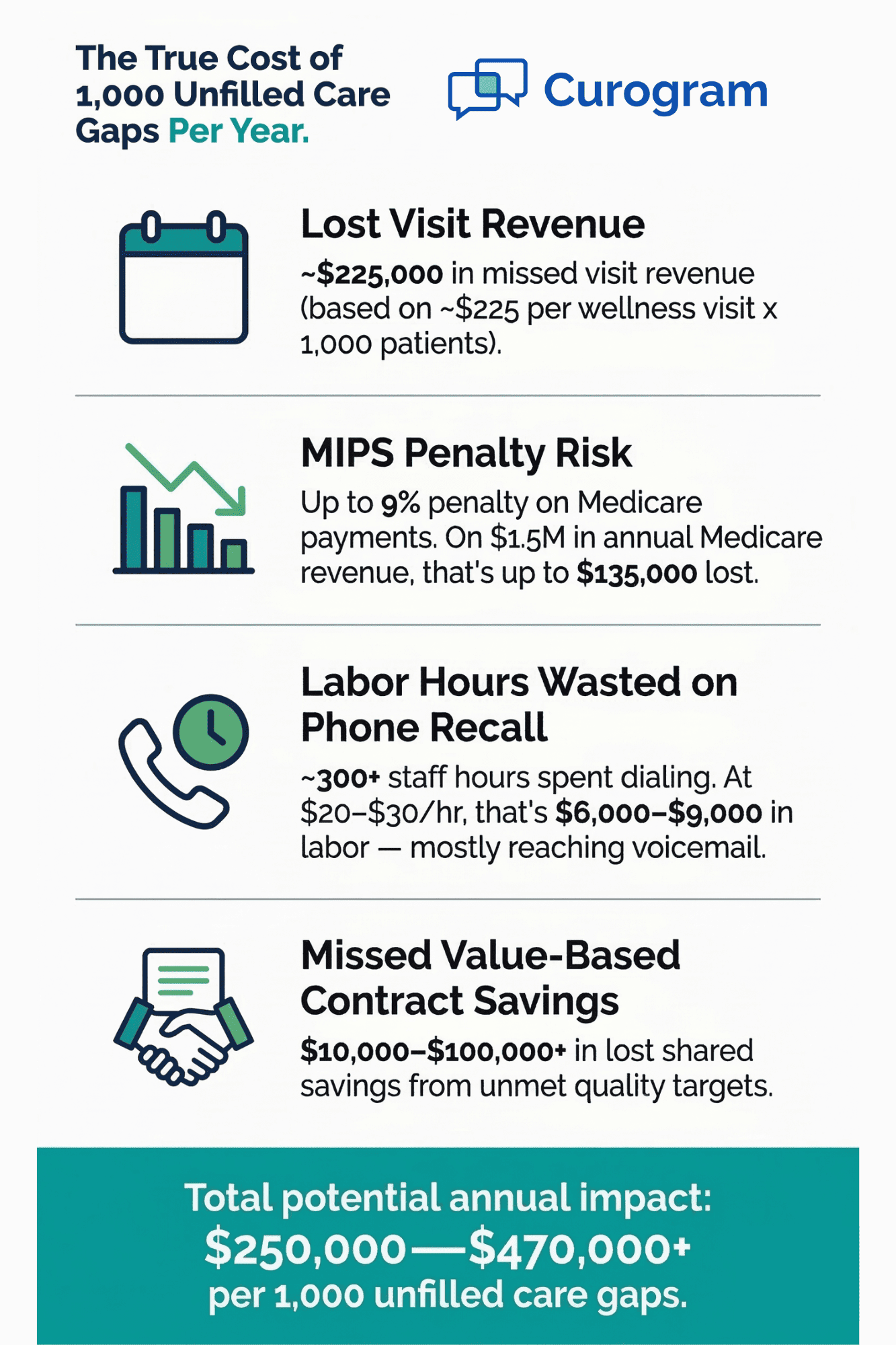
  • Lost Revenue - Every missed visit is a visit that should be on your schedule. If an annual wellness visit brings in $200 to $250 on average, then 1,000 missed visits adds up to $200,000 or more in lost revenue per year.

  • Quality Measure Erosion - Open care gaps drag down MIPS scores and hurt value-based contract results. Lower scores mean reduced bonus payments — or even penalties. For practices tied to quality measures recall automation, a long overdue list is a direct threat to the bottom line.

Here's a quick look at what a growing care gap list can cost a practice each year:

Impact Area

Example Loss

1,000 missed wellness visits at ~$225 each

~$225,000 in lost visit revenue

MIPS penalty (up to 9% of Medicare payments)

Varies by practice size

Lost value-based shared savings

$10,000–$100,000+ depending on contract

Staff time on manual phone recall (300+ hours)

~$6,000–$9,000 in labor costs


The lost-to-follow-up list isn't a one-time problem. It's a daily one. Every day that passes without outreach, more patients slip through the cracks. And the manual recall process — phone calls, voicemails, and callback attempts — simply cannot keep up.

This is why so many Athena practices look for a better way to reach patients at scale. Not one by one. Not call by call. But all at once, with the right message, to the right patients, at the right time.

That's the problem the Recall Engine was built to solve.

Visual breakdown of care gap costs across visit revenue labor hours and quality measure penalties

The Recall Engine — Targeted SMS Campaigns at Scale

Curogram's Recall Engine turns patient recall from a slow, manual task into a fast, data-driven outreach tool. Instead of calling patients one at a time, your team can send a targeted SMS recall campaign to thousands of patients in minutes — all from within Athenahealth.

Here's how it works, step by step:

Filter Patients Using Athena Data

The Recall Engine pulls patient data from your Athena system. You can filter by diagnosis code (such as all Type 2 diabetics), age range (like Medicare patients 65 and older), last visit date (not seen in six months or more), insurance type, or quality measure status. You can also combine filters.

For example, you might target female patients aged 50 to 75 with no colorectal cancer screening in the past year. This level of filtering means the right message reaches the right patients every time.

Send Personal Text Messages at Scale

Each message is built from your campaign and sent with the patient's name and a clear call to action. A message might read: "Hi Sarah, it's time for your annual wellness visit at Lakeview Family Medicine. Tap here to schedule."

The booking link lets patients self-schedule or reply to request a time. This mass text messaging approach through Athenahealth feels personal, even at scale.

Save Hundreds of Staff Hours

Let's do the math. At five minutes per phone call, reaching 3,500 patients takes about 292 hours of staff time. That's over seven full work weeks. With the Recall Engine, the same campaign goes out in minutes. Your staff stays free to focus on patients who are already in the office.

Based on our internal data, practices using SMS recall campaigns see a 35% appointment reconversion rate. That means more than a third of patients who get the text end up booking a visit. In one case, 1,240 patients were seen from recall messages alone.

Track Results in Real Time

The Curogram dashboard shows how each campaign is doing as it runs. You can see the delivery rate, how many patients opened the message, how many replied, and how many booked a visit.

If part of the list doesn't respond, you can send a follow-up message to non-responders within days. No guessing. No waiting weeks for a report.

Use Templates for Repeat Campaigns

You don't have to start from scratch each time. The Recall Engine lets you build and save templates for common recalls: annual wellness visit recall SMS campaigns, flu shot drives, chronic care check-ins, and preventive screening pushes. Schedule them ahead of time to line up with season needs or quality reporting deadlines.

Here's what a single campaign cycle looks like in practice:

Step

What Happens

Time Needed

1. Filter patients in Athena

Choose diagnosis, age, insurance, visit gap

5–10 minutes

2. Write or pick a message template

Use a saved template or write a new one

5 minutes

3. Launch the campaign

Messages go out to the full patient list

Seconds

4. Patients respond

Patients click, reply, or call to book

Within hours

5. Review results on the dashboard

See delivery, open, response, and booking rates

Real time

6. Follow up with non-responders

Send a second message to patients who didn't reply

5 minutes


The whole process — from filter to launch — can be done in under 30 minutes. Compare that to the weeks or months the same work would take by phone.

As a validated Athena Marketplace recall partner, Curogram plugs into your existing system with no extra software to install. The data flows from Athena. The messages flow to your patients. And the bookings flow back to your schedule.

The Quality Measure Connection — How Recall Campaigns Drive MIPS and Value-Based Performance

If your practice takes part in MIPS, MACRA, or any value-based contract, you already know the weight that quality scores carry. They shape your bonus payments, your shared savings, and even whether you face penalties. And every open care gap on your patient list chips away at those scores.

The Recall Engine connects outreach to outcomes. It's not just about filling the schedule — it's about filling it with the right visits to close the gaps that matter most.

Closing Gaps Tied to Specific Quality Measures

The power of the Recall Engine is in the filter. You don't send one blanket message to every patient. You target by the exact quality measure gap you want to close.

For example:

Say, your MIPS dashboard shows that breast cancer screening is your weakest measure. You filter your Athena patient list to find all women aged 50 to 74 who haven't had a mammogram in the past two years.

Then you send a simple message: "Hi [First Name], you're due for your mammogram. Tap here to schedule with [Practice Name]." One message, sent to the right patients. Each booked screening closes a gap in your quality report.


You can do the same thing for any measure: colorectal cancer screening, diabetes A1C control, depression screening, blood pressure management, or tobacco use counseling. Each Athena targeted SMS recall campaign can be built around a single measure so your results are easy to track and report.

Pushing Hard Before Reporting Deadlines

Timing matters. MIPS scores are locked in at the end of the reporting period. If your practice enters Q4 with hundreds of open gaps, there's still time to act — but only if your outreach is fast.

This is where the Recall Engine shines. A phone-based recall team might close 10 to 15 gaps per week. A single SMS campaign can generate dozens or even hundreds of bookings in the first 48 hours. Launching a focused campaign in October or November gives your team weeks to close gaps before the year-end cutoff.

Let's say your practice has 500 open care gaps in Q4:

You launch three campaigns: one for wellness visits, one for diabetes follow-ups, and one for cancer screenings. If each campaign hits a 35% booking rate (which matches what we see in our internal data), that's 175 bookings from those three sends alone.


That kind of velocity can shift your score from below the threshold to above it — and the money that comes with it.

Turning Quality Scores into Real Revenue

Good quality scores don't just look nice on a report. They pay off. MIPS bonuses can add thousands of dollars to your Medicare payments. Value-based contracts often include shared savings tied to quality targets. And poor scores? They can trigger penalties of up to 9% on Medicare revenue.

Here's a simple example:

Suppose your practice has $1.5 million in annual Medicare revenue. A 4% MIPS bonus is $60,000. A 4% penalty is a $60,000 loss. The gap between those two results is $120,000 — and it often comes down to whether the practice closed enough care gaps during the year.


Quality Score Scenario

Impact on $1.5M Medicare Revenue

+4% MIPS bonus

+$60,000

Neutral (no bonus, no penalty)

$0

-4% MIPS penalty

-$60,000

Gap between best and worst

$120,000 swing


Quality measures recall automation makes this process repeatable. Instead of a one-time push, you can set up campaigns that run on a regular basis — monthly, quarterly, or by season. Each round chips away at open gaps and moves your scores in the right direction.

Connecting the Dots Between Population Health and Revenue

Population health care gap closure is not just a clinical goal. It's a business goal. Every patient who comes in for a needed visit generates revenue from the visit itself, helps close a quality gap, and improves your standing in value-based contracts.

A practice with 18,000 active patients might have 4,000+ open care gaps at any point. Closing even half of those through SMS campaigns can mean hundreds of additional visits, stronger MIPS scores, and a measurable bump in revenue from both visit fees and incentive payments.

And the work doesn't pile onto your staff. The Recall Engine handles the outreach. Patients book through the link. Visits flow onto the schedule. Your team sees the patients — not the spreadsheets.

Tracking Measure-Level Results

One of the best parts of running quality-focused campaigns is the clarity it brings to your reporting. When you run a campaign for one specific measure, you can track exactly how many patients responded, how many booked, and how many completed the visit.

This turns your recall process into a quality improvement tool. After each campaign, you can compare your gap closure rate to the prior period.

You can see which patient groups respond best. You can test different messages to find what drives the most bookings. Over time, your campaigns get sharper and your quality scores get stronger.

For practices with a quality manager or a population health team, this data is gold. It shows the board, the providers, and the payers that you're not just hoping patients come back. You're reaching them where they are — on their phones.

And the results speak for themselves. Based on our internal research, practices using Curogram's recall tools see no-show rates 53% lower than the industry average and a 10–20% increase in revenue from recovered visits.

The quality measure connection is the bridge between patient outreach and financial results. The Recall Engine lets you walk that bridge with speed, precision, and scale.

How a 14-Provider Multi-Specialty Group Closed 2,800 Care Gaps in 6 Weeks

Here's what this looks like in the real world:

A 14-provider group in the Minneapolis–Saint Paul metro ran on Athenahealth. The practice included primary care, orthopedics, and urgent care. They took part in Medicare's MIPS program and two commercial value-based contracts. Andrea, the quality manager, was in charge of closing care gaps across 18,000 active patients.

Going into Q4, Andrea found roughly 4,200 open gaps. These included annual wellness visits, diabetes management follow-ups, cancer screenings, and depression screenings. Her team of three staff members had spent the prior three months making phone calls. The result? Fewer than 400 gaps closed in 90 days.

At that pace, the practice would miss its MIPS threshold and lose a meaningful incentive payment. The manual process just wasn't working.

Andrea's team worked with Curogram to build three campaigns through the Athena Marketplace:

  • Campaign 1: 2,200 patients overdue for annual wellness visits, filtered by last visit date and insurance status.
  • Campaign 2: 1,400 diabetic patients overdue for A1C checks and eye exam referrals.
  • Campaign 3: 600 patients aged 50–75 overdue for colorectal cancer screening.

Each campaign sent a personal text message with a booking link tied to the practice.

Within six weeks, the three campaigns closed about 2,800 of the original 4,200 gaps. Wellness visits filled morning and afternoon slots. Diabetic follow-ups went to the right providers. Screening referrals were matched to the practice's preferred specialists.

The practice hit its MIPS threshold and earned its full incentive payment. Three staff members in three months closed 400 gaps. Three SMS campaigns in six weeks closed 2,800.

Patient on couch reading SMS recall message about scheduling an annual wellness visit on smartphone

Seasonal Campaign Strategy — Flu Shots, Back-to-School, and Wellness Visit Waves

The Recall Engine isn't only for year-round care gaps. It also powers seasonal campaigns that drive visits during peak windows.

Flu Shot Season (September–November)

Text all active patients — or filter by age and risk — with flu shot availability. For urgent care practices, flu shot campaigns drive walk-in traffic during slower months. Include a link to book a flu shot clinic slot.

Annual Wellness Visit Waves (January–March)

At the start of a new benefit year, message Medicare patients to book their annual wellness visit recall SMS appointment. Early-year campaigns fill provider schedules and close quality gaps before the year is half over.

Back-to-School Physicals (July–August)

Text parents of pediatric patients with reminders for school physicals and shots. For practices with pediatric services, this fills summer schedules and keeps families on track.

Chronic Care Quarterly Cadence

Set up recurring quarterly campaigns for patients with diabetes, high blood pressure, COPD, or other ongoing conditions. Regular check-in texts keep patients on a visit rhythm and prevent drift between follow-ups.

Each seasonal campaign uses the same Recall Engine filters, templates, and tracking tools. You build it once and reuse it year after year. The schedule fills, the gaps close, and the staff doesn't burn out chasing phone calls.

Measuring the Recall Engine Effect

Running campaigns is only useful if you can see what's working. Here are the key numbers to track with each recall campaign.

  • Campaign Response Rate - This shows the share of patients who engage with the text — by clicking, replying, or calling. Compare this to your old phone recall response rate. Based on our internal data, SMS campaigns outperform phone calls by a wide margin, with response rates often three to four times higher.

  • Bookings per Campaign - Count the visits booked from each send. This ties your outreach to real schedule fill. A campaign that reaches 2,000 patients and books 700 visits has a clear, direct return.

  • Care Gap Closure Speed - Track how fast gaps close after a campaign goes out. The goal: close more gaps in weeks with SMS than you did in months with manual calls. If your team closed 400 gaps in three months by phone, but a single SMS campaign closes 500 in two weeks, the value is obvious.

  • ROI: Campaign Cost vs. Visit Revenue + Quality Bonuses - Add up the revenue from campaign-driven visits. Include the value of quality incentive payments that improve because of those visits. Then subtract the campaign cost. The Recall Engine typically pays for itself within the first campaign cycle.


For practice leaders and quality managers, these numbers make the case for scaling up. Each campaign gives you more data and more proof that mass text messaging through Athenahealth delivers better results than phone-based outreach ever could.


How Curogram's Athena Integration Makes Enterprise-Scale Recall Simple

Most recall tools treat outreach as a one-size-fits-all task. Curogram was built for the way Athena practices actually work.

As a validated Athena Marketplace partner, Curogram connects directly to your Athena system. There's no CSV export. No manual list upload. No clunky workaround. Patient data flows from Athena into the Recall Engine, and your campaign is ready to build in minutes.

What makes this different at the enterprise level is the filter depth. You're not just pulling "all patients." You're targeting patients by any field Athena tracks: diagnosis, age, visit history, insurance type, quality measure status, provider panel, and more.

A practice with 20,000 patients can run five different campaigns in a single afternoon — each one aimed at a different care gap, a different patient group, or a different quality measure.

The results feed back into real-time dashboards. You see who got the message, who clicked, who booked, and who still needs a follow-up. This closed-loop tracking means nothing slips through the cracks.

Curogram also supports HIPAA-compliant two-way texting. Patients can reply to a recall message, ask a question, or confirm a visit — all within the same thread. Staff see every reply in the Curogram inbox and can respond without picking up the phone.

Based on our internal research, practices using Curogram's recall tools achieve a 35% appointment reconversion rate and see over 1,240 patients from recall messages alone. No-show rates across Curogram clients are 53% lower than the industry average, freeing time slots and adding revenue.

For Athena practices looking for a recall partner that scales with their patient volume, Curogram makes the process fast, precise, and fully integrated. No extra software. No extra staff. Just better outreach and more patients back on the schedule.

Next Step: Launch Your First Recall Campaign in 30 Minutes

The lost-to-follow-up list doesn't shrink on its own. Phone calls can't keep up. Voicemails don't get returned. And while your staff spends hours dialing, care gaps keep growing.

Curogram's Recall Engine offers a better path. Filter your Athena patients by any data field. Write a message — or pick a saved template. Hit send and reach thousands of patients in minutes.

The results aren't just about filling the schedule, though that matters. They're about closing care gaps that affect patient health. They're about lifting quality scores that drive MIPS bonuses and value-based savings. And they're about giving your staff their time back so they can focus on the patients in front of them.

Practices that switch from phone-based recall to targeted SMS recall campaigns see more bookings, faster gap closure, and stronger revenue — without adding headcount. The math is simple: what takes three staff members three months to do by phone, the Recall Engine can do in a matter of weeks.

As a validated Athena Marketplace partner, Curogram is ready to plug into your system today. No installs. No IT projects. No learning curve that takes months. You can build and launch your first campaign in about 30 minutes.

If you're a practice leader, quality manager, or population health team member at an Athena practice, this is the tool your recall process has been missing.

Every care gap is a patient waiting to be reached. Reach them all at once.

Three months of phone calls or one afternoon of SMS campaigns — you pick. Schedule a demo and launch your first targeted SMS recall campaign in under 30 minutes.


Frequently Asked Questions

How does Curogram filter patients for a targeted SMS recall campaign in Athenahealth?
Curogram pulls Athena data and lets you filter by diagnosis, age, last visit date, insurance type, and quality measure gaps — so each campaign reaches only the patients who need that specific outreach.
Why is SMS outreach more effective than phone calls for closing care gaps?
Most phone calls go to voicemail, and few patients call back. Text messages are read within minutes, include a booking link, and based on our internal data, drive a 35% appointment reconversion rate.
How do recall campaigns help improve MIPS quality scores before the reporting deadline?

You can launch measure-specific campaigns in Q4 that target patients with open gaps. Each completed visit closes a gap in Athena's quality report, lifting your score before the year-end cutoff.

What types of seasonal campaigns can practices run with the Recall Engine?

Practices run flu shot drives in fall, annual wellness visit pushes in January, back-to-school physical reminders in summer, and quarterly chronic care follow-up texts year-round — all using saved templates and Athena filters.

How quickly can a practice launch its first mass messaging campaign through Athenahealth?

From Athena Marketplace activation to first campaign send, the setup takes about 30 minutes. You filter patients, choose or write a message, and launch — with real-time tracking from the moment messages go out.


Boosting Engagement and Campaign ROI with Mass Texting in DrChrono

Boosting Engagement and Campaign ROI with Mass Texting in DrChrono

💡 Using mass texting, clinics can boost engagement DrChrono mass texting campaigns depend on. Messages reach patients quickly and get strong...

Read More
Fill Schedule Gaps in Prime Clinical | Revenue on Demand

Fill Schedule Gaps in Prime Clinical | Revenue on Demand

💡 To fill schedule gaps in Prime Clinical Systems, the most direct method is targeted broadcast messaging through Curogram. Practices filter...

Read More
Boosting Engagement and ROI with Mass Texting in Office Ally

Boosting Engagement and ROI with Mass Texting in Office Ally

💡 Mass texting helps boost engagement Office Ally mass texting clinics depend on by sending short, clear updates that patients actually see. ...

Read More