
10 min read

AdvancedMD Recall Campaigns | Automate Care Gap Outreach at Scale

AdvancedMD Recall Campaigns | Automate Care Gap Outreach at Scale
💡 AdvancedMD patient recall campaigns, when automated with Curogram, send targeted text messages to every overdue patient in your panel. Instead of individual phone calls, your staff builds a targeted list based on diagnosis, visit history, or screening criteria.

Curogram sends the recall text to all eligible patients at once. Responses come back through a two-way inbox, where staff can book appointments right away.
The system tracks every step: messages sent, replies received, and appointments rebooked.

Based on our internal data, one multi-location practice achieved a 35% appointment reconversion rate, bringing back 1,240 patients from recall messages alone.

This works beyond the patient portal because it uses phone numbers, not portal logins. Every patient with a phone number can be reached. The result is a care gap outreach process that runs at scale, without consuming your staff's day.


Think about your last recall effort. How many patients did your staff actually reach?

If your team handles recall the old way, the answer might be 30 to 40 patients out of a list of 200. The rest wait. Some wait weeks. Some fall off the schedule entirely.

Practices with the best intentions often run the weakest recall programs. Not because they don't care, but because manual outreach does not scale. There are only so many hours in a day, and call-by-call recall always loses to a full front desk.

AdvancedMD patient recall campaigns, automated through Curogram, change that. They reach every overdue patient on your list via text, not just the ones your staff had time to call. The outreach happens without daily staff action, and results are tracked from the first message to the final booked appointment.

This matters for more than revenue. Overdue screenings, lapsed follow-ups, and missed preventive visits are care gaps. They are real health risks for real patients. When recall fails, patients don't just miss an appointment. They miss care they need.

Curogram's campaign system is built to close those gaps. It pulls from your AdvancedMD patient data, sends targeted text messages to your full panel, and reports back on what worked. No spreadsheets. No voicemail chains. No chasing a list that grows faster than your team can work through it.

Based on our internal data, one multi-location practice recovered 1,240 patients from recall campaigns, with a 35% appointment reconversion rate. That kind of result is not possible with manual calling. It takes a system.

This article walks you through why manual recall breaks down, what automated outreach looks like in practice, and how care gaps actually get closed.

The Villain: The Manual Recall

Manual recall is one of those tasks that feels manageable until you look closely. For many AdvancedMD practices, it is a steady drain: too many patients, too little time, and a process that was never built to scale. This section breaks down exactly where manual recall fails and why it keeps falling short no matter how hard your staff works.

The Spreadsheet Process

Most practices handle recall the same way. A staff member runs a report for patients who are overdue. They export the list to a spreadsheet. Then the calling begins, one name at a time.

One List. One Phone. One Patient at a Time.

The math is discouraging. After two to three hours of calling, a staff member might reach 30 to 40 patients from a list of 200. Some answer and schedule. Some go to voicemail. Some numbers are wrong or disconnected. The spreadsheet fills up with notes like "no answer" and "left VM." The remaining 160 patients simply wait.

What Happens to the Patients Who Don't Get Called

They stay overdue. They may not hear from the practice for weeks or even months. For patients with chronic conditions or overdue preventive screenings, this is a real gap in care. The problem is not intent. It is capacity. No amount of effort can make a phone-based process reach hundreds of patients in a day.

The Prioritization Problem

Recall is always "important but not urgent." That is a dangerous place to be in a busy practice, and it is why recall lists keep growing even at practices that genuinely care about patient outreach.

How Recall Gets Pushed Aside

When phones are ringing, check-ins are backed up, and the afternoon schedule is running late, recall calls are the first task to go. Staff cannot do everything at once. Recall gets pushed to tomorrow. Tomorrow becomes next week. The list grows while the time to work it shrinks.

The Real Cost of Deprioritizing Recall

Every week that passes is another set of patients who haven't heard from your practice. Some will find another provider. Some will skip care entirely. Practices that want to automate AdvancedMD recall campaign results cannot rely on a process that stops whenever things get busy, which is most days.

The Single-Channel Limitation

Manual recall depends entirely on phone calls. Phone calls require both people to be free at the same time. In 2026, that rarely happens. This single-channel approach creates a structural gap that no amount of staff effort can fix.

Why Phone Calls Don't Work Anymore

Patients ignore calls from numbers they don't know. Even calls from their own doctor's office get missed. Voicemail callbacks are unpredictable. The phone channel only works when everything lines up perfectly, and that is not a standard you can build a reliable recall program on.

Text Is a Better Channel for Recall

Text messages have a 98% open rate. Patients read them when it is convenient. They do not need to be available at the same moment as your staff. For care gap outreach beyond portal enrollment, a text broadcast reaches patients in a way that a phone call simply cannot match at scale.

The Measurement Gap

Manual recall produces almost no useful data. And without data, you cannot improve. This is one of the most overlooked costs of a phone-based recall system.

What You Can't Track Without Automation

How many patients were contacted? How many responded? What is the reconversion rate for diabetic recall versus mammogram recall? Without automated tracking, none of these questions have clear answers. The effort goes in, but the results stay invisible.

Why Measurement Matters for Quality Reporting

Practices in value-based care programs or tracking MIPS metrics need documented proof of outreach. Manual recall does not provide that. Automated campaigns do. Switching to automation is not just about saving staff hours. It is about building a record of care gap closure that supports your quality goals.    

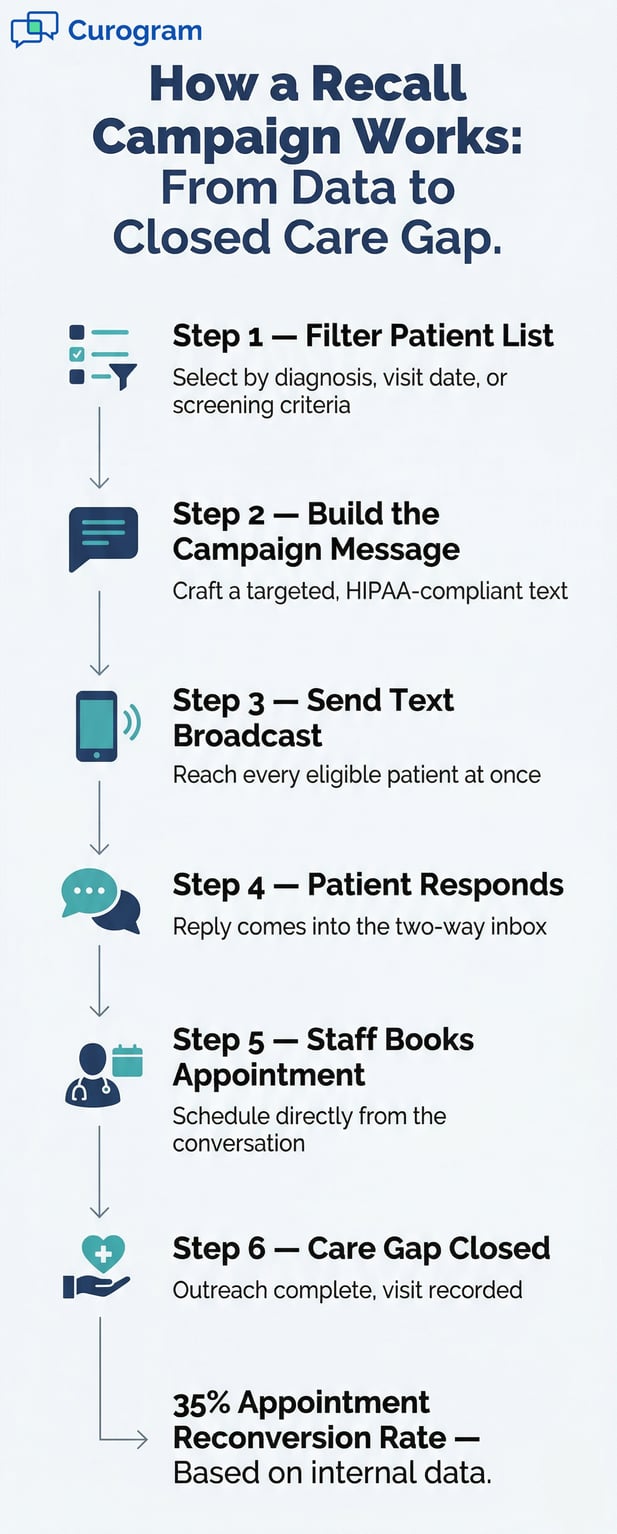
Healthcare recall campaign process infographic for medical patient outreach

The Guide: The Care Gap Closer

Once you see what manual recall costs in time, reach, and missed care, the case for automation becomes clear. Curogram's recall campaign system handles everything manual outreach cannot: volume, consistency, tracking, and full integration with your AdvancedMD workflow. Here is how each part of the system works in practice.

The Solution

The core shift is simple. Instead of calling patients one at a time, you build a targeted list and send a single campaign to every eligible patient at once. This is how you automate AdvancedMD recall campaigns and reach your full panel without adding staff hours.

Building the Campaign List

Curogram pulls directly from your AdvancedMD patient data. You filter by the criteria that matter for each campaign: diagnosis codes, last visit date, age range, or specific screening criteria. Want to reach every patient with diabetes who has not had an HbA1c in 90 days? Build that list. Want to target patients over 65 not seen in six months? The filters are flexible, and the lists can be as broad or narrow as your care gap priorities require.

Sending and Managing Responses

Once the list is ready, the message goes out to every patient on it at once. Every eligible patient with a phone number gets the text. Responses come back through Curogram's two-way inbox, where staff can book appointments, answer questions, and document the conversation. The whole process takes minutes to set up, not hours to run.

The Feature: Campaign Intelligence Reporting

The right data turns a good recall effort into a great one. Curogram's Campaign Intelligence Reporting gives you a clear view of every campaign's performance, from the first message sent to the last appointment booked.

What the Dashboard Shows You

You can see messages sent, delivery rate, patient response rate, appointments booked, and reconversion rate. You can compare campaigns by type, screening category, or patient segment. This tells you which outreach strategies work best and which patient groups respond at the highest rates, so future campaigns keep improving.

How This Supports Quality Reporting

For practices tracking MIPS or working toward value-based care goals, Campaign Intelligence provides documented evidence of proactive outreach. This is the kind of data that supports care gap closure documentation and program compliance, all in one place, without extra reporting steps.

The Integration

Curogram's recall system does not work in isolation. It connects directly to your AdvancedMD patient data, so nothing has to be entered twice and no extra steps are added to your workflow.

How the Data Flows

Patient demographics, visit history, and diagnostic codes from AdvancedMD flow into Curogram's campaign targeting system. When a patient responds to a recall text, the conversation opens in the two-way inbox.

Staff can book the appointment right there, and the patient moves into your standard confirmation flow: reminder sent, appointment confirmed, no extra steps needed.

No Portal Dependency

Reaching patients through your portal requires them to be enrolled and active. That is not most patients. Curogram's text campaigns go directly to phone numbers, so your outreach extends beyond portal enrollment to your full panel.

This means more patients reached, more care gap outreach completed, and fewer patients lost simply because they never set up a portal account.

The Recurring Campaign Advantage

The best recall programs do not run once. They run on a schedule, automatically, without anyone having to remember to launch them. This is the key to turning recall from a task into a system.

Setting Up Recurring Campaigns

Curogram supports recurring campaigns with adjustable intervals. A monthly diabetic recall goes out on the first of every month. A quarterly wellness visit campaign runs every 90 days. You set the parameters once, and the system handles the rest, every single time.

From a Task to a System

This is the real shift. Recall stops depending on staff availability. It becomes a system that runs in the background, consistently reaching overdue patients and feeding results back to your dashboard. Care gap outreach no longer competes with daily operations. It just works.  


The Success: Care Gaps Closed at Scale

Numbers tell the clearest story. Automated recall does not just save staff time. It produces results that are real and measurable: more patients reached, more appointments booked, and more care gaps documented and closed. This section looks at what those results actually look like for an independent practice.

The Metric

The benchmark for an effective recall campaign is not how many messages were sent. It is how many patients came back. That is the number that matters for both patient health and practice revenue.

35% Reconversion: What That Looks Like in Practice

Based on our internal data, one multi-location practice achieved a 35% appointment reconversion rate from SMS recall campaigns. Out of all patients contacted, 35% scheduled an appointment within a month.

In total, 1,240 patients were seen from recall messages alone. That is not a small scheduling boost. That is a large-scale recovery of patients who had fallen off the schedule completely.

Patients Overdue

35% Reconversion Rate

Appointments Recovered

Care Gaps Closed

200

35%

70

70

500

35%

175

175

1,000

35%

350

350

2,000+

35%

700+

700+


The table above shows how the math scales with your panel size. Even at 200 overdue patients, a 35% reconversion rate means 70 returned appointments. At 500 or more, the impact on both care outcomes and revenue becomes significant.

The Revenue Impact

Each recovered appointment adds directly to your practice's bottom line. Based on our internal data, consistent automated recall outreach can contribute a 10 to 20% increase in revenue by filling previously missed or overdue appointment slots. The platform pays for itself when patients start coming back.

The Shift: From Task to System

This is where the real change happens. Automated recall does not just improve one campaign. It changes how your whole practice manages patient outreach for the long term.

What Changes When Recall Runs Automatically

Before automation, recall depended on staff availability. It happened when someone had time. After automation, recall runs on a set schedule. It happens whether your team is slammed or slow.

Care gap outreach moves from reactive to proactive, and overdue patients get contacted before they have been gone so long that re-engagement becomes hard.

Consistency Is the Key

The practices with the best recall results are not the ones with the most staff. They are the ones with the most consistent outreach. A recurring campaign that goes out every month will outperform a manual effort that runs twice a year when the schedule is light. Consistency is what turns good intentions into actual care gap closure at scale.

The Outcome

The result of all this is not just better dashboard numbers. It is a different kind of practice, one that manages its patient panel instead of reacting to whoever happens to call in.

An Active, Engaged Patient Panel

When recall runs as a system, your patient panel stays engaged. Overdue screenings get caught earlier. Lapsed patients return before they have been gone too long. Preventive care rates go up. The practice starts to function more like a population health manager than a scheduling office.

What This Means for Independent Practices

Large health systems have whole teams dedicated to care management. Independent AdvancedMD practices do not.

Automated recall campaigns give smaller practices access to the same level of consistent, data-driven care gap outreach without the overhead. You do not need more staff. You need a system that reaches all patients via text broadcast, tracks results, and keeps running on its own.

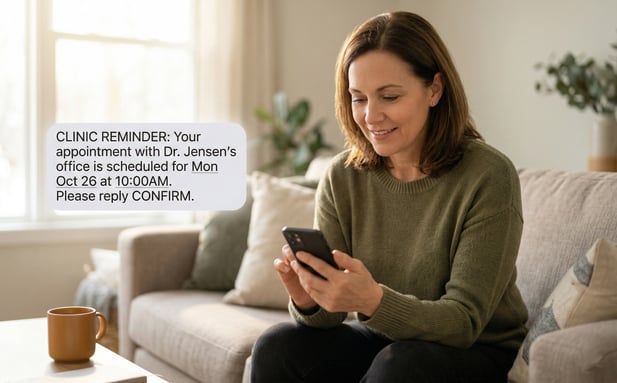
Patient happily reading an appointment reminder text message on her smartphone

Recall Should Be a System, Not a Task

Manual recall works sometimes, for some patients, when staff have time. That is not a reliable standard for care gap closure. Your patients deserve better. So does your team.

The real problem with manual recall is not effort. Staff who work recall lists are doing exactly what they should. The problem is scale. Phone calls cannot reach hundreds of patients in the time it takes to send one text campaign. And the patients who do not get called? They stay overdue.

Automating AdvancedMD patient recall campaigns changes the math. Every eligible patient with a phone number gets a message. Every response is tracked. Every reconversion is measured. Care gap outreach becomes something that happens consistently, not just when there is a gap in the schedule.

The results are clear. Based on our internal data, one multi-location practice saw 1,240 patients return from recall messages alone, with a 35% reconversion rate. That kind of outcome is built on consistency and automation, not extra staff hours.

Your practice's recall effectiveness should not be limited by available staff hours. It should be limited only by your patient list and the quality of your outreach strategy. That is the shift automated recall makes possible.

Curogram's automated recall system handles the execution so your team can focus on care. The outreach runs on schedule. The data comes back in real time.

The care gaps close, not because someone found time to make 200 phone calls, but because the system sent 200 texts while your staff focused on patients already in the building.

Stop waiting for a slow day to run your recall list. Set up automated campaigns that run on their own, and start closing care gaps now.

Schedule a demo to see Curogram's recall campaigns in action at your AdvancedMD practice.


Frequently Asked Questions

How do automated recall campaigns work with AdvancedMD patient data?

Curogram connects to your AdvancedMD data to pull patient demographics, visit history, and diagnosis codes. You filter the list by your chosen criteria, such as overdue screenings, last visit date, or diagnosis type. The campaign text goes out to every patient on the list at once. Responses come back through a two-way inbox where your staff can book appointments right away. 

Why do text-based recall campaigns perform better than phone calls?

Text messages have a 98% open rate and are read within minutes of delivery. Phone calls require both the caller and the patient to be free at the same time, which rarely happens. Patients are more likely to respond to a text on their own schedule than to answer a call from an unknown number. This makes text-based recall a faster and more reliable channel for reaching overdue patients.

How does Campaign Intelligence Reporting help a practice track care gap closure?

Campaign Intelligence tracks every step of a recall campaign: messages sent, delivery rate, patient responses, and appointments booked. You can compare performance across campaign types, patient segments, and time periods. This gives practice administrators clear data on which outreach strategies work best. It also provides documented evidence of care gap outreach, which is useful for quality reporting and value-based care programs.

Why do patients fall through care gaps even in practices that care about recall?

The issue is not intent. It is scale. Manual recall processes cannot keep up with a growing list of overdue patients, especially when daily operations take priority. When recall depends on staff availability, it gets pushed aside on busy days, and the list keeps growing. Automation removes that dependency and keeps outreach running consistently, regardless of how busy the front desk is.

How often should a practice run automated recall campaigns?

The right frequency depends on the type of recall. Chronic condition recall, like diabetic screenings, may run monthly. Wellness visit recall may work on a quarterly schedule. The key is consistency. Recurring campaigns that run on a set schedule will always outperform manual efforts that only happen when extra time is available.