eCW Patient Text-to-Pay | Pay Your Balance in 30 Seconds via SMS
💡 eClinicalWorks patient mobile payment via text link lets patients pay their medical bills in seconds from their phone. No portal login. No app....
You just left your doctor. The visit went well. The bill is on its way.
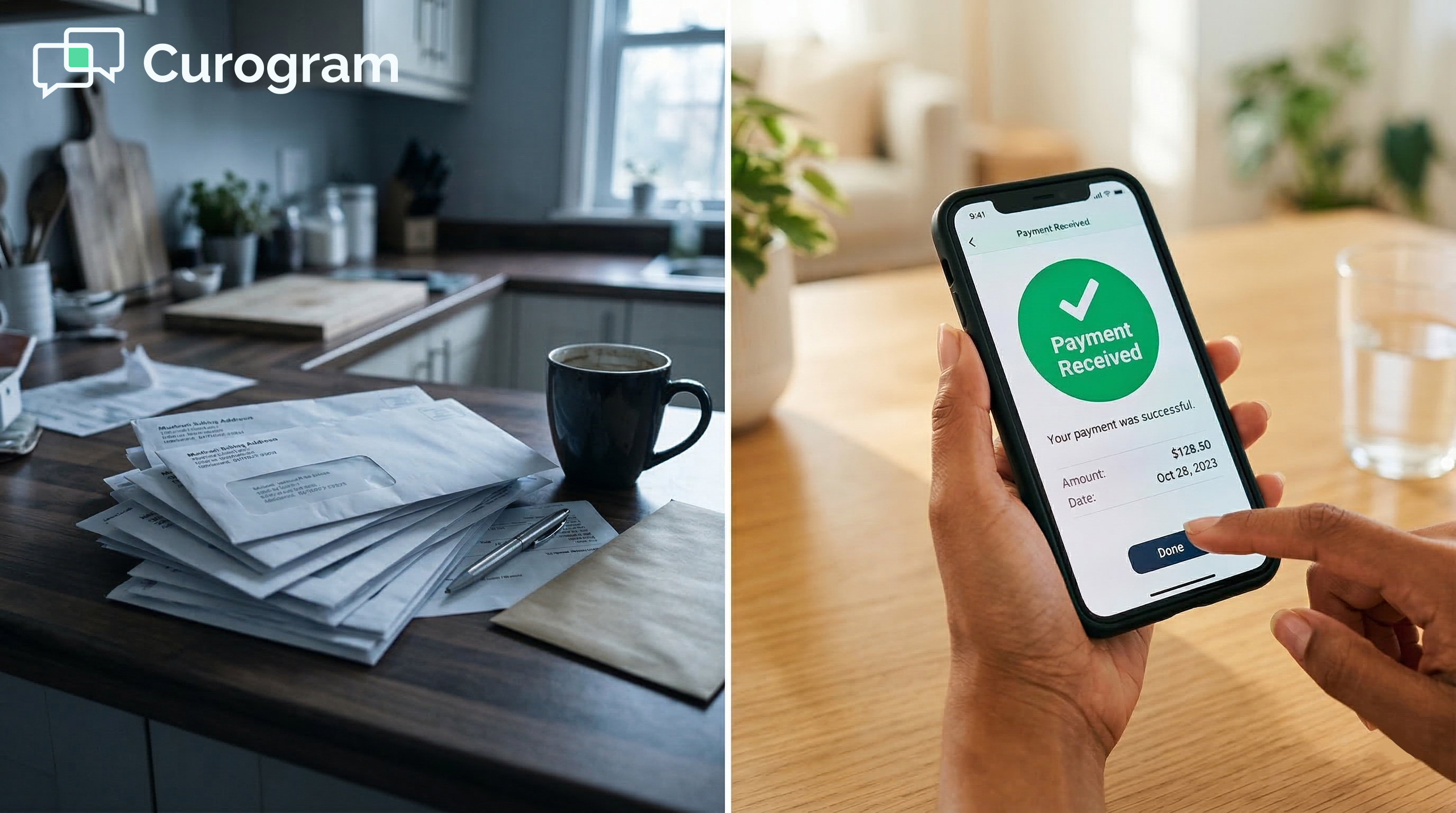
A few days later, a paper statement shows up in the mail. You plan to pay it. But it sits on the counter, then the desk, then in a pile of old mail. Three weeks pass. The balance is still there.
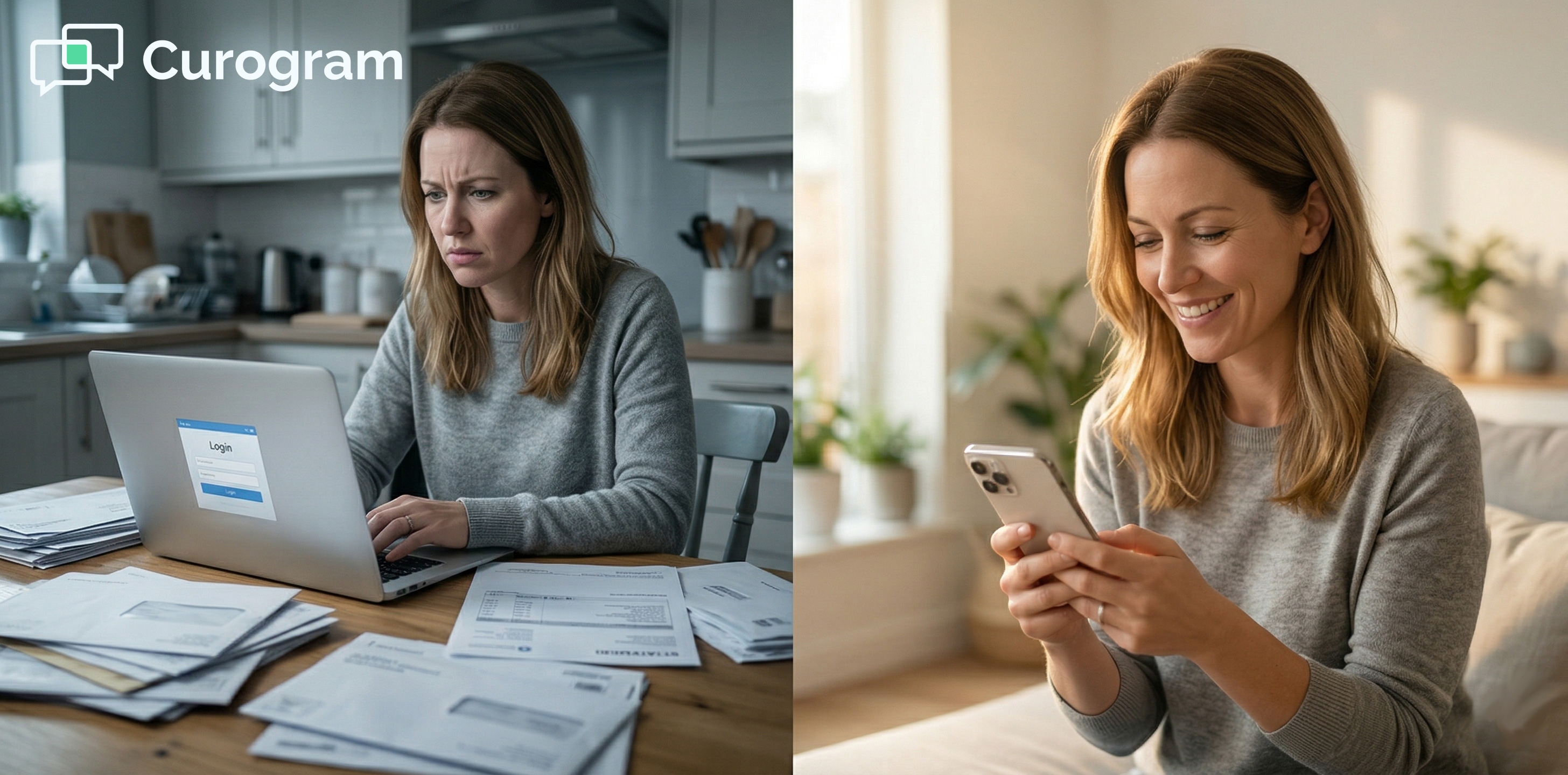
Most patients don't skip out on purpose. They skip because paying a medical bill is harder than it should be. The portal needs a password no one can recall. The checkbook is nowhere to be found. The billing office only picks up during work hours.
The payment method is the problem. Not the patient.
Practices using Curogram can let patients pay their AdvancedMD bill via text. No portal. No paper. No app to get.
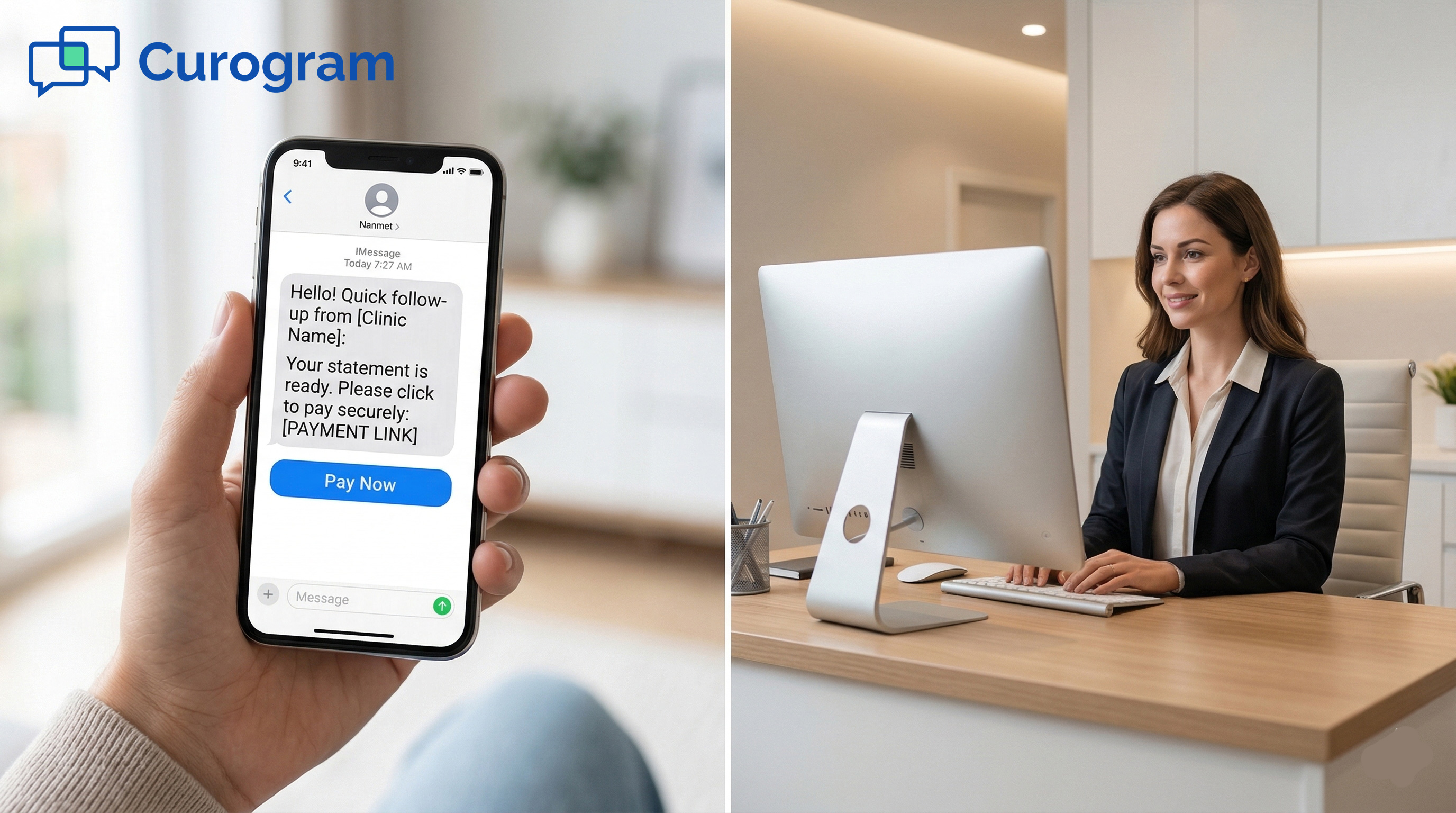
A secure SMS payment link goes right to the patient's phone. One tap opens a mobile-ready page showing the amount owed. One more tap with Apple Pay, Google Pay, or a saved card. Done in under 60 seconds.
This isn't a new idea. It's how payment already works in daily life. You tap to pay for coffee, rides, and food orders. Medical billing should work the same way.
The gap between how patients pay for most things and how they pay their doctor is real. It costs practices money. Balances age when the process has too many steps. But when a direct SMS payment link goes out, the friction is gone.
This article covers three things. Why the current billing process fails. How the two-tap checkout works. What changes for both sides when billing moves to text. Because billing should be the easy part of the visit.
Patients want to pay their bills. What holds them back is the process, not their intent. Each billing option adds steps. More steps mean more drop-off.
Paying online sounds simple. For most patients at AdvancedMD practices, it is not. The portal is the first wall they hit.
Most patients only use the portal a few times a year. By the time a bill arrives, their login details are long gone.
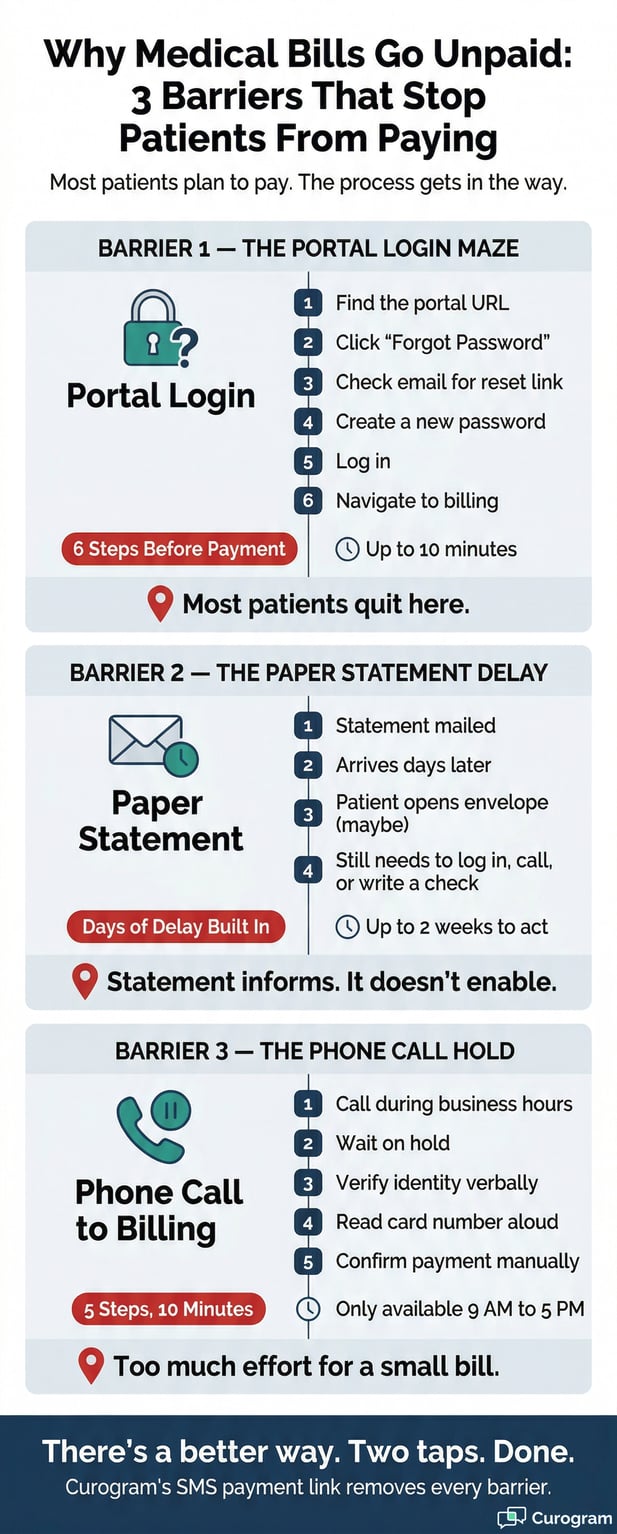
They have to find the portal URL, click 'forgot password,' check email, set a new password, log back in, and find the billing tab.
That is six steps before they can even see the payment screen. A patient who sat down to pay a $45 copay has now spent nearly 10 minutes on login alone.
Many patients quit before they reach the payment page. The portal doesn't block payment on purpose. It just makes the path long enough that people stop trying.
Patients who give up don't plan to skip the bill. They plan to come back. Later becomes next week. The balance ages while the practice waits.
Paper statements arrive days after they're mailed. Some patients open them. Many don't. An envelope can look like junk mail or an old notice.
A statement tells patients what they owe. It doesn't offer a fast way to act. They still have to write a check, log into the portal, or call the office.
The statement creates awareness. It doesn't create action. The gap between knowing and paying is where the process fails.
Patients who fully plan to pay land in the 30-day aging bucket. Then the 60-day. Then the 90-day. Not by choice.
It happens because the payment method wasn't fast or simple enough to act on right then. The intent was there. The channel was not.
Calling billing is the hardest option of all. It needs a free block of time during work hours. There is often a hold. And patients must read their card number out loud.
Most patients won't spend 10 minutes on a call for a small copay. They tell themselves they'll handle it later. Based on our internal research, this is one of the main reasons small balances go uncollected.
The effort doesn't match the size of the bill. So the bill stays unpaid.
Based on our internal research, using SMS for payment increases the collections rate and cuts the time to collect. Phone calls don't do that. Each call is one more reason to delay.
The result is a growing pile of old A/R that staff must chase. That takes time away from care.
Patients already know how fast payment can be. They tap to pay for coffee, rides, and food. They split bills with an app in seconds. Then a medical bill asks them to log in, write a check, or wait on hold.
The standard for payment in 2026 is fast, mobile, and one step. Medical billing still asks for things that feel outdated. That gap isn't just a frustration. It's why balances go unpaid.
When practices give patients the option to text to pay their AdvancedMD bill with a direct mobile link, that gap closes fast. The method matches what patients already do every day.
When the payment channel fits daily habits, patients pay. It's that simple.

Curogram's Two-Tap Checkout is built around one idea: remove every step between a balance and a payment. No portals. No paper. No phone calls. Just a text, a tap, and a receipt.
When a balance is ready to collect, Curogram sends a text with a secure link. It goes right to the patient's phone. No app needed. No paper involved.
The text comes from the practice's own number. It includes the practice name and the exact amount owed. Something like: 'You have a balance of $[amount]. Tap here to pay: [secure link].'
The patient knows this number. They've gotten reminders from it before. That's the trust built in from the start.
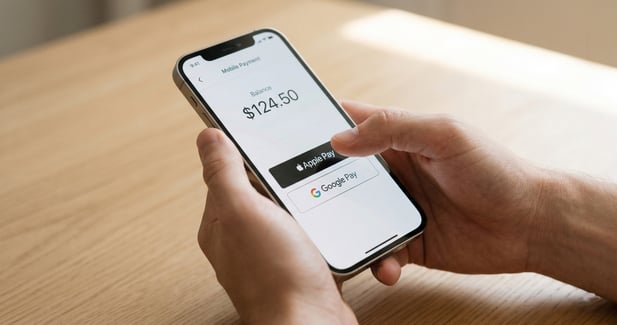
The link opens a mobile-ready payment page. It loads fast. The balance is at the top. Apple Pay and Google Pay appear first for those who have them.
A simple card form sits below for everyone else. This is the full process for patients who want to pay their AdvancedMD medical bill via text message, using an SMS link, with no portal login needed.
No sign-up. No account to create. One purpose: pay this balance, right now.
The payment page was built for phones first. Not tweaked from a desktop site. Not a portal with a billing tab. It was made for one job: to let the patient pay fast.
Design is not just about looks. It's about function. A page that loads slowly or has too many steps still creates friction, even on mobile. Curogram's page cuts every step that isn't the payment itself.
Small text, slow load times, and extra forms all push patients away. Clean design removes those barriers before they form.
There is no account set up. No 'confirm your email to continue.' The patient sees the balance, picks a method, and taps. That's it.
Based on our internal research, a simpler process leads to a higher collection rate and a shorter time to collect.
The page has one job. It does that job well.
Patients are right to be careful about payment texts. Scam messages are real. Curogram handles this by sending payment requests from the practice's own number, not from a new sender.
The text arrives from a number the patient has seen before. The practice name is in the message. The balance matches what they expect. All three factors work together to show the message is real.
Familiar sender. Familiar context. Familiar amount. That's what trust looks like in a text.
A patient who has doubts can reply to the text before tapping the link. The practice can confirm it's real. The payment page also shows the practice name and the balance, giving one more layer of proof.
Caution is welcome. The process is designed so that even a skeptical patient can confirm before they pay.
After payment, the patient gets a receipt text in seconds. Not a letter in the mail. Not a portal note to check later. The loop closes in the same channel where it opened.
The receipt reads: 'Payment of $[amount] received. Thank you!' The task is done. The patient doesn't need to follow up or call to check.
That is the full AdvancedMD bill pay via text SMS payment link process. One channel. One device. Under 60 seconds.
Patients who aren't sure their payment went through call the office to check. That's more work for staff. An instant receipt stops that call before it happens.
Both sides save time. The patient moves on. The practice gets paid.
When payment is easy, patients pay. That sounds obvious. But the results back it up. Here is what changes for patients and practices when billing moves to text.
Every old unpaid balance has a story. In most cases, it's not a patient who refused to pay. It's a patient who found the process too hard and kept putting it off.
There's a gap between planning to pay and actually paying. The payment channel decides how wide that gap is.
When an AdvancedMD patient bill pay text SMS link option is offered, with two taps on mobile and no portal or paper statement required, that gap shrinks. Patients who plan to pay can do it in under a minute.
Intent becomes action. The channel is the bridge.
Based on our internal data, using SMS to simplify the payment process increases the collections rate and cuts the time to collect. Text-based payment reaches patients on the device they use most, at the moment they're ready to act.
Paper can't do that. A phone call can't do that. A text can.
An unpaid bill sits in the back of a patient's mind. It's a task undone. The longer it sits, the easier it is to ignore. That mental weight lifts the moment payment is made.
With the two-tap checkout, billing becomes one fast action. There's no week-long gap of knowing you owe something. No guilt about a forgotten portal login. The text arrives. The patient pays. Done.
The shift from owing to done happens in seconds. That matters more than most practices realize.
Billing that feels easy reflects well on the practice. Patients notice when a practice respects their time. It shows a modern, patient-first approach to care.
Practices that make paying simple tend to see better online reviews and more return visits. Easy billing is part of the patient visit, not separate from it.
The goal is clear: get paid faster, with less effort, and fewer write-offs. Text-based billing helps practices hit all three. Here is how it plays out in real terms.
When patients pay quickly, balances don't age. Based on our internal research, SMS-based payment increases collections and cuts time to collect. Fewer accounts land in the 60-day and 90-day buckets.
The practice collects more, faster. No extra staff effort needed.
No collection calls. No ignored envelopes. No portal log-in issues. Practices that allow patients to pay their AdvancedMD bill via text, using an SMS payment link on their mobile phone with no app and no paper, see fewer overdue accounts.
Staff spend less time chasing old balances. Time and effort shift toward care instead of collections.
The table below shows how the two-tap checkout compares to the old billing options at a glance.
|
Factor |
Old Billing Method |
Two-Tap Checkout |
|
Time to Pay |
5 to 15 minutes |
Under 60 seconds |
|
Steps to Complete |
5 to 10 |
2 |
|
Device Needed |
Computer or phone (portal) |
Any mobile phone |
|
Payment Options |
Check, card via portal, phone |
Apple Pay, Google Pay, card |
|
Payment Receipt |
Mail or portal check |
Instant text |
|
Portal Login Required |
Yes |
No |
|
Paper Required |
Often |
No |
The difference isn't just speed. It's the whole process. When billing is easy, patients pay. When it's hard, they don't. The outcome follows the design.
Two steps. One phone. Under a minute. That's what it takes to turn an old unpaid balance into a collected payment. The tool is simple. The impact is not.

Portals, paper, and phone calls make billing harder than it needs to be. There's a better path. And it fits right in the patient's pocket.
Medical billing doesn't have to be hard. Patients want to pay. The old payment channels just make it too difficult. That's where the money gets lost.
Portal logins need passwords no one recalls. Paper statements pile up unread. Phone calls eat into the workday. Every one of these channels adds steps that turn willing payers into aging A/R.
Practices don't lose revenue because patients refuse. They lose it because the process is too slow and too hard to act on.
When practices send a secure SMS payment link, patients pay. When the page is built for mobile, they don't drop off. When the receipt is instant, they don't call to check.
The AdvancedMD bill pay via text SMS payment link experience, with two taps on the patient's phone and no portal or paper statement required, removes every point of friction.
What's left is a payment that takes under 60 seconds. That's the goal.
You don't think about how you pay for your morning coffee. You tap and it's done. Paying your doctor should feel exactly the same way.
Patients already pay this way for most things. The habit is set. Medical billing is the one area that hasn't caught up. When practices close that gap, patients stop delaying. The payment happens right away because the process fits their daily life.
Patients expect fast, mobile-first payment options for everything. Billing is no different. Practices that still rely on paper and portals are asking patients to step backward.
Curogram's two-tap checkout steps forward. It puts the payment where the patient already is: on their phone, in their messages, ready to act.
You don't need to overhaul your practice to improve billing. You just need to change the channel.
Stop asking patients to log into portals they don't remember. Stop waiting for paper statements to cycle through the mail. Stop making patients call during hours they're already busy.
Send a text. Two taps. Done.
Schedule a demo to see how Curogram's two-tap checkout works for AdvancedMD practices. When billing is as smooth as the visit itself, both sides win: the patient moves on and the practice gets paid.
The text comes from the same practice number used for appointment alerts and other messages. It includes the practice name and the exact amount owed. If a patient is still unsure, they can reply to confirm before tapping the link. The payment page also shows the practice name and balance clearly.
For most patients, the process takes under 60 seconds from start to finish. Opening the link, seeing the balance, and tapping Apple Pay or Google Pay is a two-step action. Even entering a card by hand takes under two minutes. No account creation or portal login is needed at any step.
Most patients get the text on their phone and act on it right then. A page that loads slowly or has too many steps will cause patients to drop off before payment is complete. Curogram's payment page is designed for phones first: fast load, clear balance, and one tap to pay. Good mobile design turns intent into action.
Calling billing takes 5 to 10 minutes and requires the patient to be free during work hours. It also involves reading a card number aloud over the phone. The text payment takes under 60 seconds, works at any time, and needs no verbal exchange. For small balances, the phone call barrier is often why payment never happens.
The payment channels ask for more effort than the bill seems to warrant. Portal logins need old passwords. Paper statements don't include a fast way to act. Phone calls require hold time during the workday. When the process takes more time than the balance feels worth, patients put it off, and the balance ages.
💡 eClinicalWorks patient mobile payment via text link lets patients pay their medical bills in seconds from their phone. No portal login. No app....
💡 Medical practices lose revenue every day, not because patients refuse to pay, but because the payment process is too hard.Paper statements get...
💡 eClinicalWorks text-to-pay SMS patient payment billing sends secure links to patients right after a visit. Patients pay in seconds from their...