

9 min read

Curogram vs TeleVox: When a Patient Texts Back

Curogram vs TeleVox: When a Patient Texts Back
 💡 A Curogram vs TeleVox comparison of patient outreach comes down to one question: who works the replies? Both platforms send at scale, and both resolve a structured reply.

TeleVox publishes closed-loop reminders where a patient confirms, cancels or reschedules from a text and the EHR updates. The off-script reply is what separates them. TeleVox routes it to a virtual agent, then to live chat.

Curogram routes it to the shared inbox your front desk already works from. Health systems with a contact center lean one way. Mid-market groups lean the other.


Comparison pages in this category usually open by calling the other vendor one-way. TeleVox is not one-way, and its own writing says so plainly: omnichannel two-way communication, a virtual agent, and closed-loop rescheduling that writes back to Epic and Oracle Cerner.

So this page follows one message instead. A patient texts back on a Tuesday afternoon, and we trace that message through both systems until it stops moving. Then a second message, harder than the first, at 7 am.

No feature list. One reply, two paths, and the moment a person has to pick it up.

One Message, Two Paths

Tuesday, 3:12pm

The reminder went out at 9am for a Thursday 2pm appointment. At 3:12pm the patient texts back: “can we do thursday instead, my ride fell through”.

Read that the way a system has to. The reply is not C, and it is not 1.

It contains the word Thursday, which is already the appointment day, plus a reason with nothing to do with scheduling. No keyword parser resolves it.

TeleVox handles confirm, cancel and reschedule from a text, and those actions write back to the EHR in real time. This message misses that path. It goes to the virtual agent, which either resolves it through clarifying questions or hands off to live chat.

In Curogram it lands in the shared inbox for that location, in the same thread as the 9am reminder, with the appointment attached.

A staff member opens it, sees Thursday 2pm, and offers two other slots. Both designs are legitimate, and clinical workflow automation compared traces the handoff in more detail.

Where each path ends

Finish the TeleVox trace honestly. A virtual agent that resolves the reschedule is faster than a person and works at 3am.

For a health system running outreach across 40 sites, an agent that clears the routine traffic is the correct build, and TeleVox has been building it for 30 years. Voice and IVR also reach patients who do not text at all.

TeleVox under the WestCX brand sits inside West Technology Group. That matters on this page for one reason: the roadmap is built around the customers TeleVox names, which are hospitals, health systems and community health centers.

Finish the Curogram trace the same way. A staff member is slower than an agent, costs more per message, and is not there overnight. What she has is context and authority. She can read four months of the thread, override the schedule, and decide.

The two traces end differently by organization rather than by quality. A contact center resolves the reply centrally. A front desk resolves it locally. Groups weighing the wider TeleVox shortlist for groups should start by naming which of those two they have.

The second message: a question at 7am

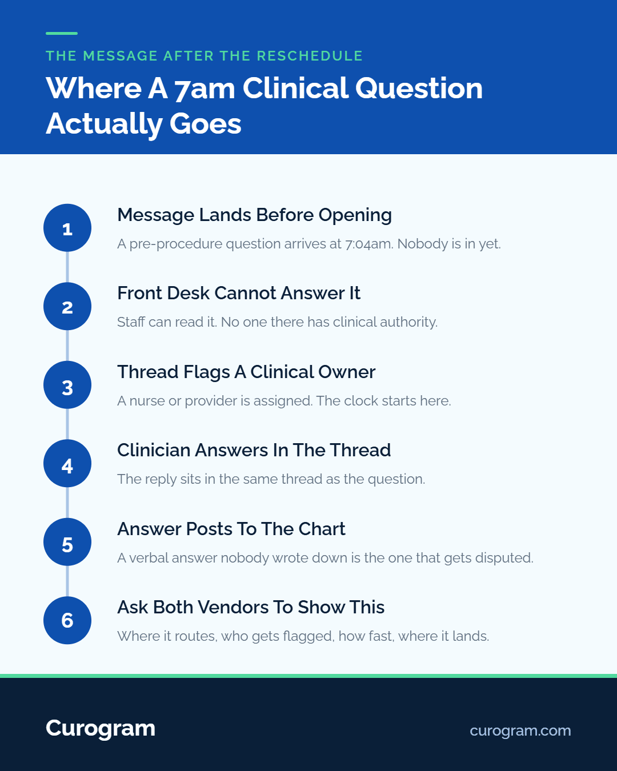
7:04am, two days before a colonoscopy. “do i take my blood pressure pill this morning or not”.

Nobody at a front desk can answer that. No virtual agent should try, and TeleVox is right not to let one. The question needs a person with clinical authority, and the answer has to land in the chart, because an undocumented verbal answer is the one that gets litigated.

Routing is the real test, not answering. Ask both vendors where this message goes, who gets flagged, how fast, and what happens to the answer once a nurse gives it. Does it post to the chart as a note, or does somebody retype it?

A platform that resolves the reschedule and drops this one has solved the easier half.

Set Against Each Other

Mode, routing and reply handling

Most Curogram vs TeleVox features questions get asked in the wrong frame. A conversational vs IVR patient outreach split does not describe these two products, because TeleVox runs both channels and rejects the one-way reminder label in its own writing.

Primary mode. TeleVox orchestrates across voice, SMS, RCS, email, chat and postcards. Curogram runs texting from one shared clinic inbox.

Breadth against depth in a single channel, and the right answer depends on how many channels your patients actually use.

Inbound reply handling. TeleVox resolves structured replies automatically and escalates the rest through a virtual agent. Curogram puts every reply in front of a person. The two assume different staffing.

Outbound voice. TeleVox does IVR natively. Curogram does not, and connects with the practice's phone system instead. That row is a straight concession.

Those three rows describe two assumptions about who staffs the other end, so neither column wins them outright. TeleVox reviews on G2 are worth reading for how organizations describe the escalation path in a busy week.

The rows a group administrator cares about

Two rows decide procurement for a 12-site group.

Multi-location routing. Each site needs its own local number and caller ID, its own templates, and its own after-hours rule, all on one account. Ask both vendors to show a message arriving at site 7 and being answered by somebody at site 7, then the same message answered centrally.

Permissions ride alongside it. Can a staff member at site 3 open a thread belonging to site 9, and should they? Groups answer that differently, and a platform that supports only one answer picks for you.

Per-location reporting. The next two sections cover it, because reporting is where most group demos come apart.

Read the EMR row closely, because it is the row most likely to end the evaluation early. TeleVox integrates with Epic, Oracle Cerner, Meditech, NextGen, athenahealth and Veradigm, and we do not. If your group runs eClinicalWorks, Practice Fusion, athenahealth or DrChrono, read that row the other way around.


Curogram

TeleVox

Primary mode

Two-way texting from one shared clinic inbox

Omnichannel outreach across voice, SMS, RCS, email, chat and postcards

Inbound reply handling

Every reply goes to a staff member in the shared inbox

Structured replies resolve automatically; the rest escalate to a virtual agent, then live chat

Shared inbox with assignment

Shared inbox yes; assignment behavior worth testing in the demo

Live chat for staff and patient conversations; patient-thread assignment not specified publicly

Named EMR integrations

Outpatient EMR and practice management systems, including eClinicalWorks, Practice Fusion, athenahealth and DrChrono

Epic, Oracle Cerner, Meditech, NextGen, athenahealth and Veradigm

Multi-location routing

Per-location numbers and caller ID on one shared workspace

Built for health systems and multi-site organizations; per-site setup scoped during implementation

Outbound voice and IVR

Not offered natively; connects with the practice's phone system

Yes, IVR and automated voice calling, alongside 30 years of voice outreach

Google review automation

Yes, post-visit review requests

Reputation management named within its solution suite

Public pricing

No public rate card

No public rate card; quoted by organization size and modules

Table sources: TeleVox product, integration and press pages and West Technology Group releases, retrieved 12 September 2026; Curogram product documentation and internal data.

Scale Without an Implementation Team

What group rollout actually needs

Four things, and every one is configuration rather than code.

Per-location numbers. Twelve sites, twelve local numbers, one workspace. Patients keep texting the number already saved in their contacts, which decides whether a message gets read or ignored as spam.

Templates by site. A downtown clinic's pre-visit instructions differ from a surgical center's. One template set across all sites means staff edit messages by hand, or patients get instructions for the wrong building.

An after-hours rule, and reporting an administrator reads without help. Messages arriving at 7pm need a defined destination: a queue somebody opens at 8am, an auto-reply with a timeframe, and an escalation path for anything clinical.

Multi-location and large group practices covers how a group account is structured, and call center solutions covers the phone side.

Who configures it

Take the stance plainly. A 12-site medical group does not employ an integration engineer, and any platform that assumes one carries a cost line nobody put in the business case.

That cost arrives as a professional services engagement, a six-week discovery, or a named technical resource your group has to supply. None of it shows up on a feature comparison. All of it shows up in month two.

Watch for the tell in the sales cycle. When a rep answers a configuration question with our team will work with yours, ask how many hours and who is billed. A platform a practice manager can configure is worth a shorter feature list.

Ask it directly in the demo. Who does this configuration, us or you? What does it cost when we add a thirteenth location next year? Get both answers in writing with a number attached.

The sync mechanics underneath belong to another page. How the two integration architectures differ works through what each platform reads and writes.

Infographic detailing the 6-step workflow for routing early clinical questions

Reporting a Group Administrator Can Use

Per-location, not aggregate

A single confirmation rate across twelve sites hides its own problem. When most sites run well and two run badly, the group average still reads acceptable, and an administrator spends a quarter congratulating everyone.

Four views do the job instead. Confirmation rate by location. The same figure by month, so a drop shows up before it becomes a trend. Message volume by location, which is how you find the site whose staff stopped using the platform.

That third view catches a failure nobody reports upward. Staff at a struggling site never file a ticket saying they gave up. Volume falls, confirmation rate follows a month later, and the group number absorbs both.

Sender attribution is the fourth and the one people forget. When a patient complains about a message, somebody has to be able to say who sent it and when.

What to ask for in the demo

Three requests, on screen, in the demo itself.

Show me one location's numbers. Not the group roll-up filtered down. The site view as a site manager would open it on a Monday.

Show me the same view for last month. Historical comparison is where reporting stops being real, because a live dashboard is easy to build and a retained one is not.

Show me who sent the messages. Sender attribution turns a patient complaint into a coaching conversation rather than an investigation.

If any of the three needs an export, the reporting is a data extract with a chart on top, and somebody at your group has just become its analyst.

Evidence at Group Scale

Figures from comparable groups

Two figures, both from our own client data, both tied to a named practice.

Covina Arthritic Clinic confirms more than 1,100 appointments a month through Curogram, based on our internal data. That is a confirmation count rather than a message count, which matters when comparing platforms that report sends.

Atlas Medical Center moved its no-show rate from 14.20% to 4.91% in three months, also based on our internal data. Both numbers are a before-and-after within one organization, which is the only shape of no-show claim we will make, because no organization publishes a national average we would defend.

That is the whole evidence base. Ask us for the months and the denominators, then ask everyone else on your list for theirs.

For arithmetic on your own volumes, the no-show ROI calculator runs it, and switch from TeleVox to Curogram covers what a move involves.

The baseline both meet at group scale

Compliance is the floor, and neither platform earns credit for standing on it. HIPAA applies to both, and both sign BAAs with covered entities.

Curogram publishes SOC 2 Type II and HIPAA compliance standards, and you can ask us for the current report date. Ask TeleVox for theirs, and ask for a date rather than a badge.

HHS HIPAA guidance for covered entities is the document to read first, because the obligation belongs to your group rather than to whoever sends the message. A BAA splits duties between you and a vendor. Yours stay yours.

At group scale, add two questions neither vendor volunteers. Who inside your organization can read a patient thread, and is that controlled per location? And what happens to the message archive if you leave, in what format, and how quickly?

Both answers belong in the contract rather than the demo notes. Access scope decides what a breach costs, and export terms decide whether your next evaluation is a real choice.

Making the Right Decision

Keep TeleVox when

Outreach runs mostly one direction and at volume. Reminders, results notifications, recalls and campaigns across a large panel, with structured replies resolving automatically. That is the build TeleVox is best at.

Voice reach matters to your panel. If a meaningful share of your patients do not text, IVR and automated calls reach them. Texting depth does not compensate for a channel a patient never uses.

You already sit inside a health system stack. If TeleVox arrived with the Epic or Cerner implementation and a contact center works the escalations, the switching cost is real, and the current setup is doing its job.

Move when

Off-script replies outnumber structured ones. Count a week of inbound messages. If most are free text rather than a confirmation keyword, routing decides your staffing.

Each site needs to answer its own patients. Local numbers, local queues, one workspace, nobody central in the middle. Groups that grew by acquisition hit this first: each practice arrives with a number its patients know.

Your administrator cannot see one location's numbers without asking somebody for an export. Book a group-scale demo and bring your 12-site reporting question to it. Consultation only.

Whose Desk It Lands On

TeleVox or Curogram for medical groups comes down to what your organization already has.

A contact center and a virtual agent resolve replies centrally, at volume, around the clock. A front desk with the thread in front of it resolves them locally, with context, during opening hours.

One reply, traced end to end, tells you which of those you are. Book a demo and bring us a real one.

Want to see the difference? Schedule a demo today.


Frequently Asked Questions

How does Curogram handle outbound voice reminders?

Curogram sends reminders by text rather than by automated voice call. For voice, it connects with the practice's existing phone system through VoIP integration, so calls and texts run from one number. TeleVox offers native IVR and automated calling.

How many locations can one Curogram account cover?

Routing decides this rather than a licence count. Each site keeps its own local number and caller ID while every thread lands in one shared workspace, and reporting breaks out by site. Multi-location and large group practices covers the routing and permission mechanics.

What does each platform cost?

Neither publishes a rate card. TeleVox quotes by organization size and selected modules, and Curogram quotes as well. The Curogram and TeleVox cost comparison works through what drives each number rather than putting a figure on either.

Why does an off-script reply matter more than a confirmation?

Confirmations resolve automatically on both platforms. A free-text message, such as a reschedule with a reason or a clinical question, needs a person or an escalation rule. How often that happens decides how much staffing a platform assumes.

What should a group administrator ask for in a reporting demo?

Three things on screen: one location's numbers as a site manager sees them, the same view for last month, and who sent each message. If any of the three needs an export, the reporting is a data extract.