

10 min read

Best TeleVox Alternatives for Medical Groups 2026

Best TeleVox Alternatives for Medical Groups 2026
💡 The TeleVox alternatives for medical groups worth a demo slot in 2026 are Curogram, Artera, Luma Health and Weave. Each one is built around two-way patient texting that writes back to your EMR.

Ask one question before you compare features: does your group still need outbound voice at all? Most multi-site groups keep a small voice footprint for lab callbacks and closure notices, then move routine reminders to text.

Based on our internal data, Curogram clients average appointment confirmation rates above 75% and no-show rates 53% below the industry average.


The renewal notice lands in your inbox on a Tuesday. It covers a patient outreach platform your group has run for six years. You forward it to three people, and not one of them can tell you who signed the original agreement.

Somebody did sign it. It just was not anyone who still works there.

This is the ordinary shape of a TeleVox contract at a mid-market medical group. It rarely arrives through a bake-off, a scorecard, or a vendor demo day. It arrives attached to something else: a health-system affiliation, an IPA agreement, or a practice you acquired two years ago that came with its own tech stack.

So the platform just sits there. It calls patients. It sends out reminders. It quietly renews.

And every year, the question of whether it still fits gets pushed to next year, because nobody owns the answer. Meanwhile your patient volume grew, you opened two more sites, and the way people expect to hear from a doctor's office changed completely.

That is the real reason groups start looking at TeleVox alternatives for medical groups. Not because the reminders stopped going out. Because the reminders are the only thing the system was ever built to do, and your front desk now spends its afternoon answering replies the platform never routed anywhere useful.

Here is what this page will give you.

The honest history of where TeleVox came from and why its architecture looks the way it does. Four platforms worth a demo slot if you run multiple locations. A clear look at who should stay exactly where they are, because some groups genuinely should.

And one question to answer before any of it matters: whose contract is this, actually?

Start there. Everything else, including your budget and your timeline, depends on that answer.

The Contract Nobody Remembers Signing

How it usually shows up

Three routes account for most of it.

The first is affiliation. Your group joins a health system or a clinically integrated network, and the network's patient outreach platform comes with the membership. Nobody framed it as a purchase. It was a line item in a much larger agreement.

The second is an IPA. You signed it for better payer contracts and network access. The shared technology stack rode along behind it.

The third is acquisition. You bought a six-provider practice in 2023, inherited their vendors, and standardized everyone onto whichever contract had the longest term left.

None of those routes involve an administrator comparing platforms. That is why, when you go looking for the person who chose this, you cannot find one. The decision was made adjacent to a decision about something else entirely.

Why that matters when renewal comes around

Contracts nobody chose renew on autopilot, because renewal requires an owner and this one has none.

Auto-renewal clauses do the rest. A notice goes out, sits in a shared inbox, and clears the notice window without anyone reading it closely. Another year attaches itself to a platform that was never evaluated against your actual workflow.

Take the stance seriously: the renewal date is the only genuine opening you get. Everything else is a conversation. The renewal date is a deadline with consequences.

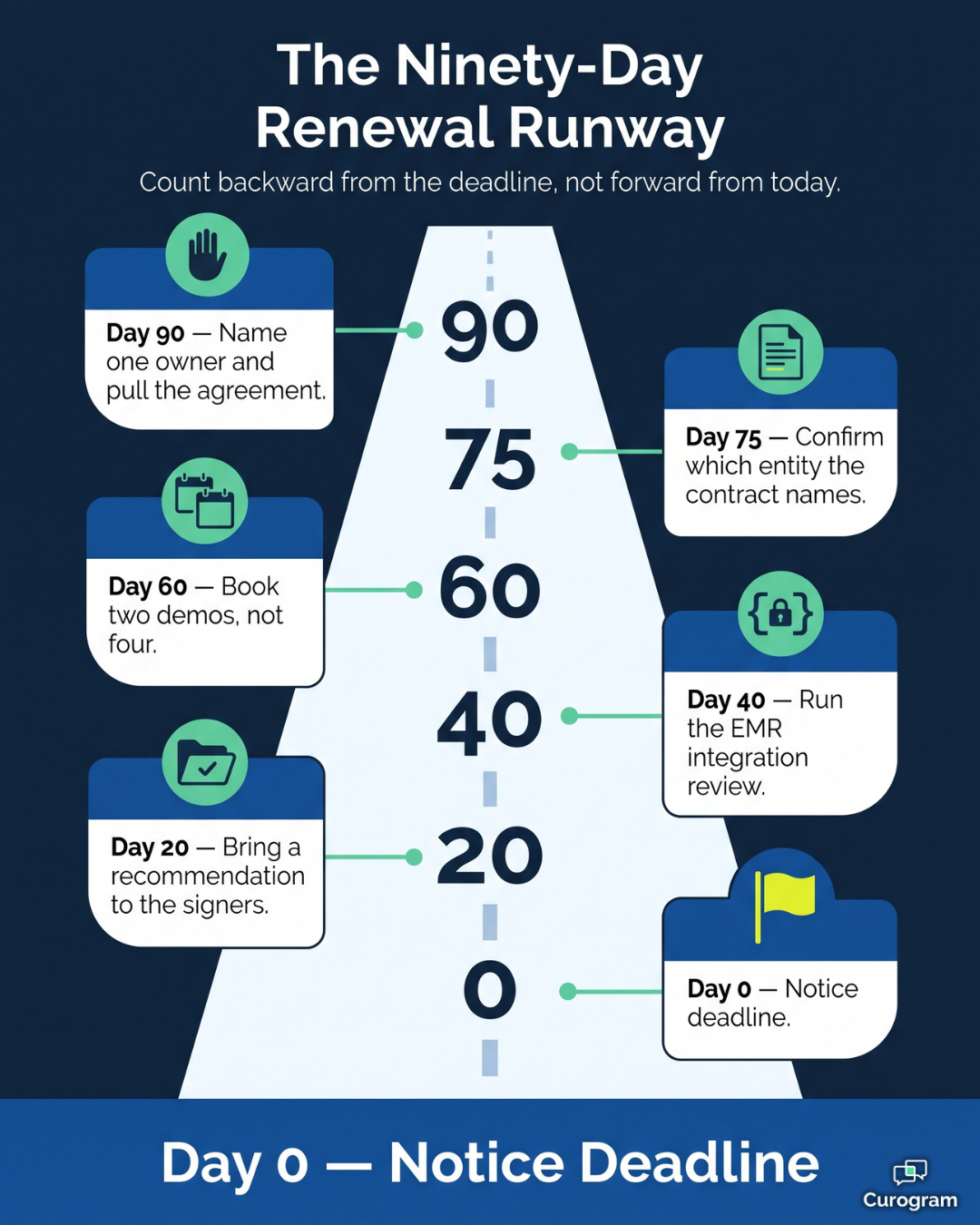
So put a name on it. One person, ninety days out from the notice deadline, responsible for three things: pulling the agreement, running two demos, and bringing a recommendation to whoever signs.

Ninety days is not generous. It is the minimum needed to schedule demos, get IT to look at the integration, and give your board or managing partners a real decision to make.

Finding out whose contract it actually is

Before you book a single demo, pull the agreement and read the first page.

You are looking for one thing: which legal entity is named as the customer. Is it your practice, your affiliate, or a parent organization you do not control?

That answer determines whether this project is possible at all.

If the agreement names your practice, you have a decision to make and the authority to make it.

If it names an affiliate or a parent entity, you are not a buyer in this conversation.

You are a stakeholder, and your path runs through the network's IT governance process instead of through a vendor demo.

Groups skip this step constantly. They run a full evaluation, pick a replacement, and then learn in month four that the contract belongs to a health system with two years left on a master agreement.

Read page one first. It takes ten minutes and it saves you a quarter.

Built for a World That Only Talked in One Direction

Where TeleVox actually came from

Most write-ups get this chain wrong, so here it is accurately.

TeleVox Software started in 1992 as a healthcare messaging company. It was built around automated outbound message delivery and on-hold messaging. West Corporation completed its TeleVox acquisition in 2007 and folded it into West Interactive.

The parent company changed names more than once. Intrado Corporation announced the 2022 rebrand to West Technology Group, and West Technology Group is controlled by affiliates of certain funds managed by Apollo Global Management. Today you will find TeleVox under the WestCX brand, alongside Mosaicx.

Two corrections worth carrying into any vendor conversation. Stericycle never owned TeleVox. And Mosaicx is a sibling brand under the same WestCX umbrella, not a parent company.

Why should a practice administrator care? Because the history explains the design. A platform born in the interactive voice response era was built to send one message to many people at once, and that founding assumption still shapes the product.

It also helps to know what consolidation means for patient engagement buyers before you sign anything new.

The reply that has nowhere to go

Here is the mechanic, step by step.

  1. Monday morning, your system sends appointment reminders to 400 patients scheduled for Tuesday and Wednesday.
  2. Twelve of them reply with a real question. "Can I move this to Thursday?" "Do I need to fast?" "Which location is this one at?"
  3. Those twelve replies have to land somewhere a human can work them.

That last step is the whole argument.

To be fair, TeleVox does support two-way outreach today across SMS, RCS, email and chat. It has kept adding channels.

So the real question is narrower than "can it receive a message." It is whether the reply lands in a thread your front desk already works, tied to the right chart, with the schedule change written back to the EMR on its own.

When it does not, the work does not disappear. It moves to your staff.

Someone reads the reply, opens the EMR in another window, finds the patient, moves the appointment, and types a response. Call it four minutes per reply, twelve replies a day, across twelve sites.

That is roughly 48 staff hours a month spent re-keying what two systems already know.

If you want the detail, we break down clinical workflow automation compared across both platforms.

Ninety-day TeleVox renewal timeline showing six steps from naming an owner to the notice deadline

Where voice still earns its place

Dismissing voice entirely would be a mistake, and any vendor who does it is selling you something.

Three cases where outbound voice still wins:

  • Populations that do not text. Some Medicare-heavy panels and rural patient bases still answer landlines and ignore SMS entirely.
  • Closure notices. When a snowstorm shuts four sites, you want every channel firing, including a call that does not depend on a smartphone.
  • Lab callbacks and other clinical outreach where a timestamped voice record matters for documentation.

Most groups land on a split rather than a swap. Voice keeps the one-way, everyone-must-hear-this traffic. Text takes everything conversational. If you route a lot of inbound calls, check how that split fits your call center solutions too.

Four Platforms Worth a Demo Slot at Group Scale

The four that handle multi-site operations

Among TeleVox competitors, four come up repeatedly for groups running more than a handful of locations.

Curogram is built for outpatient groups that live in two-way texting. It connects to nearly any EMR through API and HL7, publishes a starting price, and trains front-desk staff in about ten minutes.

That last part matters more than it sounds. You are rolling out across twelve sites, and every one of them has turnover.

Artera is the enterprise choice. It is independent and well funded, having raised Artera's $65M growth round in December 2025, led by Lead Edge Capital.

One caution worth naming: Artera carries real implementation weight. It is built for health systems with IT staff to spare. A twelve-location group without a dedicated integration team should ask hard questions about timeline and staffing before signing.

Luma Health sits in similar territory. It is strong on patient access and scheduling, and it connects to Epic, Oracle Cerner, MEDITECH, eClinicalWorks and athenahealth. Pick it when scheduling is your main problem.

Weave comes from the other direction. It started in small practices with phones at the center, and it now serves tens of thousands of healthcare locations. It bills per location, which is worth modeling carefully if you have twelve of them.

How they compare at group scale

Platform Heritage Conversational two-way texting Named EMR integrations Multi-location routing Public pricing?
TeleVox Outbound voice and IVR; founded 1992, acquired by West in 2007 Yes, added over time across SMS, RCS and chat EHR-agnostic; used by 2,000+ healthcare organizations Enterprise-oriented No, quote only
Curogram Two-way patient texting for outpatient groups Core to the platform Works with nearly any EMR through API and HL7 Per-location numbers and routing Yes, starting rate published
Artera Text-first patient communication since 2015 Core to the platform Epic, Oracle Health, MEDITECH Expanse Patient Connect, athenahealth Built for IDNs and health systems No, quote only
Luma Health Patient access and scheduling since 2015 Core to the platform Epic, Oracle Cerner, MEDITECH, eClinicalWorks, athenahealth Health-system oriented No, quote only
Weave Phones-first, small-practice heritage Core to the platform Elation Health, Prompt, 4th Dimension and other practice systems Billed per location Partly; entry plan published, higher tiers quoted

Read that pricing column closely. Three of the five make you take a sales call before you see a number, which puts your budget timeline on their calendar.

For the arithmetic, see our Curogram and TeleVox cost comparison. Review sites are thin here, so TeleVox reviews on G2 will not settle much either way.

The integration column deserves the same care. Two platforms can both claim an EMR connection and mean very different things by it. Before your IT team gets on a call, look at how the two integration architectures differ. For one matchup up close, we also keep a Curogram vs TeleVox head to head.

Rolling this out across twelve locations

A group rollout is not one switch. It is twelve small ones.

Plan for per-location phone numbers, so a patient replying to the Riverside clinic does not land in the Northside queue.

Build message templates by site, because hours, parking instructions and prep notes differ. Set after-hours routing rules per location, including which sites forward to the answering service and which hold messages until morning.

Then phase the go-live by region. Three sites in week one, five in week three, the rest in week six. Each wave teaches you something the next wave benefits from, and a problem at one site never becomes a problem at twelve.

Groups that flip every location on one day usually spend the next month undoing it. Our guidance for multi-location and large group practices goes deeper on sequencing.

When Staying Put Is the Right Call

Two cases where TeleVox still fits

Some groups should renew, and pretending otherwise would waste your time.

The first is one-way outreach at volume. Say most of your traffic is lab result callbacks, closure notices and voice campaigns to a panel that does not text. Then you are using the platform for exactly what it was built to do.

Adding a conversational layer would solve a problem you do not have. A separate tool for mass text messaging for patient outreach can cover the occasional text blast without a full platform change.

The second case is contractual. If your agreement is bundled inside a health-system master contract, you cannot exit it alone. It will not matter how good the alternative looks in a demo.

Stop playing phone tag! Reduce your call volume by 50% with Curogram's HIPAA-compliant 2-way texting platform.  

The one thing to check before anything else

It comes back to the question from the top of this page. Is the agreement yours, or the affiliate's?

That one answer changes the whole project. If the contract is yours, this is a buying decision with a ninety-day runway and a clear owner. If it belongs to a parent entity, your real path is influence rather than purchase.

The work goes into the network's technology committee instead of a vendor evaluation.

Practices that skip this check lose a full quarter learning it the hard way. Ten minutes with page one tells you which project you are actually running.

What Changes When Patients Can Reply

The numbers at group scale

Two figures, based on our internal data across Curogram clients.

Appointment confirmation rates average above 75%. And no-show rates run 53% below the industry average.

Here is what that means in practice. The example below is illustrative, not a client figure.

Take a twelve-location group booking 6,000 appointments a month, against an industry no-show rate of roughly 18%.

  • At 18%, that group misses about 1,080 appointments a month.
  • At 53% below that rate, it misses about 510.
  • The gap is roughly 570 recovered visits a month.

At an average visit value of $125, those recovered visits are worth about $71,000 a month. That is roughly $855,000 a year. Swap in your own volume and visit value and the shape holds. Confirmation rates move revenue, not just tidiness.

Start with your renewal date, not the demo

You do not need a decision today. You need a date and a name.

Pull the agreement, find the notice deadline, and count back ninety days. Put one person's name next to it. Then book two demos inside that window, not four, because four demos produce comparison fatigue and no decision.

If your evaluation points toward a change, the mechanics of the move are their own subject, and we cover them in detail for groups planning to switch from TeleVox to Curogram. Sequencing across sites follows the same logic we use with other multi-location and large group practices.

An IVR to texting upgrade in healthcare is rarely an all-or-nothing swap. It is a rebalance, and the renewal date is when you get to make it.

Give the Renewal Date an Owner

Most of this comes down to a date.

You inherited a platform. You did not choose it, you cannot find the person who did, and it has quietly renewed several times while your front desk absorbed the difference between what it sends and what your patients send back.

That is a fixable situation, but only inside a window. Miss the notice deadline and you have bought another year of the same arrangement.

So do the small things first. Pull the agreement and confirm which entity is named as the customer. Find the notice deadline. Count back ninety days and put one person's name on that date.

Then decide what you need. If your outreach is one-way and high volume, renew with confidence and spend your energy elsewhere. If your staff spends afternoons re-keying patient replies into the EMR by hand, you have a workflow problem that a broadcast platform was never designed to solve.

Groups shopping for a TeleVox alternative in 2026 tend to want the same three things: replies that land in a thread, a schedule that updates itself, and pricing they can model before a sales call. Those are reasonable requirements. Several platforms meet them.

If a TeleVox replacement for patient outreach is on your list this year, the useful next step is seeing the workflow run against your own EMR and your own location structure, rather than a generic demo environment.

Schedule a Demo with our team and bring your renewal date to the call. We will build the walkthrough around your actual site count, your EMR, and the volume you are sending now.


Frequently Asked Questions

Who owns TeleVox now?

TeleVox sits under the WestCX brand inside West Technology Group. West is controlled by affiliates of certain funds managed by Apollo Global Management. Two common mix-ups are worth correcting: Stericycle never owned TeleVox, and Mosaicx is a sibling brand under the same WestCX umbrella, not a parent.

Can we keep outbound voice and add texting?

Yes, and most multi-site groups do exactly that. Voice keeps closure notices, lab callbacks and patients who do not text. Texting takes reminders, confirmations and rescheduling. Groups that run phones alongside messaging often add VoIP integration so calls and texts share one record.

Our contract came from a health system. Can we replace it?

It depends on which entity the agreement names as the customer. If it names your practice, you can replace it on your own timeline. If it names an affiliate or a parent group, you cannot exit alone. Your path then runs through the network's IT committee, not a vendor demo.

How long does a group-scale rollout usually take?

Plan on six to ten weeks for a twelve-location group, phased by region rather than flipped on all at once. Most of that time goes to EMR testing, per-location number setup and template building. Staff training is short, often under an hour per site.

What should we compare besides price?

Compare four things: whether replies thread into one view, whether schedule changes write back to your EMR on their own, whether routing works per location, and what setup will ask of your team. Those four shape daily workload far more than the monthly fee does.