Curogram vs. Luma Health: EHR Integration Architecture Compared
💡 Curogram and Luma Health take very different paths when it comes to EHR integration architecture. Curogram uses a direct, rules-based API that...
9 min read
Mira Gwehn Revilla
:
May 15, 2026
Most clinics ask one question first: what does the platform cost? That number on the contract feels like the full price. But the sticker price often hides the real cost. And that hidden cost is where ROI lives or dies.
The real cost shows up later. It shows up in IT hours spent on setup. It shows up in training days for staff. It shows up in months of slow rollout while revenue keeps leaking out.
This is why a Curogram Luma Health cost comparison ROI study matters in 2026. Two platforms can list the same monthly fee. Yet one can pay back fast, while the other drags on. The gap comes from how each one is built.
Luma Health uses an Operational AI model that fits big health systems with full IT teams. Curogram uses a deterministic, rules-based model built for mid-sized clinics. Both can work for the right buyer. But they don't cost the same once setup, training, and ramp-up hit your budget.
For a no-show revenue recovery cost analysis, the timing of value matters as much as the price. A platform that takes 90 days to go live means 90 days of missed revenue. One that goes live in days pulls money back from week one.
This is the real measure of patient engagement platform ROI in healthcare. It is not just the monthly fee on the invoice. It is the speed of payback, the size of the configuration tax, and the staff hours pulled from patient care.
This guide breaks down both options side by side. You'll see where Luma Health hidden costs in implementation tend to show up. You'll see how deterministic automation cuts those costs. You'll also see real numbers from clinics using Curogram today, plus a clear path to faster ROI.
When clinics shop for a patient engagement platform, the demo focuses on features. The sales call focuses on the monthly fee. But the real cost lives in places nobody talks about on the call. And those hidden places are where ROI is won or lost.
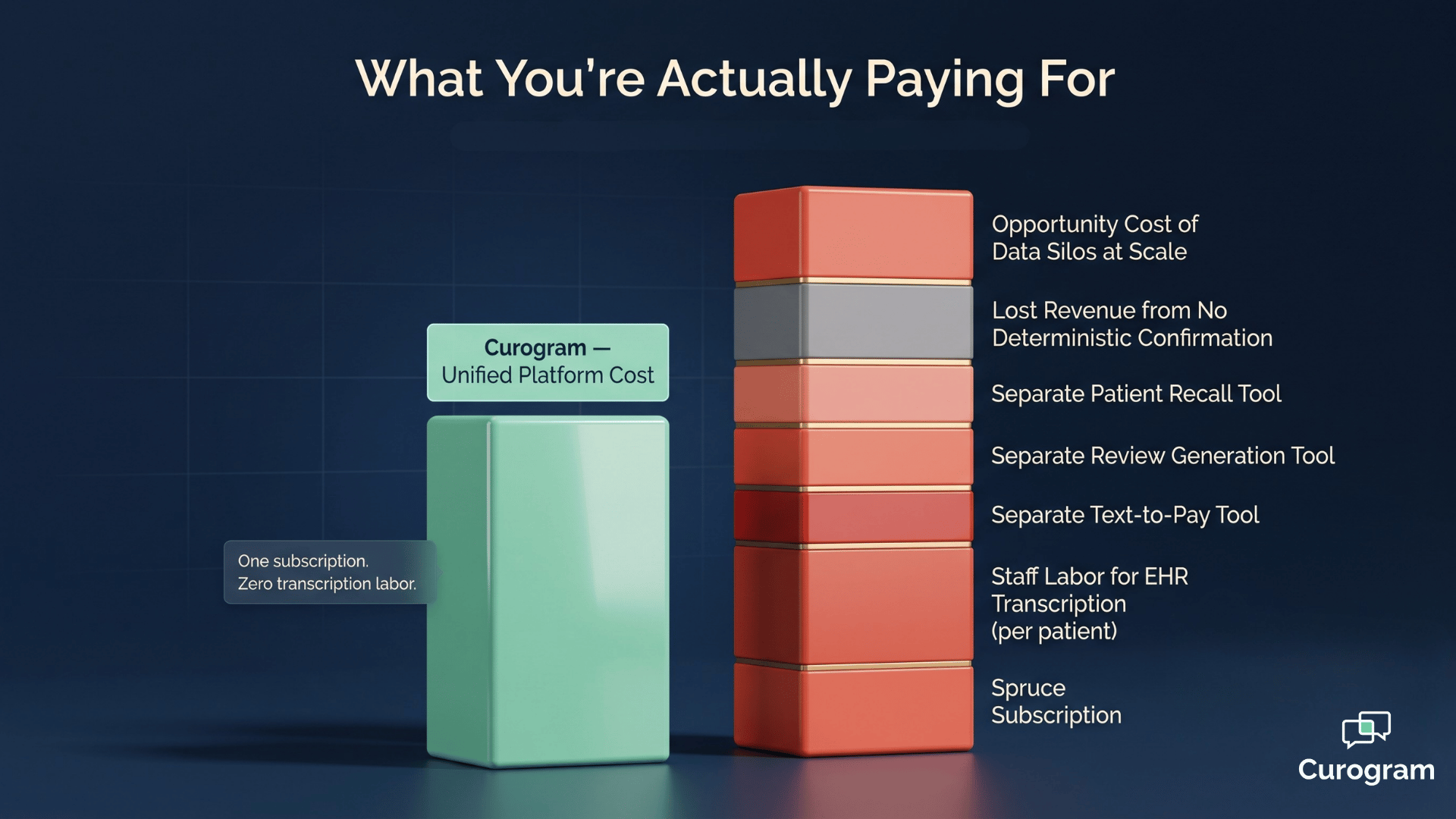
Total cost of ownership has five real layers. The subscription is just the first.
The other four are:
The fifth layer is opportunity cost. Every week your platform is not live is a week of lost revenue. That includes no-shows, missed recalls, and slow billing.
In 2026, mid-market specialty practices feel this gap more than ever. Margins are tight. Most clinics with 3 to 15 providers have one or two IT staff at most. A long, complex setup is not just costly — it is risky.
This is why a Luma Health total cost of ownership review can't stop at the line item. You have to add the hours, the delays, and the missed revenue during rollout.
For example, a clinic losing $25,000 a month to no-shows is also losing about $6,000 a week. If a long setup delays the fix by 8 weeks, that is $48,000 in missed recovery before launch. That number rarely shows up on side-by-side pricing sheets.
This article maps the true economic impact of two models. We compare Curogram's deterministic automation with Luma Health's orchestration-first design. The goal is simple. We show the configuration tax that complex systems quietly add, and how to avoid it.ç

Luma Health was built for big health systems. Its Operational AI model handles complex, multi-step workflows across many sites. For a 200-provider IDN with a full IT team, that power can be worth the setup cost. It can also fit FQHCs with complex routing across many programs.
But most U.S. specialty practices are not 200-provider IDNs. They are clinics with 3 to 15 providers, one office manager, and maybe a part-time IT contractor. For them, orchestration brings what we call the healthcare automation configuration tax.
The configuration tax has three parts:
Verified user reviews on TrustRadius describe Luma Health's setup as very difficult. G2 reviews flag a steep learning curve. These are not small details. Each hour of setup, each week of delay, each retraining session has a real dollar cost.
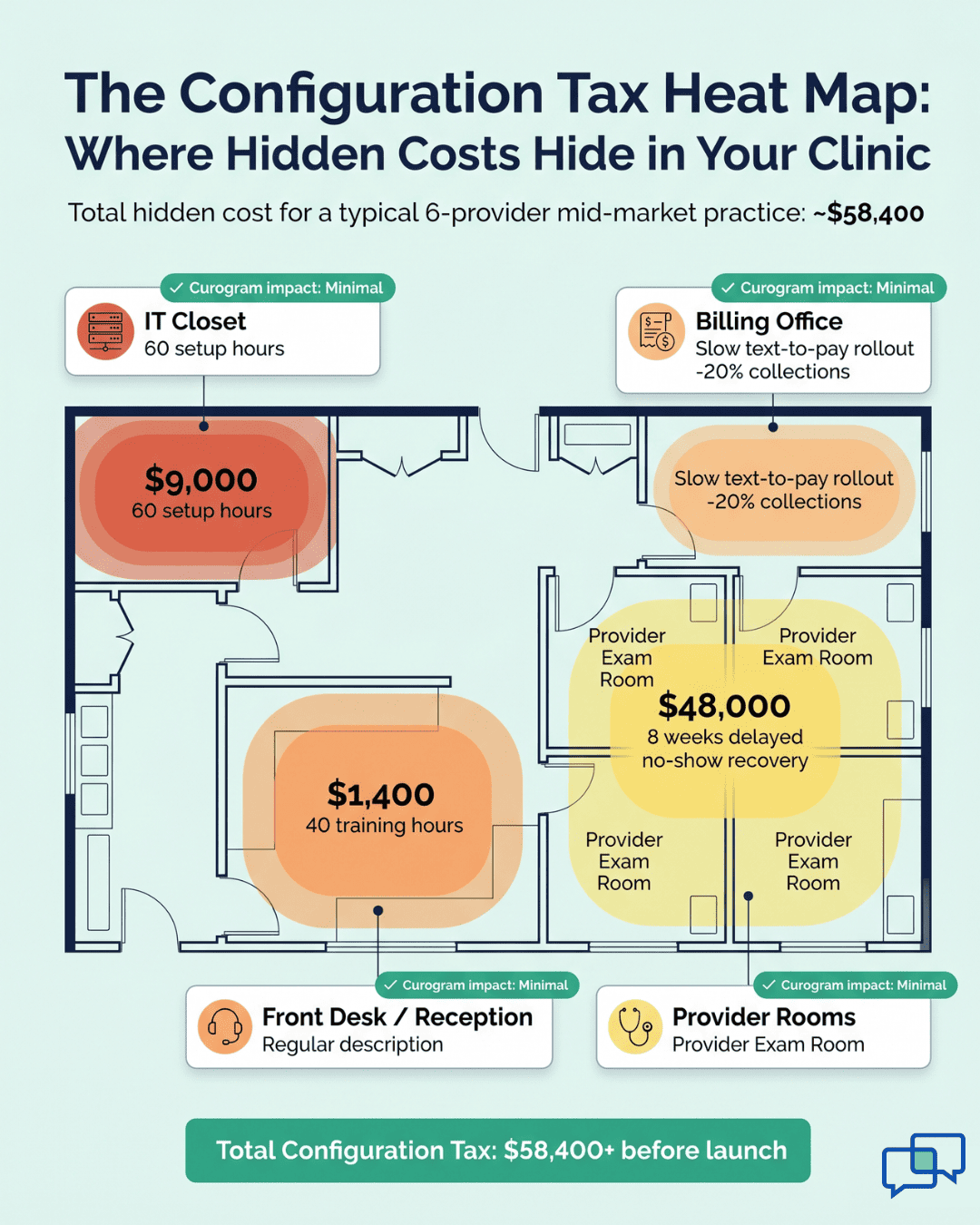
Let's quantify it. Say your IT contractor costs $150 an hour. A 60-hour setup is $9,000. Add 40 staff training hours at $35 an hour, and that's $1,400 more.
Now add 8 weeks of delayed no-show recovery at $6,000 a week — that is $48,000.
The total invisible cost: about $58,400 before the system runs at full speed. None of that appears on the subscription invoice.
Curogram is designed to remove this tax. Workflows turn on out of the box. Bi-directional EMR sync deploys in days, not weeks. Staff handle the platform on their own — no IT team needed for daily use.
The result is not just a smaller bill. It is a faster path to revenue recovery. There is less drag on staff time and less risk of a stalled rollout. For mid-market clinics, that gap is the whole game.
The cost side is only half of ROI. The other half is what the platform pulls back into the practice. For Curogram, the case is built on four clear revenue streams. Each of them starts working in the first weeks after launch.
Most specialty practices run no-show rates of 10% to 50%. That means $20,000 to $30,000 in lost monthly revenue for a typical clinic. Curogram's automated reminders push confirmation rates above 75%, cutting straight into that loss.
Atlas Medical Center is a clear example. Based on our internal data, they cut no-show rates from 14.20% to 4.91% in just three months. That is a 65% drop, and 3X better than the industry average. For a clinic billing $200 per appointment, recovering even 30 visits a month adds $6,000 to monthly revenue.
Many overdue patients drift away without ever being asked back. Curogram's SMS recall campaigns reactivate them. One multi-location practice saw 1,240 patients return at a 35% reconversion rate.
The third stream is digital billing. Practices that depend on paper statements often collect just 20% of patient balances. Curogram's text-to-pay function turns billing into a quick mobile transaction. Patients pay in seconds, and clinics see balances move from open to paid much faster.
Curogram's automated review engine produced 1,064 new 5-star Google reviews in three months for one clinic. Since 90% of new patient leads check Google before visiting a website, this directly lowers patient acquisition costs.
Together, these four streams turn the platform from an expense into a revenue engine. And they all activate fast — within weeks, not months.

Pricing pages list a monthly fee. They rarely list the rest. To compare these platforms fairly, every cost layer must sit on the same line. Below is a side-by-side breakdown built for a typical mid-market specialty practice with 5 to 10 providers.
The numbers below are illustrative — every clinic's exact figures will vary based on size, EHR, and existing workflows. But the structure of the gap is consistent across our customer base.
|
Cost Category |
Curogram |
Luma Health |
|
Subscription (monthly) |
Mid-tier SaaS pricing |
|
Implementation timeline |
Days |
Weeks to months |
|
IT configuration hours |
Minimal |
High (orchestration setup) |
|
Staff training time |
~10 minutes per staff |
Multi-day onboarding |
|
Daily IT support |
Not required |
Often required |
|
Time to first revenue recovery |
Week 1 |
Month 3+ |
|
Productivity loss during ramp-up |
Low |
Moderate to high |
A few items in this table deserve a closer look.
Implementation timeline drives almost every other cost. Days versus months means tens of thousands of dollars in rolled-back ROI. Curogram's deterministic setup needs no AI tuning. The rules are pre-built and ready on day one.
IT configuration hours are where Luma Health hidden costs in implementation often appear. Orchestration platforms need detailed flow mapping, conditional logic, and many test cycles. Each hour at $100 to $150 adds up fast. Most mid-market clinics don't have those hours to spare.
Staff training is another quiet cost. Curogram is built like texting; staff get fluent in about 10 minutes. Complex platforms can take days to learn well, with refresher sessions later. That is hours pulled away from patient care.
Time to first revenue recovery is the most underrated line. A clinic on Curogram starts pulling back no-show losses in week one. Another clinic on a slower platform may not go live for three months. Over a year, that gap can run into six figures.
The takeaway is simple. The lower-overhead model wins on ROI in mid-market practices, even if the monthly fees match. The most important number is not on the price page. It is the gap between go-live and steady revenue recovery — and that gap is where ROI is decided.
Most software decisions in healthcare get made on a spreadsheet. The problem is that the most important numbers are often the ones missing from that spreadsheet. Let's make the full case.
For mid-market practices, deterministic automation wins on three measurable fronts.
First, total cost of ownership stays low. There is no big IT bill, no months of training, no productivity dip during ramp-up. Your monthly subscription is the bulk of your real spend.
Second, time-to-value is short. Curogram clients pull back no-show revenue, recall lapsed patients, and collect overdue balances in week one. Compare that to platforms where the first 8 to 12 weeks are spent in setup. The math heavily favors fast deployment.
Third, the platform pays for itself many times over. Based on our internal data, Curogram clients see no-show rates 53% below the industry average. They also see 1,100+ confirmed appointments per month at one client and 1,240 patients recovered through recall at another clinic.
One practice generated 1,064 new 5-star Google reviews in three months. These are not vanity stats — they are dollars back in the bank.
Now think about scale. A 6-provider clinic billing $250 per visit and recovering 100 lost visits a month adds $25,000 in monthly revenue. Across a year, that adds up to roughly $300,000. Subtract a typical SaaS subscription, and the net ROI is dramatic.
Compare that with a 90-day rollout. You give up roughly $75,000 of that recovery before the system even works. That is the configuration tax in plain numbers.
The economic case is not about features. It is about how fast a platform turns into cash flow. For mid-market practices without dedicated IT teams, deterministic automation is built for speed. And speed is where ROI lives.
Choosing a patient engagement platform is more than a feature comparison. It is a budget decision that plays out over months and years. The Curogram Luma Health cost comparison ROI math becomes clear when you look past the monthly fee.
Luma Health was built for large health systems. Its orchestration model can be powerful in those settings. But for clinics with 3 to 15 providers, it tends to add costs that don't show up in the contract. The configuration tax is real.
Curogram is built for the mid-market. Its deterministic, rules-based model goes live in days. Staff manage it on their own. Workflows for reminders, recalls, billing, and reviews start running out of the box.
The numbers from our customer base back this up. Atlas Medical Center cut no-show rates by 65% in three months. Covina Arthritic Clinic confirms 1,100+ appointments a month.
One multi-location practice recovered 1,240 patients through SMS recall and earned 1,064 new 5-star Google reviews. Each of these is a dollar figure on the bottom line.
When you weigh patient engagement platform ROI in healthcare, three questions matter most. How fast can the platform go live? How much will staff and IT spend on setup and upkeep? How quickly does the platform start recovering revenue?
For mid-market specialty practices, the answers point clearly toward Curogram. Lower total cost of ownership, faster time to first dollar, and higher long-term ROI.
Find out what you're really paying with your current platform once setup, training, and delays are added in. Book a demo to get a side-by-side cost breakdown using your numbers.
Beyond the subscription, Luma Health adds IT setup hours, training time, and weeks of delayed revenue. Curogram skips most of that with rules-based workflows and a same-week launch. Mid-market practices see lower total cost and faster ROI.
Based on our internal data, Curogram clients keep no-show rates 53% below the industry average. Many also recover 35% of overdue patients through SMS recall and confirm 75%+ of appointments — adding thousands in monthly revenue.
Mid-market clinics rarely have full IT teams. Each hour spent configuring workflows pulls staff away from patient care. The healthcare automation configuration tax also delays no-show recovery, often costing more than the platform fee itself.
Track three numbers: IT contractor hours billed during setup, staff training time pulled from clinical work, and weeks before automation runs at full speed. Multiply by hourly rates plus weekly no-show losses for the true total.
Each week of delay equals one more week of lost no-show revenue. A clinic losing $6,000 weekly to no-shows loses $48,000 over an 8-week setup. Faster deployment means revenue recovery starts sooner and total ROI is much higher.
💡 Curogram and Luma Health take very different paths when it comes to EHR integration architecture. Curogram uses a direct, rules-based API that...
💡 Curogram and Luma Health both help clinics manage patient engagement, but they take very different paths. The choice in Curogram vs Luma Health...
💡 Evaluating the curogram solutionreach cost comparison roi means looking beyond the monthly subscription fee. Solutionreach runs on a batch-sync...