
8 min read

Curogram vs. Spruce: Total Cost of Ownership and ROI Analysis

Curogram vs. Spruce: Total Cost of Ownership and ROI Analysis
💡 A curogram spruce cost comparison roi analysis shows that subscription pricing is the smallest expense.  

The biggest cost is the labor needed to copy data from a communication app into your EHR. 

For a 40-patient practice, that double-logging tax can hit $30,000 to $50,000 a year. Add forgone no-show recovery and missing payment tools, and the gap widens. 

Curogram replaces the standalone communication app cost analysis with one unified platform. You eliminate transcription work, recover revenue, and stop paying for tools you do not need.

Picture your front desk at 11 a.m. on a Tuesday.

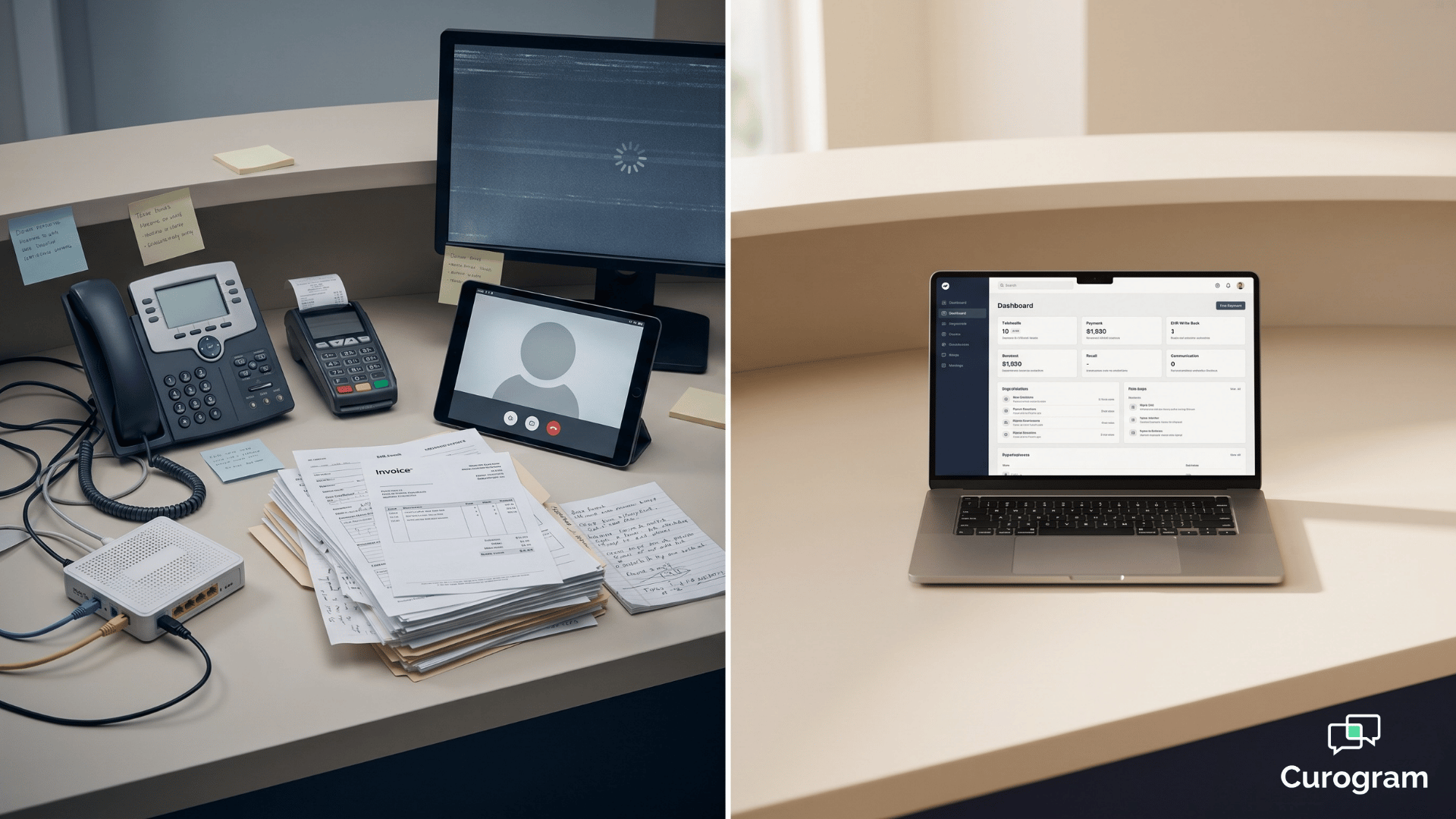
Phones are ringing. A new patient walks in. And one staff member is hunched over a screen, copying intake answers from a messaging app into your EHR, field by field.

That is not communication. That is data entry dressed up as communication.

Most practices believe their biggest software expense is the monthly subscription line item. It is not. The real cost is the human labor stitching two systems together every time a patient sends a message, confirms an appointment, or fills out a form.

This is the quiet drain that almost no spruce vs curogram pricing value medical conversation captures on the surface. It hides inside payroll. It shows up as overtime. It looks like “we just need another front desk hire.”

It sounds simple. It isn’t.

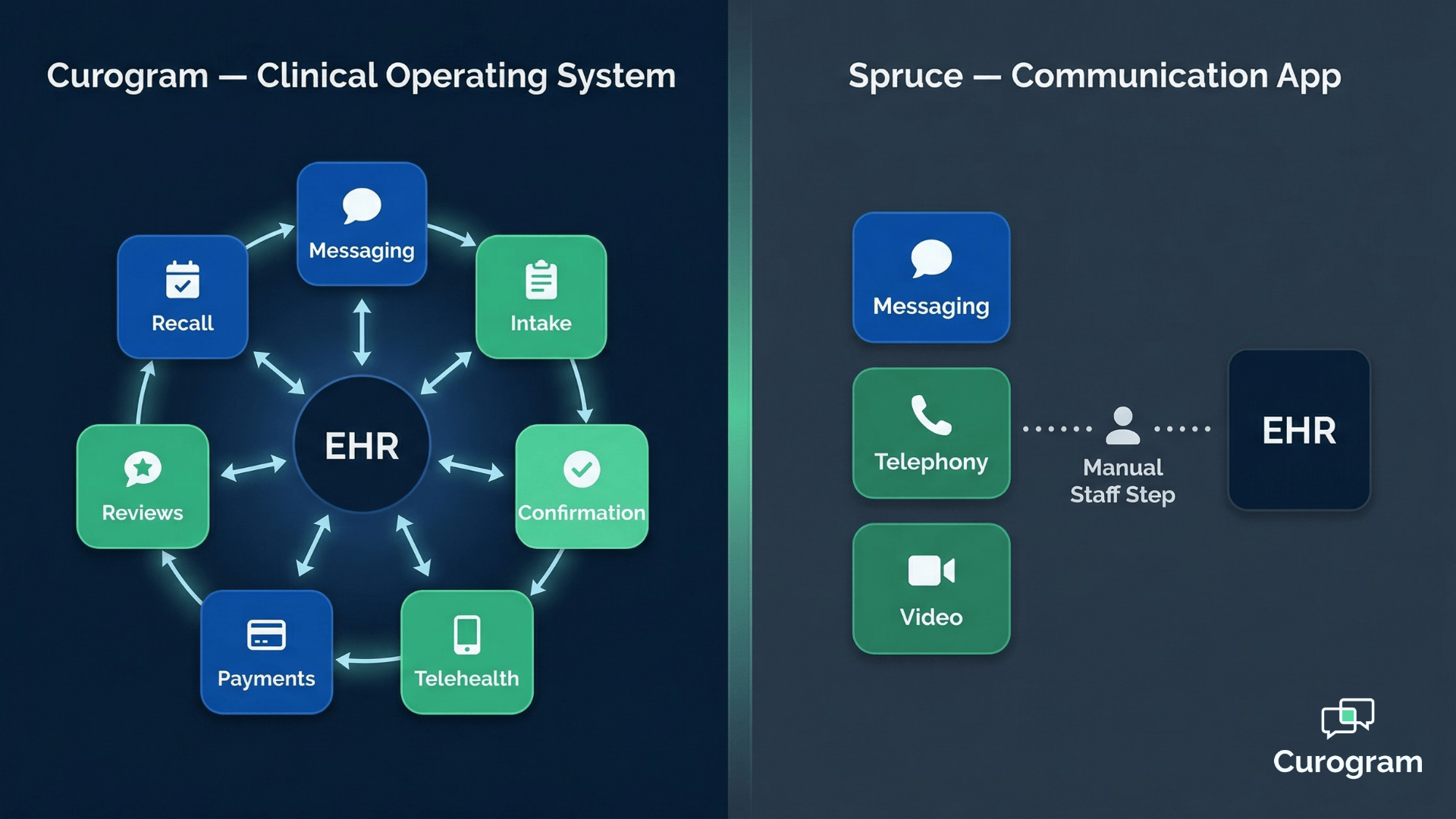
Spruce is a strong communication app. Curogram is a clinical automation platform that includes communication.

The difference matters at the bottom of your P&L. A communication app moves messages.

A unified platform moves data, updates the chart, confirms appointments deterministically, collects payments, and pulls back lapsed patients without staff in the middle.

This article walks you through a full curogram spruce cost comparison roi breakdown, including the hidden double logging hidden costs healthcare practices rarely calculate.

You will see what spruce total cost of ownership medical actually looks like once labor and lost revenue are added in. You will see where the patient engagement platform ROI unified model pulls ahead.

And you will see where the economic inflection point lives for your size of practice.

By the end, the math will speak for itself.

The Hidden Economics Behind Manual Data Bridging

The most underestimated cost in healthcare patient engagement is not the subscription. It is the cost of a person sitting between your communication app and your EHR, manually moving information between them.

Think about what happens after a patient texts your practice through a standalone communication app.

Their intake answers live in the app. Their confirmation reply lives in the app.

Their insurance update lives in the app.

Then someone has to put it all into the EHR.

That is double-logging. And it scales linearly with patient volume. The more you grow, the more you pay for it. This is the heart of the double logging hidden costs healthcare problem that pricing pages never mention.

Why a Communication App and a Clinical Platform Are Not the Same Tool

A communication app is graded on how well it sends messages. A unified clinical automation platform is graded on whether your chart is accurate by 5 p.m. without anyone retyping anything. Those are different products competing on different metrics, even if they look similar in a sales demo.

That distinction is what this entire analysis turns on.

The full economic impact of Curogram’s unified clinical automation against Spruce’s standalone communication model comes down to three things:

The labor cost of double-logging, the workflow gaps Spruce does not natively close, and the revenue cycle recovery differences that ultimately decide which platform delivers a higher ROI.

Putting a Real Dollar Figure on the Double-Logging Tax

Spruce’s communication quality is genuinely good. That is not the issue. The issue is what happens after every message.

Every patient interaction that contains clinical data creates a transcription task.

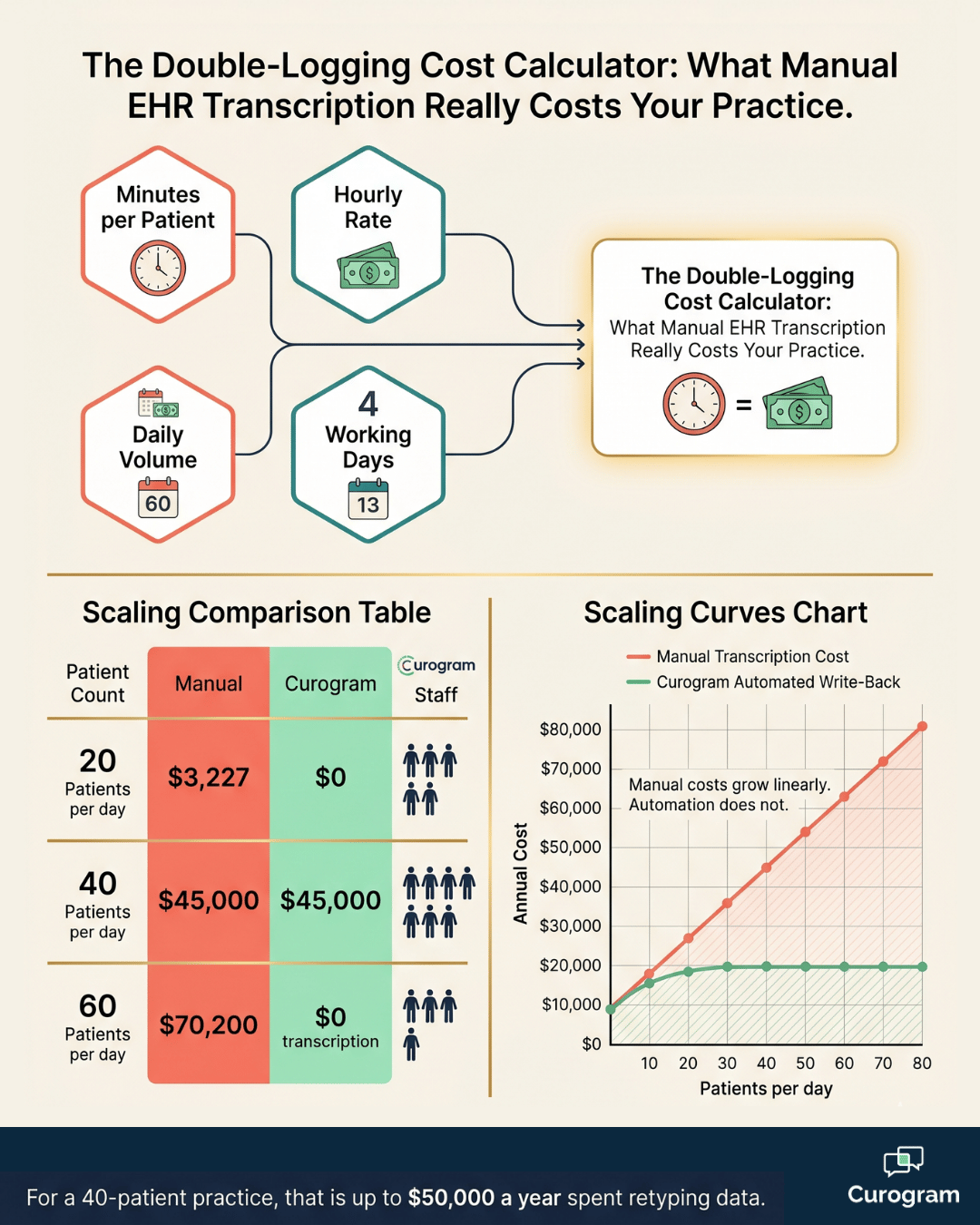
Take a practice processing 40 patients a day, with intake forms averaging 15 fields each. Manual transcription takes 8 to 12 minutes per patient. The math gets uncomfortable fast.

Here is what that looks like across a month and a year.

Practice Volume Daily Transcription Time Annual Labor Cost
20 patients/day 2.5–4 hours $15,000–$25,000
40 patients/day 5–8 hours $30,000–$50,000
60 patients/day 8–12 hours $45,000–$75,000

That is the hidden line item. For a 40-patient practice, you are looking at $30,000 to $50,000 a year in front-desk wages spent moving data from one system to another.

Not seeing patients. Not collecting payments. Not following up on recalls. Just retyping.

The Costs That Hide Beyond the Intake Form

And it does not stop at intake. Confirmation replies received in Spruce have to be manually reflected in your EHR scheduling system. Add 1 to 2 minutes per confirmation. Medication updates and insurance changes captured in messaging threads have to be logged in the chart.

Each task is small. Together, they are a full-time job.

For your team, this means burnout disguised as a software stack.

Curogram eliminates the double-logging tax through discrete, bi-directional EHR write-back. Intake data parses straight into EHR fields.

Confirmations update appointment status in real time. Clinical data flows between patient, platform, and chart without anyone sitting in the middle. Hours of daily transcription become zero manual effort.

That single shift is the foundation of every other ROI number that follows.

Double-logging cost calculator showing manual EHR transcription costs vs Curogram automated write-back

How Unified Automation Pulls Revenue Back Into the Practice

Cost savings are only half the story. The revenue side compounds the gain, and this is where the patient engagement platform ROI unified model really separates from communication-only tools.

Practices losing $20,000 to $30,000 a month to no-shows in the 10% to 50% range can recover a major chunk of that with deterministic confirmation workflows.

Curogram’s confirmation rates routinely exceed 75%, and that outcome depends on automatic EHR status updates that a standalone communication app cannot produce on its own.

What This Looks Like Inside Real Practices

Atlas Medical cut their no-show rate from 14.20% to 4.91% within three months.

That is roughly a 65% drop, and it translates into thousands in monthly recovered revenue at typical visit values.

Covina Arthritic Clinic processes 1,100+ automated confirmations a month without adding proportional staff hours. In practice, that means revenue grows while payroll stays flat.

Three more revenue vectors stack on top of confirmations:

  • 35% patient recall reconversion, which has recovered 1,240 patients for one practice
  • Native text-to-pay that addresses the 20% paper-statement collection problem
  • 1,064 new 5-star Google reviews that lower patient acquisition cost over time

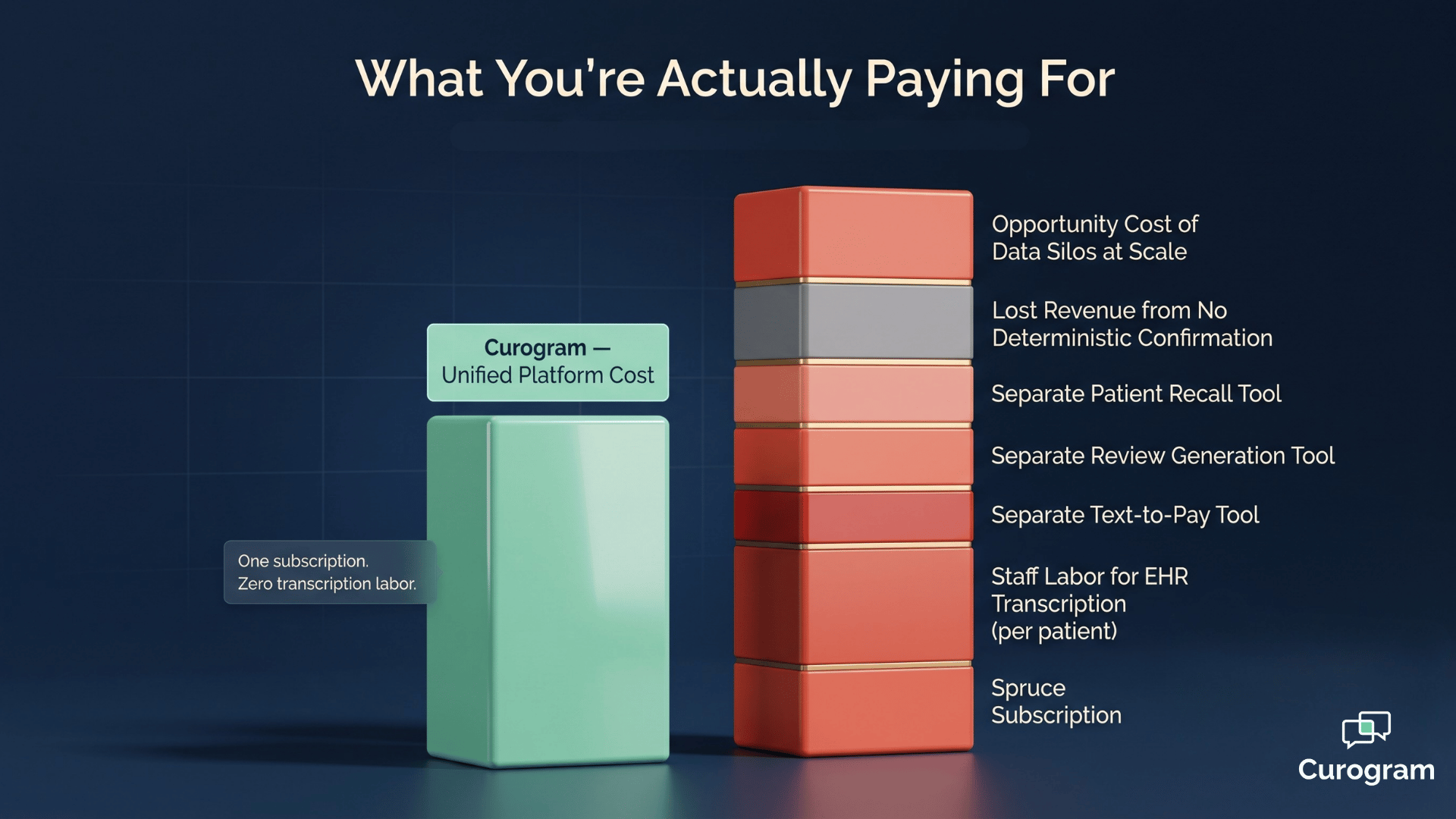
Each of these is revenue Spruce’s communication-focused architecture does not generate natively. To match it, a practice would need separate tools for recall, payments, and reputation management.

That is more software, more vendors, more invoices, and more workflows that do not talk to each other.

This means Curogram is doing two things at once. It reduces costs by killing transcription labor and consolidating tools. And it grows revenue through no-show recovery, recall, digital payments, and reputation. That compound effect is what unified clinical automation actually buys you.

curogram spruce cost comparison roi - landscape

A Side-by-Side Total Cost of Ownership Comparison

When you put both platforms next to each other, the headline subscription price is barely part of the story. The full picture includes labor, revenue, and the workflow gaps either platform leaves behind.

Cost Category Spruce (Standalone Communication) Curogram (Unified Automation)
Platform subscription Monthly fee Monthly fee
Double-logging labor (40 patients/day) $30,000–$50,000/year $0 (automated write-back)
Text-to-pay tool Separate vendor required Included natively
Patient recall tool Separate vendor or manual Included natively
Review generation tool Separate vendor or manual Included natively
No-show revenue recovery Limited (no deterministic EHR sync) 75%+ confirmation rate
Workflow gap labor Ongoing manual effort Eliminated

What the table makes clear:

A “cheaper” communication app is not actually cheaper once you add the workforce hours and the missing revenue streams.

For a practice doing the standalone communication app cost analysis honestly, the line items below the subscription matter more than the subscription itself.

The Line Items Most Practices Forget to Count

When practice owners build their own cost comparison, four expenses tend to get left off the spreadsheet:

  • The labor hours spent retyping data into the EHR
  • The monthly fees for separate text-to-pay, recall, and review tools
  • The revenue lost to no-shows that confirmations never deterministically prevented
  • The opportunity cost of staff doing data entry instead of patient-facing work

Stop playing phone tag! Reduce your call volume by 50% with Curogram's HIPAA-compliant 2-way texting platform.  

In plain language, you are not comparing two software bills. You are comparing one software bill against a software bill plus a part-time data entry role plus several other tools plus the no-shows you never recovered.

That is the real spruce vs curogram pricing value medical equation.

When Switching Becomes the Obvious Financial Move

Every growing practice eventually hits an economic inflection point. It is the moment where the cost of double-logging exceeds the value of the communication quality you are paying for.

For most practices, that point arrives at around 20+ patients per day.

At that volume, the daily transcription labor, plus the workflow gaps, plus the forgone revenue recovery, typically exceeds the cost difference between a communication app and a unified clinical automation platform. From there, the gap only widens.

Curogram is built for practices at and beyond that inflection point. It is for the practice owner who has stopped optimizing for messaging features and started optimizing for chart accuracy, confirmed visits, and revenue recovered without adding headcount.

The ROI equation at this stage demands a platform that reduces costs and generates revenue at the same time, not one that does only half the job.

If your practice is growing, the question is not whether you will outgrow a standalone communication app. It is when.

Conclusion

Numbers in a blog post are useful. Numbers tied to your patient volume, your no-show rate, and your current tool stack are persuasive.

That is the difference between a generic spruce total cost of ownership medical estimate and a real one built around your practice.

A 40-patient practice has a different ROI profile than a 20-patient practice.

A clinic already paying for a separate text-to-pay tool has a different consolidation story than one that is not. Your numbers are not the average numbers, and the decision should not be made on averages.

Here is what a Curogram demo actually shows you.

You will see how discrete bi-directional write-back works inside an EHR like yours, in real time, with sample patient data.

You will see what the deterministic confirmation workflow looks like and how it pushes status updates back into your scheduling system without staff intervention. You will see text-to-pay, patient recall, and review generation running in the same platform, not stitched together from three separate vendors.

You will also get a full, customized cost breakdown. That includes the estimated double-logging labor your team is doing today, the projected revenue recovery from no-show reduction at your visit value, and the consolidation savings from retiring overlapping tools.

If the math works, you will see it clearly. If it does not, you will see that too.

Either way, you walk away with a real answer to the Curogram - Spruce cost comparison roi question, not a generic one.

Schedule a demo and bring your numbers. We will show you what unified clinical automation looks like inside a practice that runs the way yours does, and what it would take to switch.


Frequently Asked Questions

How does Spruce’s total cost of ownership compare to Curogram for growing practices?

Spruce’s real TCO includes more than the subscription. It includes the hidden double-logging labor, which runs 5 to 8 hours daily for a 40-patient practice and lands somewhere between $30,000 and $50,000 a year in staff wages. It also includes the additional tools required to match capabilities Spruce does not offer natively, such as text-to-pay, review generation, and patient recall. On top of that sits the forgone revenue from the lack of deterministic confirmation tied to EHR status updates. Curogram eliminates the transcription labor through discrete write-back and includes the full clinical automation stack in a single platform.

At what practice size does switching from Spruce to Curogram become economically advantageous?

The economic inflection point typically arrives at around 20+ patients per day. At that volume, the daily transcription cost of double-logging between Spruce and the EHR, combined with workflow gap expenses, exceeds the cost difference between the two platforms. Above this volume, Curogram’s unified automation delivers measurably higher ROI through eliminated labor costs and new revenue recovery streams.

Can practices use Spruce alongside Curogram instead of migrating?

Technically, yes. Practically, it adds cost and complexity without solving the underlying problem. Running both platforms means paying two subscriptions, training staff on two systems, and still doing manual data bridging in places. Curogram already includes HIPAA-compliant two-way messaging that replaces Spruce’s communication functionality, and it adds clinical data automation, text-to-pay, review generation, and patient recall. Consolidating to a single platform delivers both cost savings and workflow efficiency, which is the entire point of switching.

How long does it take to see ROI after switching from Spruce to Curogram?

Most practices see measurable returns within the first 60 to 90 days. Labor savings show up almost immediately because the double-logging tasks stop the moment automated EHR write-back goes live. No-show recovery follows close behind, with confirmation rates climbing into the 75%+ range as deterministic workflows take hold. Atlas Medical hit a 65% no-show reduction within three months, which is a useful benchmark for practices of similar size. Text-to-pay and recall revenue typically build over the first two quarters as patient behavior adjusts to the new channels.

What happens to existing patient communication history when migrating from Spruce?

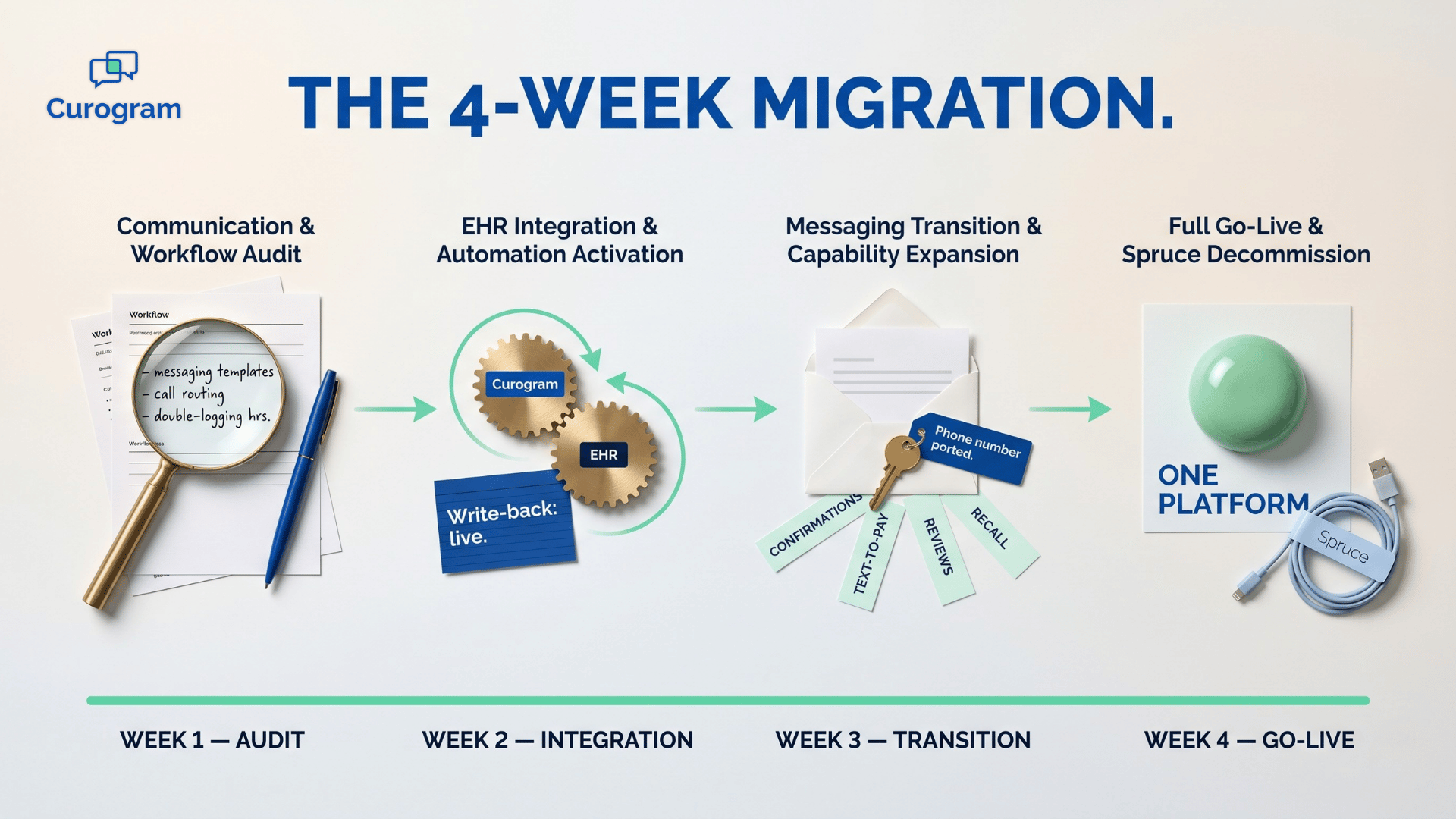
Curogram’s migration process is designed to preserve continuity for both staff and patients. Patient contact records, opt-in status, and active conversation threads can be transitioned so your team is not starting from zero. Patients keep texting the same practice number they already know, which means no confusion and no drop-off in engagement during the switch. The migration is handled in stages so daily operations are not interrupted, and most practices complete the move in a matter of weeks rather than months.


Curogram vs Spruce: Clinical Workflow Automation for Practices

Curogram vs Spruce: Clinical Workflow Automation for Practices

💡 Spruce Health is a polished healthcare communication platform built around messaging, telephony, and team inboxes. But for growing practices,...

Read More
Curogram vs. Spruce: EHR Integration Architecture Compared

Curogram vs. Spruce: EHR Integration Architecture Compared

💡 Curogram uses a bi-directional API to write intake, confirmations, and insurance data directly into structured EHR fields. Spruce focuses on...

Read More
Curogram vs. Solutionreach: Total Cost of Ownership and ROI Analysis

Curogram vs. Solutionreach: Total Cost of Ownership and ROI Analysis

💡 Evaluating the curogram solutionreach cost comparison roi means looking beyond the monthly subscription fee. Solutionreach runs on a batch-sync...

Read More