


Curogram vs. Demandforce: Clinical Workflow Automation
💡 Curogram is a healthcare-exclusive platform built for clinical workflow automation. Demandforce is a multi-industry marketing tool that...
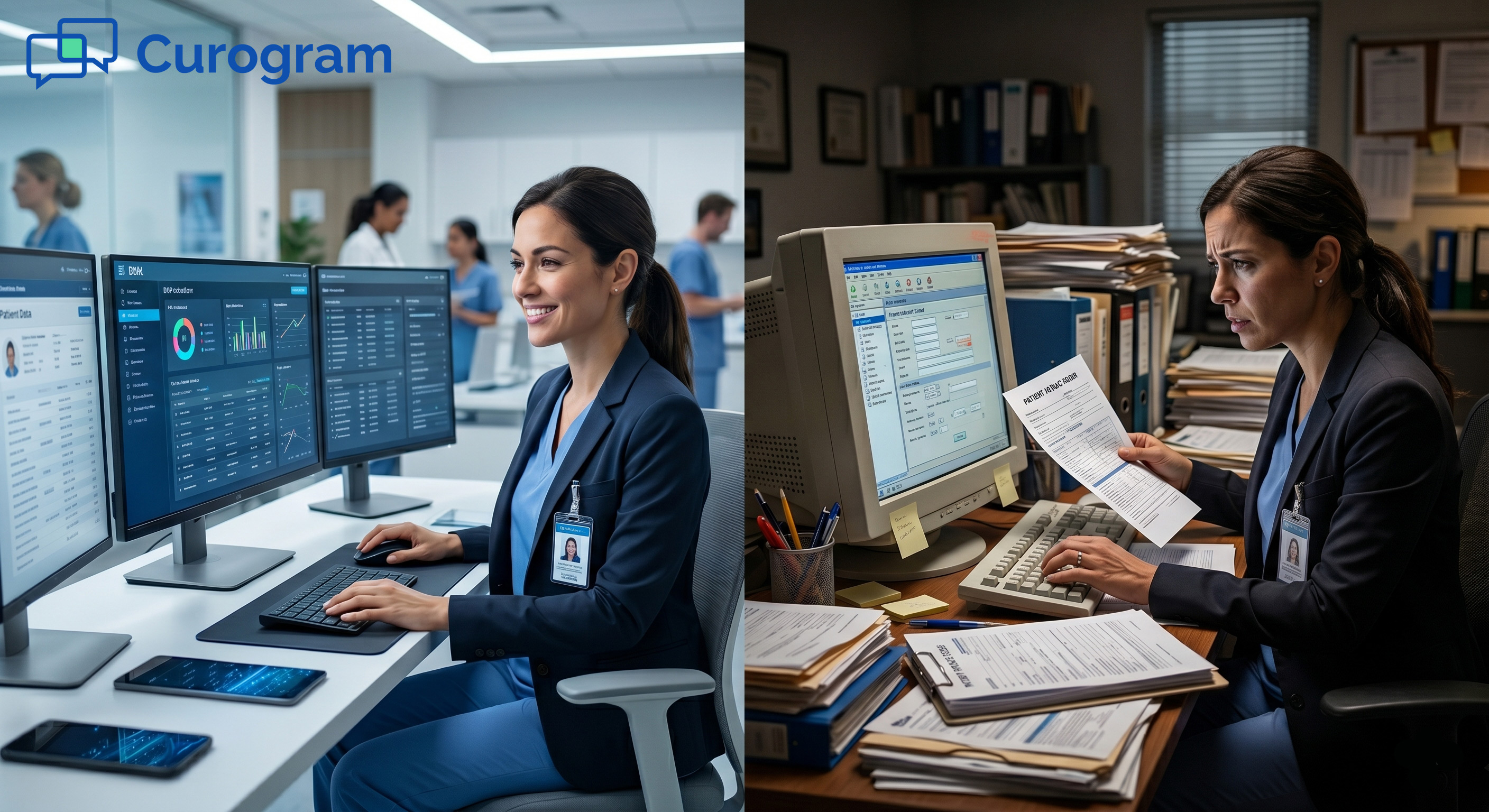
Most clinics pick a patient platform the same way they pick software for any business: they compare the monthly fee. But healthcare is not retail.
The tools a clinic uses touch real patient data, clinical workflows, and revenue cycles. Choosing the wrong platform does not just cost money. It costs time, staff energy, and lost appointments.
Demandforce started as a marketing tool for spas, auto shops, and dental offices. It later expanded into medical practices. Curogram was built for healthcare from day one.
When you line them up on price alone, the difference can look small. But when you add up the full picture, it tells a different story.
This article walks through the true Curogram and Demandforce cost comparison ROI. You will see what each platform actually covers, what Demandforce leaves out, and how that gap translates into real dollars for a typical practice.
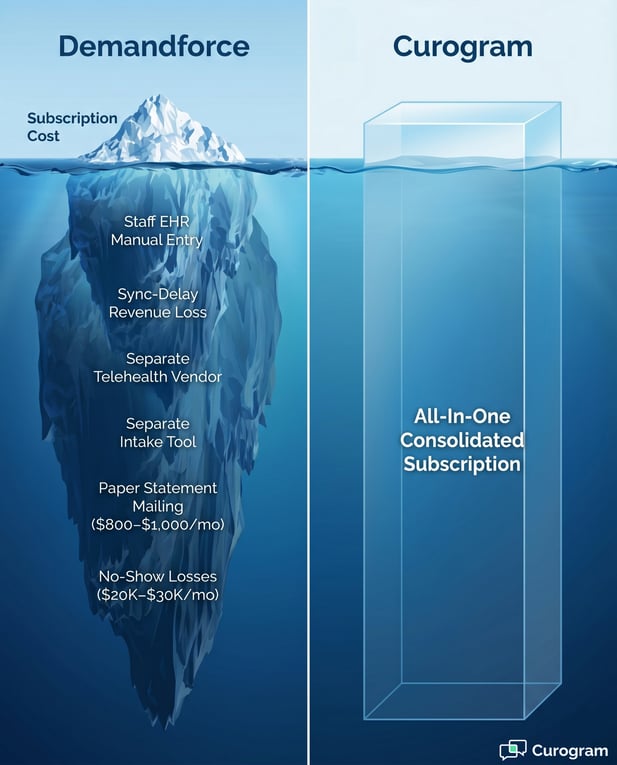
A monthly subscription is just the entry point. The real cost of running a patient communication platform includes every tool you have to buy around it, every hour staff spends doing what the software cannot, and every appointment lost because the system did not work fast enough.
For a multi-industry marketing tool operating in a clinical setting, those gaps add up fast.
Demandforce's fee covers what it was built to do: email campaigns, review prompts, and basic appointment reminders. That is the visible cost. The real cost is everything a medical practice still needs that the platform does not provide.
Demandforce handles outbound email marketing, automated review requests, and appointment reminders. These features work well for marketing-focused businesses. For a medical practice, though, they leave out key clinical capabilities.
A clinic using Demandforce still needs a HIPAA-compliant two-way messaging tool, a telehealth platform, smart intake forms that write directly to the EHR, and a way to handle patient recalls via SMS. None of these come with Demandforce. Each requires a separate vendor contract, a separate monthly fee, and its own setup and maintenance.
To cover a full clinical workflow, a practice using Demandforce often ends up managing three or more vendor contracts at once. That means three billing cycles, three support lines, and three sets of login credentials for staff.
Based on Curogram client data from clinical settings, practices are already spending $800 to $1,000 per month on paper-based billing statements. Adding more vendors to that stack only deepens the cost.
Each added vendor creates its own overhead. Staff must learn new tools, troubleshoot sync issues, and re-enter data when systems do not connect. This is time that could go toward patient care.
Demandforce relies on a localized sync extraction model. That means it pulls data from the EHR but cannot write information back in a discrete, field-level way.
When a patient fills out an intake form or updates their info, staff often have to enter that data into the EHR by hand. That is not a one-time task. It happens with every new patient, every form, every update.
When you peel back Demandforce's subscription, the cost picture changes. It is not just about what you pay for the platform. It is about what the platform forces you to pay for elsewhere.
A marketing-first tool designed for multi-industry use was not built to carry the weight of a medical practice's operations.
Most practices do not realize how many add-on tools they need until they are already using Demandforce.
HIPAA-compliant two-way messaging, telehealth, digital intake with EHR write-back, and native SMS recall are not extras in a clinical setting. They are core.
Because Demandforce does not include them, practices must buy them from other vendors.
A standalone telehealth platform can run anywhere from $50 to over $300 per month depending on features and patient volume.
Add a HIPAA-compliant messaging tool on top of that, and the no-show revenue recovery that should be coming from tighter scheduling is being offset by new vendor fees before the first appointment is even saved.
Demandforce does not include native digital intake with write-back to the EHR. That means many practices continue to use paper intake forms, then pay staff to transcribe that data into the system.
Based on Curogram client data from clinical settings, practices are spending $800 to $1,000 per month just on paper statement mailing. Paper intake adds even more to that number.
Demandforce's sync model extracts data from the EHR on a schedule. It does not pull live data. This creates a gap between what the EHR knows and what Demandforce knows.
That gap causes reminder delays, which leads to no-shows that could have been prevented.
If a patient's appointment is rescheduled at 9 a.m. but the sync does not run until noon, a reminder may still go out for the old time. The patient shows up at the wrong time or not at all.
Based on Curogram client data from clinical settings, practices lose $20,000 to $30,000 per month from no-shows. Sync delays make this worse by reducing the accuracy of reminders that are supposed to prevent exactly these situations.
Curogram connects to the EHR in real time. When a schedule changes, the reminder data changes with it. This is not a minor technical difference.
It is a direct line to no-show revenue recovery. A practice that recovers even half of its monthly no-show losses through better reminder accuracy is already ahead on the math.

Cost reduction is only one side of the equation. The other side is what a platform can actually earn back for a practice. Healthcare-native automation is not just about doing things more efficiently. It is about turning missed revenue opportunities into real appointments and real income.
No-shows are one of the most consistent sources of revenue loss in medical practices. Based on Curogram client data from clinical settings, practices lose between $20,000 and $30,000 per month from missed appointments.
A 53% reduction in no-show rates, which is the average Curogram clients see versus industry benchmarks, translates to $10,600 to $15,900 in recovered revenue every single month.
Atlas Medical Center reduced its no-show rate from 14.20% to 4.91% in just three months. That is not a small shift. That is a near-complete reversal of the no-show problem. The driver was a real-time schedule sync, which ensures reminders go out with accurate, up-to-date appointment information every time.
A reminder that goes out on a sync delay is a reminder that might be wrong. Curogram's real-time integration means the reminder reflects the actual, current appointment. That accuracy is what turns a reminder from a formality into a real no-show prevention tool.
Beyond no-show recovery, two more channels add measurable clinical automation ROI: patient recall and online reputation. Both are native to Curogram. Neither requires an extra vendor contract.
Based on Curogram client data from clinical settings, a multi-location practice achieved a 35% reconversion rate through native SMS recall campaigns.
That translated to 1,240 patients returning for care. Each of those appointments is pure recovered revenue with no extra marketing tool cost per patient, since recall is built into the platform.
One multi-location Curogram client generated 1,064 new five-star Google reviews in three months. Practices with low star ratings face a real disadvantage in local search. A stronger review profile brings in new patients at no extra ad spend.
Demandforce does offer review generation, but its multi-industry templates were not built for clinical context, which may limit the response rate compared to healthcare-specific outreach.
A total cost of ownership comparison puts the full picture in one place. The table below covers every major cost category, from core subscriptions to staff labor to revenue impact. The goal is not to oversimplify but to make the financial difference visible.
|
Cost Category |
Curogram (Clinical Platform) |
Demandforce (Marketing Tool + Workarounds) |
|
Core Subscription |
Single subscription, all clinical modules included |
Marketing platform subscription only (reminders, email, reviews) |
|
Two-Way Messaging |
Included, native HIPAA-compliant |
Separate vendor or manual phone/fax required |
|
Telehealth |
Included, native module |
Separate vendor subscription required |
|
Clinical Intake Forms |
Included, native smart forms with EHR write-back |
Separate vendor or paper forms with manual data entry |
|
Patient Recall (SMS) |
Included, native SMS recall |
Email-based only; SMS recall not native |
|
Manual Data Entry Labor |
Eliminated via discrete EHR write-back |
Significant; sync extraction requires manual transcription |
|
IT Maintenance |
Cloud-native, no on-premise software needed |
Local sync software requires installation and updates |
|
No-Show Revenue Recovery |
53% lower no-show rates; $10K to $16K/mo recovered |
Limited by sync-delayed reminder accuracy |
|
Patient Recall Revenue |
35% reconversion rate; 1,240 patients recovered |
Lower email-based reconversion rates |
|
Total Vendor Contracts |
1 |
3 or more (Demandforce + messaging + telehealth + intake) |
The table above shows both direct costs and revenue impact. For the Demandforce column, assume each "separate vendor required" line adds a minimum of $50 to $300 per month to the true marketing tool healthcare cost. For the Curogram column, the single subscription absorbs all of those line items.
Manual data entry does not show up on a vendor invoice. But it costs practices real money in staff hours every week.
When intake data needs to be typed into the EHR by hand, that is time pulled away from patient-facing work. Multiply that across every new patient, every form update, and every sync error, and the number grows fast.
Managing three or more vendor relationships means three contracts to renew, three support teams to call, and three potential failure points when something goes wrong.
Clinical consolidation is not just a financial benefit. It reduces the operational load on practice managers and front-desk staff.
No comparison table fully captures the cost of things that do not happen. A patient who gets the wrong reminder and misses their appointment is a cost that does not appear on any invoice.
An intake form that was never digitized is a liability that does not show up until an audit. These invisible costs are part of the real patient communication platform cost picture.
Every month, a practice runs on a platform that requires workarounds is a month of staff hours, vendor fees, and missed revenue that could have been recovered.
The math is not always dramatic in any single week. But over a year, it compounds.
Demandforce's localized sync software runs on-premise, meaning it has to be installed, updated, and maintained on the practice's local machines.
When it breaks, it creates scheduling and reminder failures until it is fixed. Curogram is cloud-native, which removes that maintenance burden entirely.

The Curogram and Demandforce cost comparison ROI is not a simple subscription comparison. It is a question of whether a practice's core communication infrastructure was built for healthcare or adapted from another industry.
Demandforce was built for marketing. It does that job well. But a medical practice needs more than marketing. It needs real-time schedule sync, HIPAA-compliant messaging, digital intake with write-back, telehealth, and native patient recall. When those capabilities are missing, practices either go without or they buy them from other vendors.
For practices already losing $20,000 to $30,000 a month to no-shows and spending $800 to $1,000 on paper billing, the clinical automation ROI of a unified platform is not incremental. It is foundational.
Curogram clients see 53% lower no-show rates, 35% patient recall reconversion, and over 1,000 new reviews in a single quarter. Those outcomes do not come from a marketing tool. They come from a platform that was designed around the way clinical workflows actually operate.
Quantify the ROI for your practice. Ask an expert today.
Demandforce covers email marketing, review requests, and basic reminders. Medical practices typically add separate vendors for HIPAA-compliant messaging, telehealth, and clinical intake forms. They also absorb the staff labor cost that comes from manual EHR data entry. Curogram's single subscription includes all of these natively, which consolidates both vendor fees and staff time into one platform.
Based on Curogram client data from clinical settings, practices with high no-show rates lose $20,000 to $30,000 per month. A 53% reduction in no-show rates, which is what Curogram clients average versus industry benchmarks, translates to $10,600 to $15,900 recovered every month.
Atlas Medical Center cut its no-show rate from 14.20% to 4.91% in three months, which shows what real-time sync can do when it is the core of the reminder system.
Demandforce pulls data from the EHR on a schedule rather than in real time and cannot write information back at the field level. That means staff often have to manually enter intake data into the EHR, reconcile discrepancies from sync delays, and troubleshoot when the extraction software errors out. These labor costs do not appear on a vendor invoice, but they represent a real and ongoing operational expense.
Based on Curogram client data from clinical settings, a multi-location practice achieved a 35% reconversion rate through native SMS recall, bringing back 1,240 patients. Each of those appointments is recovered revenue at no incremental marketing cost, since recall is built into the Curogram platform. Demandforce offers email-based recall, but email reconversion rates tend to run lower than SMS, and SMS recall is not native to the Demandforce feature set.
Managing three or more vendor contracts means three billing cycles, three support relationships, and three potential points of failure in your workflow. When one system goes down, it can break the chain for the others. Clinical consolidation into a single platform reduces that risk, simplifies staff training, and removes the overhead of managing multiple renewals and integrations at once.
💡 Curogram is a healthcare-exclusive platform built for clinical workflow automation. Demandforce is a multi-industry marketing tool that...

💡 When comparing Curogram vs. Demandforce for EHR integration architecture, the core difference comes down to how patient data moves. Curogram uses...
💡 When comparing patient communication tools, the subscription fee rarely captures the full cost. For practices outside the ModMed ecosystem,...