12 min read

Klara Alternative for AdvancedMD | Curogram

Klara Alternative for AdvancedMD | Curogram
💡 The best Klara alternative for AdvancedMD practices depends on the work you need texting to do. If you just want reminders and group texts, AdvancedMD's own Patient Messaging tool is the short path.

If your team also chases balances, runs recalls, and sorts replies for many providers, a separate texting tool fits better. Look for one that syncs with your EHR.

Curogram is one such tool. It sends reminders, collects balances by text, sends each reply to the right team, and asks every patient for a Google review. Its ownership is also separate from both vendors, and AdvancedMD has changed hands four times since 2011.


AdvancedMD has had four owners since 2011. ADP bought it that year, and Marlin Equity Partners took over in 2015. Global Payments paid $700 million in 2018. Francisco Partners closed its purchase in December 2024.

If your practice has used AdvancedMD that whole stretch, the company behind your invoices has changed four times. You've likely signed at least one renewal under an owner that wasn't there when you started.

Klara has a shorter story with the same shape. ModMed bought it in 2022, and Clearlake Capital took majority control of ModMed in 2025. A practice running Klara on top of AdvancedMD now pays two vendors. Both are backed by private equity, and both were sold within the last five years.

That history shows up at renewal. A practice manager opens the new order form and has to work out which company is on the other side of the contract this year.

For an AdvancedMD practice that's leaving Klara, the choice comes down to two paths. You can buy the AdvancedMD patient messaging add-on your rep has likely quoted already. Or you can add an independent texting layer that also collects balances and books recalls.

We think one number should decide it: patient balances over 60 days that your team chased only by phone. Your billing manager can build that list from an AdvancedMD aging report. It says more about fit than any feature grid.

Vendor Stability, Asked Honestly

Marlin Equity Partners is the easiest owner to forget. Its 2015 purchase is also when AdvancedMD started running as a standalone company.

Four Owners Since 2011

Years

Owner

What happened

2008 to 2011

Francisco Partners

Bought AdvancedMD, then sold it to ADP

2011 to 2015

ADP

Ran it as a unit of a payroll company

2015 to 2018

Marlin Equity Partners

AdvancedMD became a standalone company

2018 to 2024

Global Payments

Paid $700 million in cash

Dec 2024 on

Francisco Partners

Deal valued at $1.125 billion


ADP bought AdvancedMD in March 2011. Marlin closed its purchase from ADP on September 2, 2015. Three years later, Global Payments' 2018 acquisition cost $700 million in cash.

Then came a return trip. Francisco Partners had owned AdvancedMD from 2008 to 2011. It signed a new deal in October 2024 and closed it on December 16.

The $1.125 billion price breaks into $1 billion paid at closing and up to $125 million tied to future returns. Fortune reported in March 2024 that Global Payments had hoped for $3 billion. The final number came in at just over a third of that.

The customer base kept growing across those sales. At the ADP deal in 2011, AdvancedMD served more than 10,000 physicians in 4,100 practices. By 2024, the company reported about 40,000 practitioners across 13,000 practices, plus 850 billing companies.

Each buyer ran a different kind of business. ADP sells payroll services. Marlin is an investment firm, Global Payments processes card payments, and Francisco Partners invests in tech companies.

What the 2024 Sale Kept in Place

Francisco Partners' acquisition of AdvancedMD left the team in place. Amanda Sharp, already president, added the CEO title. Global Payments stayed on as a long-term partner behind payment acceptance.

AdvancedMD shipped its Fall 2024 release, with new two-way messaging, on October 8. The sale was announced three weeks later.

The Global Payments tie matters in a billing office. Your software has one owner, and your card processing runs through a partner that used to own it. When you renew, ask which company's name sits on each agreement you sign.

The new owner has framed AdvancedMD as a standalone company with room to invest. That may well help the product. For context, Francisco Partners held AdvancedMD for about three years the first time before it sold to ADP.

And on the Messaging Side

Klara went through its own sale first. ModMed announced on February 8, 2022, that it had acquired Klara. Today ModMed sells it as ModMed Patient Engagement, powered by Klara.

ModMed builds its own specialty EHR. So Klara's roadmap is now set by a company that sells a rival to the system you use every day. Klara connects to AdvancedMD, which is how it runs next to your schedule today.

ModMed changed hands too. Warburg Pincus sold a majority stake to Clearlake Capital, in a deal Axios said valued ModMed at $5.3 billion. Clearlake closed it on April 30, 2025.

Neither vendor is independent of a larger parent. Between December 2024 and April 2025, both your EHR vendor and your messaging vendor got new controlling owners, about four months apart.

Questions to Ask at Renewal

Signed contracts usually carry over after a sale. Renewal terms get written by whoever owns the vendor that year. Put these questions to both reps, in writing, before you sign again:

  • Which legal company is named on the order form, and has it changed since your last renewal?
  • Can the price rise at renewal, and is there a cap on the increase?
  • If the product gets sold, renamed, or folded into another brand, how much notice do you get?
  • Who owns your message history, and in what file format can you export it?
  • Will your texting number stay yours if you leave?

Keep the written answers in the same folder as the contract, where the next office manager can find them.

All of this comes back to one question worth asking out loud: which company is on the other side of this contract now? For the product side of the comparison, see our Curogram vs Klara head to head.

The Add-On You are Probably Already Quoted

Tell your AdvancedMD rep you're pricing a Klara AdvancedMD replacement, and the first quote back will likely include the Patient Messaging module. It's the easy sale for them, and for some practices it's the right one.

What AdvancedMD Patient Messaging Does

AdvancedMD Patient Messaging is one module inside the wider Patient Engagement suite. It sends automated texts and emails, and each patient picks the channel they prefer.

Staff can split the patient list into groups and send targeted notes. AdvancedMD lists uses like recall visits, office closures, new providers, and changes to payment methods. The wider suite adds a patient portal, reminders, intake forms, and reputation tools.

The 2024 Two-Way Upgrade

AdvancedMD's Fall 2024 release added a two-way messaging platform. It tracks calls, texts, and web leads in one dashboard.

It can send automatic texts from the main office number, and it includes a chatbot for common questions. Patients can also text in photos of insurance cards and send medical histories.

If your team last looked at AdvancedMD messaging before October 2024, book a fresh demo. The product has changed.

A Setting to Check in the Review Survey

AdvancedMD's reputation page explains how its post-visit survey works. Patients who give 4 or 5 stars get an invite to post on Google. Patients who give 1 to 3 stars get a private feedback prompt instead.

Google's review policy bars businesses from selectively asking happy customers for reviews. Ask your rep whether that routing can be switched off before you turn the survey on.

Where Per-Provider Add-on Pricing Bites

The 2024 customer figures above work out to roughly three providers per practice on average. Those 850 billing companies also show how much of AdvancedMD's base is built around billing work.

Per-provider pricing grows with headcount. Each new hire raises the messaging bill, even if the number of patients you text stays flat. A part-time provider who sees patients one day a week can cost the same seat as a full-time one, so check how the quote counts them.

Some quick illustrative math shows the effect. At any per-provider rate, a 10-provider group pays ten times what a solo doctor pays. Add two providers, and that group's messaging bill rises by 20% overnight.

Neither AdvancedMD nor Klara posts a public price for its messaging tools, so we won't guess at either number. To compare quotes fairly, ask every vendor to price the same case: your current providers, plus two new hires, across your current locations.

To see what reminders are worth on your own schedule, run your numbers through our no-show ROI calculator. It gives you a dollar figure to hold up against any quote.

What the Add-on Quote Usually Excludes

A quote covers only what it names. Before you compare it with anything, ask the rep to mark every line as per provider, per location, or flat. Then work through these:

  • What's priced per provider, and what's priced per location?
  • Is there a monthly cap on texts, and what does going over cost?
  • Is the reputation tool part of this quote or a separate line?
  • Which phone number will patients see on automated texts?
  • What changes at renewal, and how much notice comes with it?

Balance texting needs its own line on that list. AdvancedMD's text and email bill-pay reminders sit in its ePayments suite, which is a separate product from Patient Messaging. Ask whether balance texts are in the messaging quote at all.

Card processing fees also tend to be billed apart from software, so ask who processes payments and at what rate.

The phone number question has a clear answer on record. AdvancedMD's release notes list 1-855-730-1564 as the sender on automated Patient Engagement texts, including reminders, recalls, and reputation requests. A patient who saved your office number will see an unfamiliar toll-free sender.

Texting That Touches the Ledger

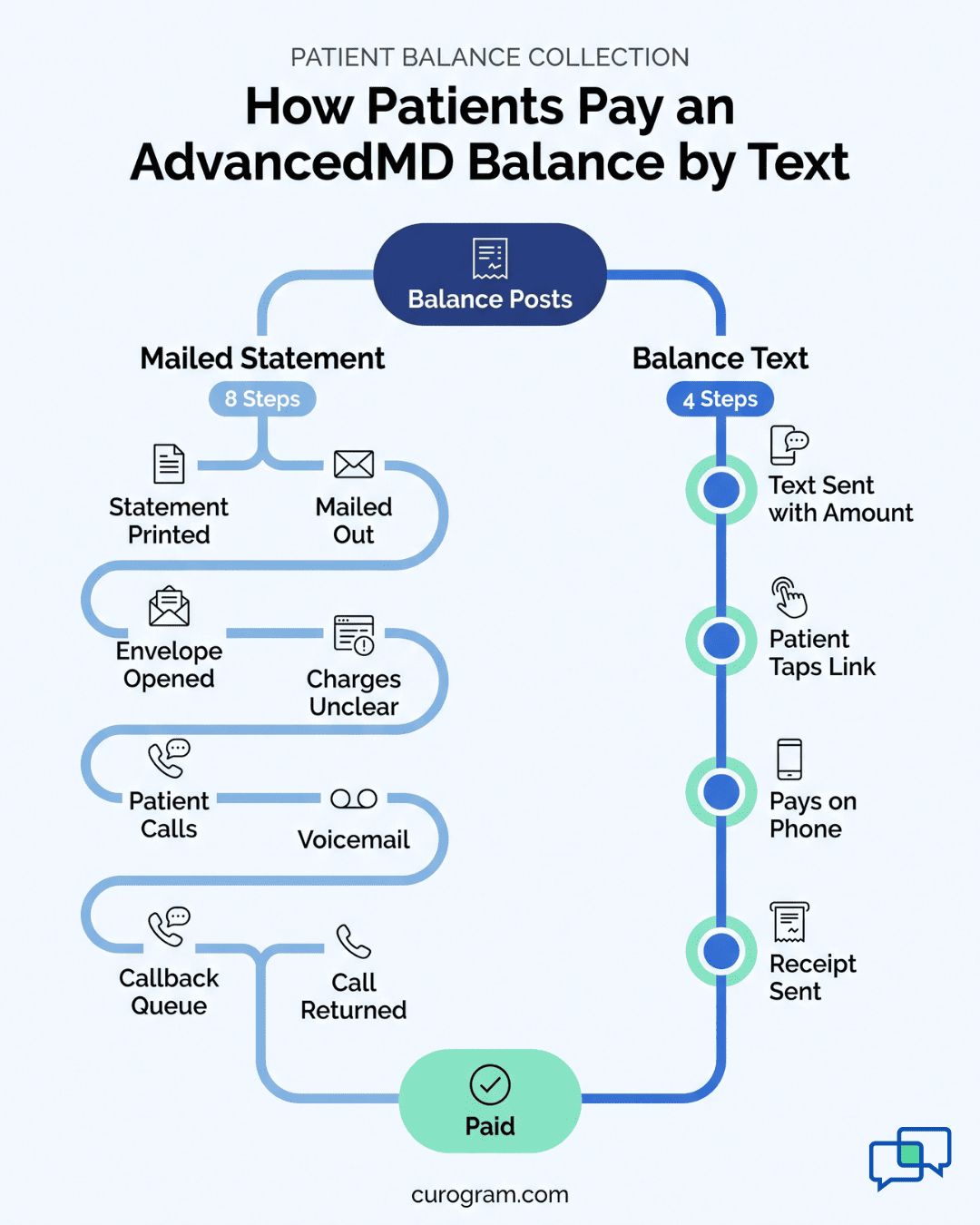
ake an illustrative $85 balance from a routine follow-up. Your office mails a statement at month end. On Friday, the patient calls with a question and reaches voicemail. That callback sits in a queue nobody works until Monday.

Balance Collection by Text

With text-to-pay, the same balance moves in four steps:

  1. Curogram picks up the open balance from AdvancedMD.
  2. A text goes to the patient with the amount and a secure payment link.
  3. One tap opens the payment page, and the patient pays with no portal login. The link works on any phone that can open a web page.
  4. A confirmation text goes out, and the request shows as paid in the Curogram dashboard.

If the patient has a question, they reply to the same text. Curogram's Smart Routing sends that reply to billing, so it doesn't pile up at the front desk. Nobody has to return a Friday voicemail on Monday morning.

All of this runs through our AdvancedMD integration. Balances, appointments, and patient details come from the same records your team already works in, so nobody types them twice.

Reminders That Hold Up Across 10 Providers

Ten providers means ten sets of visit types, prep steps, and cancellation habits. One reminder template can't serve a new-patient physical and a 10-minute med check with the same wording.

Three setup choices keep automated appointment reminders accurate at that size:

  • Reminder wording matches the visit type, so prep steps only reach the patients who need them.
  • Messages carry the right location, so a patient booked at your second office isn't sent to the first.
  • A manager assigns replies from a shared inbox, so "running late" lands at the front desk and "what do I owe" goes to billing.

Groups with several sites can see how this works for multi-location and large group practices.

Based on our internal data, Curogram clients average an appointment confirmation rate above 75%. Their no-show rates run 53% below the industry average.

Two client results show what that looks like at the practice level. Atlas Medical Center cut its no-show rate from 14.20% to 4.91% in three months. Covina Arthritic Clinic averages more than 1,100 confirmed appointments a month through automated confirmations.

Two-lane infographic showing how AdvancedMD practices collect patient balances by text in four steps

Statements That Actually Get Read

Timing drives collections in a billing-heavy practice. A text sent within 72 hours of the visit can name the date and the amount while the patient still remembers the appointment:

"Hi Maria, your balance from your March 4 visit with Dr. Patel is $85. Tap to pay securely: [link]"

A paper statement mailed on the 30th reaches the patient weeks later. It often lists procedure codes most people can't read, and paying means finding a website or calling in. By then, the visit is a blur.

Curogram lets your billing team attach a PDF of the bill or the EOB to the text. Patients can check the charge first, which heads off the "what is this for?" call. If the link sits unopened, an automated reminder follows, so your team isn't tracking who still owes by hand.

Across five daily workflows, the add-on and Curogram line up like this:

Workflow

AdvancedMD Patient Engagement add-on

Curogram + AdvancedMD

2-way texting

Two-way platform added in the Fall 2024 release

Two-way texting from your office number, synced with AdvancedMD patient data

Shared inbox with assignment

Dashboard for calls, texts, and leads; confirm assignment rules with your rep

Shared inbox with manager assignment and Smart Routing by department

Balance collection by text

Text and email bill-pay reminders tied to the ePayments portal

Text-to-pay links with the bill or EOB attached, plus automated follow-ups

Google review automation

Post-visit survey; 1 to 3 star patients aren't invited to Google

Review request sent to every patient after the visit

Missed-call follow-up

Tracks calls and voicemails; confirm missed-call auto-texts with your rep

Missed Call to Text and Voicemail to Text


Who Should Stay on the Add-On

Some AdvancedMD practices should keep the add-on and skip the switch. We'd tell them so on a sales call.

Two Cases for Staying Put

The first is a practice already inside an AdvancedMD bundle discount. AdvancedMD sells its full software set as a discounted bundle. If Patient Messaging is already in yours, paying for a second texting tool makes little sense.

Single-provider practices with low message volume make up the second group. One doctor and a few dozen texts a week don't need department routing or bulk balance requests. Reminders and group texts from the add-on cover that load.

The Number That Settles It

Every other AdvancedMD practice should decide with one figure: the count of patient balances over 60 days that your team chased only by phone.

That figure measures work your staff is already doing by hand. Each of those accounts stands for at least one call, and often a voicemail that never got returned.

It also points you to the tool that matters most. If the phone-only list is long, your biggest gap sits in collections, and reminders alone won't close it. Your billing manager already has the data to check.

The 60-Day Balance Exercise

Pull the number in four steps:

  1. Run your patient aging report in AdvancedMD and filter to patient-owed balances older than 60 days.
  2. Count the accounts and note the total dollars.
  3. Check the notes on each account, and mark the ones worked only by phone calls or mailed statements.
  4. Divide the phone-only count by the total.

Take an illustrative case. A three-provider practice finds 180 accounts over 60 days, worth $21,600. Notes show that 126 of them got only calls and statements. That's 70% of the aging list running on phone tag.

Share chased only by phone

What we'd do

Under 25%

Current follow-up is working; the add-on may be enough

25% to 50%

Price balance texting next to reminders

Over 50%

Make balance texting the first line you price, from any vendor


Leaving Klara Without a Gap

Setting up AdvancedMD patient texting after Klara comes down to timing. Your new texting line should be live before the old one shuts off. Plan it that way, and no reminder batch goes unsent and no patient reply lands in a closed inbox.

The Move, Briefly

Our guide on how to switch from Klara to Curogram has the full steps, and they hold for AdvancedMD practices. Before you open it, find two dates in your Klara agreement: the term end date and the deadline for a non-renewal notice.

Miss the notice deadline, and an auto-renew clause can lock in another term. Put both dates on the billing manager's calendar today.

The First Call to Make

Your first call goes to your billing manager. Ask for the 60-day count from the exercise above, since it frames every talk with a vendor after this.

Next, confirm what Curogram reads from your system on the AdvancedMD integration page linked above. If you run other tools next to AdvancedMD, check them against our EMR and EHR integration directory.

After that, size the reminder side with the no-show ROI calculator. Bring both numbers to an AdvancedMD-specific demo, and we'll map them to your actual schedule and billing queue.


Conclusion: Choosing a Klara Alternative for AdvancedMD Practices

AdvancedMD and Klara both have new controlling owners since late 2024. A practice that has now worked under four AdvancedMD parents has good reason to keep its patient texting portable, with its own contract and its own export rights.

We'd let the aging report make the call. Every vendor in this comparison sends reminders. Balance texting is where the tools differ most for an AdvancedMD billing office, and it's the work your staff is doing by phone right now.

If the phone-only list is short and your bundle already covers messaging, keep the add-on. Save the switching work for something that pays back.

If the list is long, that backlog is money your team is chasing one voicemail at a time. Book an AdvancedMD-specific demo with Curogram. Bring your 60-day count and your Klara end date. We'll show you how reminders, text-to-pay requests, and reply routing would run on your AdvancedMD schedule.

Frequently Asked Questions

How does Curogram connect with AdvancedMD, and what data syncs?

Curogram connects through our AdvancedMD integration. Patient details and appointment data come from AdvancedMD, so reminders reach the right patient and incoming texts match the right record. Intake forms that patients complete flow back into their records. Payment requests line up with your billing and scheduling data, while your team keeps charting and billing in AdvancedMD.

How do Curogram and AdvancedMD's patient portal split the work?

The portal stays in place for patients who like it, with records, statements, and portal messages. Curogram adds a text channel from your office number for quick contact, such as reminders, balance links, and short questions. Patients who never log in still get reached. Staff answer every text from one shared inbox, and nothing about the portal has to change. 

How does Curogram's cost compare with the AdvancedMD patient messaging add-on?

Neither publishes a public price, so any figure you find online is a guess. Compare scope instead, and ask each vendor what's priced per provider, what's priced per location, and what can change at renewal. Then run your schedule through the no-show ROI calculator. Bring that number to a demo, and you'll get a quote built on your own provider count. 

Why does AdvancedMD's ownership history matter when choosing a texting vendor?

AdvancedMD has had four owners since 2011, and each renewal after a sale follows the terms of the owner at that time. With an independent texting layer, your reminders, balance requests, and message history don't hinge on how a future owner packages its add-on. Ask any vendor how you'd export your message history if the product changed hands. 

What should a billing manager bring to an AdvancedMD-specific demo?

Bring the count of patient balances over 60 days and the share your team chased only by phone. Those two figures show whether balance texting should lead the decision. Add your Klara term end date and its non-renewal deadline, since they set how long both systems can run side by side. A sample reminder and a sample statement help too. 


Klara Alternative for athenahealth | Curogram

1 min read

Klara Alternative for athenahealth | Curogram

💡 The best Klara alternative for athenahealth practices does two things. It writes back into athenaOne. And it isn't owned by a company that sells...

Read More
Curogram vs Klara: A Clinical Workflow Automation Guide

1 min read

Curogram vs Klara: A Clinical Workflow Automation Guide

💡 Curogram and Klara both support medical practices, but they are built for different scopes of work. Klara is a messaging-first platform designed...

Read More
Klara or Curogram: Which One Fits Your Practice

1 min read

Klara or Curogram: Which One Fits Your Practice

💡 Curogram vs Klara comparison patient communication questions almost always end at one place: the EMR already running your schedule. Klara is...

Read More