9 min read

Klara Alternative for athenahealth | Curogram

Klara Alternative for athenahealth | Curogram
💡 The best Klara alternative for athenahealth practices does two things. It writes back into athenaOne. And it isn't owned by a company that sells a rival EHR. Curogram meets both tests.

ModMed bought Klara in February 2022. It sells Klara today as ModMed Patient Engagement, powered by Klara. athenahealth launched its own agentic messaging on February 19, 2026, with Patient Conversations, Waitlist Scheduling and an Intelligent Patient Assistant.

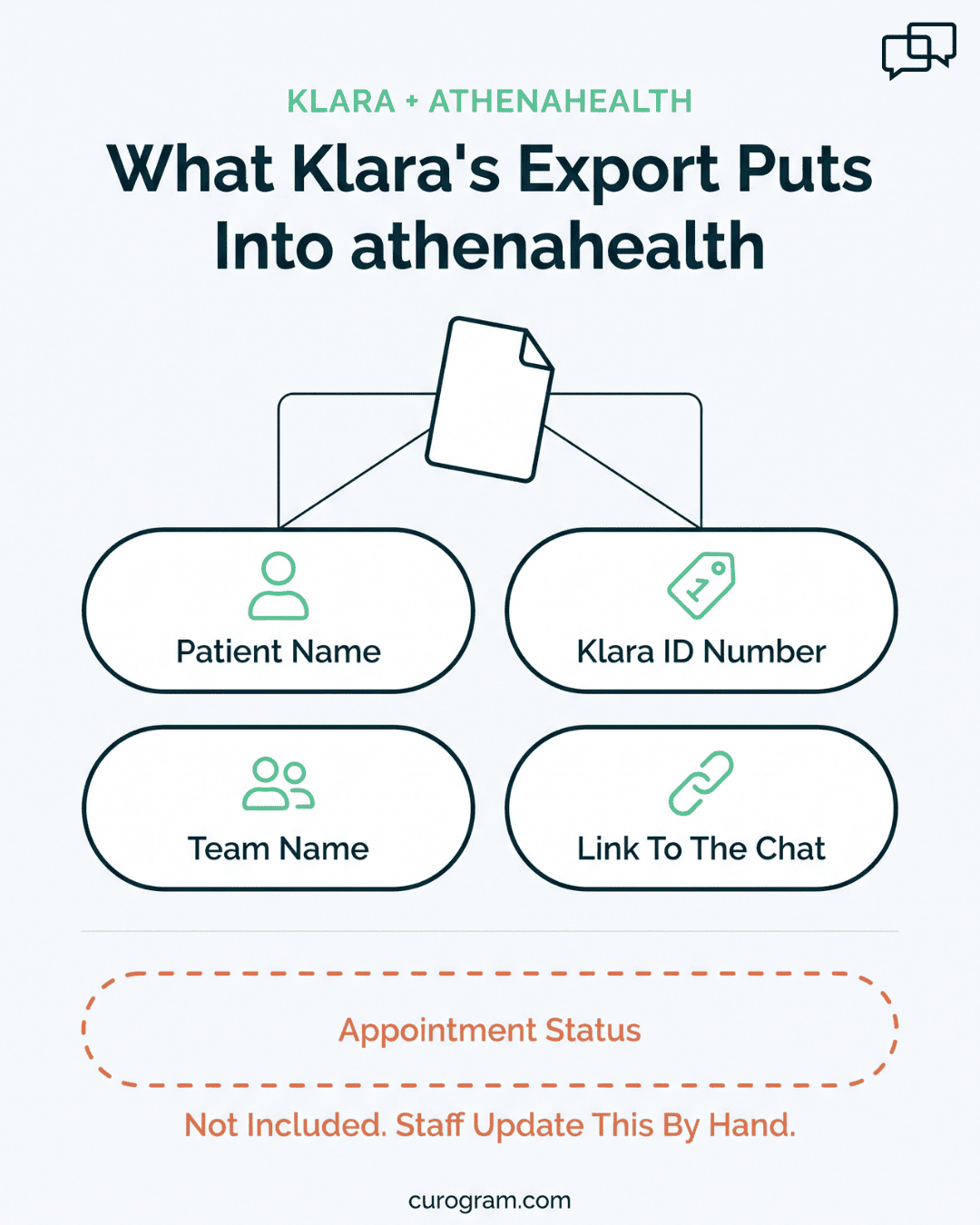
Klara's published athenahealth workflow exports a chat link into athenaNet, and slot status is not part of that export.

Curogram runs through the athenahealth Marketplace. A patient's confirm reply updates the slot on your athenaOne schedule. Curogram clients average a confirmation rate above 75%, based on our internal data. If the new athenaOne tools already cover your messaging, measure for 30 days before you buy.


Count the systems that can text one patient about one appointment at an athena practice running Klara. athenaOne sends the reminder. Klara carries the thread your staff answers. Your athenaPatient app pings the same patient about the same visit.

Two of those three show up as line items on your budget. Only one can change an appointment status on your schedule without a person typing it in.

Check your own bill. If athenaOne messaging is switched on for your tablet and Klara still invoices you monthly, you're buying two-way texting twice.

Both sides of that stack moved. ModMed bought Klara in February 2022 and sells it today as its own patient engagement product. athenahealth announced agentic text and voice tools inside athenaOne on February 19, 2026.

So an athena practice running Klara now pays two companies for messaging. Neither one counts athenahealth as its first-choice EHR. A Klara alternative for athenahealth practices has to clear a narrower bar than a general one: write-back into athenaOne, and no ownership by a company selling a rival chart system.

If you're weighing this outside the ModMed world entirely, our wider look at Klara alternatives for non-ModMed practices covers that ground.

One claim runs underneath everything below: integration depth follows commercial interest. You can check that claim yourself, and we'll point at where to look.

The Messaging Layer You Are Paying For Twice

athenaOne has sent appointment reminders for years. The athenaPatient mobile app handles records, lab results and balances. On February 19, 2026, athenahealth added far more.

What athenaOne Already Sends

Patient Conversations brings two-way texting and secure web chat, with a handoff to staff that keeps the thread's context. Waitlist Scheduling spots a cancellation and texts patients to fill the slot.

An Intelligent Patient Assistant lands in the portal and the athenaPatient app for rescheduling and balance questions. Enhanced Patient Self-Scheduling lets a patient describe what they need in plain words.

Paul Brient, athenahealth's chief product and operations officer, framed it around AI assistants taking routine work off care teams.

Timing matters as much as the feature list. Texting was in alpha on announcement day, with broad release targeted for the first half of 2026. Voice, the Intelligent Patient Assistant and enhanced self-scheduling were all second-half items.

We found no general availability announcement for Patient Conversations texting as of this writing. Read your athenaOne release notes. Ask your account manager what is switched on for your tablet.

Why Practices Bought Klara on Top of It

Back in 2022, athenaOne patient communication ran through the portal. Someone with one quick question had to remember a password, wait on a reset email, then find the right thread. Most patients skipped it. They called instead, and your front desk absorbed every one of those calls.

Take a patient who needs to know whether to hold her blood thinner before Thursday's procedure. She texts her sister, her pharmacy and her dog groomer. She's not resetting a portal password to ask her doctor.

Klara sold directly against that. Real SMS from a number patients could reply to. A shared inbox so any staffer could pick up a thread. Web chat on the practice site.

For a practice buried in phone tag, it was worth a second line item.

Give the February 2026 release its due, because it narrows the gap. Patient Conversations puts two-way texting inside athenaOne, with the documentation trail already attached to the chart. No second login for staff. No sync job anyone watches on a Monday morning.

Availability is the open question. Phased rollouts reach practices at different times, and yours might still be waiting.

Portal Opens versus Text Replies

Pull two numbers for the same 30 days before you argue about platforms.

First, the open rate on portal messages your practice sent. Second, the reply rate on text reminders across that same window. Set them side by side and the argument settles itself, in whichever direction your data points.

Plenty of practices can't produce both numbers. athenaOne reporting will give you portal message volume. A texting vendor should hand over delivery, reply and opt-out rates on request, broken out by campaign.

If one of those two takes a support ticket and a week to produce, note the delay. You'll be asking for that number every quarter.

What Changed on Klara's Side

ModMed bought Klara in February 2022. Klara is sold today as ModMed Patient Engagement, powered by Klara, next to ModMed's own EHR for dermatology, ophthalmology, orthopedics and gastroenterology.

ModMed Sells an EMR. athenahealth is an EMR

None of this is a scandal. It's what acquisitions do. Your messaging vendor now belongs to a company whose flagship product competes with athenaOne for the same practice.

We don't know ModMed's roadmap and won't pretend otherwise. Priority order is the fair question. When a ModMed customer and an athena customer file the same request in the same week, which one gets scheduled first?

For a feature-by-feature look, our Curogram vs Klara head to head sets the platforms beside each other. Klara reviews on G2 are worth a scan too, filtered to practices your size.

What That Means for athena Write-Back

Our claim here is mild and checkable: integration depth follows commercial interest. Vendors build their deepest connections into the systems that bring them customers.

So ask a specific question about your own setup. Is your Klara-to-athena connection a validated Marketplace integration, or a general-purpose API feed?

Klara's own athenahealth help docs lay the workflow out plainly. Staff link a Klara patient to an athenaNet profile. They pull demographics with an Update From EHR action. Then they press Export to push a conversation into athenaNet.

That export carries the patient's name, a Klara ID number, the team name and a link back to the thread.

Read that list again for what isn't on it. A Klara athenahealth integration replacement has to close that one gap. Slot status changes when the patient replies, with nobody clicking Export.

Curogram Inside an athenahealth Workflow

Trace one loop end to end. Tuesday's 2:15pm slot sits on the athenaOne schedule. A reminder goes out 24 hours ahead from your own practice number. The patient replies C, the slot status changes, and nobody at the front desk types a thing.

Where the Data Lands

Curogram Two-Way Texting runs that loop through the athenahealth Marketplace integration. Curogram reads appointments and patient data from athenaOne, sends plain SMS from your practice number, and posts the outcome back. Patients install nothing. Patients log in to nothing.

Late in the day is where this usually breaks. A reply lands at 4:52pm, the desk has closed out, and the thread sits in an inbox nobody owns until Wednesday. By then the slot has either held or gone quiet, and you find out at 2:15.

Write-back takes that dependency out for confirmations and cancellations. A reply changes the status whether or not a person reads it that evening. Staff keep the clinical threads and anything needing judgment, which is where you'd want their attention anyway.

Our athenahealth integration page lists what connects and what posts back. For setup detail, see our pages on HIPAA-compliant 2-way texting and automated appointment reminders, plus the full EMR and EHR integration directory.

The 3-Vendor Problem

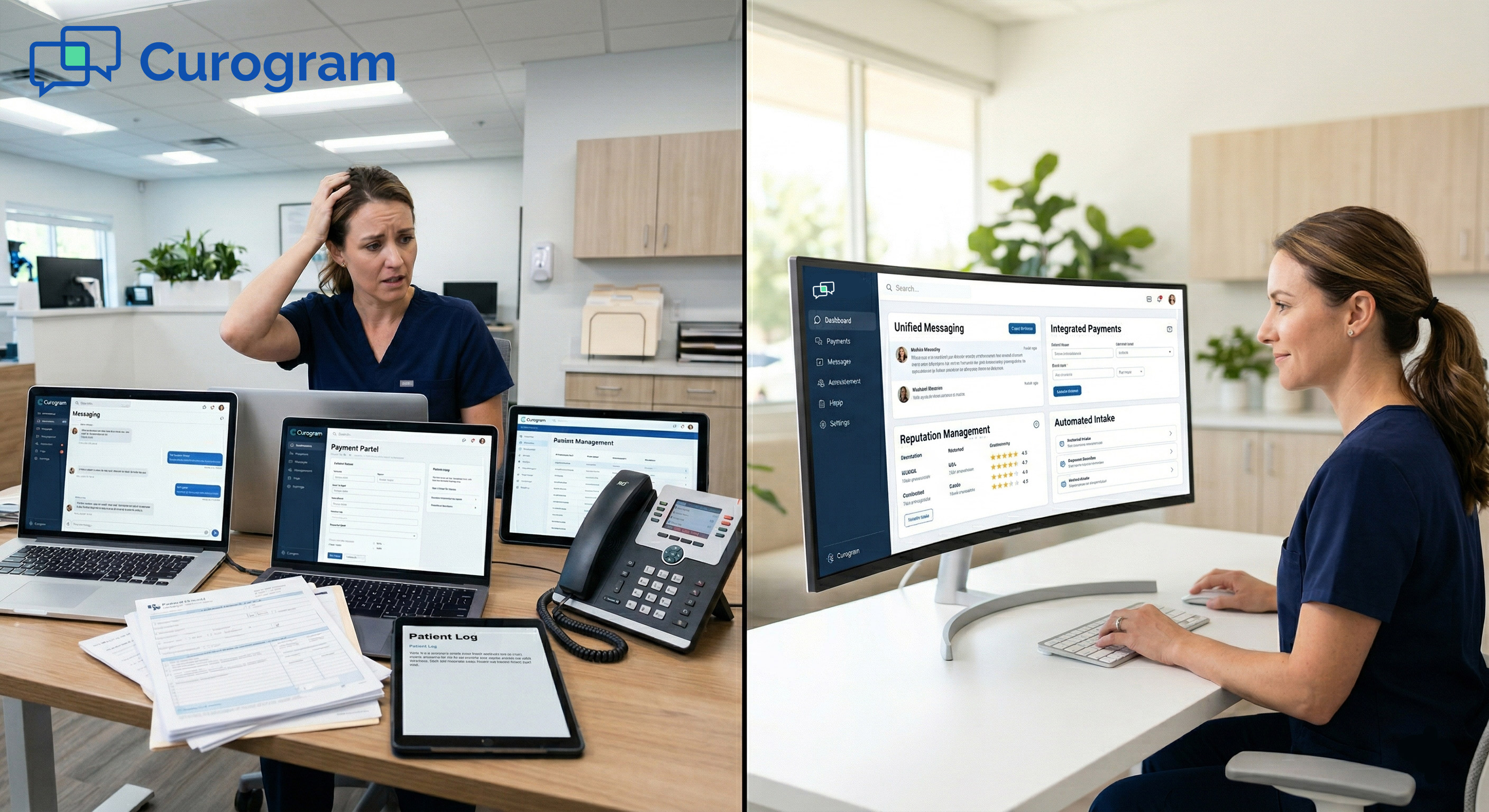
Price out the alternative honestly. Reminders from one vendor, review requests from a second, text-to-pay from a third. Three contracts, three BAAs, three logins, three renewal dates that never line up. Your administrator then has to match up three reports that count patients differently.

One platform collapses that stack. The thread that confirms Tuesday's visit carries Wednesday's payment link and Thursday's review request.

Three figures from our client base, all based on our internal data. Confirmation rates average above 75% across Curogram practices. Front desk teams save 2 to 3 hours a day that used to go to reminder calls.

On SMS recall campaigns, 35% of patients who got a recall text booked within a month. That came to 1,240 patients seen at one multi-location practice.

Covina Arthritic Clinic confirms more than 1,100 appointments a month through automated reminders, with replies handled as they arrive.

Diagram of what Klara's athenahealth integration syncs and the appointment status it leaves blank

Reporting Your Administrator Can Actually Read

Three reports do most of the work at a mid-size athena practice.

Confirmation rate by provider tells you which reminder template needs rewriting. Usually the gap traces to one provider's appointment type rather than the whole practice.

Reply volume by hour decides whether you staff the desk until 6pm or route evening replies to a named person. Whatever share of replies lands after 5pm is the real size of your after-hours problem.

No-show rate before and after is the number your administrator carries into the renewal talk. Atlas Medical Center moved from 14.20% to 4.91% in three months, based on our internal data. Run that chart monthly and a bad template shows up in week two instead of quarter two.

Workflow

athenaOne native

Curogram + athenaOne

2-way texting

Patient Conversations, phased through 2026; voice in the second half

Live now from your practice number, no patient login

Appointment confirmation write-back

Built in, thread sits inside athenaOne

Marketplace integration updates the slot status

Google review requests

Not in the February 2026 engagement release

Post-visit ask to every patient, no rating filter

Text-to-pay

Balance questions via Intelligent Patient Assistant, second half of 2026

Payment link in the same thread as the reminder

Missed-call follow-up

Voice assistant for inbound calls, second half of 2026

Missed call triggers an automatic text back


Who Should Not Switch

Two kinds of athena practice should stay put, and we mean it.

Two Practices We Would Tell to Wait

First: a practice whose messaging need the February 2026 release already covers. Take a three-provider internal medicine office at 60 visits a day. No recall program, no mass outreach, no separate payments tool. Patient Conversations inside athenaOne will handle that once it reaches you.

Second: any practice inside the first 90 days of an athena implementation. Appointment types are still being rebuilt, provider templates are still moving, and staff are learning a new schedule view. Stacking a messaging layer on top adds a second learning curve during the worst month to have one.

Primary care practices in both situations call us, and we tell them the same thing. Not yet.

What to Test Before You Decide

Any athenahealth two-way texting platform should clear three checks before you sign.

Does a patient reply actually change the schedule? Send a test reminder to a staff phone, reply with the confirmation code, then open that slot in athenaOne and look at its status. Do it yourself. A demo recording doesn't count.

Who owns the after-hours thread? Name a person and a cutoff time. Without both, ownership defaults to whoever opens the inbox first the next morning, and that's how a Friday cancellation becomes a Monday no-show.

What happens to consent records at renewal? Opt-in and opt-out history belongs to your practice. Ask for it in writing, in an exportable format, before the contract is signed rather than after.

A 30-day Test You Can Run Before Deciding

Run the athenaOne tools properly for 30 days first. Call your account manager and ask which February 2026 features are live on your tablet. Availability has been phased, and practices got them at different times.

Then measure three things across those 30 days. Portal message open rate. Text reply rate on reminders. No-show rate against the same month last year.

Planning athenahealth patient messaging after Klara gets much easier with those three numbers in hand. If no-shows drop and evening replies get handled, you have your answer and you saved a contract.

If the no-show line stays flat, you'll know which part of the loop broke. That turns your next demo into a talk about your data instead of a feature tour.


Moving Off Klara Without a Gap

Moving off Klara without a service gap takes about two weeks of overlap. You run both platforms briefly.

The Short Version

Port your number so patients keep texting the one they already know. Carry consent records across so nobody starts from zero.

Our guide to switching from Klara to Curogram covers porting timelines, consent migration and the order for shutting off old reminders.

Settle one thing early. Pick the date your Klara reminders stop and put it in writing with both vendors. Overlap on the inbox is fine for a couple of weeks. A single date has to govern reminders, so no patient gets two texts about one visit.

Starting Point

Start with our athenahealth integration page, which lists what connects and what posts back to the schedule. Then book a demo built around an athena workflow rather than a generic one.

Bring your own numbers. Portal open rate, text reply rate and no-show rate for the last 30 days. A demo built on three real numbers from your practice runs very differently from a feature tour.

Before any of that, run one check tomorrow. Open the athenaOne schedule at 4:45pm and count how many of the next day's appointments still sit unconfirmed. Write the number down, then count again after 30 days on whichever tool you pick.


Conclusion: Making the Call

Two companies are selling messaging into your athena practice right now. ModMed owns an EHR that competes with athenaOne. athenahealth is shipping its own tools on a phased calendar you don't control.

A platform that connects to athenaOne sits outside both problems. It posts confirmations back to your schedule and sells nothing that competes with your chart system.

Book an athenahealth-specific demo and bring your last 30 days of no-show data. We'll run your numbers against what write-back changes. If the answer is that you should wait, we'll say so.

Frequently Asked Questions

How does Curogram post appointment updates back into athenaOne?

Curogram connects through the athenahealth Marketplace integration. It reads appointments and patient data from athenaOne and sends reminders from your practice number. Confirmations and status changes post back to the schedule. A patient who replies to confirm or cancel updates the slot directly. Our athenahealth integration page lists what connects.

Why can a practice keep athenaPatient and add texting at the same time?

The two cover different jobs. athenaPatient holds records, lab results and balances, which patients open when they want to look something up. Texting handles the fast loop: confirm, reschedule, cancel, ask one question. Keeping both means nobody has to log in for a 10-second answer.

What is the current support status of Klara for athenahealth practices?

Klara is still sold and still supported. ModMed markets it as ModMed Patient Engagement, powered by Klara, and athenahealth practices keep using it. The argument on this page is about roadmap priority and integration depth. Support has not been withdrawn, and any claim that Klara is being discontinued would be false.

How should a practice tell a validated integration from a generic API feed?

Ask for the Marketplace listing, then test the write-back yourself. Send a reminder to a staff phone, reply to confirm, and check the slot status in athenaOne. A validated connection changes that status. A general feed usually creates a note or a document link and leaves the schedule alone.

Why do text replies reach the schedule faster than portal messages?

A text arrives with no password, no app and no reset email in between. Patients reply from the same screen they use for everything else. Portal messages wait on a login many patients never finish. The reply comes late, or it turns into a phone call your front desk answers.