12 min read

Klara Alternatives for Medical Practices (2026)

Klara Alternatives for Medical Practices (2026)
 💡 The strongest Klara alternatives for medical practices in 2026 are Curogram, OhMD, Spruce Health, Weave, and Artera. Curogram lists 70+ EMR and PM connections and adds Google review requests, patient recalls, and text-to-pay to the same inbox.

OhMD publishes 85+ EHR connections and an AI voice agent, with plans from $300 a month. Spruce Health starts at $24 per user and pairs a full phone system with texting, though its named EHR syncs are Athenahealth, Elation, and Hint. Weave posts $249 a month per location and runs deepest in dental and eye care. Artera serves health systems on several EMRs at once.

Klara remains strong for ModMed, athenahealth, and Nextech practices. One detail drives most switches: with Klara, the EHR interface is a paid add-on.

Klara sells the EHR link as a separate purchase. Its own setup guide says so. New customers are walked through requesting an API key from Nextech, Athenahealth, or ModMed EMA.

Skip that add-on and you upload a patient list instead. First name, last name, date of birth, mobile number. By hand.

One line in a help article explains most searches for Klara alternatives. Your EMR decides how much of a platform you get to use. Whether the sync is bundled decides what you pay for it.

With no live read of your schedule, reminders become a manual export each morning. With no write-back, every text thread turns into a copy-paste job for whoever sits closest to the desk.

Our stance is blunt. Match the platform to your EMR and your site count first, then compare feature grids.

A tool with 40 features you can't switch on loses to a plain one that pulls tomorrow's schedule at 6 p.m. and texts patients at 7.

What follows: five options ranked by who they fit, each with one limit drawn from the vendor's own help pages. Then a side-by-side table. Then a worked example for a six-site group on eClinicalWorks, and a list of what to export before you cancel.

We build one of these platforms, so read our block with that in mind. Every rival claim here comes from that vendor's own site, help center, or press release, or from a verified reviewer profile. Estimates are labeled as such.

Why Practices Look Beyond Klara

Klara handles two-way texting well, and switching costs are real. Something specific usually triggers the search.

Klara After the ModMed Acquisition

ModMed acquired Klara in 2022. It now sells as ModMed Patient Engagement, powered by Klara, alongside ModMed's specialty EHR.

The deepest interface runs into ModMed's EMA. Klara has been public about wanting broader reach. A 2022 post on its own blog states the goal of working no matter which EHR or PM system a practice uses, and describes an interface with Greenway Health for practices on Intergy.

Product direction still tracks ModMed's specialty roster, which centers on skin, gut, bone, eye, and surgical care. Ask where your specialty lands on that roadmap before your next renewal.

What Klara Does Well

Give the incumbent its due. Call-to-text turns a ringing phone into a message thread, which is the best trick in this category. Voicemail transcription lands in the same thread. Web chat, self-scheduling, and video visits round it out.

Staff like it. Software Advice reviewers rate ease of use at 4.8 out of 5, with an overall score of 4.6. G2 named Klara a top healthcare product in its 2025 Best Software Awards.

Klara also ships a Chrome extension that lets staff view any web-based EHR next to Klara in one window. Its help center names Practice Fusion and EMA for that feature.

The EMR Question Settles Most of It

Practices hunting for a Klara EMR integration alternative usually share one blocker. Their system isn't among the named interfaces, or the interface costs extra.

Say your six sites run eClinicalWorks. With no sync, someone pulls a schedule report each afternoon, cleans the phone column, and uploads it by hand. Call it 20 to 30 minutes a day.

It breaks the first week that person takes vacation. Reminder sends drift. Confirmations stop landing in the chart.

Published coverage is where the field separates. OhMD advertises 85 or more EHR connections on its site. Curogram publish 70 or more. Spruce names 3 EHR partners and routes everything else through links or its API.

Pricing You Can't See Until You Talk to Sales

Klara publishes no rates. Capterra's profile lists no plan pricing, so every number comes from a quote. Outside trackers estimate $125 to $450 per user each month.

Across a 40-seat front office, that spread runs from roughly $5,000 to $18,000 a month. Budget approval gets hard when the range is that wide. Spruce, OhMD, and Weave each publish a starting number. Klara, Artera, and we do not. Knowing which camp a vendor sits in tells you how long your buying cycle will run.

Quote-only pricing has a fair reason behind it. Practice size, site count, and message volume really do change what a vendor charges. Ask for your number early and in writing, then ask what triggers an increase at renewal.

Reviews and Recalls Usually Live in a Second Tool

Google drives new patients. Based on our internal data, 90% of new patient leads look at a practice's Google Business Profile before the website. One multi-site client of ours collected 1,064 new five-star reviews in three months. About 90% of surveyed patients left five stars.

Recalls work the same way. Based on our internal research, 35% of patients who got an SMS recall booked within a month. That brought 1,240 people back for care.

ModMed's site describes post-visit surveys that encourage online reviews while letting less-satisfied patients send private feedback.

Any survey configured that way, on any platform including ours, deserves a look from your compliance lead. The FTC rule on consumer reviews, 16 CFR Part 465, took effect on October 21, 2024 and covers review suppression.

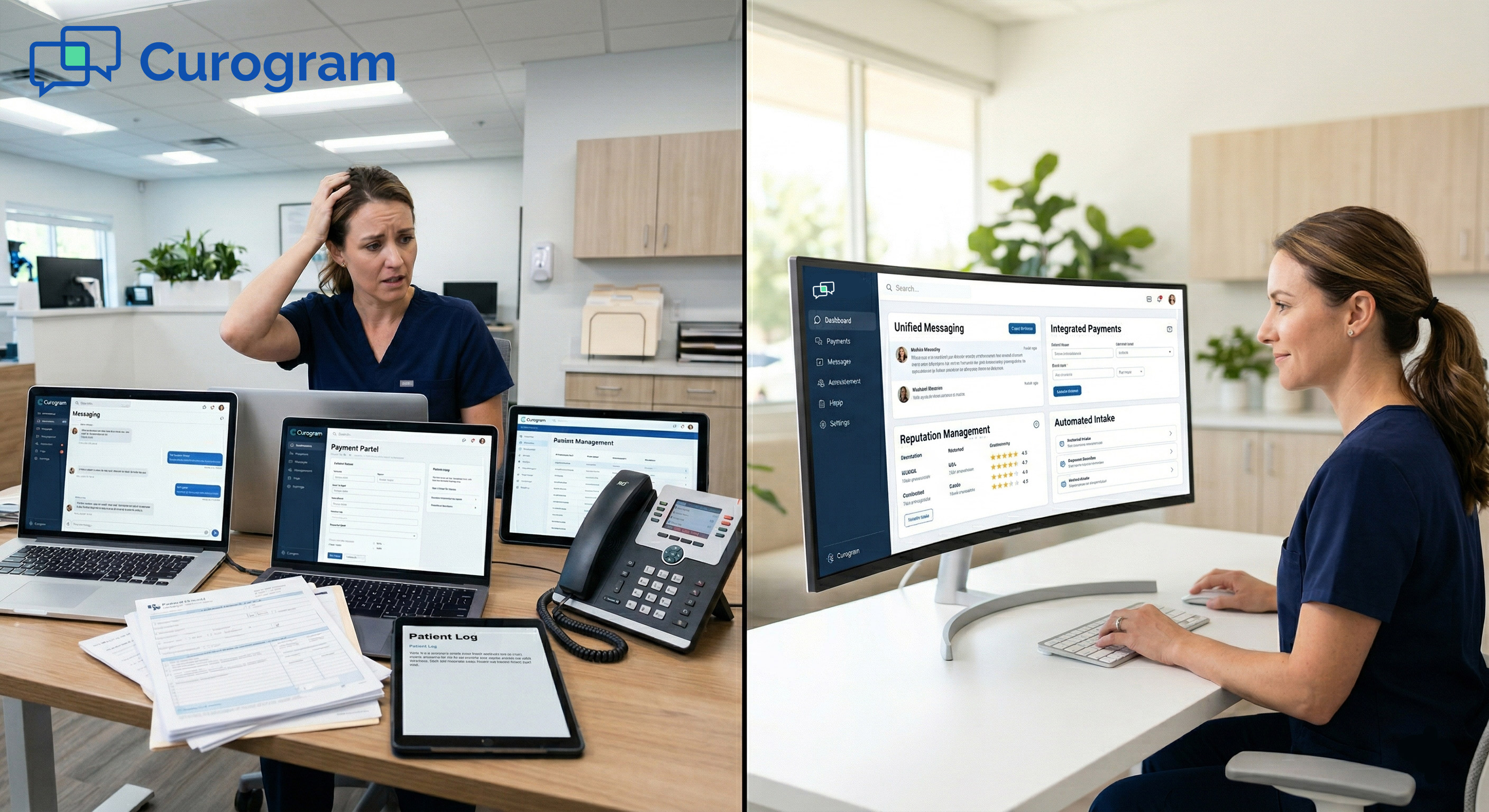
Chart comparing staff hours lost to manual EMR work against the price difference between patient texting platforms

5 Klara Alternatives Worth a Demo Slot

The Klara competitors below all handle medical texting. They differ in what rides along with it, and in who they were built for. Integration claims come from each vendor's own site.

Curogram: Best for Outpatient and Multi-Site Groups on Any EMR

We publish 70 or more EMR and practice management connections. We build them four ways: API, HL7, direct database, and a proprietary method for systems that offer none of those.

Named syncs include eClinicalWorks, Tebra, Elation, Office Ally, Veradigm, GE Centricity, NextGen, Oracle Health, Practice Fusion, Meditab IMS, CureMD, Osmind, and Medstreaming. We connect with Athenahealth, ModMed, and Greenway too, so we don't win the coverage point everywhere.

Most practices go live in under two weeks. There's no long-term contract.

Two-way texting sits next to reminders, digital forms, telemedicine, text-to-pay, mass messaging, recalls, and Google review requests. Based on our internal data, our clients average above a 75% confirm rate. No-show rates run 53% below the industry average.

OhMD: Best for Practices Drowning in Inbound Calls

OhMD leads with Nia, its AI voice agent. Nia handles routine scheduling and refill calls before staff pick up.

Their site reports 40,000+ providers and 85 or more EHR connections. Named ones include Athenahealth, eClinicalWorks, NextGen, Veradigm, ModMed, Elation, DrChrono, AdvancedMD, Nextech, Healthie, and Office Practicum.

Published plans start at $300 a month for Communicate and $500 for Automate. Custom pricing sits above that.

Honest limitation: Patient call automation is billed apart from the Automate plan, so $500 isn't your ceiling. Reviewers on Capterra name cost as their main gripe, and one wrote that they found more features elsewhere for less.

Spruce Health: Best for Small Practices Replacing Phones and Texting Together

Pricing is public and low. Basic runs $24 per user each month, Communicator $49, with a 14-day trial and no card required. Calls, texts, fax, voicemail, video, and phone trees sit in one app.

For a four-person direct primary care office, that bundle is hard to beat. Spruce announced an Athenahealth integration in 2026, joining its existing Elation and Hint syncs.

Honest limitation: Those three are the only named EHR partners. Spruce's own help center says any other EHR is handled through links or formatted copy and paste. The other route is their public API, which needs a developer on your side and the Communicator plan. The Elation sync needs Communicator too.

Weave: Best for Dental, Optometry, and Small Medical Offices

Weave trades as WEAV on the NYSE and reports more than 39,000 healthcare locations. Phones, texting, reminders, forms, payments, and review requests land on one bill. Call Pop shows patient history when the phone rings, and front desks like it.

Pro starts at $249 a month per location. Elite, Ultimate, and Enterprise are quote-only.

Honest limitation: Pro caps bulk texting at 1,500 messages a month, which a single full-panel recall can burn through. Independent reporting puts one-time setup at $500 to $750. Pricing is per location, so six sites multiply the bill before you add a tier.

Artera: Best for Health Systems Running Several EMRs

Artera was WELL Health until 2022. Its December 2025 announcement reports more than 1,000 provider groups and about 2 billion patient messages a year.

Oracle Health and MEDITECH both white-label it inside their own products. Federal customers include the VA, the Department of Defense, and Indian Health Service sites.

Messages go out over SMS, email, IVR, and web chat in more than 100 languages. FHIR and HL7v2 interfaces come standard.

Honest limitation: Enterprise scope brings enterprise timelines and enterprise cost. Outside trackers estimate entry near $20,000 a year, rising with site count, and that figure is illustrative. A five-provider clinic pays for capacity it never uses.

Klara Alternatives Compared Side by Side

Six platforms, one table. Published figures only, taken from each vendor's own site.

Platform

Best fit

Published start price

Priced by

Published EMR reach

Klara

ModMed, Athenahealth, Nextech

By quote

Per user

Named interfaces, sold as an add-on

Curogram

Outpatient and multi-site groups

By quote

Per practice

70+ systems, four connection methods

OhMD

High inbound call volume

$300 per month

Flat plus add-ons

85+ systems

Spruce Health

Practices under about 10 seats

$24 per user/month

Per user

3 named partners, plus API

Weave

Dental, optometry, small medical

$249 per month

Per location

Dental and optical systems

Artera

Health systems on several EMRs

By quote

Enterprise

FHIR and HL7v2, major systems


Three pricing models hide in that table, and they rank the field differently at every size. Per user punishes headcount. Front desk, nurses, billing, and providers all need logins, so a 40-person group pays 40 times.

Per location punishes site count. A single office loves it. Six sites hate it.

Flat pricing looks cheapest until you read the add-on line. OhMD's Automate plan is $500 a month, with call automation billed on top.

One more column belongs on your version: message volume caps. Weave's Pro tier allows 1,500 bulk texts a month. A flu-season blast to 4,000 patients clears that in one send.

Quote-based pricing hides the question until you're three calls deep. Ask for the number in writing before the second demo, and ask what the renewal rate looks like.

A Worked Example: 6 sites, 42 seats, eClinicalWorks

Run your own math before you shortlist. Here's how it lands for a 6-site primary care group with 42 front desk and clinical seats on eClinicalWorks.

Two of the cheapest options fail first. eCW isn't among Klara's named interfaces, and Spruce names only Athenahealth, Elation, and Hint, so both would need manual imports or custom API work.

That leaves OhMD, which publishes an eClinicalWorks sync, and us. Weave can text, though its integration depth sits with dental and optical systems, so a primary care group gains less from the bundle.

Price only matters after that filter. Spruce Communicator would run $2,058 a month at 42 seats and Weave Pro $1,494 across six sites, but both numbers buy a workflow with a manual step in it.

Cost the manual step, too. Thirty minutes a day per site across six sites is about 66 staff hours a month, which outweighs most of the monthly gaps above.

Five Questions That Break a Tie

  1. Which of your EMRs does the vendor sync today, in production, not on a roadmap?
  2. Is the integration included, or is it a separate line item?
  3. What writes back to the chart: message threads, confirmations, form responses, payments?
  4. What does it cost at your real seat count and site count, with add-ons listed?
  5. What go-live date will they put in the contract?

Question two catches more people than any other. Ask it before the pricing conversation, since the answer changes the number.

Write the answers in a shared doc as you go. Sales calls blur together after the third vendor, and question three is the one people misremember. A rep saying "yes, it works with eCW" and a rep saying "yes, threads write back to the eCW chart" are answering different questions.

Question five deserves extra weight for multi-site groups. Rolling out six offices at once rarely works. Ask for a per-site sequence with a date against each location, then hold the vendor to the first one.

Keep the demo recordings if the vendor allows it. Six weeks later, when the build looks different from the pitch, a recording settles the discussion faster than anyone's notes.

Practice leaders comparing patient texting platforms using a printed EMR coverage chart in a back office

Klara vs Curogram vs Spruce: Matching Platform to Practice

Three names show up in most shortlists, and they solve different problems. Here's how we'd sort them:

Stay on Klara If You Run ModMed

Deep interfaces cost a lot to rebuild, and Klara already has them for those three. Call-to-text and voicemail transcription pull real phone volume into threads. Ease-of-use scores are among the best in the category.

A dermatology group on EMA has little to gain by moving. Renegotiate instead. Bring the published starting prices from Spruce, OhMD, and Weave to your renewal call. Then ask whether the EHR link can be folded into the base rate.

Choose Curogram When Coverage and Scope Both Matter

Our published list runs to 70+ systems across four methods. That includes direct database work for platforms with no usable API. Setup runs under two weeks for most practices.

Scope is the other half. Reminders, forms, telemedicine, text-to-pay, recalls, and Google review requests come in one platform. You won't bolt a review tool onto a texting tool and read two reports.

Based on our internal data, Atlas Medical Center cut no-shows from 14.20% to 4.91% in three months. Covina Arthritic Clinic now confirms more than 1,100 appointments a month.

Pick Spruce for a Small Practice Already on Elation or Hint

Three conditions have to line up: under about ten seats, running one of the three named EHR partners, and replacing your phone system at the same time. Miss one and the case weakens quickly.

Check the tier before you price it. Basic runs $24 per user, but the Elation sync and the public API both require Communicator at $49. Forty-two seats on that tier costs $2,058 a month.

G2's Spruce reviewers are 99.1% small business, so multi-site references are thin. Spruce also doesn't market review generation or recall campaigns, which means a second vendor later if reputation work matters to you.

Behavioral health teams should ask about bulk messaging limits before signing. Group and intensive outpatient programs push a lot of schedule-change texts through in a single send.

How the Three Compare

Question

Klara

Curogram

Spruce

Published price

No

No

Yes, $24 to $49 per user

Published EMR reach

Named interfaces

70+ systems

3 named partners

Integration bundled

Sold as an add-on

Included

Included on Communicator

Phone system included

No

No

Yes

Review and recall tools

Surveys

Built in

Limited

How to Switch from Klara Without Breaking the Front Desk

Migration risk is mostly clerical. Handle four things and the rest is training.

Export Before You Send the Cancellation Notice

Ask in writing for your message history, patient opt-out list, message templates, saved replies, and automation rules. Do it while the account is active and paid.

Vendors have no duty to hand you an export after the term ends. Your opt-out list matters most. Texting someone who opted out carries real legal weight under the TCPA, and that list doesn't travel by itself.

Give yourself 30 days between the export request and your notice date. Most contracts auto-renew on a fixed notice window, so check that date before booking demos.

Protect the Number Patients Already Text

Front desks underestimate this one. Patients save the texting number in their phones. A silent change means messages land nowhere, and nobody tells you for weeks.

Ask both vendors, in writing, whether the number can transfer. Then start A2P 10DLC brand and campaign registration early. Carrier approval can take days to weeks, and nobody texts at volume until it clears.

Run Two Weeks in Parallel

Keep both platforms live for one full billing cycle. Send reminders from the new system. Keep the old inbox open for stragglers.

Watch three numbers daily: delivery rate, confirmation rate, and inbound replies nobody answered. That third one catches routing gaps before patients notice them.

Confirmation rate matters most. Based on our internal data, above 75% is a healthy target for automated reminders. Anything under 50% means your reminder timing or your phone data needs work.

Retrain the Front Desk in 10 Minutes

Front desk turnover makes long training a recurring tax. Our staff training runs about ten minutes, because the inbox looks like the texting app people already use.

Ask each vendor how many minutes it takes. Then ask them to prove it in the demo, using a staff member who has never seen the tool.

One more thing worth scheduling: a 30-day check-in with the front desk after go-live. Ask what they've stopped using and why. Features nobody touches by day 30 rarely get adopted later.


Where Curogram Fits When You Leave Klara

Curogram EMR Integration is the reason most Klara refugees call us. We publish 70 or more EMR and practice management connections. We build them four ways: API, HL7, direct database, and a proprietary method for systems offering none of those.

What syncs matters as much as whether it syncs. Patient names, phone numbers, appointments, providers, and site data flow into Curogram. Message logs push back to the chart, so nobody retypes anything.

Setup takes under two weeks for most practices. We don't require a long-term contract, and staff training runs about ten minutes.

Results come from work that runs unattended. Based on our internal data, Atlas Medical Center dropped no-shows from 14.20% to 4.91% in three months. Covina Arthritic Clinic confirms more than 1,100 visits a month.

Across our client base, confirmation rates average above 75%. No-show rates sit 53% below the industry average, and practices report a 10% to 20% revenue lift from slots they used to lose.

Alternatives to Klara for patient communication often stop at messaging. We add reminders, digital forms, telemedicine, text-to-pay, mass texting, recalls, and Google review requests in one place. Multi-site groups stop paying four vendors.

Live support runs 5 a.m. to 5 p.m. Pacific, by phone and email.


Conclusion: Choosing your Klara Alternative

Klara earns its place for ModMed, Athenahealth, and Nextech practices, and we'd tell you to stay if that's you. Everyone else is buying around a named interface list, or paying extra for the one connection that makes the rest work.

Sort your shortlist by published EMR reach first. Then ask whether the sync is bundled. Then price it at your real seat and site count.

OhMD wins when calls are the bottleneck. Spruce wins small, on Elation or Hint. Weave wins in dental and eye care. Artera wins at health system scale.

We win on breadth and on scope, when your EMR needs a direct database connection and you want reviews, recalls, and payments in the same inbox as your texts.

Whichever way you go, ask for a named live customer on your exact EMR. That one question sorts shipping integrations from roadmap promises faster than any feature grid.

Schedule a demo now and bring two things: your EMR name and your site count. We'll show you the sync running on your system, walk through what writes back to the chart, and give you a go-live date you can hand to your administrator.


Frequently Asked Questions

How do we know whether a Klara alternative really supports our EMR?

Ask for a live client on your exact EMR and version. Then ask to watch that sync on a screen share. A working link proves more than a marketplace badge or a roadmap slide.

Why does it matter whether an EHR integration is bundled or sold separately?

A seat price can look cheap until the EHR link shows up as its own line item. Klara's setup guide treats that link as a purchase, so ask early where yours sits.

How long should a switch from Klara actually take?

Plan 4 to 6 weeks. Exports and carrier sign-off eat the first two, setup runs about two more, and a parallel billing cycle catches whatever broke quietly while nobody was watching. 

What should outpatient practices ask about write-back before signing?

Find out what lands in the chart: text threads, confirms, form answers, payment receipts. Some tools push data out well and write back by copy-and-paste, which leaves staff doing the filing. 

Why do review and recall tools matter when comparing Klara competitors?

Buying texting alone usually means adding a review vendor later. Based on our internal data, 90% of new patient leads check your Google Business Profile first, and SMS recalls brought back 35% of overdue patients.

Curogram vs. Klara: Automation ROI vs. Walled Garden Cost

Curogram vs. Klara: Automation ROI vs. Walled Garden Cost

💡 When comparing patient communication tools, the subscription fee rarely captures the full cost. For practices outside the ModMed ecosystem,...

Read More
Curogram vs Klara: A Clinical Workflow Automation Guide

Curogram vs Klara: A Clinical Workflow Automation Guide

💡 Curogram and Klara both support medical practices, but they are built for different scopes of work. Klara is a messaging-first platform designed...

Read More
Switch from Klara to Curogram: Complete Migration Guide

Switch from Klara to Curogram: Complete Migration Guide

💡 Switching from Klara to Curogram is about more than changing a messaging tool. Most practices using Klara also rely on separate vendors for...


Read More