9 min read

Klara or Curogram: Which One Fits Your Practice

Klara or Curogram: Which One Fits Your Practice
💡 Curogram vs Klara comparison patient communication questions almost always end at one place: the EMR already running your schedule. Klara is owned by ModMed. If you run the ModMed EHR, Klara writes back to it first and best.

Run any other EMR, and Curogram is the platform built for that job. It connects to a long list of systems and bundles reminders, two-way texting, review requests, text-to-pay and recalls in one contract.

Neither company publishes public pricing. Both require a demo. Start by naming your EMR out loud.

You sit through two demos in the same week. Both platforms text patients. Both send reminders. Both handle forms and video visits.

Both reps answer every question well. By Friday, you are no closer to a decision.

Here is the shortcut.

The Curogram vs Klara comparison patient communication buyers really need comes down to one question: which EMR runs your schedule right now?

If the answer is ModMed, Klara is usually the stronger buy. ModMed owns Klara and builds to its own system first. If the answer is any other EMR, Curogram exists for exactly that situation.

That settles it for most practices. Everything after this is detail.

The reason it feels harder comes down to how both products get sold. Feature lists are written to look complete. Two-way texting, automated reminders, digital forms, telehealth: both check every box.

So teams end up comparing screenshots, message counts and demo polish. None of those predict what happens on a Tuesday morning at your front desk.

Meanwhile the decision sits. Staff keep calling patients one by one. No-shows keep eating slots you already paid for, and every week of delay costs real money.

A practice losing 40 appointments a month is not standing still while it deliberates. It is losing them again next month, at the same rate, for the same reason.

This page is built to end that stall fast. You will get the EMR question first, then a row-by-row table you can check against public sources. After that comes a walk-through of one real front desk moment where the two platforms behave differently.

You will also get the numbers we can stand behind and the compliance facts on both sides. Then two questions worth asking every vendor before you sign anything.

Pricing is handled elsewhere, and we link you there.

Your EMR Settles This Before Any Feature Does

The one question that decides it

Do you run ModMed?

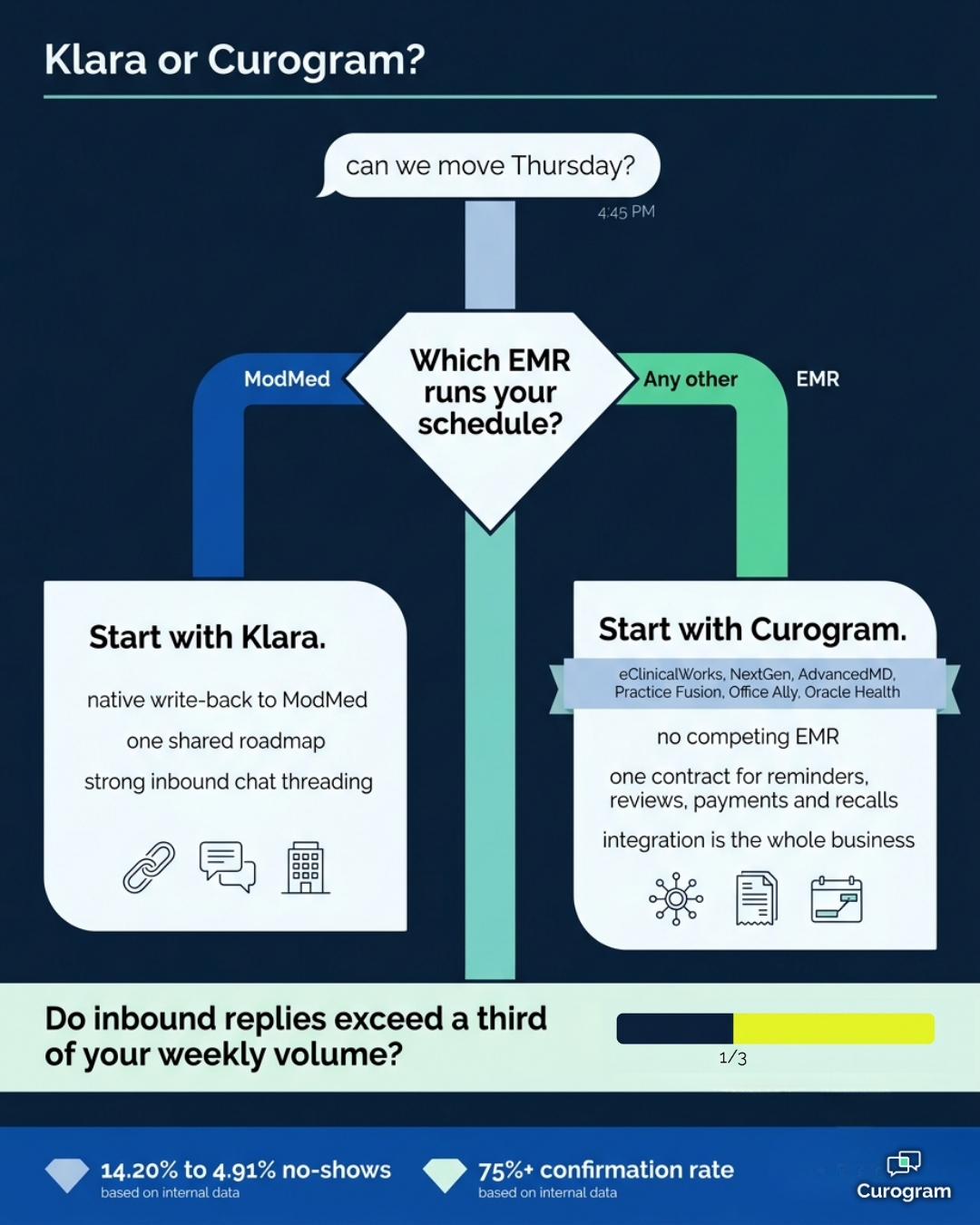
If yes, start with Klara. ModMed acquired Klara in 2022, and the product now ships as ModMed Patient Engagement, powered by Klara. Messages, intake details and text payments flow straight into the ModMed patient record without a nightly cleanup pass.

If no, start with Curogram. Curogram does not sell an EMR, which means every integration is a customer relationship rather than a competing product line. Practices on eClinicalWorks, NextGen, AdvancedMD, Practice Fusion, Office Ally, Oracle Health and dozens of others fall here.

That is the branch. If you want to see how the two platforms handle the connection itself, how the two integration architectures differ goes deeper. Still building a vendor list?

The wider Klara alternatives shortlist is the better starting point.

Why the feature lists look identical

Both platforms do two-way texting. Both send automated reminders. Both handle digital intake forms.

Both offer telehealth. We are not going to pretend otherwise.

The difference sits underneath all of that, in which EMR the write-back is certified against and who controls the product roadmap.

Here is what that means at the desk.

A patient texts back "YES" to confirm a Thursday appointment. In a certified write-back, the appointment status changes in the schedule within seconds, and nobody touches it again.

Without that, the reply lands in a message inbox. Someone reconciles it against the schedule by hand at 5pm.

Same feature on the brochure. Two very different Thursdays.

The second question: how often do your patients reply?

The EMR question decides most cases. This one decides the rest.

Pull one week of message volume and count what share came from patients rather than from your automations. That single number tells you a lot about which platform will feel right.

If inbound replies run above roughly a third of your total volume, your team lives inside conversation threads. Thread quality matters most there, and Klara is strong at it.

If inbound sits well below that, your volume is outbound and automated. Breadth of automation matters more than thread design, and one platform covering reminders, reviews, payments and recalls will save you more time than a better inbox.

That threshold is our own operating rule of thumb from working with practices, not a published industry statistic. Use it as a starting line, not a law.

Curogram and Klara, Line by Line

The rows worth checking

Any Klara comparison texting platform shoppers run will surface the same handful of features.

Two-way texting, reminders, forms, telehealth:

Everyone has them, so listing them again helps nobody.

The table below focuses on rows that actually change the answer. Every one is checkable from a public source or from our own site.

  Curogram Klara
Owner Curogram, Inc., independent ModMed, acquired 2022
Sells a competing EMR? No Yes, the ModMed EHR
Named EMR integrations Published list covering eClinicalWorks, NextGen, AdvancedMD, Practice Fusion, Office Ally, Oracle Health, ModMed and more ModMed EHR first, plus a published interface list for other systems
Two-way texting Yes Yes
Automated reminders Yes Yes
Google review automation Built in Post-visit surveys that can prompt reviews
Text-to-pay Built in Text payments through ModMed Patient Engagement
Public pricing Not published Not published

Third-party profiles are worth a look too. Klara reviews on G2 and Klara on Capterra both list pricing as vendor-quoted only, which matches what you will find on either company's site.

Reading the table honestly

Two rows go to Klara for the customer it was built to serve.

Native write-back to the ModMed EHR is the first. Nobody interfaces with ModMed better than ModMed does. The second is provider-to-patient chat threading, which Klara has invested in heavily and which practices with heavy inbound messaging genuinely like.

The rows where breadth matters run the other way. Review automation, text-to-pay, recalls and missed-call capture all ship inside one Curogram contract.

Assembling that same set around a messaging-first platform usually means two or three vendors. That is two or three invoices, two or three support queues, and two or three renewal dates to track. Ask any office manager who has done it which part they hated most.

The ownership row deserves one more beat. When your vendor also sells an EMR, your integration competes internally with their own product. That is not a scandal, just a fact of how roadmaps get prioritized.

Searches for Curogram vs Klara features pricing weld two questions together. This page answers the features half. For the cost side, our full Klara and Curogram pricing comparison does the work properly.

Decision tree showing Klara for ModMed practices and Curogram for other EMR systems

What Your Front Desk Notices First

The 4:45pm reschedule test

A patient texts at 4:45pm: "can we move Thursday to next week?"

Trace that message. With certified write-back, a staff member opens the thread, offers an open slot pulled live from the schedule, and the patient picks one. The appointment moves inside the EMR. Done before 4:50.

Without it, the message sits in a separate inbox. Someone reads it, switches to the EMR, hunts for the Thursday slot, moves the appointment, switches back, and replies.

That context switch is the step that costs you. Repeat it 30 times a day and you have burned close to two hours of staff time.

At six minutes saved per reschedule and 30 reschedules a day, that is roughly 60 hours a month back. This is an illustrative calculation, not a measured result. The shape of it will be familiar to anyone who has watched a closing shift.

More detail on that mechanic lives in clinical workflow automation compared and in how automated appointment reminders get configured.

Reviews and recalls, or a second contract

Now the two jobs that quietly decide your quarter.

Post-visit review requests and overdue-patient recalls both ship inside Curogram. One platform, one bill, one place to check results. With a messaging-first product, review generation and recall campaigns are usually a separate purchase from a separate company.

The results are worth the line item. Based on our internal data, one multi-location practice generated 1,064 new five-star reviews in three months, with 90% of surveyed patients leaving five stars.

On recalls, 35% of patients who received an SMS recall booked an appointment within a month. That worked out to 1,240 patients seen from recall messages alone.

For your team, that is 1,240 visits that would not have existed otherwise. See healthcare reputation management for how the review side gets set up.

Results We Can Put Our Name To

Two figures we stand behind

Atlas Medical Center cut its no-show rate from 14.20% to 4.91% in three months. That is a 65% drop, and it came from automated reminders and confirmations rather than more phone calls.

Across current Curogram clients, average appointment confirmation rates run above 75%. Both figures come from our internal data and case study records.

Here is what that means in money. Say a practice loses 40 appointments a month to no-shows at $150 each.

That is $6,000 a month, or $72,000 a year. A 65% reduction recovers about $3,900 a month, close to $47,000 a year.

Those dollar amounts are illustrative and will move with your specialty and payer mix. Run them against your own numbers with the no-show ROI calculator before you trust any vendor's math, including ours.

Compliance, on both sides

Curogram maintains SOC 2 Type II certification, operates under HIPAA, and executes a BAA with every client. Details sit on our SOC 2 Type II and HIPAA compliance page.

One honest detail most vendors skip: standard SMS is not encrypted anywhere, on any platform. Reminders and confirmations are fine over plain text because they carry no clinical information.

Anything with a diagnosis, result or treatment detail moves through the secure portal instead. That rule applies to every texting vendor you talk to.

We are not claiming a compliance gap at Klara. We have no verifiable basis for one, and this comparison runs on facts. Ask both vendors for their BAA and their current audit report, then read the HHS HIPAA guidance for covered entities so you know what you are responsible for either way.

Two Questions Every Vendor Should Answer

Who picks up at 4:45 on a Friday

Ask both companies the same two questions, then compare the answers rather than the marketing.

First: is the support queue staffed by people who only handle healthcare accounts?

A generalist queue will not know what a rejected appointment write-back looks like in your EMR, and you will spend the call explaining your own problem.

Second: what is the written escalation path when messages stop flowing? Ask for it in writing, with named tiers and response times. A vendor who has one will send it in a day.

We are not going to answer these on Klara's behalf. We cannot verify their internal staffing, and guessing would make this whole page less useful to you.

What to ask about the roadmap

One more request, and it is the most revealing thing on this list.

Ask each vendor for the last three dated release notes that mention your EMR by name.

That request is specific, dated and answerable. If a vendor sells an EMR of its own, you learn quickly whether your system is on the build schedule or waiting behind it.

If a vendor sells no EMR, you learn whether your integration gets real engineering time or just a logo on a partner page. Silence is an answer too.

Either way, you learn more from those three documents than from any positioning we could write here.

How to Make the Call

The Klara or Curogram medical practice decision usually resolves in under a minute once the EMR is named. Here is the short version for both directions.

Klara is the better buy when

  • You run the ModMed EHR and want native write-back with no middle layer
  • Inbound patient messaging is most of your volume, so thread quality matters most
  • You are already inside the ModMed ecosystem for billing, analytics or payments

Those are real strengths. For a ModMed practice, they are hard to beat, and we would rather say so than waste your time.

Curogram is the better buy when

  • You run eClinicalWorks, NextGen, AdvancedMD, Practice Fusion, Office Ally, Oracle Health or any other non-ModMed system
  • You want reminders, review requests, text-to-pay and recalls under one contract instead of three
  • Your priority is filling empty slots, not only answering messages faster

Each of those maps to a workflow you can name. A confirmation reply that updates the schedule. A recall campaign that pulls back overdue patients. A payment link that clears a balance without a phone call.

If that list sounds like your practice, the next step is short. Get someone to run the workflow against your actual EMR and watch what happens.

Bring Your EMR Name to the Demo

Most patient messaging comparison work fails the same way. Teams line up features, find them nearly identical, and stall for weeks.

The faster path is the one this page opened with. Name your EMR first. Everything downstream gets easier.

Run ModMed, and Klara is likely your answer. The write-back is native, the roadmap is shared, and the ecosystem is already yours. We would rather tell you that than waste your afternoon.

Run anything else, and the math changes. You need a platform whose business depends on your EMR working well, not one whose parent sells a competing system.

That difference shows up in three places you can actually check. Release notes. Support queues. How quickly a rescheduled Thursday lands back in your calendar.

The results side is checkable too. Atlas Medical Center dropped no-shows from 14.20% to 4.91% in three months. Confirmation rates across our client base run above 75%.

One multi-location practice brought back 1,240 patients through SMS recalls alone. Those figures come from our internal data, and we will walk you through the underlying case studies on request.

Neither company publishes public pricing. That means a conversation is the only way either of us can quote you honestly, and any number you find online is secondhand.

Make that conversation specific. Come with your EMR name, your weekly message volume and your current no-show rate. Thirty minutes with those three numbers will tell you more than another month of feature grids.

Schedule a Demo and ask us to run it against your EMR. If the honest answer is that Klara fits your practice better, we will say so on the call. That is a strange promise for a vendor to make, which is exactly why it is worth something.


Frequently Asked Questions

Does Curogram integrate with ModMed?

Yes. Curogram connects to ModMed, so practices running it can use two-way texting, reminders, review automation and text-to-pay alongside their current setup. Details are on the ModMed integration page. Answering this honestly matters more to us than winning the argument.

How long does a Klara to Curogram switch take?

Most practices finish the move in a few weeks. Timing depends on your EMR and how much old message data you bring across. Our switch from Klara to Curogram guide walks through the sequence, the data checkpoints and what your team handles at each stage.

What does Curogram cost compared to Klara?

Neither company publishes pricing, so any figure you find online is secondhand. Both quote per practice, based on providers, locations and features. For a real breakdown, see the full Curogram and Klara cost comparison and our pricing article.

Does Klara work with EMRs other than ModMed?

Yes. Klara interfaces with other systems and has done so since before the ModMed acquisition. The question is depth, not existence. Ask for the last three dated release notes naming your EMR, then compare that against what you get on the ModMed side.

Do I have to replace my EMR to use Curogram?

No. Curogram sits alongside your EMR as a communication layer and does not replace it. Your schedule, charts and billing stay exactly where they are. Confirmations and intake details write back into the system you already run.