
5 Critical Rules to Remember When Texting Patients
 Joshua Inciso : 11/10/22, 12:56 PM
Discover how the 5 rules for texting your patients can improve your practice. Maintain proper and secure communication by implementing these rules.
6 min read

💡Transitional care texting runs to three fixed dates. Medicare wants two-way contact within 2 business days of discharge. The follow-up visit is due in 7 or 14 days. One more rule caps the program at three messages a week.
A patient goes home on a Friday with six new medications and a folder of printed sheets. By Monday, nobody has spoken to them. By Thursday, they are back in the emergency department.
Most transitional care programs are built around a cadence somebody invented. Day 2, day 5, day 14, and so on. There are real deadlines to build around instead. Two of them decide whether the work can be billed. One caps how much you may send.
This piece sets out those dates, what counts as contact, and how a 30-day texting program fits inside them. None of it is hard. It is mostly a matter of knowing which dates are fixed before anyone designs a cadence.
The walkthrough below is illustrative. No practice is being described, and no outcome figure here was measured anywhere.
Saying so matters, because transitional care writing is full of invented results. The deadlines in it are real and sourced. The schedule built around them is an example.
Medicare's transitional care management guidance was last issued in August 2025. It sets two of the three.
Interactive contact is due within 2 business days of discharge. The follow-up visit is due within 7 calendar days for code 99496, or 14 days for 99495. The third is the readmission window itself, which runs 30 days. Everything in a transitional care program sits inside it.
Those dates are fixed. A cadence that ignores them is doing unpaid work on the wrong schedule.
Day 1 brings a check that asks a question and waits for a reply. A medication prompt follows on day 3. The visit reminder goes on day 5.
Three messages. That is the ceiling for the week, and the next section explains why. Anything else the patient needs that week goes by phone from a named person, outside the automated run.
Friday discharges are where this breaks. Two business days from Friday is Tuesday, and the list is usually stale by then.
There is relief in the guidance for this. Two or more separate attempts, made in a timely way and documented, let you still report the service. Documented is the operative word. An attempt nobody wrote down did not happen.
CMS names phone, email, and face-to-face contact. Texting is not on that list. Worth stating plainly, since we sell texting. A one-way text going out is not evidence that contact happened.
What a practice can show is an exchange. The patient answered, a staff member read it, and the thread sits in the chart. Two-way texting is the shape that produces one. A broadcast does not, however many people it reaches.
Which is why the reply matters more here than anywhere else. Our write-up of two-way confirmation in Practice Fusion covers how the answer comes back.
A separate federal rule governs all of this. Part 64 of the FCC rules lists post-discharge follow-up intended to prevent readmission as a permitted purpose.
Permission comes with a cap. One message per patient per day, and three a week, counting calls and texts together.
A 30-day pathway with weekly check-ins, medication prompts, visit reminders, and symptom surveys goes over that in week one. Those are four separate features in most systems. Nobody adds them up, because no single one looks like a problem.
The same rule bars financial content. A balance, a copay prompt, or a collections notice cannot ride along on a transitional care message.
Length is capped too, at 160 characters for a text. Discharge instructions do not fit and should not be sent that way.
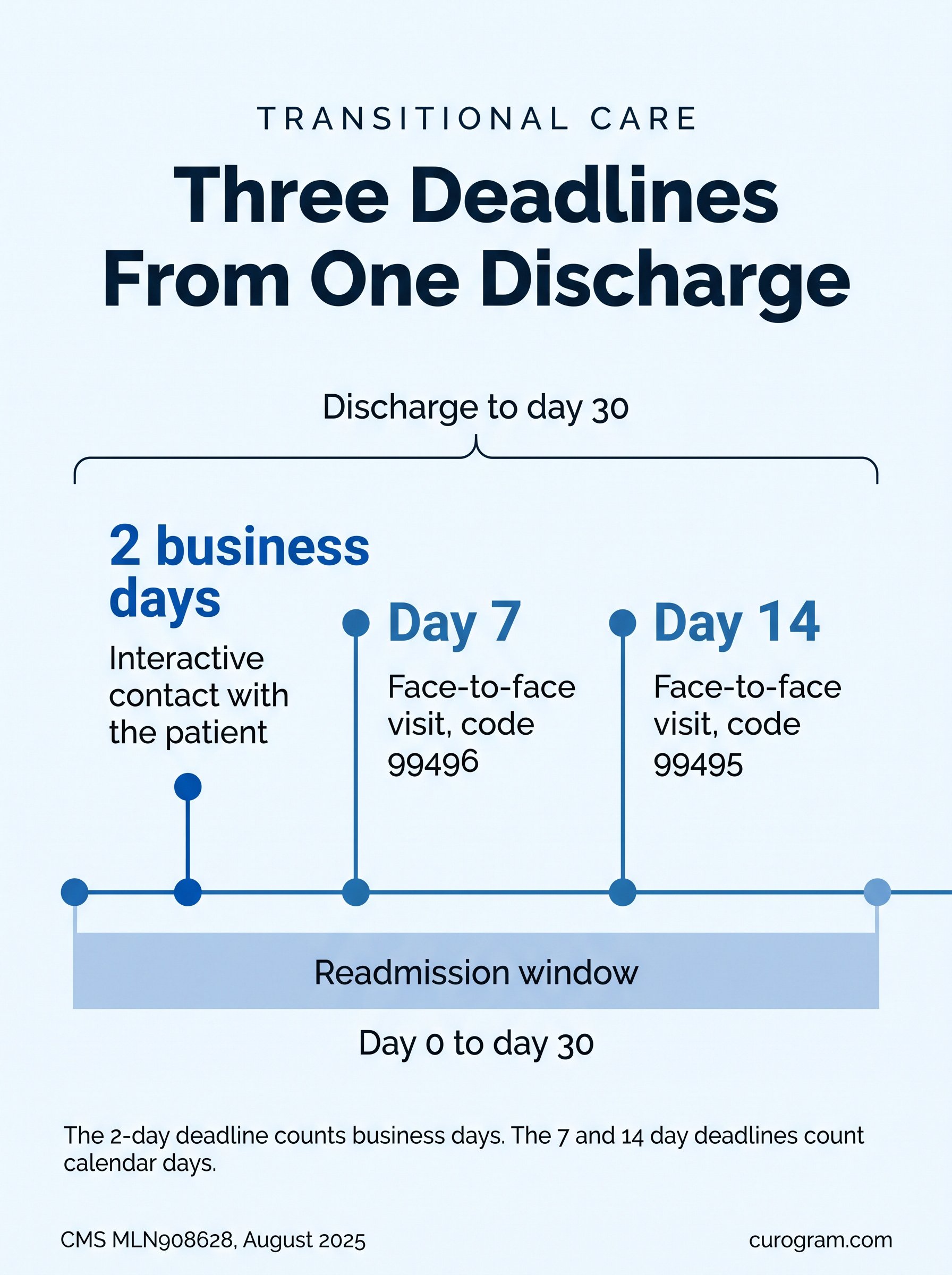
Contact within 2 business days starts the clock. Payment turns on the face-to-face visit happening in time. Seven days for 99496, 14 for 99495. A visit on day 15 is a visit, and it is not a billable transitional care visit.
So the reminder carries more weight after a discharge than it does in ordinary scheduling. Our piece on reminder systems in Oracle Health covers the mechanics.
A visit on day 15 is still worth having. It bills as an ordinary office visit instead. Which is usually the right call. The alternative is pushing a patient toward a slot that suits the code rather than the recovery.
Track the misses separately, though. A practice that keeps missing the window has a scheduling problem rather than a clinical one.
It has to land inside the window, carry a reply route, and get written back to the chart. A patient who cannot make day 6 needs an alternative on day 7, not an open slot three weeks out.
Which means the reschedule path has to know the deadline. Most reminder tools do not.
Send the prompt, take the reply, log it, flag the ones that need a person. Automation is good at all four. Escalation is the part that stays human. A patient reporting chest pain by text needs a call, not a workflow branch.
Transitional care billing rests on documentation. Date of discharge, date and nature of the contact, who made it, and what came back.
A thread sitting in a separate messaging tool is not in the record. It has to reach the chart to count.
Our writeup of secure patient communication in Office Ally covers the landing point. Messages end up where the billing team can find them.

Curogram HighlightCurogram's HIPAA-Compliant Texting keeps the whole exchange in one thread, tied to the patient record. Replies come back to the same inbox staff use for scheduling. Keyword routing moves urgent answers to a named person rather than a queue. |
Medicare's readmissions reduction program covers six conditions. Heart attack, COPD, heart failure, pneumonia, bypass surgery, and elective hip or knee replacement.
Payments can be cut by up to 3%. That applies to a hospital's whole Medicare inpatient payment, not to the readmissions alone. Practices sitting downstream of those hospitals feel it as pressure to get patients seen quickly.
Readmission has many causes, and a practice controls few of them. The follow-up visit happening on time is one it does control.
So attendance is the honest metric for a program like this. It is measurable weekly, and it sits upstream of the outcome everyone is chasing.
Claiming a texting program lowered readmissions needs a study. Claiming it raised attendance needs a report you already have.
Run that report two ways. Visits completed inside the window, and visits booked but missed. The second number is the one that moves first. It is also the one a reminder change shows up in within a fortnight.
Start by writing down the three dates for every discharge. Two business days, then 7 or 14 depending on the code.
Then count every automated message a discharged patient could receive in one week. Include reminders, recalls, results, and surveys. If that total is above three, decide what gets cut before adding a transitional care pathway on top.
Check that the two-day contact produces a reply you can point to. An outbound message with no answer is an attempt, and attempts have to be logged to count. Then give Friday discharges their own handling. They are the ones that miss the window, and they do it every week.
Pick one person to own the two-day list. Not a team, and not a queue, because both of those let a Friday slide to a Tuesday. Last, read the thread back. If the reply a patient sent is not visible to whoever bills the visit, the documentation is not finished.
Then book a Curogram demo to see the thread and the handoff in one pass.
 Joshua Inciso : 11/10/22, 12:56 PM
Discover how the 5 rules for texting your patients can improve your practice. Maintain proper and secure communication by implementing these rules.
 Joshua Inciso : 5/16/22, 7:47 AM
Convenience is key when it comes to patient engagement. Here are 10 reasons you need to tap into the power of technology - and online scheduling.

Learn how two-way SMS can streamline telehealth, boost patient communication, and ensure HIPAA compliance for your care practice with an actual case...