8 min read
Reducing Revenue Leakage with 2-Way Reminders | Curogram
Aubreigh Lee Daculug
:
April 29, 2026
Curogram's intelligent SMS reminders pair this timing with 2-way confirmation and real-time updates to Cerner Millennium.
Patients reply to confirm, cancel, or reschedule in one tap.
The result: no-show rates drop from 14.2% to under 5%, call center volume falls 70%, and clinical staff see at-risk appointments 24+ hours in advance.
Picture a Monday morning at a 40-location health system running on Cerner Millennium.
Three exam rooms sit empty. Two providers wait for patients who never show. Front desk staff are on the phone, scrambling to fill the gaps.
It sounds avoidable. It isn't — not with the reminder tools most health systems are using today.
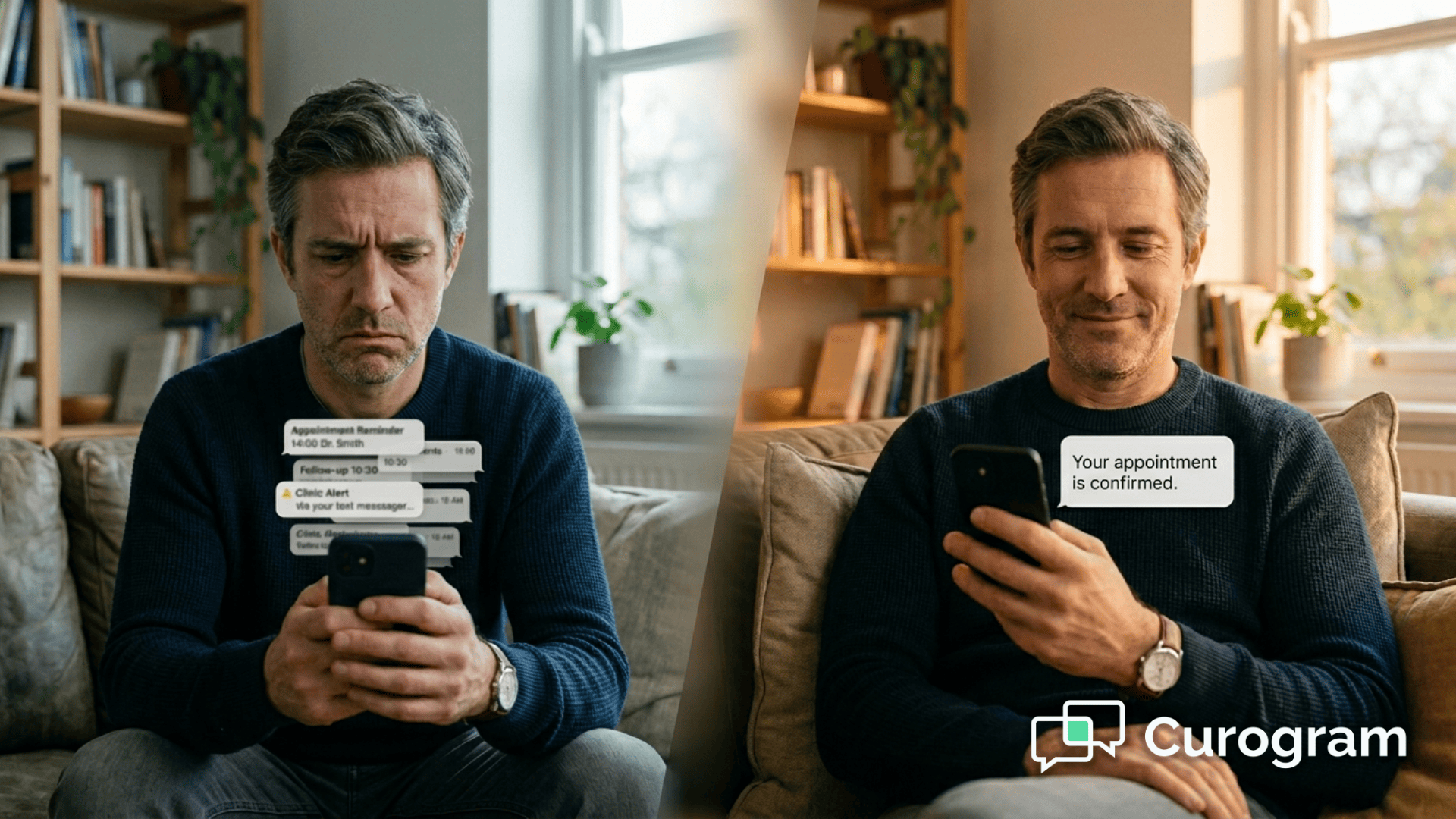
Here's the frustrating part. Those patients did get a reminder. They got it 24 hours ago, along with four other reminders from four other clinics. They deleted it without reading.
This is reminder fatigue, and it's quietly costing Oracle Health customers millions. The average no-show rate in large health systems sits around 14%.
For a system doing 25,000 appointments a year at $150 each, that's over $500,000 walking out the door every single month.
Now think about this.
What if your reminders knew the difference between a routine follow-up and a pre-op appointment? What if patients could confirm with one tap, and your Cerner schedule updated in real time? What if clinical staff could see which patients were likely to no-show 24 hours before it happened?
That's the shift from generic SMS blasts to intelligent reminders.
And it's what separates a $3 million annual loss from a $3 million annual recovery.
This guide walks you through why traditional reminders fail, how smart appointment reminders work inside Oracle Health, and what the real numbers look like for medical practices and health systems ready to stop bleeding revenue on empty chairs.
Let's get into it.
Why One-Size-Fits-All Reminders Are Falling Short
The Reminder Fatigue Problem Nobody Talks About
The average patient gets 5–8 appointment reminders per month from different sources:
- Primary care check-ins
- Specialist follow-ups and lab visits
- Preventive screenings and imaging
- Pharmacy refill alerts
All of them say roughly the same thing. All at roughly the same time. All with no way to respond.
HealtheLife's built-in reminder engine follows this same pattern. It fires off a 24-hour SMS, then a 2-hour SMS, regardless of whether the appointment is a 15-minute follow-up or a 4-hour infusion. A routine check-up gets the exact same treatment as a knee replacement pre-op.
Patients stop reading. The reminders become noise.
And here's the kicker. Most of these reminders are one-way broadcasts. There's no "Can you make it?" No "Reply 1 to confirm." Just a notification your patient swipes away on the way to work.
Clinical Teams Flying Blind Until It's Too Late
Walk into any scheduling office using Cerner's native tools and ask a simple question:
Which of tomorrow's appointments are at risk of no-showing?
Nobody can answer. Not really.
Cerner's scheduling system marks every appointment as "Scheduled" until the patient either arrives or doesn't.
There's no middle ground. No confirmed vs. unconfirmed split. No early warning system.
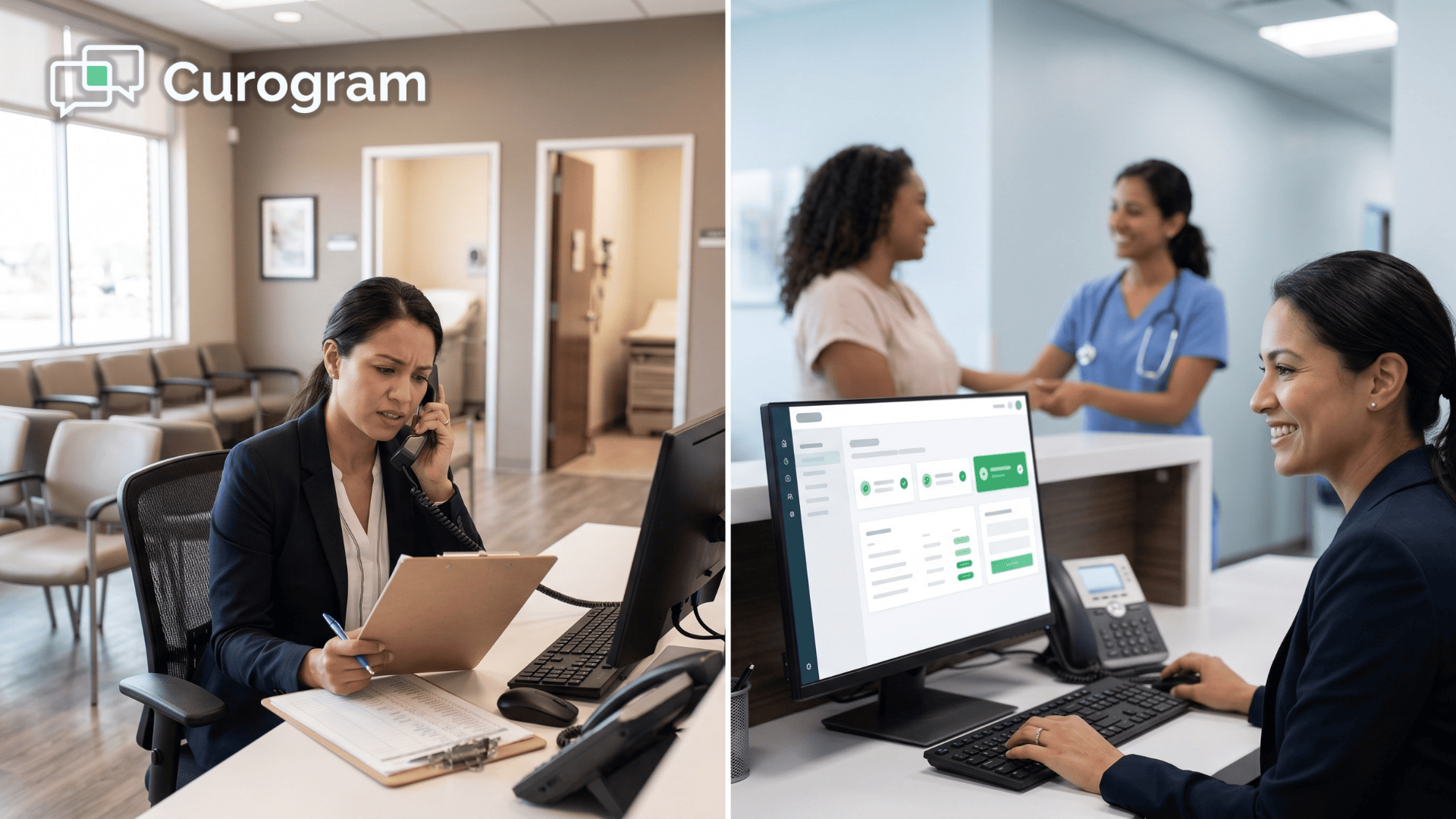
So what do teams do? They call patients one hour before the appointment. They call the ones who already left for work. They call the ones already in the waiting room. And they succeed maybe 30% of the time.
Staff burn 8–12 hours a week on this reactive triage. It's chaotic, demoralizing, and barely moves the needle. By the time a no-show is officially logged, the revenue is already gone. The exam room is already empty.
For a 50-location system, silent no-show losses add up to $1M–$1.5M per month. That's not a rounding error. That's a P&L problem.
Why Smart Timing Changes Everything
Not every appointment is created equal. So why would every reminder be?
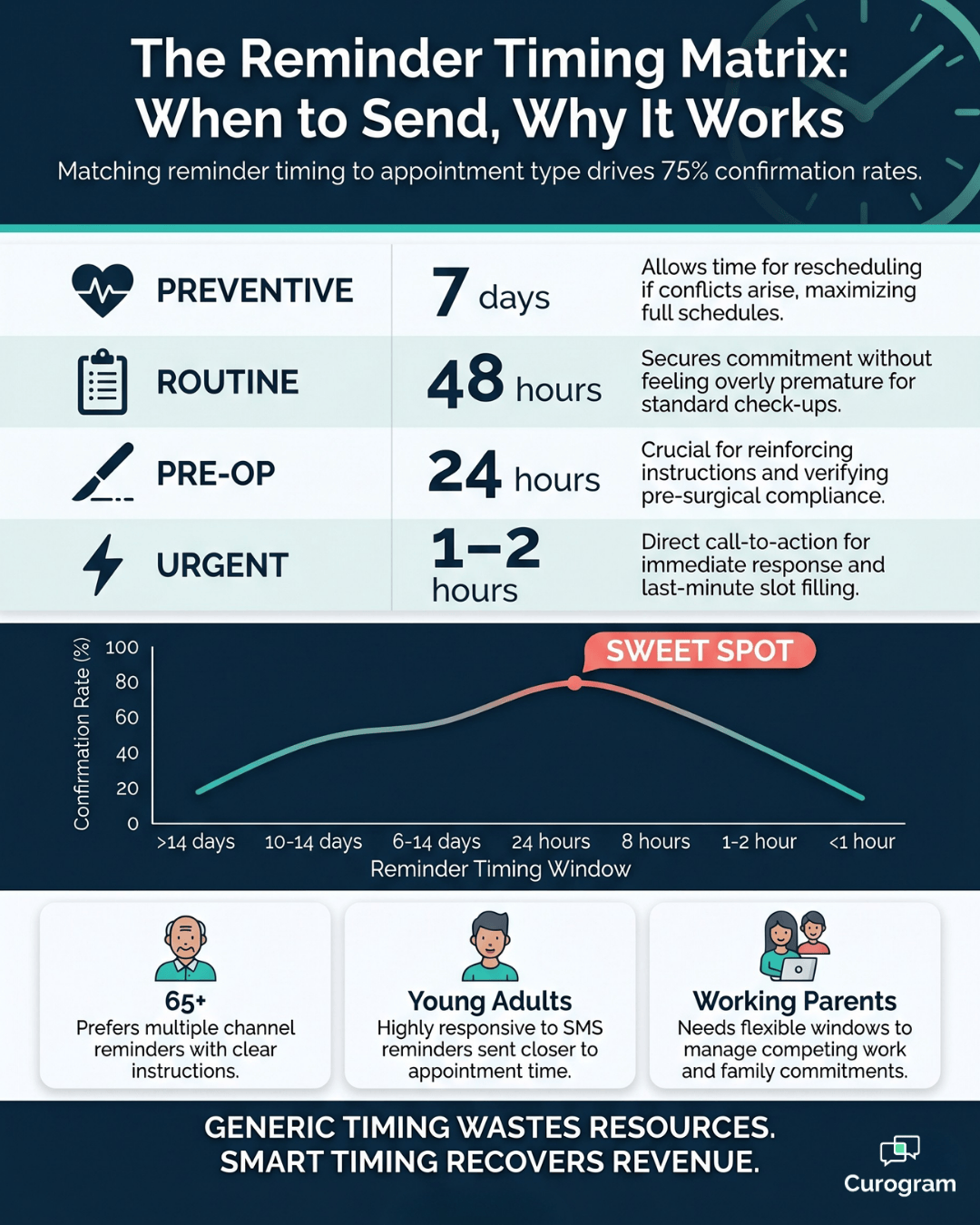
A routine follow-up benefits from a 48-hour heads-up. If the patient has a conflict, they have time to reschedule. A pre-op appointment needs a 24-hour reminder — close enough to be top of mind, far enough to allow for fasting or prep instructions. A same-day urgent care visit? One to two hours is the sweet spot.
Demographics matter too. Different patient segments respond to different rhythms:
- Patients 65 and older: earlier reminders and simpler confirmation paths
- Younger patients: fewer messages, clear action steps, no spam-like follow-ups
- Working parents: evening send times and weekend reschedule options
Generic timing fails everyone. Too early and patients forget. Too late and they've already made other plans. Too frequent and you train them to tune you out.
Intelligent reminder engines solve this by matching timing to appointment type and patient behavior.
That's not a nice-to-have anymore. It's the difference between a 25% confirmation rate and a 75% one.
How Smart Reminders Work Inside Your Cerner Environment
Matching Reminder Timing to Appointment Type
Curogram's reminder engine classifies every appointment using Cerner's existing AppointmentType and ServiceCategory fields.
No new data entry. No workflow changes for your scheduling team.
From there, configurable rules take over.
Here's how timing typically breaks down:
| Appointment Type | Optimal Reminder Window | Why It Works |
|---|---|---|
| Preventive (annual physical) | 7 days out | Gives patients time to request PTO |
| Routine follow-up | 48 hours out | Enough runway to reschedule if needed |
| Pre-op or procedure | 24 hours out | Top of mind, supports prep instructions |
| Urgent or same-day care | 1–2 hours out | Immediate action window |
These rules aren't hard-coded. Department directors can adjust them through Curogram's admin portal without filing an IT ticket. Cardiology might want 48-hour reminders for stress tests but 24-hour for follow-ups.
Orthopedic surgery might want one-hour pre-op confirmations. Each department tunes what works for their patient population.
Cerner's AppointmentPriority field also drives escalation logic.
When the field reads "urgent" or "stat," Curogram automatically tightens the reminder window.
High-priority cases never slip through the cracks.

Two-Way Confirmation That Updates Cerner in Real Time
Here's where intelligent SMS reminders get interesting.
The patient gets a message that looks something like this:
"Hi Sarah, your appointment with Dr. Chen is tomorrow at 2:00 PM at Westside Clinic. Reply CONFIRM, CANCEL, or RESCHEDULE."
One message. One decision. Done.
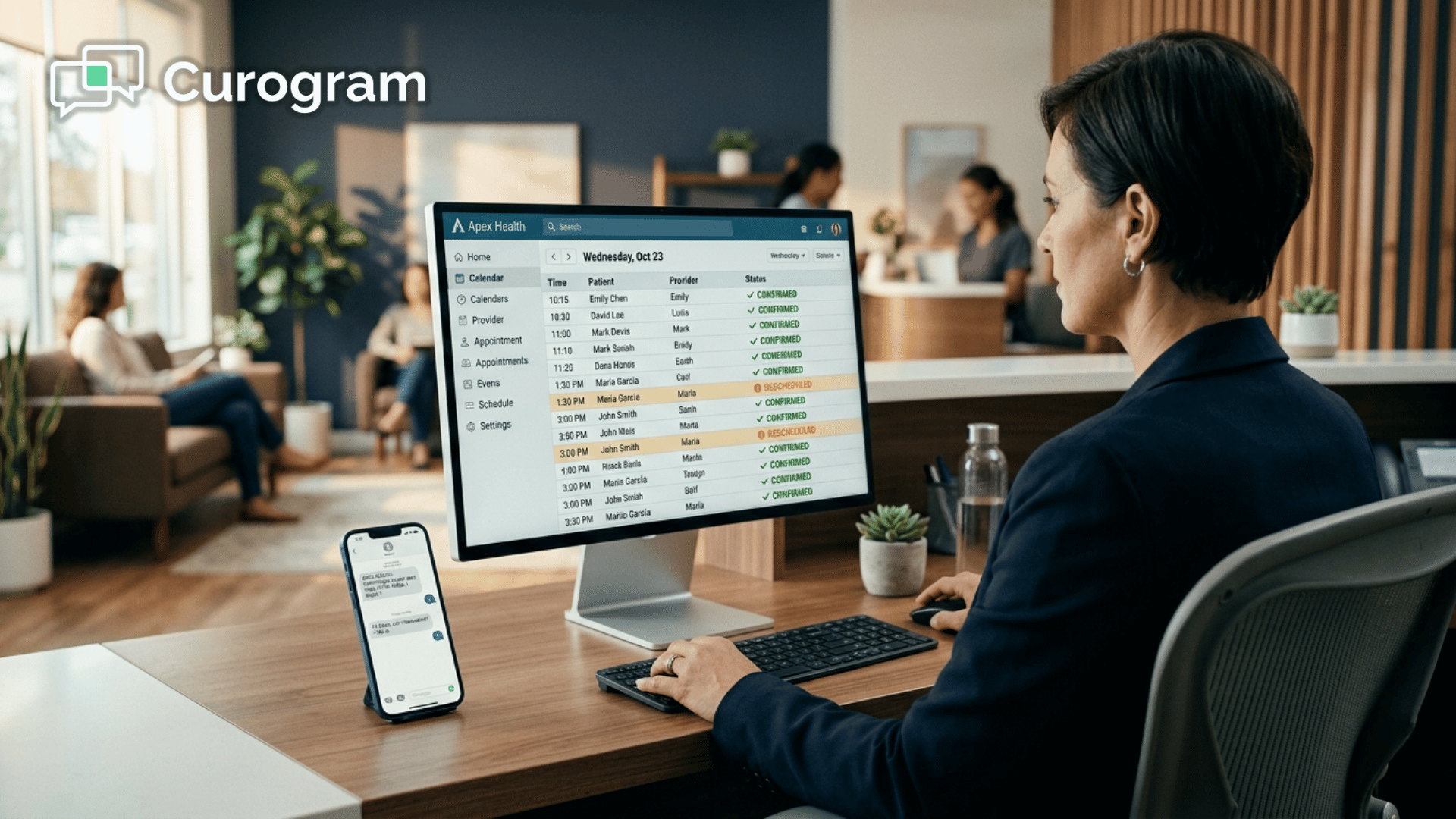
When the patient replies, Curogram updates Cerner's Appointment.status field immediately.
"Scheduled" becomes "Confirmed."
Or it flags as "NOSHOW_RISK" if no response comes in after 24 hours.
Cancellations update instantly so the slot can be offered to another patient.
Routing happens automatically. Confirmations go to the clinical team's dashboard. Reschedule requests route to the scheduling department's SMS inbox. Cancellations trigger waitlist outreach. Your staff stops chasing information and starts acting on it.
This is what separates Cerner intelligent SMS reminders from legacy broadcast systems. The conversation flows both ways, and your EMR stays in sync the entire time.
Spotting At-Risk Appointments Before They Vanish
The magic happens in the 48-hour window before each appointment. Curogram flags patients who haven't confirmed, patients with a history of no-shows, and patients from demographics with historically higher no-show rates.
Clinical staff see this list on a dashboard. They have options:
- Send a second reminder with escalated language
- Make a quick confirmation call
- Offer a telehealth alternative
- Suggest a different time slot
Proactive intervention on at-risk appointments succeeds 60–70% of the time. Compare that to the zero success rate you get when you find out about a no-show after the fact.
The math is simple. A 5-minute staff intervention saves a $150 appointment plus 30 minutes of provider time.
You're trading minutes of effort for thousands of dollars in recovered revenue — every week.
What Intelligent Reminders Actually Deliver
Cutting No-Show Rates and Reclaiming Revenue
Let's look at real results. Atlas Medical started with a 14.2% no-show rate. After switching to intelligent reminders, that dropped to 4.9% — a 9.3 percentage-point improvement.
For context, the healthcare industry average sits around 5.3%. Atlas went from nearly three times the average to well below it.
Scale that drop to a typical 40-location system running 25,000 appointments a year at $150 each. The shift from 14.2% to 4.9% recovers roughly 2,325 appointments annually — about $3.46 million in recovered revenue. Payback on implementation typically lands at 4–6 weeks.
Covina Health Center tells a similar story. They scaled from 369 confirmations a month to over 1,300 in five months — more than 11,000 confirmations annually.
Conservatively, that translates to about $837,000 in recovered revenue per year.
For your team, this means one thing: the money is already on your books. You just need a system that keeps it there.

Shrinking Call Volume and Freeing Up Staff
Before intelligent reminders, a typical 40-location system runs about 80 confirmation calls per location per day. That's 3,200 calls daily at roughly 4 minutes each — the equivalent of 26 full-time employees doing nothing but dialing.
Curogram typically reduces that call volume by 70%. The math:
- 18+ full-time positions freed up
- $1.35M+ in annual labor savings at a $75K fully-loaded cost per FTE
- Redeployed staff handle higher-value work like insurance verification and billing follow-up
There's a secondary benefit too. When patients get clear, actionable SMS confirmations, they stop calling to ask "When is my appointment?" That deflects another 10–15% of inbound call volume.
In practice, your front desk becomes proactive instead of reactive.
They spend their days solving bigger problems, not reading the same script 80 times.
Strengthening Your Oracle Health Investment
Health systems pay a premium for Cerner expecting enterprise-grade capabilities across the board. But when it comes to automated SMS reminders, HealtheLife's native functionality leaves gaps — and patients feel them.
Intelligent reminders close those gaps. They make your Cerner investment deliver more. And they reduce the odds that frustrated leadership starts shopping for a new EMR.
This matters more than ever. Oracle has lost 57 health system customers over the past 36 months, and patient communication gaps consistently show up as a secondary reason for exits. Fixing this one layer strengthens your retention story.
Compare this to point solutions on the market today:
- Luma Health handles scheduling
- Phreesia handles intake
- Relatient handles reminders
Stacking three vendors to replicate what one integrated platform does creates cost, complexity, and data silos.
A unified Cerner intelligent SMS reminders workflow — with patient messaging, forms, intake, and payments all connected — is something standalone competitors can't match.
Turn Empty Chairs Into Recovered Revenue
The status quo is expensive. Generic reminders fail. Silent no-shows drain millions. Call centers burn out. And your Cerner investment underperforms where it matters most: the moment a patient decides whether to show up.
Smart appointment reminders flip this equation.
Patients get the right message at the right time. They confirm in one tap. Your scheduling team sees real-time status updates. Clinical staff spot at-risk appointments 24 hours in advance — with time to actually do something about it.
The numbers back it up. No-show rates drop from 14% to under 5%. Call volume falls 70%.
Revenue recovery lands in the millions for any multi-location health system. And your Oracle Health environment finally delivers the enterprise-grade patient communication experience your investment promised.
This isn't about bolting on another vendor. Curogram integrates directly with Cerner Millennium, respects your existing workflows, and gives department directors the flexibility to tune timing without IT tickets. It's a HIPAA-compliant, 2-way texting platform built to work with your EMR, not around it.
Here's the takeaway. Every day you run generic reminders is a day you're leaving money on the table and burning out your front desk.
The technology to fix this already exists. It already works inside Oracle Health. And it already delivers measurable ROI in weeks, not quarters.
Your team doesn't need more reminders. They need smarter ones.
Ready to see what intelligent reminders look like inside your Cerner environment? Schedule a demo with Curogram today. We'll walk you through a live configuration, show you the ROI math for your specific appointment volume, and map out what a 90-day rollout looks like for your health system.
Frequently Asked Questions
Traditional SMS sends every patient the same reminder at the same time — usually 24 hours before the appointment. Smart reminders factor in appointment type, clinical urgency, and patient history to choose the best timing for each individual. A routine follow-up might get a 48-hour reminder. A pre-op gets 24 hours. Urgent care gets 1–2 hours. Smart reminders also allow in-message confirmation and update your scheduling system in real time. The result is a 75% confirmation rate, compared to 25–30% for traditional SMS blasts.
When a patient confirms via SMS, their Cerner appointment status flips from "Scheduled" to "Confirmed" instantly. Clinical staff can then see which appointments still haven't been confirmed 48 hours out — and intervene before it's too late. Options include a second reminder, a quick phone call, or a telehealth alternative. This 24-hour advance visibility converts 60–70% of at-risk appointments into confirmed attendees. Without it, your team only learns about a no-show when the chair is already empty.
Yes. Curogram's admin portal lets department directors set their own rules. Cardiology can run 48-hour reminders. Surgery can run 24-hour reminders. Urgent care can run 2-hour reminders. Timing can also vary by appointment type within a department. All changes happen inside Curogram's interface — no IT ticket, no code changes, no waiting on a vendor release cycle.
Reschedule requests route automatically to your scheduling department's SMS inbox. Staff can offer alternative times directly through text, and when the patient confirms a new slot, Cerner updates on its own. No manual handoffs, no phone tag, no missed requests sitting in a voicemail queue. Pre-populating open slots from Cerner's ScheduleSlot availability makes the whole loop even faster.
No. Curogram is an add-on that works alongside Cerner Millennium. Your scheduling workflows, provider templates, and billing integrations all stay intact. Curogram layers intelligent SMS reminders, 2-way texting, and real-time status updates on top of what you already have. Think of it as a communication upgrade — not a replacement.