9 min read
No-Portal Appointment Reminders for Oracle Health Patients
Aubreigh Lee Daculug
:
May 6, 2026
Intelligent reminder timing matches the message to the appointment type.
Routine visits get a 48-hour notice. Same-day urgent care gets a 2-hour nudge. Patients confirm in one tap, and the loop closes.
The result is a 75% confirmation rate, no-show rates under 5%, and patient satisfaction climbing from 6.2/10 to 9.1/10. Less spam, more clarity.
Imagine your patient, Sarah. She has three specialist appointments this month.
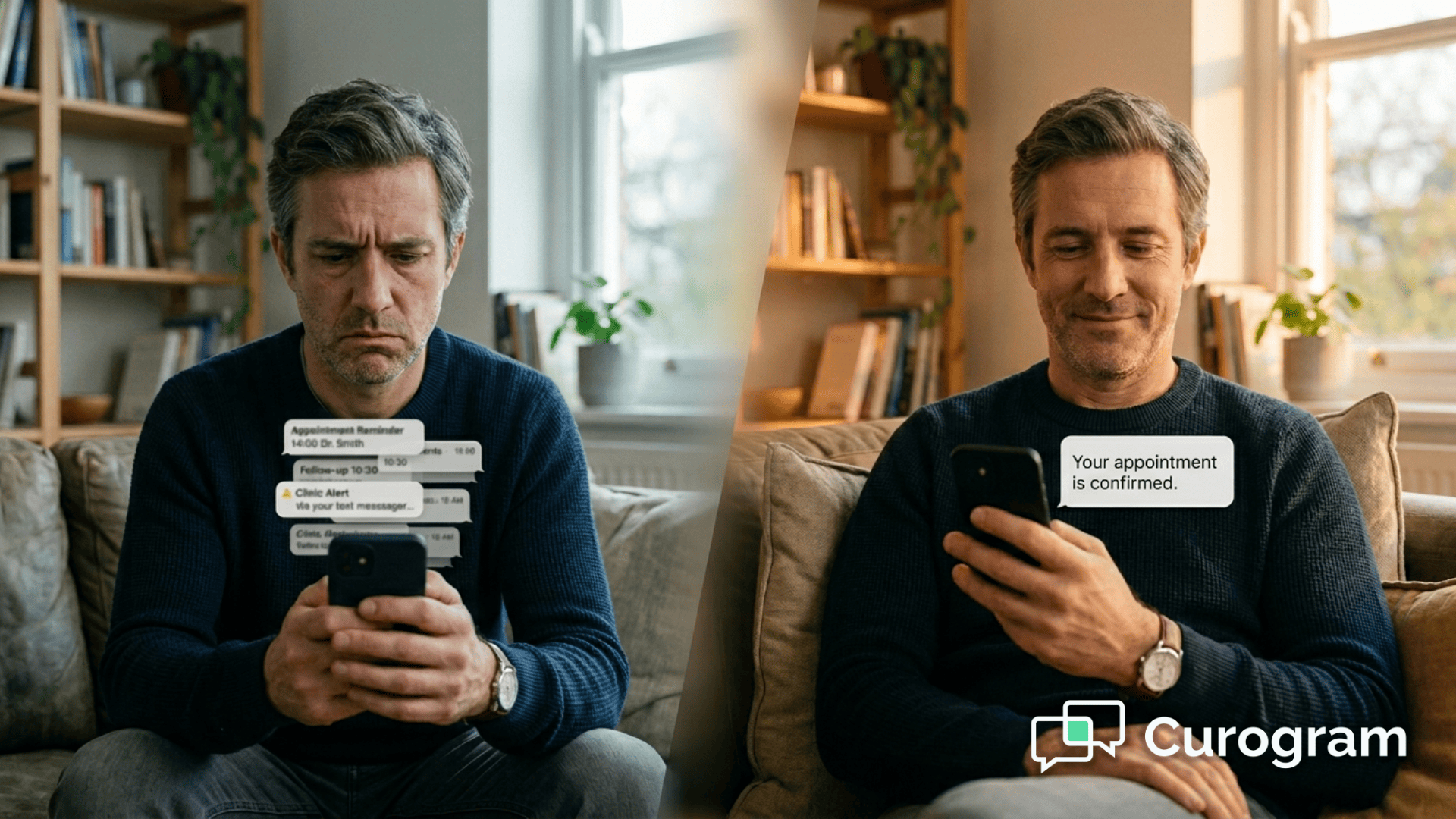
Her phone buzzes. Again. It's the fifth reminder this week from a clinic, and she hasn't even read the last three.
By the time her actual appointment day arrives, she's already mentally tuned out every healthcare text on her phone. She no-shows.
Not because she doesn't care, but because the reminders blurred together.
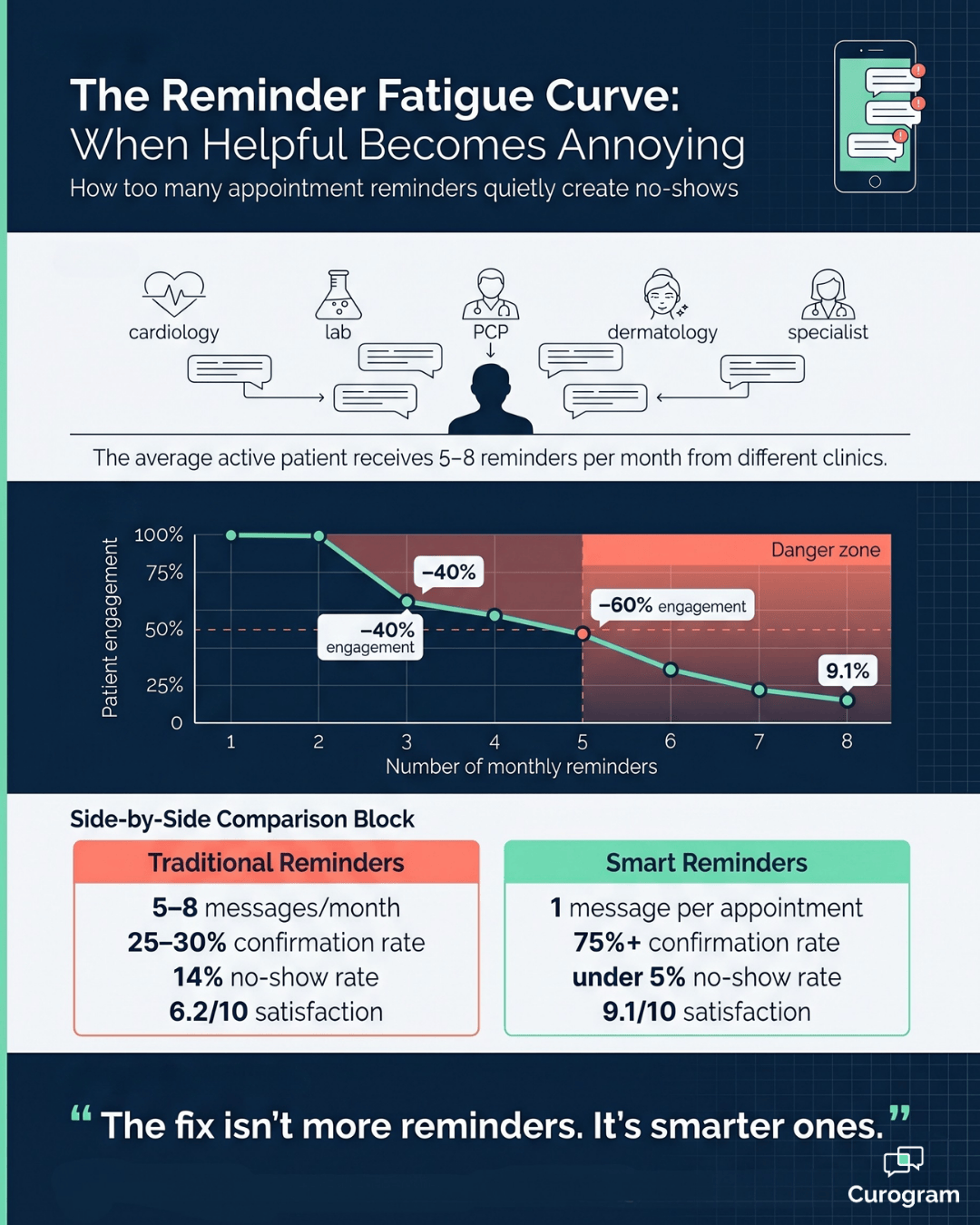
This is appointment reminder fatigue, and it's quietly draining your schedule. Patients today get 5 to 8 healthcare reminders per month from different clinics, all sent on autopilot, all begging for attention, almost none of them actionable.
After three reminders in a month, patient engagement drops 40%. After five, it falls 60%.
It sounds simple. It isn't. The very tool meant to prevent no-shows is creating them.
Here's the painful irony for medical practices. You invested in an appointment reminder system to protect revenue.
But if those messages feel like spam, patients tune out, miss appointments, and your front desk ends up making the same calls the software was supposed to replace. You're paying for noise.
The fix isn't more reminders. It's smarter ones.
In this article, you'll learn why traditional reminder systems quietly fail your patients, how intelligent reminder timing changes the entire dynamic, and what confirmation-enabled SMS does for compliance, accessibility, and your bottom line.
You'll see real numbers, real workflows, and real patient behavior, all in plain language.
If your no-show rate is creeping up while your reminder volume is going through the roof, you're not alone. You just need a different approach.
Let's get into it.
The Quiet Cost of Generic Appointment Reminders
Most patients don't hate reminders. They hate bad ones.
The reminder fatigue problem is real, measurable, and almost always invisible to the practices causing it.
Three issues quietly compound on top of each other:
- Too many reminders from too many sources
- Messages that don't let patients take action
- Timing that ignores the type of appointment
Each one alone is annoying. Together, they push patients into ignore-mode, and your no-show rate pays the price.
When Too Many Texts Become Background Noise
Patients with chronic conditions, ongoing care, or active families don't get reminders from one clinic. They get them from five.
Cardiology sends a 24-hour reminder, then a 2-hour reminder. Lab work sends its own. The PCP follows with an annual physical reminder a week out.
Add a specialist follow-up and a dermatology check, and suddenly your patient is fielding 5 to 8 texts a month from different systems.
Each one fixed in time. Each one generic. None of them connected.
Their brain starts treating it the way it treats marketing email. Skim. Delete. Ignore.
After the third reminder lands in a week, what research describes as message fatigue reduces patient engagement starts to kick in, with engagement dropping 40%. By the fifth, 60% is gone.
The worst offender is the double-tap. Patient gets reminder one ("Your cardiology appointment is tomorrow"), marks the calendar, and moves on. Two hours before the visit, reminder two arrives. It feels redundant. It feels nagging. And it teaches the patient that your messages aren't worth reading.
Messages That Don't Let Patients Do Anything
A traditional reminder says, "You have an appointment Tuesday at 2pm."
That's it. No way to confirm. No way to reschedule. No answer to the questions the patient actually has, like whether to bring an insurance card, whether they can move it, or how long the wait will be.
So what does the patient do? They call the front desk. Now your staff is on the phone explaining things the text could have said in two lines. Average call handle time goes up. Patient frustration goes up. And the patient who couldn't confirm in-message?
They give up, go silent, and become tomorrow's no-show, a pattern well documented where communication gaps contribute to missed appointments.
Then you label them unreliable. They aren't. The reminder system failed them.
Why One Time Slot Doesn't Fit Every Appointment
Most legacy systems send every reminder at the same time, usually 24 hours before the visit. That's a problem.
For a routine 3-month follow-up, 24 hours is way too late. The patient can't easily rearrange work or childcare on that timeline, so they no-show instead of rescheduling. For a same-day urgent care visit, a 24-hour reminder makes no sense at all. The patient just booked it because they're sick.
Then there's behavior. Working parents check their phones at lunch. Older patients check theirs over morning coffee.
A 9 AM blast misses the working professional and arrives during the elderly patient's most chaotic hour.
Wrong message, wrong time, no result.
Add these three failures together, and the picture becomes clear: the problem isn't your patients. It's the system telling them too much, too often, with no way to respond. So what does a smarter system actually look like?
How Smart Reminder Logic Rewrites the Rules
The fix isn't sending more. It's sending right.
Intelligent appointment reminders adjust three things at once:
When the message goes out, what it asks the patient to do, and how often it follows up.
That combination is what kills reminder fatigue.
Timing Built Around the Appointment, Not the Calendar
Smart reminder systems use the appointment type to decide on optimal timing. Here's how that looks in practice.
| Appointment Type | Optimal Reminder Window | Why It Works |
|---|---|---|
| Routine follow-up | 48 hours before | Gives patient time to reschedule conflicts |
| Pre-op or surgery | 24 hours before | Creates urgency, still actionable |
| Same-day urgent care | 2 hours before | Matches same-day booking behavior |
| Annual physical | 5 to 7 days before | Allows for time-off planning |
That single shift changes outcomes.
A 48-hour window for a routine visit gives the patient breathing room to confirm or move it without ghosting you.
Smart systems can also flex around patient context. Patients aged 65+ tend to respond better when reminders arrive 60 hours before, giving them time to arrange transportation.
Working professionals tend to engage with messages sent in the early evening when they're home and have a phone in hand. Parents prefer short, confirmation-first messages they can answer between school pickup and dinner.
The result is a single, well-timed touchpoint. Patient sees it. Patient confirms. Patient shows up.

Reminders That Close the Loop in One Reply
Here's the move that changes everything: confirmation-enabled reminders.
A smart reminder reads,
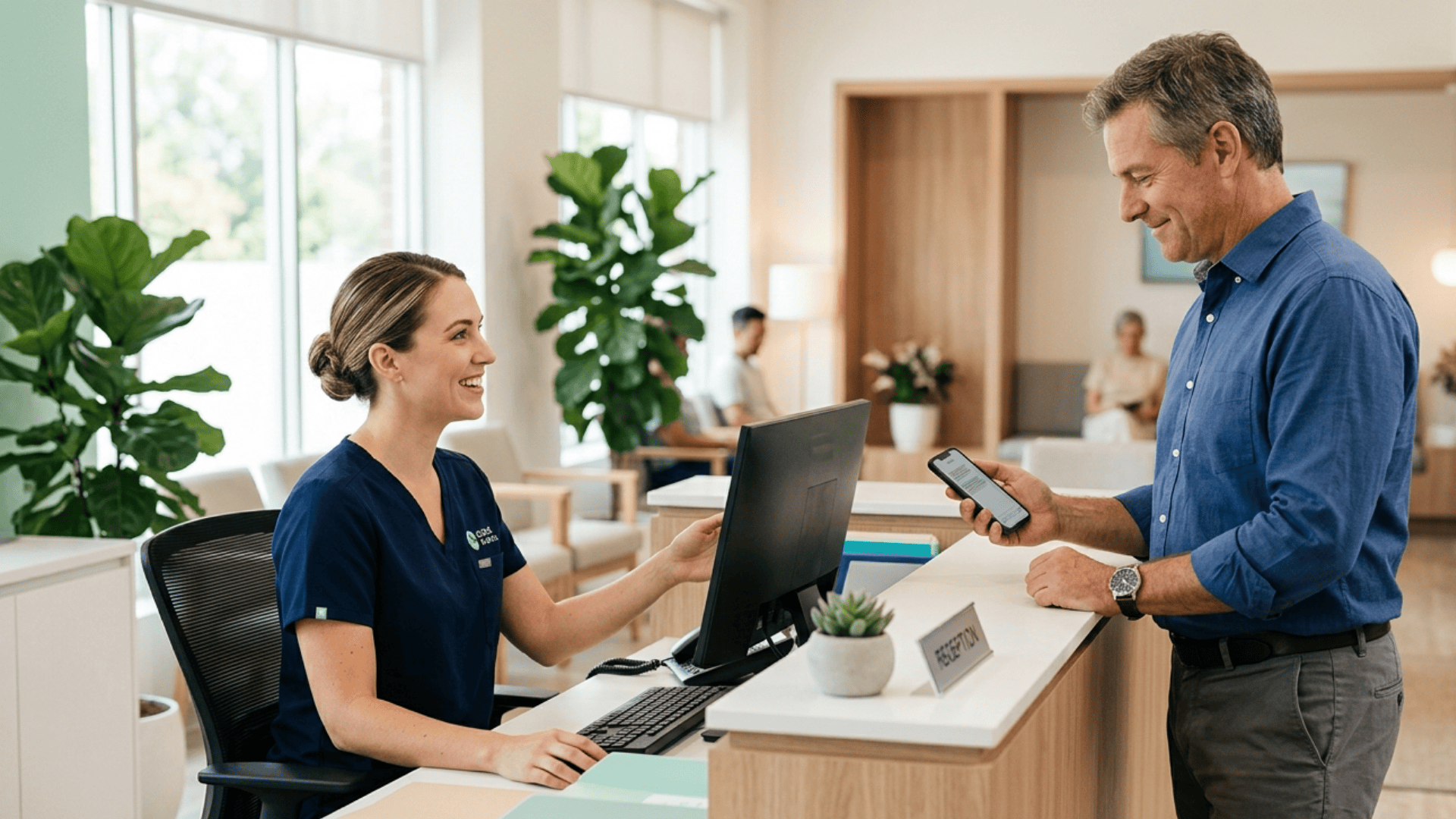
"Hi Sarah, your cardiology appointment is Thursday at 2pm. Reply CONFIRM, CANCEL, or RESCHEDULE."
That's it. The patient doesn't need to log in to a portal, dig for an email, or call the front desk. One word, and the loop is closed.
Compare that to the legacy approach below.
| Approach | Touchpoints Per Appointment | Confirmation Rate |
|---|---|---|
| Traditional double-reminder | 2 to 3 (text, text, staff call) | 25 to 30% |
| Smart confirmation-enabled reminder | 1 (text with reply) | 75%+ |
You're cutting reminder volume by roughly 70% and tripling your confirmation rate. Patients describe this as feeling respected. Their time is valued. Their inbox isn't crowded.
Patient satisfaction with appointment communication jumps from 6.2/10 to 9.1/10 in clinics that switch.
For your team, that means fewer outbound calls, fewer questions about "did Sarah confirm?", and a real-time view of who's coming and who isn't.
Content That Respects the Patient's Time
Smart reminders are short, specific, and useful. Here's the difference.
Generic reminder:
"You have an appointment scheduled with Dr. Smith. Please log into your patient portal for more details."
That's friction. The patient has to leave the text, find a password, navigate a portal, and locate the visit. Most won't.
Smart reminder:
"Hi Marcus, your orthopedic surgery is Friday 7am at Main Campus. Please arrive 30 min early for pre-op. Reply CONFIRM."
Everything the patient needs. Nothing they don't.
Personalization adds another layer.
"Hi Mrs. Chen, your 3-month cardiology follow-up is next Tuesday at 2pm with Dr. Patel. Bring your insurance card and any updated medications list. Reply CONFIRM."
That message acknowledges who she is, why she's coming back, and what to bring. It feels like a person wrote it, even when a system did.
When reminders feel personal, patients act on them. When they feel generic, patients delete them.
And the impact reaches further than just the no-show column on your dashboard.
What Better Reminders Do for Patient Experience and Equity
Lower no-show rates are the headline. The patient experience story underneath is bigger.

Less Anxiety, Better Compliance
Patients tell us smart reminders ease pre-appointment anxiety. Instead of wondering whether they have something Tuesday or Thursday, they get a clean confirmation and move on with their day.
That certainty matters most for elderly patients and anyone managing health-related stress.
There's also a behavioral effect at work. Once a patient types CONFIRM, they're psychologically committed. Behavioral research on choice and commitment shows that small public actions, like a one-word reply, increase follow-through on the larger behavior, like showing up.
This is part of why no-show rates drop from 14% to under 5% with intelligent reminders.
Curogram clients see no-show rates 53% lower than industry averages across primary care, pediatrics, psychiatry, dermatology, and specialty clinics.
Patients aren't suddenly more reliable. The system just stopped failing them.
In practice, every recovered appointment is direct revenue. For a clinic running 1,000 visits a month at $200 each, dropping no-shows from 14% to 5% recaptures roughly 90 appointments.
That's $18,000 a month, or about $216,000 a year, from a single workflow change.
Accessibility for the Patients Who Need It Most
SMS works where portals fail. That matters for the populations most often left behind.
The gap shows up clearly when you compare engagement by group:
- Elderly patients: roughly 85% engagement on SMS vs. 15% on portals
- Patients with limited English proficiency: full multilingual SMS support, where portals rarely translate
- Visually impaired patients: SMS plays cleanly with screen readers, where most portals fail accessibility checks
Each of these wins comes from the same simple truth. SMS doesn't ask the patient to learn anything new.
There's no app, no password, no tutorial, just a text and a one-word reply.
For a Spanish-speaking patient, that might look like,
"Hola Maria, tu cita de cardiología es mañana a las 2pm. Responde CONFIRMAR."
The pattern works in any language your patient population speaks. For your team, this means you're meeting patients where they already are, not asking them to come to you.
Giving Patients a Sense of Control
Smart reminders flip the relationship. Instead of telling the patient what's happening, they ask. "Can you make it?"
That single shift creates a feeling of agency, and agency is one of the strongest drivers of patient satisfaction.
When a patient can't make it, the in-message cancel and reschedule options give them an out that doesn't feel rude.
They reply CANCEL or RESCHEDULE, and they know your team is on it. That's how you prevent frustration-driven no-shows, the ones where the patient gives up because they didn't see an easy path.
Patients who feel heard show better treatment adherence and higher long-term loyalty. Smart reminders create that dynamic at scale, without anyone on your team picking up the phone.
The next question is what it actually takes to put this into practice.
Smarter Reminders Start With the Right Platform
The math on intelligent appointment reminders is hard to ignore: less reminder fatigue, higher confirmation rates, fewer no-shows, happier patients, and less strain on your front desk.
But those outcomes don’t happen on their own.
They come from using a system that adapts to appointment types, patient demographics, and real-time response behavior—while staying tightly integrated with your EMR to keep data accurate and workflows seamless.
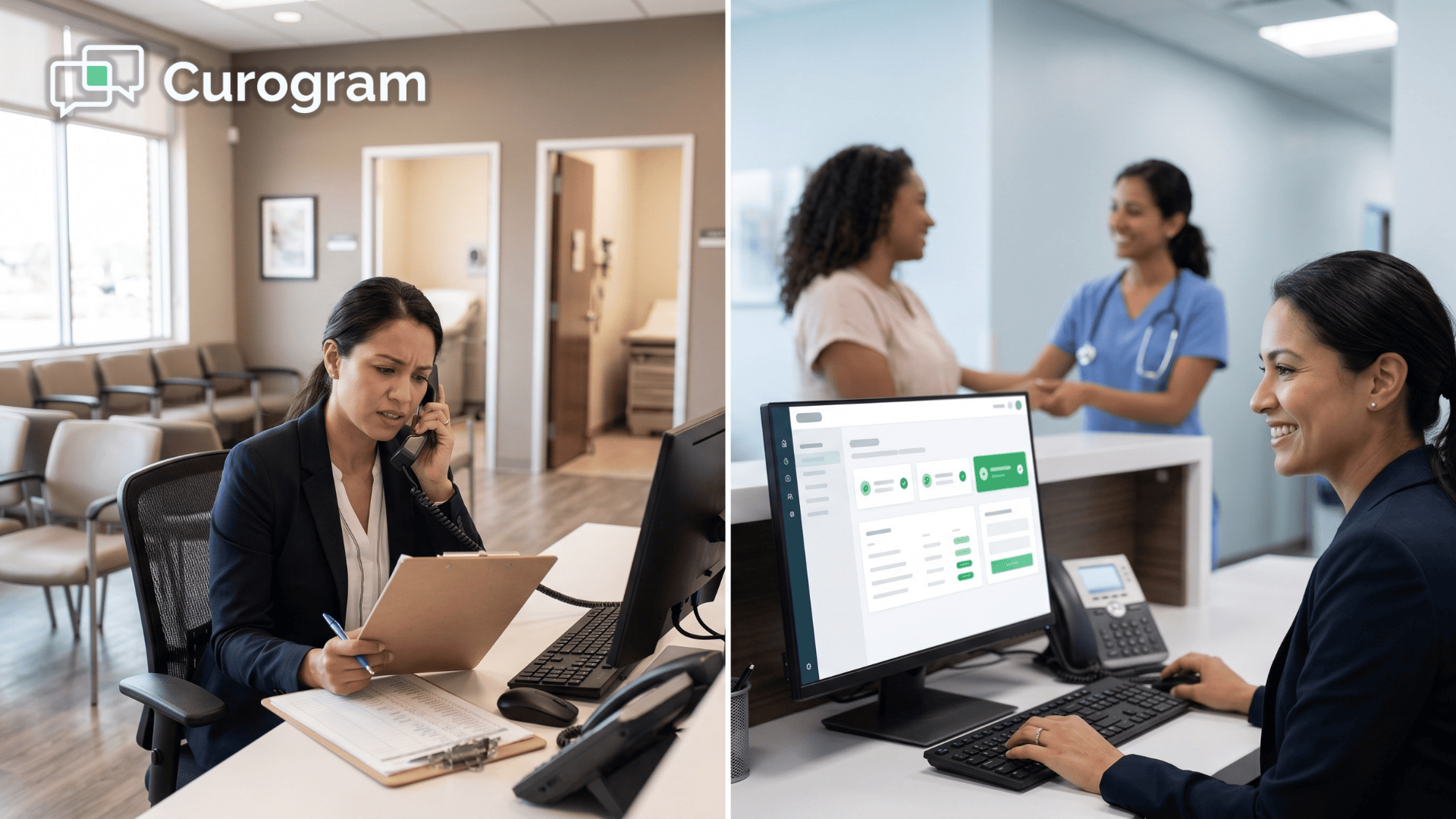
Curogram is designed to do exactly that. As a HIPAA-compliant, two-way patient texting platform, it automates appointment reminders and confirmations from start to finish.
It integrates with EMR, so there’s no need for disruptive system changes. Instead, you get smarter reminder timing, confirmation-enabled SMS, and clear, real-time visibility into which patients are confirmed and where staff attention is actually needed.
The results speak for themselves.
Practices using Curogram report average confirmation rates above 75%, no-show rates that are 53% lower than industry benchmarks, and revenue increases of 10 to 20% from filling appointments that would have otherwise been missed.
At Covina Arthritic Clinic, more than 1,100 appointments are confirmed each month through fully automated workflows, without adding any extra burden to staff.
For your team, that means less time chasing confirmations and more time focused on patient care.
For patients, it means receiving a single, clear message instead of a stream of reminders. And for your practice, it means capturing more revenue from the schedule you already have.
Schedule a demo with Curogram to see how intelligent reminders can work within your existing EMR. You’ll get a clear view of the setup, real-time reporting, and the measurable impact on your patient volume and revenue.
Frequently Asked Questions
Not when the texts are useful. Patients filter spam and marketing. They don't filter relevant messages from their healthcare provider. Smart reminders feel personal, name the patient, reference the specific visit, and let them act in one tap. About 95% of healthcare appointment texts are opened within 3 minutes, and 75%+ are acted on, far outperforming any other channel. Patients value medical SMS because it respects their time.
Smart systems flag non-confirming patients as at-risk and alert your front desk early, while there's still time to act. Staff can send a follow-up text, place a quick call, or offer a different time slot. Proactive outreach converts 60 to 70% of at-risk patients into confirmed shows. The advantage is timing, intervening 24+ hours before the visit instead of 1 hour before, when it's already too late.
One smart reminder beats two or three generic ones, every time. Single confirmation-enabled reminders see roughly 75% confirmation rates, compared to 25 to 30% for traditional multi-touch approaches. Patients want clarity, not repetition. They'd rather confirm once and move on than be reminded again and again that something they already know is happening.
Yes. The right platform plugs into almost any EMR or practice management system as an add-on, so your appointment data flows in automatically and reminders go out without manual setup. You don't need to switch systems or train staff on new workflows. You just turn on smarter reminders on top of what you already have.
Standard SMS is HIPAA-compliant when the message contains only generic appointment information, like name, date, time, and a confirmation prompt, without disclosing diagnosis, condition, or treatment details. A platform built for healthcare keeps templates inside compliance boundaries automatically, so your team doesn't have to second-guess each message.