
8 min read

Reduce No-Shows at Meditab IMS with Text Reminders

Reduce No-Shows at Meditab IMS with Text Reminders

💡 Meditab IMS patient communication without portal login via secure texting lets practices reach patients through SMS — no app download, no account creation, no password resets.   

Atlas Medical Center cut their no-show rate from 14.20% to 4.91% in three months using Curogram. That's a 65% drop, and roughly 3X better than the industry average.     

For practices losing $20,000–$30,000 per month to empty chairs, two-way reminders close the gap between hoping patients show up and knowing they will.


Your front desk just sent 40 appointment reminders for tomorrow. Forty patients got the text. Forty patients saw the date and time. And tomorrow morning, six of those chairs will sit empty.

You won't know which six until the slots pass.

That's the strange tragedy of how most Meditab IMS practices run their schedules.

The reminders go out on time. The system "works" the way it was designed to work. But the practice is still bleeding revenue, still scrambling at 9 AM, still wondering why a tool built to prevent no-shows isn't actually preventing them.

Here's the gap nobody talks about.

A reminder is not a confirmation. Sending a message into someone's phone tells you nothing about whether they plan to walk through your door.

And if your patient has no way to text back, you're flying blind until the appointment time hits.

For a busy gastroenterology, dermatology, or pain management practice, that blind spot can cost $20,000 or more every month. Multiply that across a year, and you're looking at the salary of a full-time nurse practitioner — gone, quietly, one missed appointment at a time.

This is what we mean when we talk about reduce no-shows Meditab IMS practice strategies.

The fix isn't sending more reminders. It's giving patients a way to respond, and giving your team a way to act on those responses before the day starts.

The good news?

Practices that solve this aren't shaving off 5% or 10% of their no-show rate. They're cutting it in half — sometimes more. And they're doing it without overhauling their EMR or hiring a single new person.

The Hidden Drain Inside Every "On-Time" Reminder System

IMS InTouch is dependable in the narrow sense. It fires off scheduled messages, hits the right patients, and lands at the right time. As a notification engine, it does what it was built to do.

But a notification is a one-way street. Your patient gets the text. They glance at it between meetings or while loading groceries into the car. The reminder gave them information — but no way to reply.

So the message goes out. Silence comes back. And your front desk hopes.

This is what we call the silent no-show:

The patient who got reminded but had no channel to respond, and simply doesn't appear.

It's not a behavior problem. It's a system problem.

What a Single Quiet Morning Actually Costs

Let's run the math on a real scenario. Say you operate a gastroenterology practice with 40 appointments scheduled tomorrow. Your historical no-show rate is around 15%, which puts six patients at risk. Your average reimbursement per visit is $150, in line with physician practice benchmark survey findings.

That's $900 in revenue gone before lunch. Now stretch it across the calendar:

Time Frame Lost Visits Revenue Lost
Per Day 6 $900
Per Week (5 days) 30 $4,500
Per Month (20 working days) 120 $18,000
Per Year 1,440 $216,000

That's a single mid-sized practice. For pain management, behavioral health, or psychiatry — where no-show rates can climb to 25% or even 50% — the monthly bleed often hits $25,000 to $30,000. In practice, you're not just losing visits.

You're losing the equivalent of a full provider's monthly billing.

The Cost No Spreadsheet Captures

Empty chairs don't just lose face value. They drag down the rest of the day too. Your medical assistants pulled the chart. The billing team verified insurance. A room was prepped, gowned, and warmed up. All of that labor is now sunk cost.

Meanwhile, your provider sits idle for 30 minutes — time that can never be billed back. Then there's the patient who could have been seen. The one with worsening symptoms. The one waiting three weeks for an opening.

The true cost of a single no-show typically runs 2–3X the missed visit's reimbursement once you factor in wasted prep, idle provider time, and displaced demand.

The Frustration That Doesn't Show Up on the P&L

Talk to any office manager and you'll hear the same quiet exhaustion. She knows the no-show rate. She watches the dashboard. She sees the dollar drain every month.

But the reminders are going out. The system is doing what the manual says.

So what else is there to do?

The answer she hasn't been offered:

Stop sending one-way messages. The reminder isn't broken. The reply is missing.

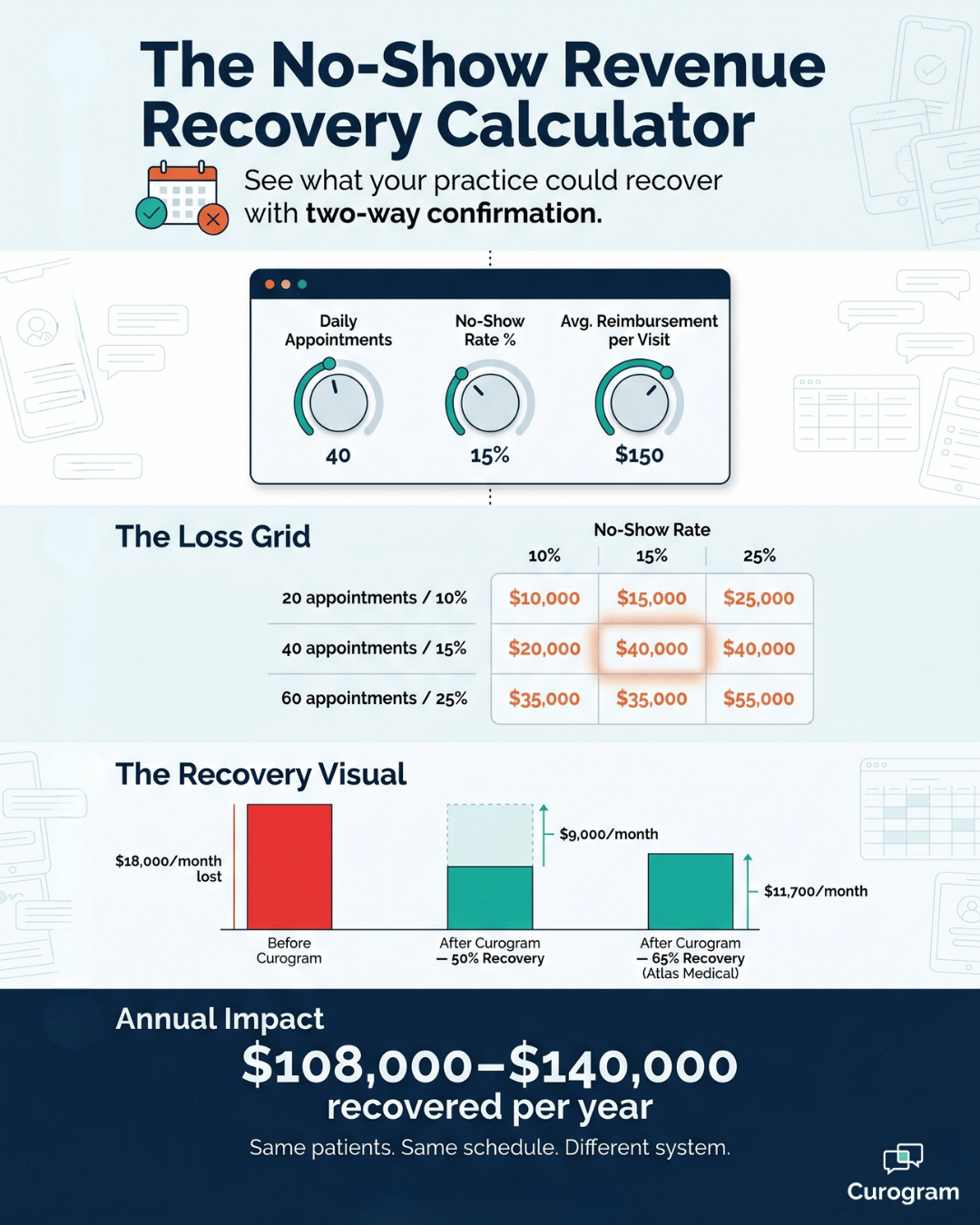
No-show revenue recovery calculator showing monthly losses and Curogram savings for Meditab practices

Why Most "Fixes" Don't Actually Fix It

Before introducing a real solution, it's worth being honest about what hasn't worked. Most practices have already tried the obvious workarounds — and most of those workarounds either cost too much labor or move the needle too little.

Here's what tends to fall short:

  • Calling every patient the day before: Effective but expensive. It costs 3–4 hours of front desk labor daily, or roughly $2,000 a month in staff time, just to confirm what a text could capture in seconds.
  • Adding a second one-way reminder: Marginal at best. If a patient couldn't act on the first message, two messages they can't reply to won't change much.
  • Charging no-show fees: Sometimes effective, often unpopular. And it doesn't recover the lost slot — only the penalty.

The fundamental issue isn't that patients are careless. It's that the channel doesn't let them respond. Make replying easy, and behavior shifts fast.

A Smarter Way to Confirm Every Appointment Before the Day Begins

This is where Curogram changes the equation. Built around automated appointment reminders Meditab practices can actually rely on, the platform sends two-way SMS messages that patients reply to with a single tap.

Confirm. Reschedule. Cancel.

Each reply lands instantly. Your schedule updates in real time. Your front desk reviews a dashboard at 8 AM instead of dialing through a list at 4 PM the day before.

Smart Reminder Sequences That Match the Visit Type

Not every appointment carries the same weight. A routine follow-up doesn't need the same nudge a colonoscopy needs.

Curogram lets you build sequences that adjust to the visit type:

  • 48-hour reminder with a reply option for early confirmation
  • 24-hour reminder with prep instructions attached when needed
  • Day-of reminder for high-value or complex procedures

A standard follow-up might get one short message. A surgical consult, an injection series visit, or a colonoscopy gets a full sequence with prep steps attached.

This is Meditab appointment confirmation via text done the way it should be — adaptive, not blanket.

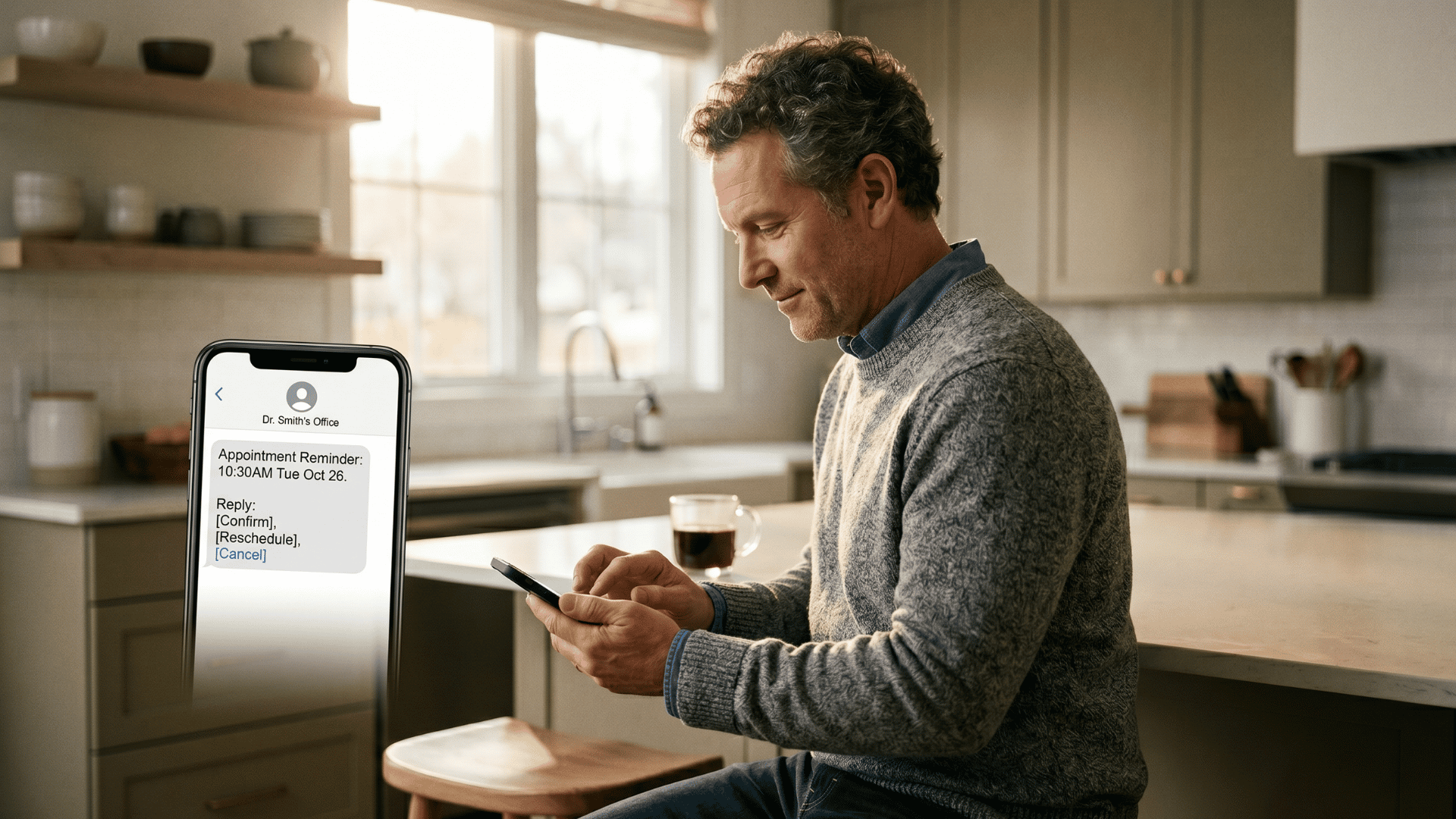
Patient confirming clinic appointment by text reply on smartphone showing two-way SMS reminder

Built to Work With Your Existing IMS Schedule

The Curogram platform pulls appointment data from Meditab IMS automatically. There's no manual entry, no CSV exports, no double-keying for your staff. Reminders fire based on your live schedule, and confirmation status appears in the Curogram dashboard alongside your IMS view.

The two systems run together, not against each other. That means your front desk doesn't learn a new EMR — they just gain a smarter layer on top of the one they already use every day.

Specialty Workflows That Actually Fit

A dermatology practice tracking biopsy follow-ups has different needs than a pediatric office coordinating with parents. Curogram adapts to both. Gastroenterology offices get prep instructions attached to the day-before reminder.

Pain management clinics get sequenced reminders that track injection series across the full course. High-volume primary care gets streamlined single-touch confirmations that keep the workflow lean.

The result is a system that respects how each specialty actually operates — instead of forcing every visit into the same template.

From Hoping They Show Up to Knowing They Will

The most striking proof comes from Atlas Medical Center. Before Curogram, their no-show rate sat at 14.20%. Three months in, it dropped to 4.91%.

That's a 65% reduction, and it puts them roughly 3X ahead of typical industry no-show rates, which often hover between 10% and 15% for primary care.

This is what no-show revenue recovery Meditab practice owners are actually after — not a marginal improvement, but a structural change in how reliable the schedule is.

What "Predictive Scheduling" Looks Like in Practice

Before two-way confirmation, your team finds out about no-shows as they happen. After two-way confirmation, you know by the night before. Cancellations trigger automatic waitlist outreach. Empty slots get filled before the provider walks through the door.

Picture a 40-slot day under the old setup. By the time the office opens, your front desk has made 30+ confirmation calls, and you're still not sure who's actually coming. Five or six chairs sit empty by mid-morning. The damage is done before lunch.

Now picture that same day with Curogram running in the background. By the night before, 38 of those 40 slots are confirmed. The two cancellations that came in by text were already routed to the waitlist, and both replacements confirmed before 8 AM. Your front desk made zero confirmation calls.

For your team, that means a calmer morning, a fuller schedule, and a billing cycle that doesn't keep leaking. The schedule on Tuesday afternoon is already telling you what Wednesday morning will look like — which is exactly the visibility most office managers have been asking for.

The Revenue Picture, Shown Plainly

If your practice was losing $18,000 a month to no-shows and Curogram cuts that by 50%, you're recovering $9,000 monthly — or about $108,000 a year.

Atlas Medical's 65% reduction would bring that closer to $140,000 in annual recovered revenue for the same practice.

That's not a small operational improvement. That's a new line on the income statement, generated entirely from patients you were already scheduling.

Stop Letting Forgotten Appointments Quietly Drain Your Practice

Every empty chair on tomorrow's schedule is a story. A patient who meant to come. A patient who couldn't reach the front desk. A patient who got the reminder but had no easy way to reply.

You've been doing the right things. The reminders are going out. The schedule is being managed. But the gap between "reminder sent" and "patient confirmed" is exactly where the revenue keeps slipping through.

Two-way SMS confirmation IMS scheduling closes that gap, fully and quickly. It doesn't require a new EMR. It doesn't require new staff. It requires a reply channel — and a system smart enough to act on the responses in real time.

Meditab IMS manages your clinical schedule. Curogram protects the revenue sitting on it. InTouch tells patients an appointment is coming. Curogram confirms they're coming with it.

The math is hard to argue with. If your practice is losing $20,000 a month to no-shows and you cut that in half, you're recovering $10,000 every 30 days. Multiply that by 12 and you've added six figures to your bottom line — without touching pricing, payer mix, or patient volume.

Most practices are live on Curogram within 48 hours. There's no long-term contract.

No system rip-and-replace. Just a working two-way layer on top of the IMS schedule you already trust.

You've watched the no-show rate long enough. You know the dollar figure. You know the frustration. The next step is the one that actually moves the number.

Schedule a demo with Curogram. We'll walk through your specific practice volume, model the recovered revenue, and show you exactly how two-way confirmation looks inside your IMS workflow. 


Frequently Asked Questions

How is Curogram's reminder system different from IMS InTouch?

IMS InTouch sends one-way reminders. Patients receive the message but cannot reply. Curogram's reminders are two-way — patients confirm, reschedule, or cancel by text, and your schedule updates instantly. The difference is between hoping a patient will show up and knowing.

Will this create extra work for my staff if patients start replying?

The opposite, actually. Right now your front desk likely spends 1–2 hours daily calling patients to confirm appointments. Curogram automates that workflow entirely.

What does Curogram cost compared to the revenue we're losing to no-shows?

If your practice loses $20,000 a month to no-shows and Curogram cuts that in half, you're recovering $10,000+ every month. The platform's cost is a small fraction of that recovery — typically paid back many times over within the first 30 days.

How quickly can a Meditab IMS practice go live with Curogram?

Most practices are fully implemented and sending two-way reminders within 48 hours. Because Curogram pulls appointment data directly from Meditab IMS, there's no manual schedule import or duplicate data entry to slow things down.

Does this work for high-prep procedures like colonoscopies or injections?

Yes — and these are often where practices see the biggest impact. Curogram lets you attach prep instructions to specific appointment types and send sequenced reminders for high-value procedures. Patients arrive prepared, which reduces same-day cancellations and rescheduled prep visits.