

8 min read
Reduce Front Desk Phone Calls at Meditab IMS | Two-Way Texting
Aubreigh Lee Daculug
:
May 8, 2026
Curogram layers on top of IMS so patients can reply to reminders, reschedule, or ask questions by text instead of calling.
The result is fewer phone calls, faster answers, and recovered revenue from missed visits. Practices commonly absorb 80+ daily calls that could be quick text exchanges.
Covina Arthritic Clinic confirmed 1,100+ appointments per month using Curogram's automated platform.
In short: your IMS handles the chart. Curogram handles the conversation.
Your front desk is drowning in phone calls that shouldn't exist.
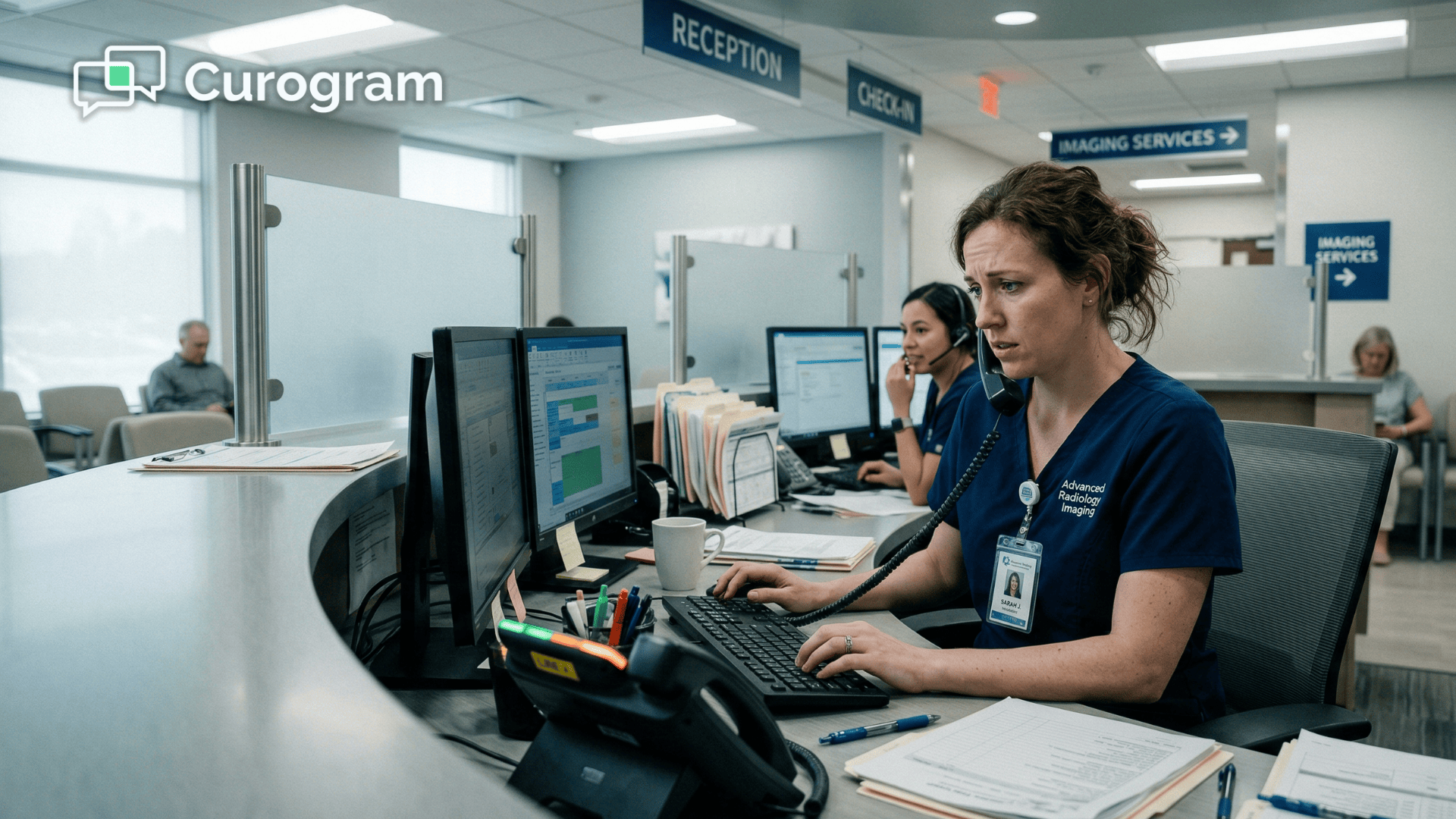
Meditab IMS InTouch sent 45 reminders over the weekend. Now it's Monday morning, and the lobby phone won't stop ringing.
Eight patients want to reschedule. Three have prep questions. Two are stuck in traffic and trying to let you know.
None of them can simply reply to the text they received.
So they call. One after another. Each call eats 3 to 5 minutes of staff time for what should have been a 10-second exchange. Meanwhile, the patient with a real urgent need sits on hold, growing more frustrated by the minute.
You bought an all-in-one system. You followed the vendor's playbook. The "engagement" box on the feature checklist is checked. So why does the front desk still feel like a call center?
Here's the quiet truth most Meditab practices live with: IMS is excellent clinical software, but InTouch only sends. It doesn't listen.
Patients can receive your reminder, but they can't respond to it. That single gap is where your no-shows hide, where your staff hours disappear, and where your monthly revenue quietly leaks away.
This is the all-in-one illusion. The belief that because reminders are going out, communication is handled. It isn't.
In this guide, you'll see what that gap actually costs a Meditab IMS practice each month, why phone-based workarounds make the problem worse, and how two-way HIPAA-compliant texting for Meditab IMS practices closes the loop without ripping out anything you've already built.
You'll see real numbers, real workflows, and a practical path forward. No fluff, no overhauls — just the missing layer your practice needs.
The Hidden Gap in Your "All-in-One" System
Meditab IMS does a lot of things well. It supports more than 40 specialties, handles billing, manages charts, and ties practice operations together under one roof. For clinical work, it earns its keep.
InTouch is where the story changes. It sends automated reminders out, but it can't accept anything coming back in. The text lands on the patient's phone, and the conversation ends right there.
That's not a small detail. Patients today expect to text a business the same way they text a friend. When they can't, they default to the only option you've left them. They call.
A Typical Monday at the Front Desk
Walk into a Meditab IMS practice at 8:01 AM on any given Monday. The phones light up almost immediately. By 9:30, your front desk has handled 30 to 40 calls, most of them small.
80+ |
| Routine inbound calls per day at a typical Meditab IMS practice — most could have been a two-line text exchange. |
A patient confirming. Another asking what to bring. A third running 15 minutes late. Each one a quick conversation that took five times longer than it needed to.
This is what a Meditab IMS patient communication without portal login looks like in real life right now: phone tag. Patients won't dig out a username and password to send a message. They'll grab the phone every time.
What That Gap Actually Costs You
Phone volume is the visible problem. The financial drain underneath it is the bigger one. Based on broader practice operations benchmarks, let's put a real number on it.
A primary care practice seeing 40 patients a day at a 15% no-show rate loses 6 visits every day. At a conservative $150 reimbursement, that's $900 walking out the door — daily.
~$20,000/month |
| Lost revenue at a typical 40-visit-per-day practice. Specialty practices with higher no-show rates often see $25,000–$30,000 disappear each month. |
For your team, this means a Meditab practice losing 6 visits a day is bleeding roughly $216,000 a year. That's not a soft cost. That's a clinician's salary walking out the door every 12 months.
The Part Nobody Talks About
There's a human cost that doesn't show up on a spreadsheet. The practice manager who picked the all-in-one feels personally responsible when the front desk burns out — a common result of healthcare administrative burden, when patients complain about hold times, and when the doctor asks why slots keep going empty.
It's a quiet weight. You bought what you were told you needed. And it's still not enough.
That's not a failure of judgment. It's a gap in the product.
Why Workarounds Keep Falling Short
Most Meditab practices have already tried to patch this. They've trained staff to call back faster. They've added more phone lines. Some have stood up a separate appointment reminder tool on top of InTouch, which only doubles the systems staff have to monitor.
None of these fix the core issue. The patient still can't reply.

Here's why the usual fixes fall apart:
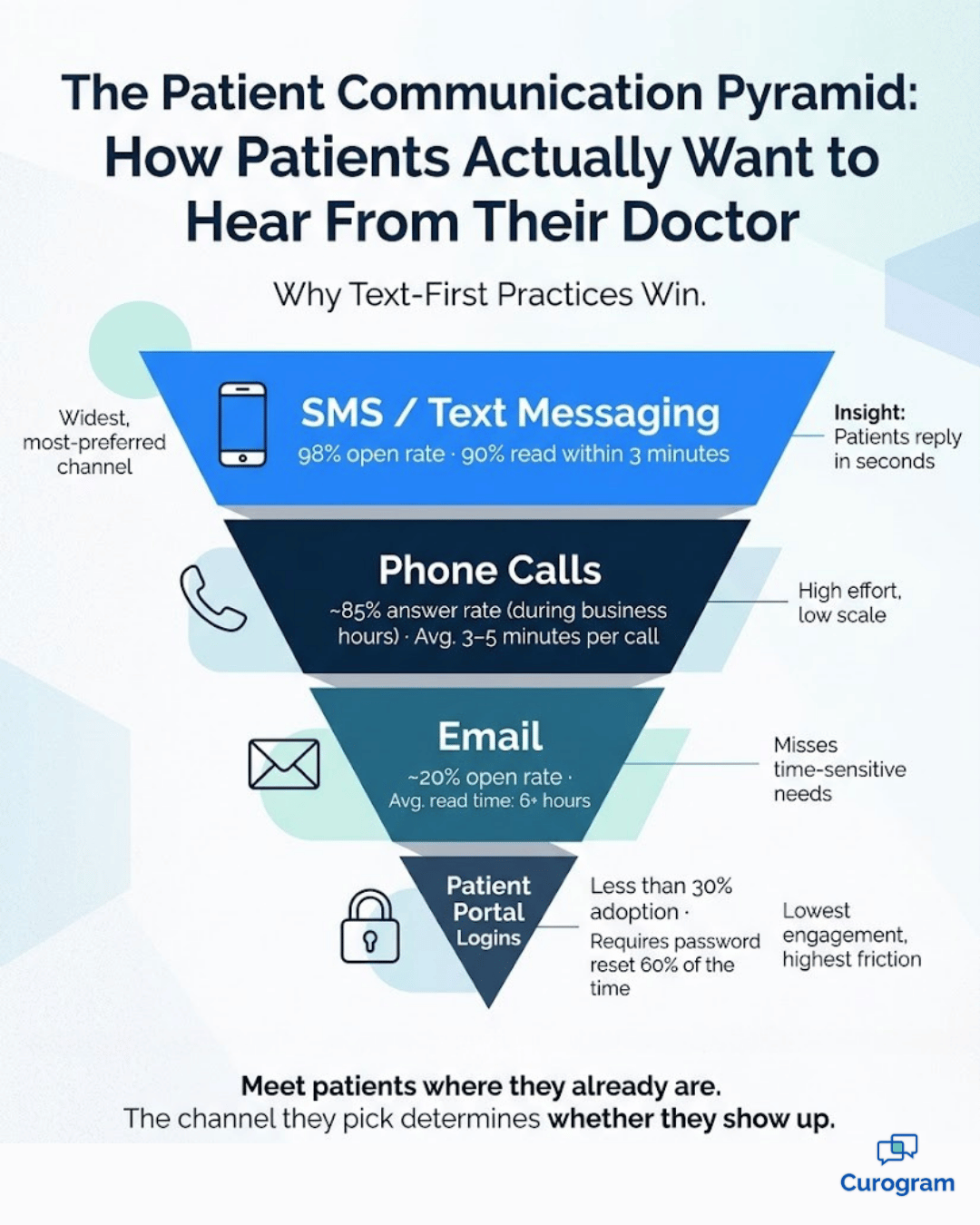
- Patient portals: Most patients won't reset a password to send a one-line message. They'll text their kid's coach all day but won't log in to ask about parking.
- Email: Gets read late, if at all. Useless for time-sensitive confirms or reschedules.
- Voicemail: Adds another layer of phone tag instead of removing one.
- Bolt-on reminder tools: Send more outbound messages but still can't accept a reply.
The only channel that actually reaches patients is the one InTouch can't complete:
SMS. Not more reminders. Not another app. A real conversation channel layered onto the system you already use.
Curogram: The Conversation Layer Meditab IMS Was Missing
Curogram doesn't replace Meditab IMS. It sits beside it.
Think of it this way:
IMS handles the chart, the billing, and the clinical record. Curogram handles every patient conversation that happens outside the exam room.
One platform. One dashboard. About 10 minutes of training for staff to get comfortable with it.
Patients don't download anything. They don't log into anything. They just text — the way they already do with everyone else in their life.
How Two-Way HIPAA-Compliant SMS Actually Works
Here's the simple version of secure patient texting with IMS integration.
A patient gets a reminder text from your practice.
They reply directly to that text — "Confirmed," "Need to reschedule," or "What time should I stop eating before the procedure?"
That reply lands in the Curogram dashboard in real time. Your staff see it next to every other active conversation, color-coded and time-stamped. They can reply in seconds.
Every message is encrypted. Every conversation is logged. The platform is fully HIPAA-compliant and SOC 2 Type II certified, with a Business Associate Agreement in place.
The HIPAA-compliant SMS for Meditab practices conversation looks and feels exactly like a regular text to the patient — but on your end, it meets every requirement your compliance team needs.
For multi-specialty clinics, replies can route automatically. Dermatology questions go to dermatology staff. GI prep questions go to the GI team. The general front desk stops being a switchboard.

How It Connects to Meditab IMS
Curogram pulls appointment and patient contact data from Meditab IMS, so your staff aren't keying information into two systems. The integration handles the heavy lifting in the background.
Onboarding is straightforward and includes:
- A dedicated onboarding specialist who runs setup end-to-end.
- Two-way appointment and contact data sync with your existing IMS configuration.
- Staff training that takes about 10 minutes per team member.
Most practices are fully live within 48 hours, with no long-term contract required. That's the whole shape of two-way text messaging Meditab front desk staff can actually run on their own.
Why This Fits Specialty Practices Especially Well
Specialty practices feel the communication gap hardest because their patients have specific, often time-sensitive questions.
A dermatology recall.
A colonoscopy prep.
A pain management injection series schedule.
Phone calls don't scale for any of this. Two-way texting does. Patients get answers fast, and your staff handle four to five times the volume in the same hours.
Automation, done right, actually feels more personal than a phone tree. The patient gets an instant response. That's what they wanted in the first place.
What Changes When the Phones Stop Ringing
The shift isn't subtle. It's the difference between reactive and proactive work.
Covina Arthritic Clinic confirmed more than 1,100 appointments per month through Curogram's automated platform. To handle that by phone would have required multiple full-time staff members doing nothing else. Instead, the system handled it quietly, and the team focused on patients in front of them.
From Phone Tag to Text-First
Most Meditab practices that adopt the Meditab IMS patient texting workflow Curogram offers report a sharp drop in routine inbound calls within the first month.
That's not theoretical. That's the practice's own phone log.
50%+ Drop in routine inbound calls within the first month — freeing up roughly 4 staff hours per day at a 40-visit practice.
The no-show side of the ledger moves just as fast. Practices typically see no-show rates drop from 15–20% down to 7–10% within a few weeks of going live, simply because patients now have a frictionless way to confirm or reschedule.
For a 40-visit-per-day practice, that's 80–100 recovered visits a month — roughly $12,000–$15,000 in revenue that used to disappear into empty slots.
For your team, this means mornings spent on patient care instead of phone tag. The practice manager finally has bandwidth for the work that grows the business — recall campaigns, reviews, new patient outreach.
That's the shift. Reduce phone calls Meditab IMS office workflows look broken because they were never designed for the way patients actually communicate today. Once they are, the whole front desk feels different.
Ready to See It Work With Your Setup? Schedule a Demo
You didn't get into healthcare to answer phones all day. Your staff didn't either.
The fix isn't another module bolted onto a system that wasn't built for two-way conversation. It's a purpose-built layer that meets your patients where they already are — on text — while leaving your Meditab IMS clinical workflow exactly as it is.
Two-way HIPAA-compliant texting for Meditab IMS practices is genuinely the single highest-impact change you can make this quarter. It hits phone volume, no-show rates, and staff burnout at the same time.
The math works. The technology is proven. And the implementation is short enough that you'll be live before your next billing cycle closes.
A quick demo with our team walks through your specific Meditab IMS setup, shows you the Curogram dashboard with real workflows from practices like yours, and covers pricing transparently — no long-term contracts, no surprise programming fees. Most practices are live within 48 hours of saying yes.
Your compliance team gets full access to our HIPAA and SOC 2 Type II documentation up front, so legal review doesn't slow you down.
Your patients already know how to text. They've been texting your competitors, their pharmacy, and their dentist for years. It's time your Meditab practice met them on the channel they actually prefer.
Schedule a demo with Curogram and see exactly how the platform works alongside your existing IMS configuration. You'll walk away with a clear picture of what your front desk could look like next month — calmer, faster, and finally focused on patient care instead of the phone.
Frequently Asked Questions
Yes. Curogram is fully HIPAA-compliant and SOC 2 Type II certified. Every conversation is encrypted, logged, and protected under a Business Associate Agreement. Your compliance team can review our security documentation before you go live, and most practices get internal approval within a few days.
The opposite, actually. Two-way texting replaces phone calls; it doesn't pile on top of them. Once patients can reply to a reminder, they stop calling for routine things. Practices consistently report a 50%+ drop in routine inbound calls within the first month, and staff manage one Curogram dashboard instead of juggling phone lines all day.
Curogram integrates with Meditab IMS to sync appointment and patient contact data, so there's no double data entry. Your dedicated onboarding specialist handles the setup end-to-end — your staff don't need to become IT experts. We're transparent about exactly what syncs and how, with no hidden programming fees or surprise add-on costs.
Most Meditab IMS practices are fully live within 48 hours of signing on. Staff training takes about 10 minutes because the dashboard works the way texting already works. There's no long onboarding period and no long-term contract.
Nothing changes for them. The phone still rings, and your staff still answer. The point of two-way texting isn't to force patients onto a new channel — it's to give the 70%+ who prefer text a way to actually use it. Your phones get quieter because the easy questions move to SMS, leaving more time for the patients who genuinely need a voice on the line.