8 min read

Two-Way Patient Texting for Meditab IMS | HIPAA-Compliant SMS

Two-Way Patient Texting for Meditab IMS | HIPAA-Compliant SMS

💡 Two-way HIPAA-compliant texting for Meditab IMS practices turns one-way InTouch reminders into real conversations between your front desk and your patients.   

Curogram layers on top of Meditab IMS so patients can confirm, reschedule, or ask a quick question by text instead of calling.  

The result: fewer phone calls, faster responses, and tighter schedules. Practices report absorbing 80+ daily calls that could have been quick text replies, while losing $20,000+ per month to no-shows that two-way texting helps prevent. 


For specialty and multi-specialty practices, it's the missing communication layer your EHR was never built to be.


Your front desk lead just hung up on her seventh call before 9 AM. Three of those callers wanted to reschedule. Two had quick questions about prep instructions. One was running late and just wanted someone to know.

Every single one of them got an automated text reminder over the weekend.

None of them could reply to it.

That's the strange paradox Meditab IMS practices live with every day. You invested in capable, all-in-one clinical software. InTouch fires off appointment reminders like clockwork. CarePortal is set up. On paper, patient engagement is "handled."

In reality, your phone lines are still a war zone.

Here's the issue. A reminder that doesn't accept replies isn't a conversation. It's a notification. And patients in 2026 don't behave like patients in 2010. They expect to text you back.

When they can't, they pick up the phone, leave voicemails, no-show, or rebook somewhere easier to reach.

This is where two-way HIPAA-compliant texting for Meditab IMS practices changes the math entirely. Not by replacing your EHR, but by adding the layer it was never designed to handle: real, secure, two-sided patient conversations.

In this article, we'll walk through why InTouch alone leaves money on the table, what the financial damage actually looks like in your practice, and how a HIPAA-compliant SMS for Meditab practices closes the gap.

You'll also see how a two-way text messaging Meditab front desk workflow plays out in practice, and what specialty offices in dermatology, GI, pain management, and primary care are doing differently.

Let's start with the villain almost no one names out loud.

When "All-in-One" Quietly Breaks Down

Meditab IMS has earned its reputation. With templates across more than 40 specialties, deep customization, and an all-in-one architecture that handles EHR, billing, and practice management under one roof, it's a serious clinical platform. That's not in dispute.

The problem is what gets assumed because of it.

The All-in-One Illusion

InTouch, the native engagement module, sends one-way automated reminders. Patients receive a text. They cannot reply. The "engagement" box is checked on a feature comparison sheet. But the conversation never actually starts.

This is what we'd call the all-in-one illusion. You bought a complete system, so it must be complete. Except patient communication isn't complete unless your patients can talk back. And that gap isn't theoretical — it shows up the moment your phones open Monday morning.

A Typical Monday Morning at a Meditab Practice

Walk through a real scenario. Over the weekend, InTouch sent out 45 appointment reminders. Eight patients want to reschedule. Three have questions about colonoscopy prep. Two are running late. One isn't sure if their insurance changed.

None of them can reply to the reminder text. So all of them call.

By 8:01 AM Monday, every line is lit up. Each call eats 3 to 5 minutes of front desk time. A two-sentence text exchange would have closed the loop in 15 seconds. Meanwhile, the new patient who genuinely needs help getting through the door is stuck on hold listening to your voicemail menu.

This is not a staffing problem. It's a channel problem. And once you see it that way, the financial damage starts to make a lot more sense.

The Real Financial Drain

Let's put numbers on it.

A practice seeing 40 patients per day with a conservative 15% no-show rate loses about 6 appointments daily.

At $150 average reimbursement, that's $900 a day.

Over a month, you're looking at $18,000 to $20,000 in walked-away revenue.

Specialty practices have it worse. Pain management, psychiatry, and dermatology routinely see 25% to 50% no-show rates, which pushes losses to $25,000–$30,000 per month for a single-location practice.

Practice Type Daily Visits No-Show Rate Monthly Lost Revenue
Primary Care 40 15% ~$18,000
Dermatology 50 20% ~$30,000
Pain Management 35 35% ~$33,000
Multi-Specialty 60 18% ~$32,000

These aren't hypothetical figures. Curogram prospect data consistently shows practices calculating 222+ no-shows per month before they go looking for a fix.

For your team, that means revenue you've already earned through marketing, scheduling, and clinical prep just dissolves.

The Quiet Cost Nobody Puts on a Spreadsheet

The practice manager feels this one personally. She championed the all-in-one purchase. She trained the team. She followed the vendor's playbook to the letter. And the front desk is still drowning, patients still complain about hold times, and the doctor still walks past empty exam rooms and asks why.

There's a quiet shame in admitting the tools you're paying for aren't working. Most of the time, they're not failing because they're bad. They're failing because something is missing — the ability for your patients to text you back.

A Layer Built for the Conversations You're Already Having

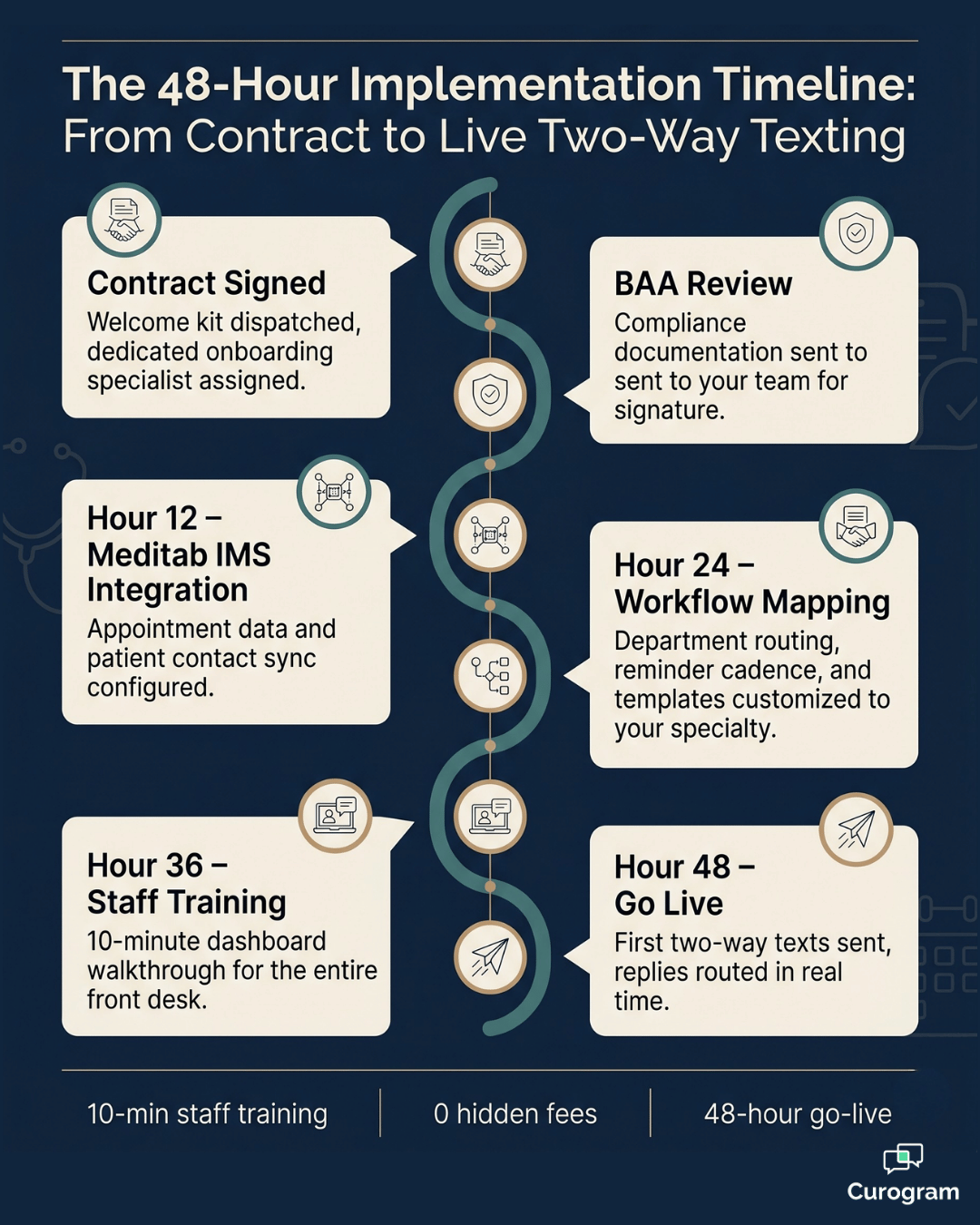
48-hour implementation timeline for two-way HIPAA texting in Meditab IMS practices.

Curogram doesn't replace Meditab IMS. It works alongside it as a secure patient texting IMS integration that finally lets your practice carry on real conversations with patients, instead of just broadcasting at them.

The setup is intentionally light:

  • One platform and one dashboard for all patient texting.
  • One short training session for the entire front desk team.
  • No app downloads, portal logins, or password resets for patients.

That last point matters more than it sounds. Most patient engagement tools fail because they ask patients to do something new. Curogram doesn't.

How the Two-Way HIPAA-Compliant SMS Actually Works

A patient gets a text. They reply right from their phone — to confirm, reschedule, ask a question, or say they're stuck in traffic. Your staff sees every reply in real time on the Curogram dashboard, and the conversation is encrypted, logged, and HIPAA-compliant from end to end.

For multi-specialty clinics, replies route automatically to the right department. A dermatology question doesn't pile up at the general front desk — it lands with the dermatology team where it belongs.

This is the Meditab IMS patient texting workflow most practices assumed they already had. They didn't. Now they can.

The Integration With Meditab IMS

Curogram integrates with Meditab IMS to sync appointment data and patient contact information, keeping your texting connected to the clinical workflow without forcing staff to bounce between systems for routine communication.

That means no double entry. No copy-paste. No "let me pull up the chart while you hold." When a patient confirms by text, the practice knows. When they ask to reschedule, your team can act on it without leaving their workflow — and without learning a new system.

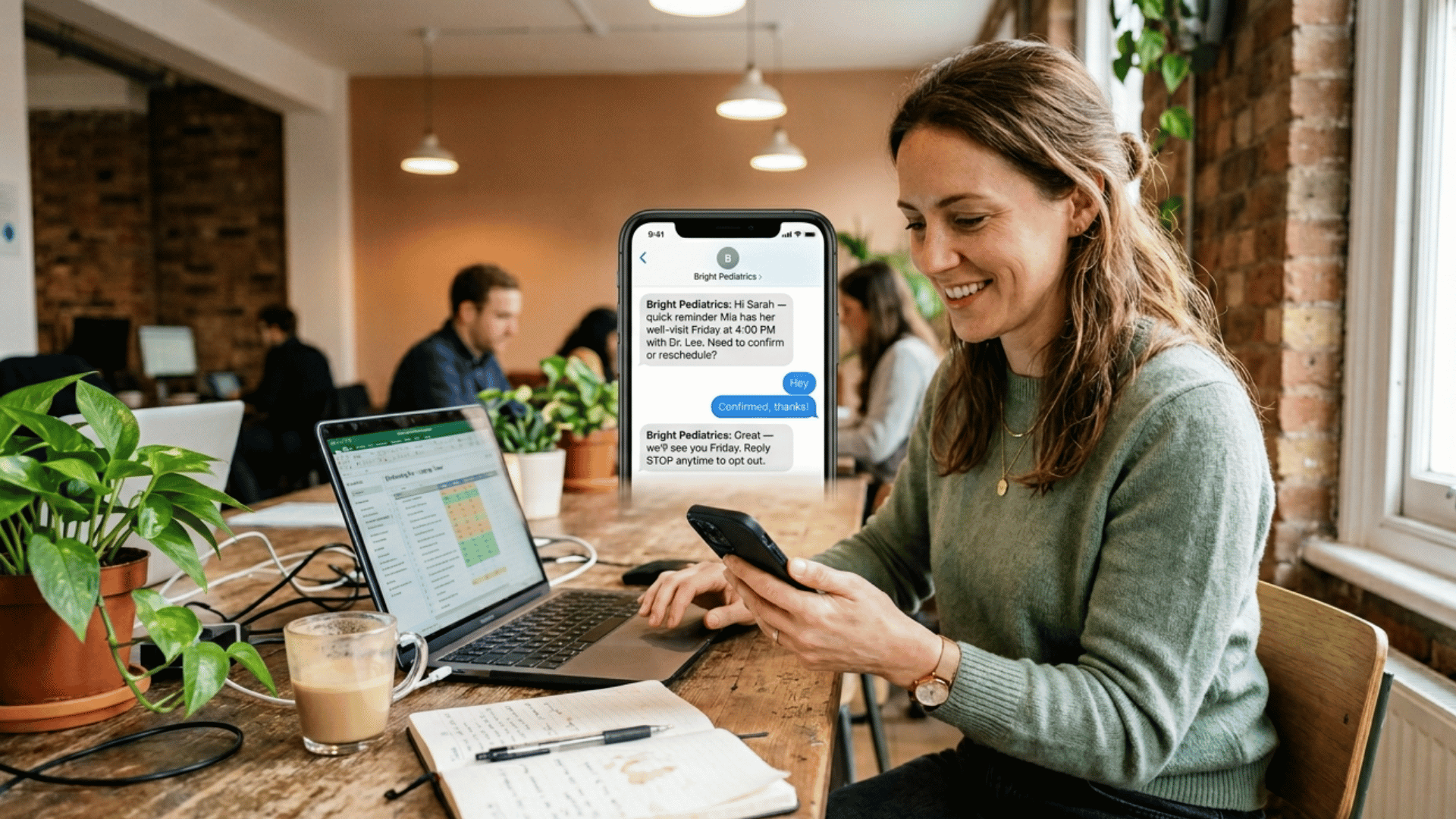
Working mom confirming her child's pediatric appointment via two-way HIPAA-compliant texting.

Why This Matters for Specialty Practices

The same platform flexes to fit very different specialties:

  • Dermatology offices manage high recall volumes for skin checks and cosmetic follow-ups.
  • Gastroenterology practices coordinate detailed colonoscopy prep instructions where missed steps cancel procedures.
  • Pain management clinics track injection series and check in between visits.
  • Pediatric offices reach parents who never answer unknown numbers but always read texts.

Automation here actually feels more personal, not less. Patients get instant responses instead of a phone tree. They feel known, not processed.

Patient Communication Without the Portal Headache

If you've ever asked patients to use a portal, you know the truth:

Most won't. Meditab patient communication without portal login is one of the biggest operational unlocks Curogram offers.

Patients don't have to remember a username. They don't need a password reset email at 9 PM the night before their appointment. They just text — the same way they text everyone else in their life.

That single shift is what drives the volume changes you're about to see. Text-based communication has become the default across age groups, not the exception.

What "Text-First" Actually Looks Like in Practice

The point of all this isn't more texting. It's a quieter, faster, more profitable practice. Here's what that shift looks like once it takes hold.

The Volume Tells the Story

Covina Arthritic Clinic confirmed more than 1,100 appointments per month via automated text after rolling out Curogram. Handling that confirmation volume by phone would have required multiple full-time staff just to keep up. Instead, those confirmations happen quietly in the background while your team focuses on the patients in front of them.

For your team, that means the work of three phone shifts collapses into a single dashboard.

From Reactive to Proactive

The transformation isn't incremental. Practices stop reacting to ringing phones and start managing organized conversations. Staff spend mornings supporting patient care instead of playing phone tag.

The practice manager finally has bandwidth to work on the things that grow the business — recall campaigns, online reviews, patient acquisition — instead of just keeping the lights on.

This is the part that's hard to put on a feature comparison sheet, but it's the one practices remember.

A Different Front Desk at 9 AM

Imagine your front desk one month after going live.

Instead of five lines ringing at once, your staff is scanning a tidy text thread:

  • Three patients confirmed for tomorrow.
  • One rescheduled to Thursday at 2:30.
  • One asked about parking and got a one-line reply.
  • One sent a photo of a rash to the dermatology team for triage.

All handled before the first patient walked through the door. That's what a text-first Meditab practice looks like — and that's what reduce phone calls Meditab IMS office initiatives are actually delivering when they're done right.

The Numbers, in Plain Language

Practices using Curogram routinely report a 50% drop in routine inbound calls within the first month. If your front desk handles 80 calls a day, that's 40 calls back.

At an average of 4 minutes per call, you've just returned more than 2.5 hours of staff time, every single day. Across a five-day week, that's nearly 13 hours — basically a part-time hire's worth of bandwidth, recovered.

Pair that with even a modest 10-point drop in no-show rate, and a single Meditab IMS practice can recover $10,000 to $15,000 a month before counting any new patient acquisition gains. In practice, this is what "text-first" pays for.

Open the Conversations Your Patients Want to Have 

Two-way HIPAA-compliant texting isn't a small upgrade for a Meditab IMS practice. It's the single highest-impact change you can make this quarter — because it touches phone volume, patient satisfaction, no-show rates, and staff burnout at the same time.

Meditab IMS handles your clinical workflows. Curogram handles your patient conversations. They aren't competing — one runs the chart, the other runs the relationship.

Together, they finally give your practice what the all-in-one promise was supposed to deliver in the first place.

Your patients already know how to text. They text their kids, their pharmacy, their bank, their food delivery driver, and probably their dentist. They're sitting at home wondering why their doctor's office is the only place that still requires a phone call to do anything.

It's time your Meditab IMS practice spoke their language.

You didn't get into healthcare to manage a switchboard. Neither did your team. Curogram is built for that exact swap — most practices are fully live within 48 hours, with no long-term contract, and your staff can master the dashboard in under 10 minutes.

Schedule a demo and we'll walk through your specific Meditab IMS setup, map the workflows that would benefit most from two-way texting, and show you the math on what your current phone volume and no-show rate are costing you. 


Frequently Asked Questions

Is two-way patient texting through Curogram HIPAA-compliant?

Yes. Curogram is fully HIPAA-compliant and SOC 2 Type II certified. Every text conversation is encrypted, logged, and protected under a Business Associate Agreement (BAA). Your compliance team can review our security documentation before you go live, and most practices get internal approval within days, not weeks.

Will two-way texting create double work for my staff — checking texts and the phone?

The opposite, actually. Two-way texting replaces phone calls; it doesn't stack on top of them. When patients can reply to a reminder by text, they stop calling. Practices consistently report a 50%+ drop in routine inbound calls within the first month. Your staff manages one Curogram dashboard instead of juggling phone lines all day.

Does Curogram integrate with Meditab IMS, or do we need to manually enter patient information?

Curogram integrates with Meditab IMS to sync appointment and patient contact data, so there's no manual re-entry. Your dedicated onboarding specialist handles the technical setup — your staff doesn't need to become IT experts. We're transparent about what syncs and how it works, and there are no hidden programming fees or surprise add-on costs.

How is this different from what InTouch already does?

InTouch sends one-way reminders. Patients receive them, but they cannot reply. Curogram adds the missing two-way layer, which is where almost all the real operational savings live — confirmations, reschedules, quick questions, and follow-ups that today land as phone calls.

How long does implementation actually take?

Most Meditab IMS practices are live with Curogram within 48 hours. Staff training typically takes about 10 minutes per person, because the dashboard is built around how front desk teams already work.