Skip to the main content.

8 min read

10 Reasons Why Healthcare Practices Should Offer Online Scheduling

10 Reasons Why Healthcare Practices Should Offer Online Scheduling
💡 Online scheduling lets patients book, change, or cancel appointments on their own, at any time, from a phone or computer. For healthcare practices, it cuts phone volume, fills open slots faster, and helps lower no-shows, which average about 20% nationally.

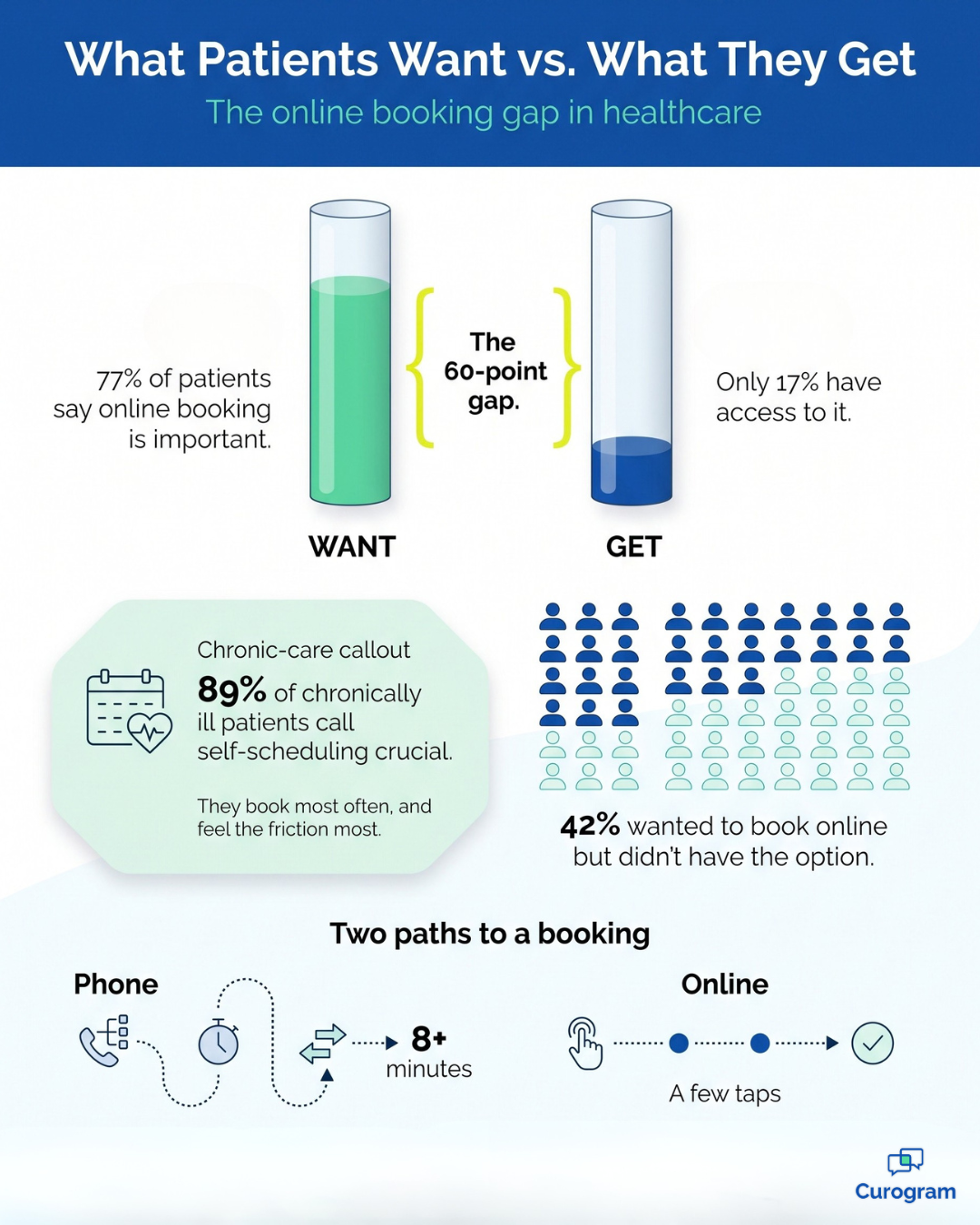
Patients want this option. Accenture found that 77% of patients value booking online, while booking by phone takes more than eight minutes on average. Practices that offer online booking draw in new patients and keep current ones loyal. They also free up front desk time for in-person care.

Platforms like Curogram pair HIPAA-compliant online scheduling with text reminders, so booking and follow-up happen in one place. Practices using Curogram's reminders and two-way texting see no-show rates 53% lower than the industry average.

Your patients can order groceries, book flights, and reserve restaurant tables from their phones in under a minute. Then they try to book a checkup with you, and suddenly they're calling, waiting on hold, getting transferred, and sometimes giving up before anyone picks up.

That gap costs your practice more than you might realize.

Nationally, about 20% of patients miss their appointments, and every missed visit is a slot that could have gone to someone else. Meanwhile, your front desk spends hours each day on the phone just to fill and refill the schedule. It's a slow, frustrating system, and patients definitely notice.

Here's the good news.

Online scheduling closes much of that gap without asking your team to work harder. Patients pick a time that works for them, day or night, while your staff handles fewer calls and your calendar fills more evenly.

It sounds like a small change. For many practices, it isn't.

Online scheduling software lets patients book with a few simple clicks from a computer or phone. It has quietly become an essential part of how modern healthcare practices operate, and forward-thinking clinics use it to reduce no-shows, prevent scheduling errors, and give patients the same easy experience they get everywhere else.

Still, some practices hesitate, often worried about losing control of their calendar or assuming patients would rather call. The data says otherwise: most patients want the option, and many will choose one practice over another because of it.

In this guide, you'll find 10 clear reasons to offer online scheduling at your practice. Each one covers a practical benefit, from patient loyalty and revenue to staff workload and the overall patient experience.

By the end, you'll understand how this one tool can save time, fill your calendar, and help keep your patients healthier.

1. Creates Patient Loyalty

Patients want more control over their care, and that control starts with booking. According to Accenture, 77% of patients say being able to schedule online is important to them. Among patients managing chronic conditions, that number climbs even higher, to 89%.

Think about why. Chronic care patients visit more often, so they feel the hassle of phone booking more than almost anyone else. When you make scheduling fast and simple, you give them one less reason to look elsewhere.

Over time, that convenience turns into trust, and trust is exactly what keeps patients returning to your practice year after year.

2. Accomplish More Important Tasks

Every scheduling call takes a few minutes. Multiply that by dozens of calls a day, and your front desk loses hours to a task patients could easily handle on their own.

An online appointment scheduling system takes much of that load off your team. When staff aren't tied to the phone,

They can focus on work that truly needs a person, such as:

  • Greeting and checking in patients
  • Verifying insurance before visits
  • Answering questions about care and billing
  • Following up on referrals and test results

The result is a calmer front desk and a team with more energy for the tasks that matter. That shift improves the whole patient visit, not just the booking step.

3. Increases Your Revenue

Missed appointments are expensive. Patient no-shows cost practices an average of $6,000 per provider per month. Much of that loss comes from empty appointment slots that nobody had an opportunity to fill.

Online scheduling helps in two important ways. Patients book times that fit their busy lives, which makes them more likely to show up, and any slot that opens becomes visible to other patients right away.

Here's an illustrative example of what a modest drop in no-shows could mean for one provider.

These numbers are sample figures, not data from a specific practice.

Monthly snapshot (illustrative) Before online scheduling After online scheduling
Booked visits per provider 300 300
No-show rate 20% 15%
Missed visits 60 45
Lost revenue (at $100 per visit) $6,000 $4,500

In this example, a five-point drop in no-shows saves $1,500 every month, which equals $18,000 a year for a single provider.

For a five-provider clinic, those recovered visits add up to roughly $90,000 annually.

4. Preferred By Patients

There's a noticeable gap between what patients want and what most practices actually offer.

42% of surveyed patients said they would have preferred to book online but didn't have the chance. Only 17% said they had access to online booking at all.

This means most patients who would prefer to book online still can't. When you add online scheduling, you meet a need that many competing practices continue to ignore, and that difference alone can help you stand out.

5. Attracts Prospective Patients

These days, most people only make phone calls when they have to.

They know what's waiting for them when they call a medical office:

  1. An automated phone tree with too many options
  2. A long wait on hold
  3. A transfer to the wrong person
  4. Another hold before they can finally book

For someone comparing new providers, that experience is often enough reason to move on. Online scheduling removes every one of those steps. A new patient can find your practice, see open times, and book in minutes, often before they'd even think to call another office.

6. It Fills Calendar Slots

Using online scheduling makes medical practices much more likely to fill empty slots on their calendar. If your online calendar shows real-time availability, patients looking for a same-day appointment will likely take the first available appointment.

7. Always Accessible

Before online scheduling, patients could only book during office hours. That's a problem, because many people can only think about their health after work or late at night.

With online scheduling, patients can visit your website, check a provider's availability, and book at any hour.

This helps people like:

  • Working parents who plan their week on Sunday night
  • Shift workers whose free time falls outside office hours
  • Caregivers who manage visits for a family member

Patients can plan their visit around their lives. Meanwhile, your practice keeps taking bookings even when the office is closed.

Infographic comparing patient demand for online scheduling with how few practices offer it

8. Reduces Patient No-Shows and Cancellations

Online scheduling does more than simplify booking. It changes how patients feel about the appointment they chose.

Patients Show Up When They Choose the Time

When patients see that you value their time, they're more likely to value yours. Letting them choose their own appointment slot gives them a genuine sense of ownership. People tend to keep commitments they made for themselves.

Easy Rescheduling Means Fewer Silent No-Shows

Online scheduling also gives patients the freedom to change their plans. Instead of simply skipping a visit, they're more likely to notify your office when they need to reschedule or cancel. That advance notice gives your team valuable time to react.

Open Slots Get a Second Chance

When a patient cancels, that slot immediately opens up for someone else, which helps prevent lost revenue from empty, non-billable hours. Pair online booking with automated appointment reminders, and the effect becomes even stronger.

Key Takeaway: Start Small and Expand

You don't have to open your whole calendar to online booking on day one. Start with the visit types that are easiest to schedule, such as follow-ups, annual checkups, and new patient visits, while keeping complex or lengthy appointments on the phone for now.

Set clear rules, like buffer times and daily limits, so your providers never feel overbooked. After 30 days, review your no-show rate, your call volume, and the number of bookings that came in online, then expand to additional visit types based on what's working.

9. Improves Patient Experience

Booking by phone usually takes longer than most people expect. According to a study by Accenture, it takes patients more than eight minutes to book a medical appointment by phone, counting time on hold or being transferred.

Here's how the two options compare from the patient's side:

  Phone booking Online booking
Time to book 8+ minutes on average A few clicks
When patients can book Office hours only 24/7
Hold times and transfers Common None
Same-day and next-day openings Depends on who answers Visible in real time
Changing a visit Requires another call Done online in moments

For your patients, this means less waiting and greater control. For your practice, it strengthens loyalty and retention, which leads to more business over time.

That's the heart of a positive patient experience.

10. Reduction In Administrative Work

Your front desk juggles many responsibilities at once, since billing, phone calls, check-ins, and paperwork often land on the same few people simultaneously. When that happens, hold times increase, mistakes slip in, and patients can feel rushed.

Online scheduling takes one of the biggest tasks off that list. Patients enter their own details and choose their own times, so no one has to transcribe information from a phone call, which also means fewer double bookings and scheduling errors.

The payoff can be large. Practices using Curogram's patient communication tools have cut call volume by up to 50% and raised front desk productivity by more than 30%. For your team, that translates into more time for the patients standing in front of them and more focus for complex administrative work.


Integrate Seamless Online Scheduling into Your System with Curogram

Online scheduling is no longer a nice extra. Patients expect it, and it's one of the simplest ways to operate a smoother, more profitable practice.

Consider what these 10 reasons add up to. Patients get a faster, more convenient way to book at any time of day, and your team spends less time on the phone and more time with the people in front of them. Your calendar fills more evenly, fewer patients skip their visits, and last-minute openings get a valuable second chance.

Best of all, none of that requires additional staff or extended hours.

The practices that move first typically gain the most. Since relatively few providers offer online booking today, adding it helps you stand out to prospective patients. It also shows your current patients that you respect their time, and that kind of respect builds loyalty that lasts.

Of course, the tool you choose matters. Your scheduling system should be easy for patients to use, simple for staff to manage, and designed to protect patient information at every step.

That's where Curogram comes in. Curogram offers a HIPAA-compliant online appointment scheduling system that fits the way your practice already works. Patients can book, change, or cancel visits online, and your team gets fewer interruptions and a clearer view of the day ahead. Because Curogram also handles text reminders and two-way messaging, booking and follow-up live in one place.

The result is a practice that's easier to reach and easier to run. Your providers can focus on patient care, your front desk can focus on service, and your patients get the same convenience they already enjoy everywhere else.

Ready to see how it works? Book a demo to see Curogram's online scheduling in action and find out how much time your team could get back each week.


Frequently Asked Question

What is online scheduling in healthcare?

Online scheduling lets patients book, change, or cancel appointments on their own through a practice's website, patient portal, or a text link. Patients can see real-time availability and choose a time that works for them, with no phone call needed. The booking then syncs with the practice's calendar so staff always see an up-to-date schedule.

Will online scheduling cause double bookings or overbooking?

Not if the system syncs in real time with your EHR or practice management software. Each booked slot is removed from the online calendar right away, so two patients can't book the same time. You can also set buffer times, daily limits, and visit-type rules so providers never feel overloaded.

Is online appointment scheduling HIPAA compliant?

It can be, but not every tool is. Patient names, contact details, and visit reasons count as protected health information, so the platform must encrypt that data and sign a Business Associate Agreement (BAA) with your practice. Always confirm both before choosing a scheduling system.

Do older patients use online scheduling?

Many do, especially as more older adults use smartphones and patient portals. Still, some patients will always prefer to call. The best approach is to offer online booking alongside phone scheduling, so every patient can choose the option that feels easiest.

How long does it take to set up online scheduling at a medical practice?

It depends on the platform and how it connects to your current systems. Many practices can go live within a few weeks. A simple way to start is to open a few visit types for online booking, track results for 30 days, and then expand from there.


How TCPA and TRACED Rules Apply to the Healthcare Industry

1 min read

How TCPA and TRACED Rules Apply to the Healthcare Industry

💡 The TCPA and TRACED Act both govern how medical practices reach patients by phone and text. They control different things. The TCPA, passed in...


Read More
The Ultimate Guide to Healthcare Communication: 35+ Strategies

1 min read

The Ultimate Guide to Healthcare Communication: 35+ Strategies

💡 Communication in healthcare is how patients, families, and care teams share what they know. It travels through speech, body language, written...

Read More
Patient Communication Evolution: Phone to Multi-Channel Guide (2026)

1 min read

Patient Communication Evolution: Phone to Multi-Channel Guide (2026)

💡 Patient communication evolution refers to the shift from phone-only contact to multi-channel outreach in healthcare. For years, medical...

Read More