
How Telehealth Improves the Patient Experience
One way to improve the patient experience is to implement telehealth in your medical practice. Telehealth offers benefits to patients and providers.
7 min read
Most of a patient’s relationship with your practice happens outside the exam room. It’s the refill question at 9 p.m., the lab result they don’t understand, and the visit they need to move because their child woke up sick.
When all of that has to go through the phone, the relationship stalls. The patient sits on hold. Your front desk has two lines ringing and a patient at the window, so the question waits for a callback two days later.
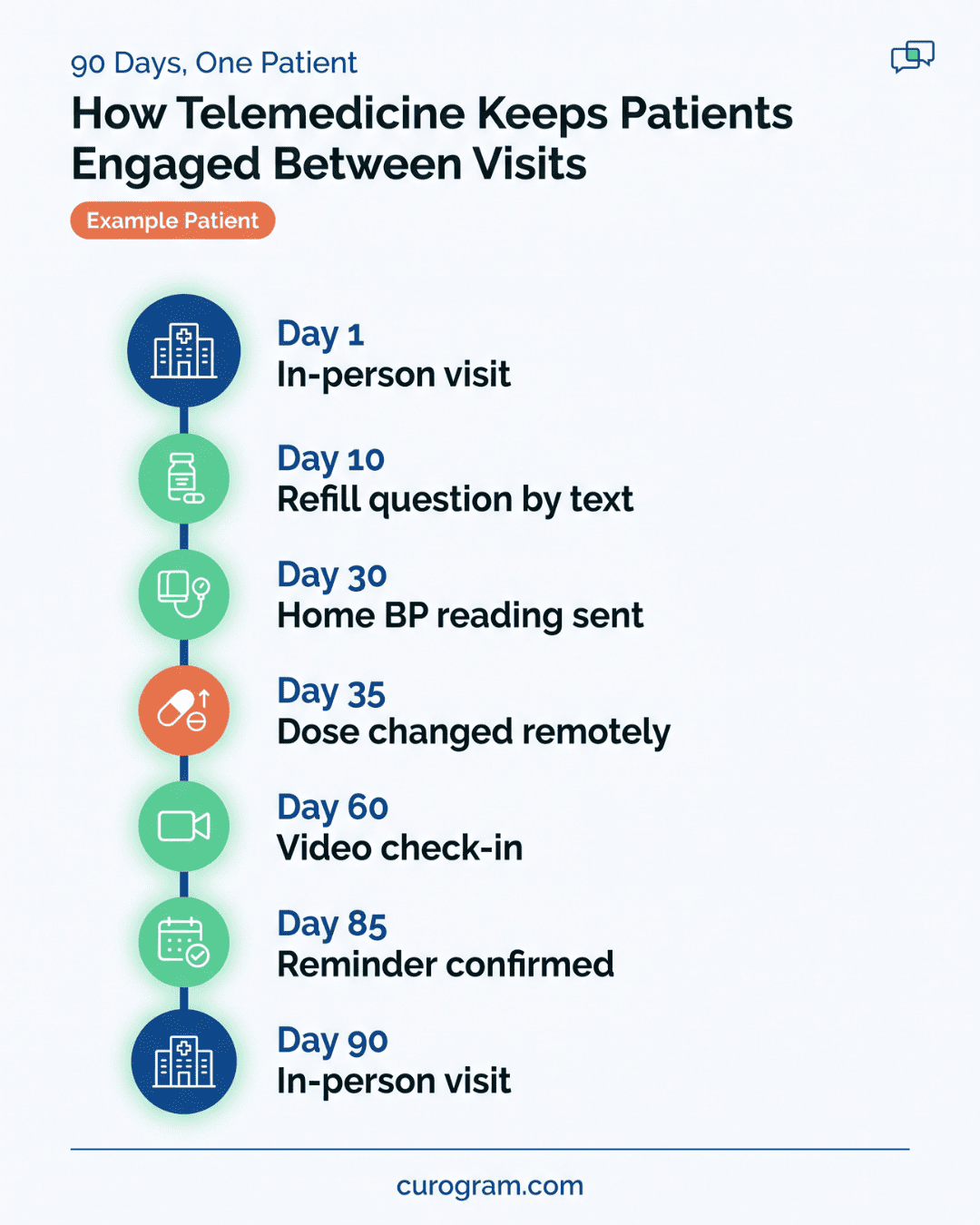
Telemedicine closes that gap. Texts, video visits, and readings sent from home let patients reach you between appointments.
That steady contact builds more trust than a 15-minute visit every few months can build alone, and it moves your practice toward patient-centered care.
The effect shows up on the practice side, too. Based on our internal data, automated texting cuts inbound calls by 24%. Atlas Medical Center brought its no-show rate down from 14.20% to 4.91% in three months.
Telemedicine isn’t new. Doctors used it for years before COVID-19, and the pandemic made it part of everyday care.
Many patients tried their first video visit in 2020. The CDC now lists remote care for hospital follow-ups, chronic care coaching, and home blood pressure checks.
In our view, that shift raised the bar for every practice. Patients expect faster answers, more say in their treatment, and fewer trips to the clinic for questions a text could settle. Practices that meet those expectations keep patients longer and spend less staff time on the phone.
The Health Resources and Services Administration (HRSA), part of the U.S. Department of Health and Human Services, defines telemedicine as using electronic tools to give care from a distance.
HRSA’s definition covers more than patient visits. It also includes public health work and health education for patients and providers alike.
The tools behind it are mostly ones your team already uses:
For some conditions, a remote visit can do the same job as an office visit. Research points to sudden childhood illness, minor injuries, and breathing problems, as well as early COVID-19 screening.
The pandemic made this real for millions of patients. Many tried a video visit for the first time in 2020, and telemedicine reached far more of the country than it had before.
An in-person exam still has a place. Some problems only show up when a doctor can listen, press, or look closely. Telemedicine gives patients another way to reach that doctor when a trip to the clinic isn’t practical.
The Centers for Disease Control and Prevention (CDC) lists these uses for remote care:
| Type of care | How the CDC says remote care can help |
|---|---|
| Post-hospital | Follow-up after a hospital stay |
| Urgent care | Low-risk urgent care for conditions other than COVID-19 |
| Triage | Spotting patients who need more testing or an in-person visit |
| Chronic care coaching | Support for weight management, nutrition, and other ongoing conditions |
| Therapy | Physical and occupational therapy that mixes in-person and virtual sessions |
| Remote monitoring | Tracking readings like blood pressure and blood glucose |
Two things drove the rapid growth: better technology, and providers getting good results with it. That growth has changed how patients and doctors work together. The next section starts with how that relationship works.
The American Medical Association’s Code of Medical Ethics says a patient-doctor relationship begins when a physician starts caring for a patient’s medical needs. It grows through clear talk, shared decisions, and patient education. Over time, those build trust and loyalty.
How strong that bond is can affect how well patients do. In its basic form, the relationship follows a familiar path:
Real visits carry more than that list shows. A patient may share fears or habits they haven’t told anyone else, like skipping doses because the copay is too high. Patients also help shape their own care plan based on what they understand and believe will work for them.
Trust built this way supports recovery and overall well-being. For a long time, though, care was provider-centered. The doctor’s view drove most decisions.
That has changed in recent years. Patients are now seen as active partners, which is the core of the patient-centered care model:
| Provider-centered care | Patient-centered care | |
|---|---|---|
| Whose view shapes the plan | Mostly the doctor’s | The doctor’s and the patient’s |
| Patient’s role | Follows instructions | Plans and manages care with the doctor |
| What the doctor learns | Symptoms and test results | Also the patient’s goals, worries, and daily life |
The patient-centered model asks your practice to fit care around how patients live and make their own health choices. Telemedicine makes that easier to do day to day. It supports better care, happier patients, lower costs, and more contact between visits.
It also changes the relationship in two clear ways:
Six features of telemedicine drive these changes. Each is covered below.
Your practice can reach patients in several ways, from text messages to video visits. A refill question works fine by text. New symptoms might call for a video visit so the doctor can see and hear the patient.
You can also send automated reminders tailored to each patient. A reminder can include the patient’s name, the provider, and the visit time, and ask for a quick reply to confirm.
Small prompts like these keep patients involved in managing their own condition. Based on our internal data, Curogram’s automated reminders keep the confirmation rate above 75% across our platform.
Patients feel they can reach their providers easily, no matter how far away they live. A patient two hours from your clinic can send a question by text or join a video visit without making the drive.
That access goes both ways. Your providers can check in with patients who would otherwise wait weeks for an opening that fits a long trip. Phones, broadband, and secure messaging now make care across that distance routine.
A copay is only part of what an office visit costs a patient. Several other costs add up before they even reach your front desk:
With a virtual visit, the patient joins from home, from work, or from wherever they happen to be. Most of those extra costs drop away, and the patient keeps that money.
Patients can book a visit and see their doctor from any location, at a time that fits their day. A parent can join a video visit during a lunch break and skip asking for the afternoon off.
They also avoid two common complaints about office visits: time in the waiting room and travel time they can’t predict. A 15-minute check-in stays a 15-minute check-in.
When patients can text your practice, fewer of them call. Each reschedule that comes in by text is one less call your front desk has to take while a patient waits at the window.
Curogram lets patients book, cancel, and reschedule appointments by text, and that also cuts no-shows. Based on our internal data, practices using our platform have seen these results:
| What changed | Result |
|---|---|
| Inbound calls with automated texting | 24% fewer |
| Overall phone volume | Up to 50% lower |
| Front desk productivity | 30%+ higher |
| No-show rate at Atlas Medical Center | 14.20% down to 4.91% in three months |
Distance used to limit how often patients and doctors could talk. Telemedicine closes that gap. A text, a video visit, or a home blood pressure reading keeps both sides in touch between appointments.
That steady contact is how the relationship grows. It also moves more practices toward patient-centered care, where patients and doctors share the work of diagnosis, treatment, and recovery.
Patients have more control over their healthcare than they used to, and they expect a bigger say in it. Your practice should make that easy.
In our view, the practices that hold on to patients are the ones that answer simple requests by text: confirmations, reschedules, refill questions, and quick follow-ups.
Those small requests are also what jam your phone lines. When they move to text, your front desk can focus on the patient standing at the window. Your providers spend visit time on care.
Curogram brings two-way texting, automated reminders, and telemedicine together in one HIPAA-compliant platform. Patients can book, cancel, and reschedule on their own. Your staff stays in the loop without picking up the phone.
Schedule a demo to see how Curogram fits your clinic’s workflow and keeps your patients connected between visits.

One way to improve the patient experience is to implement telehealth in your medical practice. Telehealth offers benefits to patients and providers.
 Carylee Gali : 4/4/22, 7:00 AM
Telehealth helps establish patient engagement and expands care beyond the office using video conferences, SMS, and remote patient monitoring (RPM).
Learn how two-way SMS can streamline telehealth, boost patient communication, and ensure HIPAA compliance for your care practice with an actual case...