Smart Appointment Reminders That Reduce No-Shows Fast
💡 Medical practices lose thousands of dollars every month from missed appointments. Automated appointment reminders help solve this problem by...
13 min read
Aubreigh Lee Daculug
:
February 14, 2026
Every medical practice faces the same frustrating problem. Patients miss appointments without warning. Your front desk spends hours making reminder calls that often go straight to voicemail. Empty appointment slots mean lost revenue and wasted provider time.
The solution isn't more phone calls. It's smarter technology that works automatically. An EMR-integrated reminder system can transform how your practice handles appointments. Instead of chasing patients, you can let technology do the work.
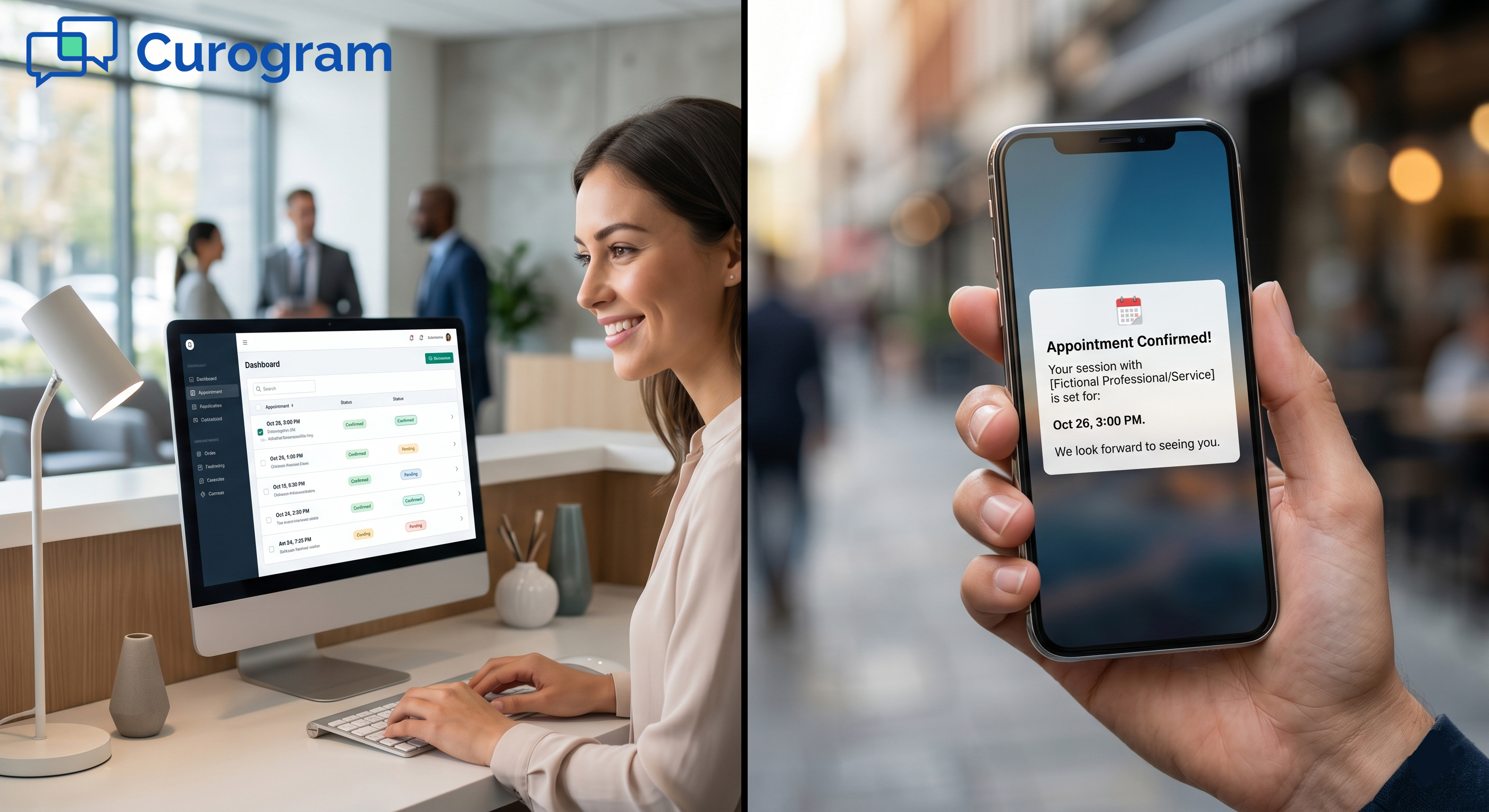
Smart appointment reminder systems send patient appointment confirmation SMS messages at the right times. They connect directly to your practice management software. When patients respond, the system updates their status automatically. No double entry. No missed communications. No surprise no-shows.
This approach doesn't just save time. It fundamentally changes how your practice operates. Your staff shifts from making endless calls to coordinating care. Your patients get convenient text reminders instead of disruptive phone calls. Everyone wins.
Beyond just appointment reminders, these systems can send follow-up messages, preventive care notifications, and post-visit instructions. Patients feel supported and informed, while your team stays organized and proactive.
The best part? Modern reminder systems take less than 10 minutes to learn. They work with almost any EMR. And they start reducing no-shows from day one. Over time, they not only improve efficiency but also strengthen patient relationships, boost satisfaction, and increase revenue.
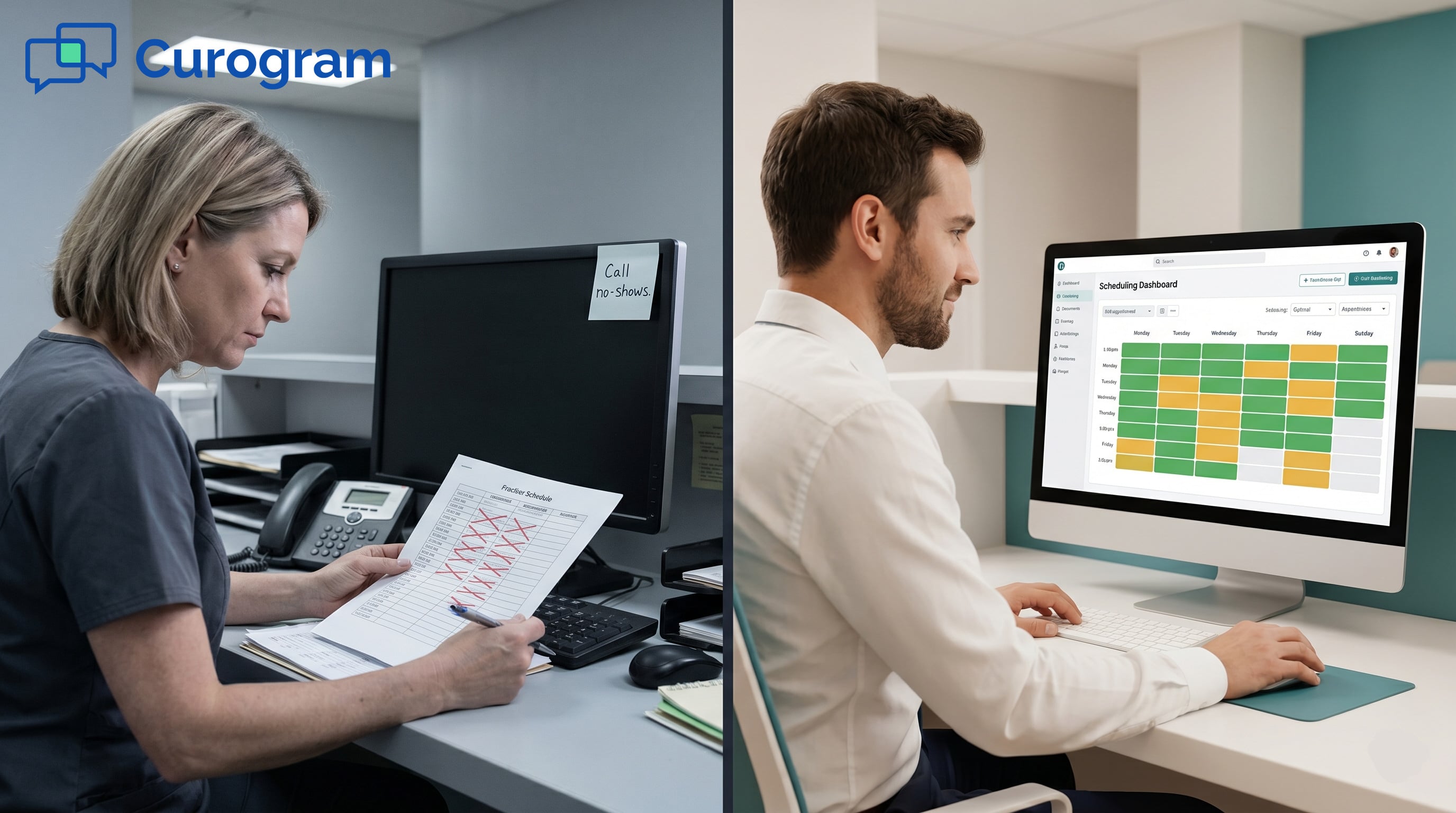
Manual reminder calls create a cycle that never ends and do little when it comes to reducing no-shows. Your staff picks up the phone. They call patients days before appointments. Half the calls go to voicemail. Some patients don't call back. Others forget to show up anyway.
This phone tag cycle wastes valuable time. Front desk staff spend hours each day on reminder calls. That time could go toward patient care or other important tasks. But the calls never stop because appointments keep getting scheduled. The cycle repeats itself week after week, consuming staff energy and practice resources without delivering reliable results.
Unfilled appointment slots hurt your bottom line in ways that extend far beyond the obvious. Every no-show appointment represents lost revenue that can never be recovered. Your provider sits idle during those gaps. Your exam rooms stay empty. Support staff wait with nothing to do.
Consider the ripple effect across your entire practice:
The financial impact becomes even more significant when you factor in these fixed costs. Your overhead continues regardless of how many patients walk through your door. This makes every empty slot a direct hit to your practice's profitability.
The worst part comes during busy shifts when your team needs efficiency the most. Manual reminders become the first task that gets dropped. When the waiting room fills up, when phones ring constantly, when emergencies happen - reminder calls get delayed or skipped entirely. This inconsistency leaves patients unprepared and your schedule at risk.
Manual systems also lack real-time updates. Even when staff reach patients by phone, they must manually note confirmations in the EMR. This double entry takes more time and creates chances for errors. A patient might confirm but the note never gets recorded. Another staff member might call the same patient twice. The lack of synchronization creates confusion and wastes additional time.
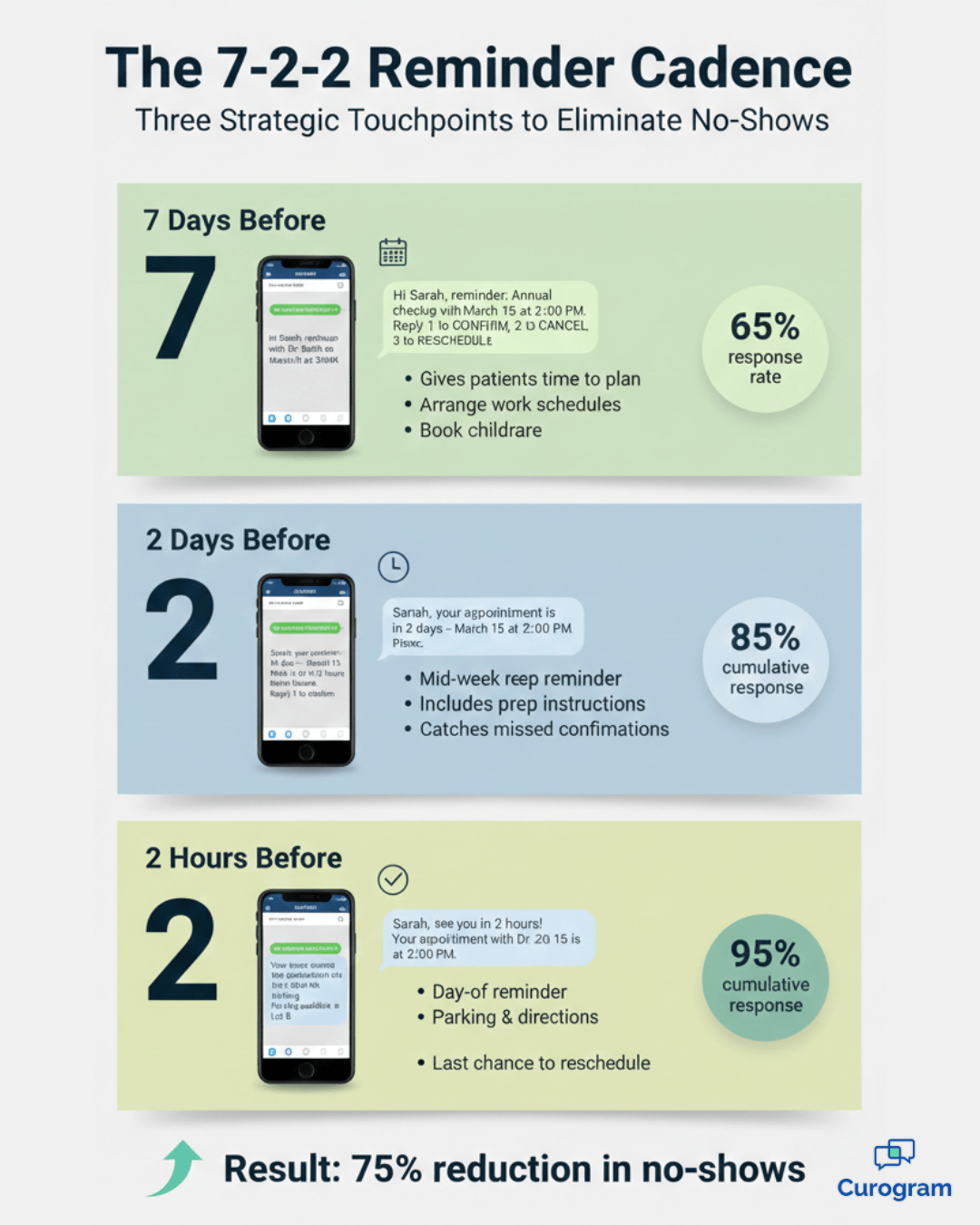
A smart reminder cadence works like a safety net with multiple layers, catching patients at different stages of their journey to your office.
The system automatically sends messages at strategic intervals designed to maximize confirmation rates:
These automated triggers run without any staff intervention whatsoever. The system checks your schedule automatically and sends messages at exactly the right times. No one needs to remember to make calls or check reminder lists. The EMR-integrated reminder system handles everything in the background, working around the clock to keep your schedule optimized and your patients informed.
The timing of these reminders is based on research into patient behavior and response patterns. The first reminder at seven days gives patients enough time to request time off work or arrange childcare if needed.
The two-day reminder catches those who forgot about the initial message. The same-day reminder serves as a final nudge to ensure the appointment stays top-of-mind amid busy daily schedules.
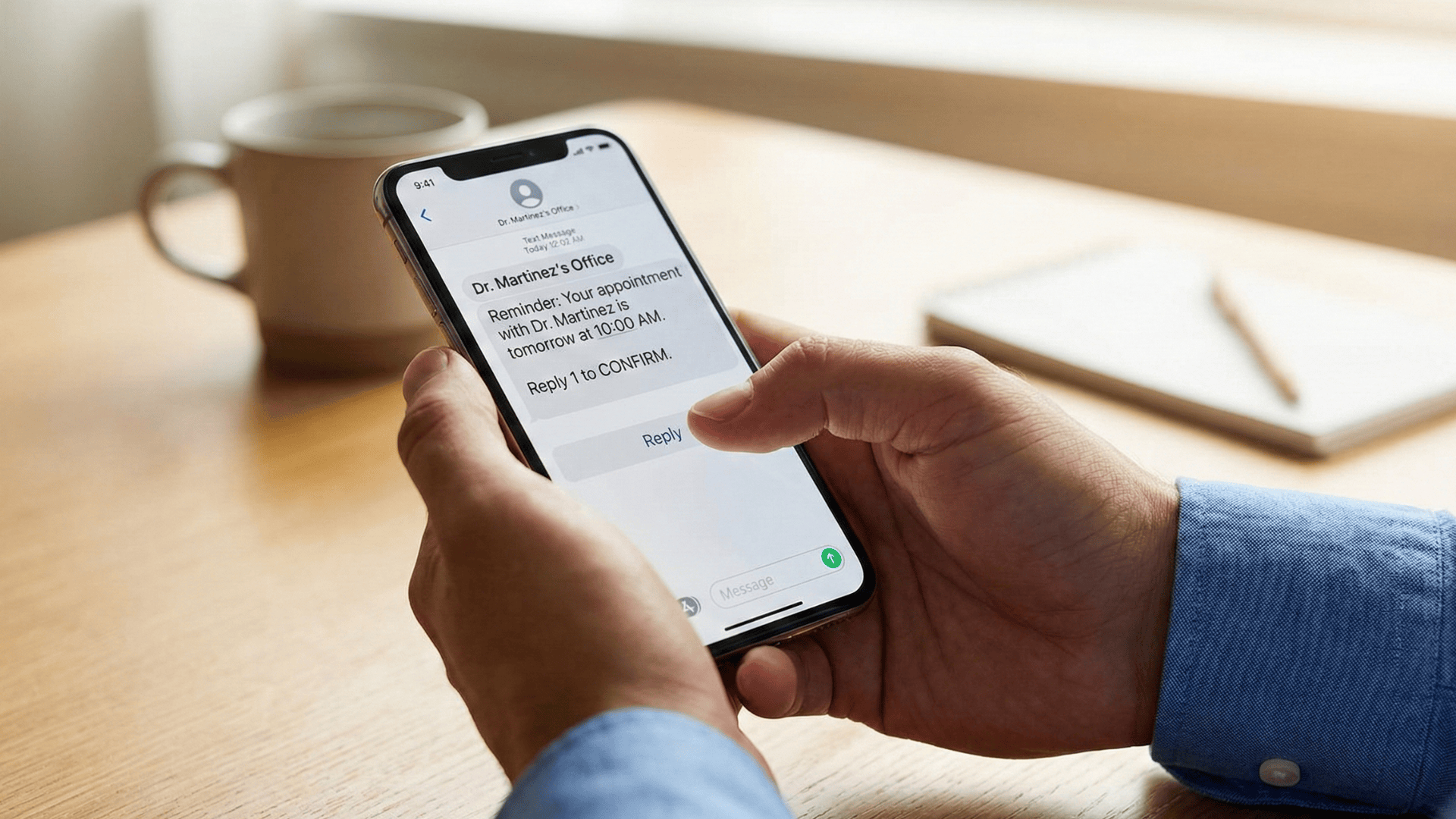
Two-way interaction makes these reminders truly smart and transforms the patient experience completely. Patients receive a text with simple, clear options that require minimal effort. Reply "1" to confirm. Reply "2" to cancel. Reply "3" to reschedule.
The system processes these responses instantly and updates your EMR in real time. Your staff sees current status for every appointment without making a single call or checking multiple systems.
This immediate feedback loop changes everything about appointment management in your practice. Instead of wondering who will show up, your team knows exactly who's confirmed and who needs follow-up.
When a patient cancels, the system can immediately alert staff about the newly available slot. Some advanced systems can even automatically offer that time to patients on a waiting list, filling gaps before they become revenue losses.
The simplicity of the response system matters more than many practices realize. Patients don't need to compose a message or call back. A single digit reply is all it takes. This low barrier to response dramatically increases confirmation rates compared to systems that require more complex interactions.
Personalization happens at scale with smart systems in ways that manual processes could never achieve. A wellness checkup reminder might include fasting instructions and a note about updating medication lists. An imaging appointment text explains prep requirements and what to wear for the procedure.
A specialist visit reminder lists documents to bring and parking information. The system customizes each message based on appointment type, provider preferences, and patient history - all automatically without any staff input.
This level of customization would be impossible with manual calls for most practices. Staff would need to look up prep instructions for each patient individually. They would need to remember different details for different visit types. They might forget important information or deliver it inconsistently from patient to patient.
Smart reminders handle all this complexity behind the scenes, ensuring every patient gets exactly the information they need in a consistent format.
The personalization extends beyond just appointment details and preparation instructions. The system can adapt language based on patient preferences, send messages at optimal times for different age groups, and even include specific provider instructions or office updates.
This attention to detail makes patients feel valued and improves their overall experience with your practice. When patients receive relevant, helpful information tailored to their specific appointment, they're more likely to show up prepared and on time.

Real-time status updates eliminate guesswork about who's coming and transform how your team manages daily operations. When a patient confirms via text, your EMR updates immediately without any manual intervention. Staff see the confirmation without checking separate systems or making follow-up calls. When someone cancels, the slot opens up right away for another patient who needs care.
This instant visibility changes how practices manage schedules throughout the day in fundamental ways. Instead of wondering who will show up, staff know the status of every appointment at any given moment.
They can reach out to unconfirmed patients proactively before the appointment time arrives. They can fill newly available slots before the day slips away. The practice runs more smoothly because everyone has current information at their fingertips, enabling better decision-making throughout the day.
The visibility extends beyond just appointment status. Your team can see patterns in patient behavior, identify which reminder times get the best response rates, and track confirmation trends over time. This data helps you continuously optimize your reminder strategy for even better results.
No double entry means no wasted time transcribing notes and no risk of transcription errors that plague manual systems. Staff don't need to update charts with confirmation details after every phone conversation. They don't need to manually mark appointments as confirmed in your scheduling system.
'The patient appointment confirmation SMS system syncs directly with your EMR, creating a single source of truth. What patients text becomes part of the record automatically, maintaining a complete audit trail without any additional work.
This elimination of double entry saves more time than most practices realize. Consider how many appointments your practice schedules each day. If each confirmation requires even just 30 seconds of data entry, those seconds add up to hours of wasted time each week. Smart reminder systems redirect that time toward activities that actually improve patient care.
Virtual care integration makes telehealth appointments seamless and eliminates common points of confusion that frustrate both patients and staff. For video visits, the reminder text includes a secure link that patients can click to join their appointment directly.
No need to email links separately. No confusion about how to connect or which platform to use. The automated medical reminders workflow handles this integration effortlessly, creating a smooth experience from reminder to video consultation.
This integration extends to other features that enhance the patient journey from start to finish:
The workflow benefits multiply when you consider the entire patient journey from booking through follow-up care. Reminder texts can include directions to your office, parking instructions, or what to bring. Post-appointment messages can confirm next steps and provide resources. This comprehensive approach to patient communication strengthens relationships and improves outcomes while requiring minimal staff time.

Moving reminders to SMS cuts phone call volume by 50% or more in most practices. Your front desk stops spending hours on outbound calls every single day. They handle incoming calls faster because fewer patients call to confirm or ask basic appointment questions.
This time savings adds up to hours every single day - time that can be redirected to activities that truly require human attention and expertise.
The impact on daily operations is immediately noticeable from the first day of implementation. Phone lines that used to be constantly busy become more manageable. Staff who felt perpetually behind on tasks suddenly find they have breathing room in their schedules.
The constant stress of trying to reach every patient on the reminder list disappears, replaced by a calmer work environment.
This reduction in call volume has secondary benefits that extend throughout your practice. When staff aren't tied to the phone making reminder calls, they're available to help patients who walk in with questions.
They can focus on scheduling complex appointments that require coordination across multiple providers. They can handle billing inquiries with more patience and attention. The entire front office operates more smoothly when staff aren't overwhelmed by reminder call obligations.
A 30% productivity boost lets smaller teams handle larger patient volumes without sacrificing quality of service. One or two front desk staff can manage what used to require three or four people. They coordinate care instead of making routine calls. They help patients with real questions instead of reading reminder scripts over and over to voicemail boxes.
The transformation in staff roles includes significant shifts in daily responsibilities:
This shift has implications beyond just staffing numbers and budget considerations. Smaller, more efficient teams often have better morale because they're doing more meaningful work.
They're not burning out from repetitive tasks that feel like busywork. Job satisfaction improves along with efficiency, which helps with staff retention in an industry that struggles with high turnover rates.
The improved morale translates to better patient interactions. Staff who aren't exhausted from making hundreds of calls each week have more energy and patience for patients who need help. They can provide better service because they're not multitasking between reminder calls and patient questions. This creates a positive cycle where better staff experience leads to better patient experience.
Simplicity matters when staff are already overwhelmed with competing priorities and constant changes in healthcare technology. The best systems take less than 10 minutes to learn from start to finish. Staff log in, see confirmed appointments clearly displayed, and know exactly what to do next.
No complex training sessions that take hours away from patient care. No thick manuals that no one reads. Just a straightforward tool that makes work easier from day one.
This ease of use matters especially during onboarding of new staff members. New hires can start using the reminder system immediately without extensive training. They don't need to learn complex phone scripts or memorize reminder protocols. The system guides them through the process naturally, reducing the learning curve and getting them productive faster.
The reduced call volume also improves patient experience in unexpected ways that extend beyond simple convenience. Patients prefer text reminders over phone interruptions that come at inconvenient times during their workday.
They can respond on their schedule, whether that's during their lunch break, late in the evening, or early in the morning. They don't miss calls while at work or asleep. The whole system becomes more respectful of everyone's time and preferred communication style, which patients appreciate and remember.
Optimized provider time means seeing patients instead of staring at gaps in the schedule. When no-shows drop by 75%, providers stay busy and productive throughout their clinical hours. Every appointment slot has value. The schedule runs smoothly throughout the day without unexpected holes that disrupt workflow. Revenue increases because the practice serves more patients without extending hours or adding providers to the team.
The consistency matters just as much as the raw numbers. Providers can maintain their clinical rhythm when patients show up as expected.
They're not constantly adjusting their workflow to accommodate gaps. They can plan their day with confidence, knowing the schedule is reliable. This predictability reduces stress and allows providers to focus on delivering quality care rather than managing schedule chaos.
Full schedules also mean better utilization of your practice's resources. Exam rooms stay occupied. Medical equipment gets used efficiently. Staff members have consistent work rather than periods of frantic activity followed by idle time. The entire practice operates at optimal capacity, which improves both financial performance and team morale.
Improved patient readiness reduces bottlenecks and wait times throughout your facility in ways that patients immediately notice. Patients arrive on time when they get reminder texts on the day of their appointment. They come prepared when messages include specific instructions about fasting, medications, or documents.
Check-in moves faster because patients have had time to complete forms in advance. The waiting room flows better. Everyone's time gets used more efficiently, creating a smoother experience from arrival through checkout.
A modern convenience creates a "cared-about" experience that patients notice and appreciate deeply. Patients appreciate text reminders because texts fit seamlessly into their lifestyle and daily routines. They feel valued when the practice uses their preferred communication method.
This attention to convenience builds loyalty and satisfaction. Happy patients return for future care and enthusiastically refer friends and family members to your practice, driving organic growth.
The patient experience improvements extend beyond just the convenience of text reminders. When patients arrive prepared and on time, their entire visit goes more smoothly. They're less stressed. They have more time with their provider. They feel like the practice respects their time. These small improvements in experience add up to significant increases in patient satisfaction scores and online reviews.
The practice atmosphere changes in subtle but important ways that everyone notices. Staff feel less stressed without the constant pressure of calling through reminder lists. Providers work more productively with fuller schedules and better patient flow.
Patients experience less confusion about appointments and feel more connected to your practice. The entire workflow becomes calmer and more organized, creating a better environment for both healing and working.
Financial benefits go beyond simply preventing no-shows and the immediate revenue they represent:
The long-term benefits compound over time in ways that transform your entire practice. Practices that use automated reminder systems consistently report improved patient satisfaction scores in surveys and online reviews. Staff retention improves when team members feel less overwhelmed by administrative tasks.
Provider satisfaction increases when they can focus on medicine instead of managing schedule chaos and dealing with unexpected gaps in their day. These cultural improvements make your practice a better place to work and receive care, creating a positive reputation that attracts both patients and talented staff members.
Manual reminder calls no longer make sense for modern medical practices operating in today's fast-paced healthcare environment. They waste staff time, create inconsistent results, and still allow high no-show rates that hurt your bottom line.
Smart reminder workflows solve all these problems through smart automation and seamless integration with your existing systems.
An EMR-integrated reminder system powered by smart automation sends text messages at optimal times based on patient behavior patterns. Patients respond instantly to confirm or reschedule with a simple text reply. Your staff sees real-time updates without manual data entry. The practice runs more smoothly and profitably from day one of implementation.
The benefits extend throughout your entire operation in ways you'll notice immediately. Staff productivity increases by 30% or more. Phone call volume drops by half.
Most importantly, patient no-shows can decrease by up to 75%. These improvements start within days of implementation and compound over time.
The technology is simple to use and works with almost any EMR system on the market. Your team can learn it in minutes, not hours or days. Patients love the convenience of text reminders. Everyone benefits from a more organized and efficient workflow that respects their time.
Take the first step toward eliminating your no-show problem today. Book a demo with Curogram today to see how automated medical reminders workflow can transform your practice and improve both patient satisfaction and your bottom line.
Medical practices typically reduce patient no-shows by 60-75% after implementing smart reminder workflows. The exact reduction depends on your current no-show rate and how you configure the reminder sequence. Most practices see significant improvement within the first month. Some practices with particularly high baseline no-show rates have reported reductions exceeding 80% after optimizing their reminder timing and messaging.
Curogram integrates with almost any EMR system through standard integration protocols. The EMR-integrated reminder system syncs appointment data automatically and updates patient status in real time. Your staff doesn't need to switch between systems or enter data twice. The integration typically takes just a few hours to set up and requires minimal IT involvement.
Text message open rates exceed 98%, much higher than email or voicemail. Patients prefer receiving appointment reminders via SMS because they can respond instantly from their mobile device. The patient appointment confirmation SMS format makes it easy to confirm with a simple reply. Most practices see response rates of 70-85% for confirmation texts.
When someone cancels through an automated medical reminders workflow, the system updates your EMR immediately. Staff receive notifications about newly available slots. They can then offer those appointment times to other patients who need care. Some practices set up automated waitlist notifications, where patients on the waitlist receive immediate alerts about newly available appointments.
Yes, you can fully customize reminder messages to match your practice's voice and include specific information. You can create different message templates for different appointment types, providers, or departments. Messages can include prep instructions, parking information, forms to complete, or any other details your patients need. The system maintains HIPAA compliance while allowing complete flexibility in messaging.
💡 Medical practices lose thousands of dollars every month from missed appointments. Automated appointment reminders help solve this problem by...
Missed appointments are a significant drain on resources, revenue, and operational efficiency for healthcare practices. Understanding how to remind...
💡With automated text reminders and smart workflow automation, you can transform your clinic's front desk from a bottleneck into a seamless...