


Skip to the main content.

10 min read

What is the Impact of Online Reviews on Medical Practice Growth & ROI?

What is the Impact of Online Reviews on Medical Practice Growth & ROI?
💡 The impact of online reviews on medical practice growth shows up in two clear ways: more new patients and better search engine rankings. Practices with a high volume of 5-star Google reviews rank higher in local search results, which drives patient traffic without paid ads.

Automated patient surveys sent right after a visit turn happy patients into public advocates. This builds a strong healthcare market presence over time. The result is lower patient acquisition cost in healthcare, since organic reviews replace expensive ad spend.

Practices that use this approach see steady medical practice revenue growth and a fuller daily schedule. In short, online reviews act as a free, always-on engine that helps increase patient volume and boost long-term profitability.

Your practice delivers great care. Your staff works hard. Your patients leave happy. But none of that matters if new patients can't find you online.

Here's the problem most clinics face today. They spend thousands on ads and still struggle to fill their schedule. They pour money into flashy marketing tools that promise results but don't deliver. Meanwhile, the clinic down the street — with fewer doctors and a smaller space — stays fully booked. The difference? That clinic has 400 Google reviews. Yours has 40.

The impact of online reviews on medical practice growth is no longer a theory. It is a well-studied, well-proven fact. Patients today act like shoppers. They search, compare, and pick based on what they see online. A strong review profile does more for your bottom line than most ad campaigns ever will.

Think about how you choose a new restaurant or hotel. You check the reviews first, right? Your patients do the same thing before picking a doctor. They scroll through Google, look at star ratings, and read what other patients had to say. If your profile looks thin or out of date, they move on to the next option.

This guide breaks down how reviews drive medical practice revenue growth — and why they cost far less than most clinics think. You'll learn how to increase patient volume with a simple change in workflow. You'll see how to lower your patient acquisition cost in healthcare without hiring a single new staff member. And you'll walk away with a clear plan to build lasting healthcare market presence that pays for itself.

Let's get into the numbers.


The Growth Villain: Why a Stagnant Reputation Costs You Money

Most practices don't lose patients because of bad care. They lose them because of what patients see — or don't see — online. A stale review profile creates a silent drain on your revenue that's easy to miss but hard to fix once it builds up.

The Opportunity Leak

Every day, people in your area search for a doctor. They type phrases like "best doctor near me" or "top-rated clinic in [city]." Google shows them a list. And guess what they look at first? The star rating and the number of reviews.

If your listing shows 3.8 stars with 25 reviews, and the practice next door shows 4.7 stars with 300 reviews, the choice is already made. That patient never calls your office. They never see your waiting room. You don't even know they existed.

This is what we call the opportunity leak. It's the flow of new patients who find you online but pick someone else. Each lost patient is not just one missed visit. It's a year or more of lost revenue from follow-ups, referrals, and long-term care.

If your practice loses just five new patients per month to a better-reviewed rival, that could mean $100,000 or more in lost yearly revenue. The impact of online reviews on medical practice growth is not a small detail. It's a core driver of whether your clinic grows or stalls.

High Marketing Overhead

Many clinics try to solve this with more spending. They hire marketing firms, invest in paid search ads, or sign up for AI-powered tools that cost thousands each month. But here's the catch — none of that fixes a weak review profile.

Running ads to a Google listing with few reviews is like painting a house that needs new walls. The surface looks fine, but the structure won't hold. Patients who click your ad still check your reviews. If those reviews look sparse, they bounce.

The patient acquisition cost in healthcare keeps going up because clinics throw money at the wrong problem. Reviews are the root. Fix the root, and the rest of your efforts finally start to work.

Market Invisibility

Google's local search ranking pays close attention to review signals. That means how many reviews you have, how recent they are, and what your average rating looks like. Without a steady flow of new reviews, your listing slips down the page.

When you drop off the first page of local results, you become invisible to the patients who need you most. This kills your healthcare market presence slowly but surely.

Fewer reviews lead to lower rankings. Lower rankings mean fewer clicks. Fewer clicks mean fewer patients, which means fewer reviews. It's a cycle that feeds on itself, and the only way to break it is to take control of your review pipeline.


Driving Revenue Through "Predictive" Visibility

Visibility isn't luck. It's the result of a steady system that puts your practice in front of the right patients at the right time. When your online profile stays fresh and strong, revenue follows.

Maximizing New Patient Acquisitions

High review volume sends a clear signal to both Google and patients. It says your practice is active, trusted, and chosen by many. This drives more clicks on your listing, which leads to more calls, more bookings, and a fuller schedule.

Studies show that practices with over 200 reviews get up to 50% more calls from Google Maps than those with under 50. That kind of boost can reshape your monthly numbers without a single dollar spent on ads.

When you increase patient volume through reviews, you're not buying attention. You're earning it. That's a very different kind of growth. It’s one that builds on itself month after month.

New patients who come through reviews already trust you before they walk in. They've read about other patients' good experiences. This means fewer no-shows, better retention, and stronger referral chains.

Increasing Market Presence

Curogram's automated surveys work right after each visit. A text goes out. The patient taps a link. If they had a good visit, they're guided straight to your Google review page. If not, the feedback stays private so you can fix the issue first.

This approach builds your healthcare market presence day by day. Every new review adds to your online footprint and pushes your listing higher in local search results.

Think of each review as a small billboard that works for you around the clock. Over time, hundreds of these add up to a wall of trust that your area's patients can't ignore.

Dominating Local Search

Local SEO is the biggest lever most practices overlook. Smart automation ensures your clinic stays at the top of search results for terms your patients actually use. This is how you become the first choice in your area: not by outspending rivals, but by outpacing them in social proof.

The impact of online reviews on medical practice growth is strongest when reviews are recent and frequent. Google rewards freshness. A practice with 20 new reviews this month will outrank one with 200 old reviews from three years ago.

Consistency is the key. Automated survey systems remove the guesswork and keep your review pipeline flowing without your staff lifting a finger.


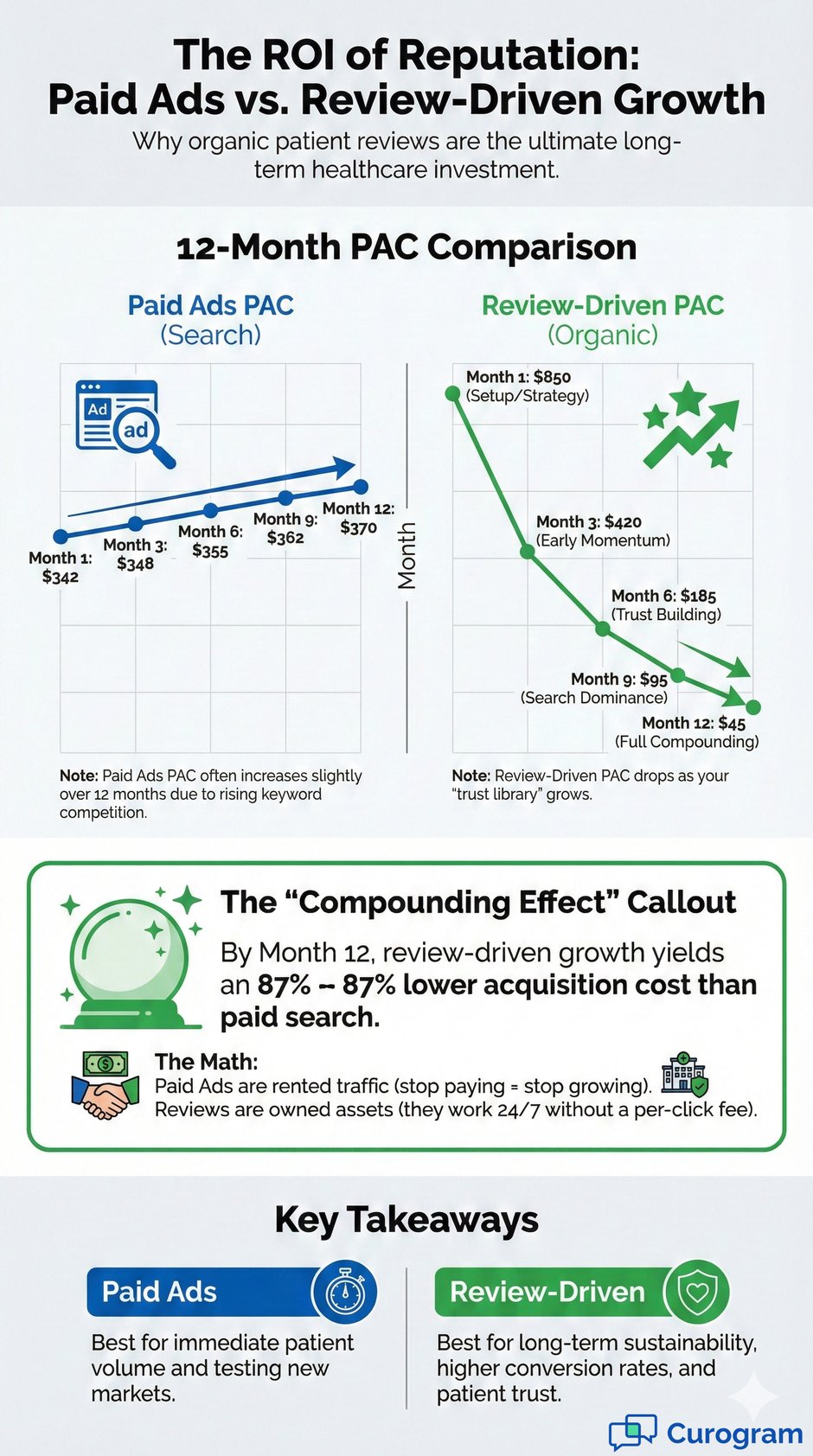
Infographic comparing 12-month healthcare patient acquisition costs: paid ads vs. review growth


Reducing Costs with Automated Growth Engines

Growth doesn't have to mean spending more. The smartest practices are cutting costs while still attracting more patients. The secret is letting automation handle what used to eat up staff time and marketing budgets.

Lowering Patient Acquisition Costs

The average patient acquisition cost in healthcare ranges from $200 to $800 per patient when using paid ads. That number keeps rising as more practices compete for the same clicks. But organic Google reviews cost almost nothing to collect — and they keep working long after they're posted.

Each 5-star review acts like a tiny ad that never expires. When ten patients leave reviews after their visits, that's ten new trust signals that attract future patients for free. Over a year, this compounds into massive savings.

Practices that switch from heavy ad spend to review-based growth often cut their cost per new patient by 60% or more. That freed-up budget can go toward better equipment, more staff, or higher take-home pay.

Unlike ads that stop the moment you stop paying, reviews stay live forever. A review posted today still brings in patients a year from now. This is why review-driven growth delivers far better long-term return than any paid channel.

Zero Administrative Drain

Before automation, getting reviews meant asking patients face-to-face, sending manual emails, or printing cards with QR codes. All of that took time your front desk staff didn't have.

With Curogram's smart surveys, the process runs on its own. A text goes out after every visit. No one has to remember. No one has to follow up. The system handles it all in the background while your team stays focused on patient care.

This kind of hands-off approach is what makes the difference between a growth strategy that works and one that dies after the first busy week.

The best tools don't add to your team's workload. They remove it. That's the core design behind automated survey systems — maximum output with minimal effort from your staff.

Staff Productivity Gains

When your front desk no longer has to chase reviews or manage feedback by hand, they get hours back each week. Those hours can go toward work that gives real value: greeting patients, answering phones, or handling insurance tasks.

Freeing office staff from marketing chores also reduces burnout. Your team signed up to help patients, not to run ad campaigns. Automation gives them back the role they were hired for.

This boost in productivity doesn't show up on a marketing report, but it shows up on your bottom line. Happier staff, less turnover, and a smoother day-to-day operation all feed into medical practice revenue growth.

Staff retention alone saves the average practice tens of thousands of dollars a year. When your team feels less stressed and more focused, they stay longer, and your practice runs better because of it.

The ROI of Cared-About Patients

Patients who feel heard don't just come back. They become your best source of growth. The simple act of asking for feedback sends a strong message: you care about their experience, not just their co-pay.

Increasing Patient Retentions

Retention is often overlooked in favor of chasing new patients. But keeping a current patient costs far less than finding a new one. A simple post-visit survey shows patients that their opinion matters, which builds loyalty over time.

Patients who feel valued return for follow-ups, refer their friends, and leave positive reviews. This creates a loop where retention fuels growth and growth fuels retention.

Loyal patients are worth up to ten times their first visit in lifetime value. By making them feel cared about, you unlock a stream of revenue that keeps flowing year after year.

Reducing Revenue Attrition

Not every patient leaves happy. Some had a long wait. Some felt rushed. Some had a billing issue. If you don't catch these problems early, those patients walk away — and they might leave a harsh public review on their way out.

Automated surveys give you a private channel to catch and fix issues before they become public. When a patient rates their visit poorly, the system alerts your team so they can reach out and make it right. This protects both your revenue and your online reputation.

A patient whose complaint gets resolved quickly often becomes more loyal than one who never had an issue at all. These moments are powerful; they stop revenue loss and build deeper trust at the same time.


A Sense of Security

Running a practice comes with enough stress. Worrying about what patients are saying online shouldn't add to it. With a system that routes happy feedback to Google and keeps negative feedback private, you gain peace of mind.

You can feel confident that your public-facing brand reflects the high-quality care your team provides every day. That kind of security lets you focus on what you do best: helping patients get better.

When you control the review pipeline, you control the story patients see before they call. That's a level of brand management most practices never achieve, and it costs a fraction of what traditional marketing demands.


Strengthening the Balance Sheet Through Authority

A strong online reputation doesn't just fill chairs. It reshapes your practice's financial future. As your review count grows, so does your authority in the local market. That authority translates directly into dollars.

Increased Clinical Capacity

More patients on the schedule means better use of your space, staff, and time. When your reputation drives steady demand, you stop scrambling to fill slots and start managing a healthy flow instead.

Full schedules reduce the per-visit cost of running your practice. Fixed costs like rent, salaries, and equipment payments stay the same whether you see 15 patients a day or 30. Higher volume means each of those costs is spread across more visits, which lifts your margins.

The goal isn't to overwork your team. It's to use the capacity you already have. A strong review profile helps you reach that sweet spot where every room, every hour, and every provider is put to good use.

Compounding Financial Success

Reviews compound like interest. Every new review lifts your search ranking a little. Every higher ranking brings a few more patients. Every new patient has a chance to leave another review. This cycle feeds itself over time.

After six to twelve months of steady review growth, practices often report a noticeable shift. The phone rings more. The schedule fills faster. The stress of finding new patients fades. Medical practice revenue growth becomes a trend, not a wish.

Practices that build their growth on reviews create a durable asset. Unlike ad campaigns that end, a strong review profile keeps working for you every single day. This is how you move from surviving to thriving.

Staying Positive in a Tough Market

Healthcare is getting more competitive. New clinics open. Insurance plans shift. Patient expectations rise. In this kind of market, the practices that win are the ones patients trust the most.

Curogram helps you stay ahead by turning your best asset — happy patients — into your strongest marketing tool. Poor visibility and slow response times are the real villains holding most practices back. Automated surveys solve both of those problems at once.

Waiting for patients to leave reviews on their own is a losing strategy. The practices that grow fastest are the ones that ask, and they use automation to ask every single patient, every single time.


Doctor in a medical office reviewing growth data and patient satisfaction ratings on a monitor

Get Started

The numbers don't lie. Online reviews are the most cost-effective growth tool available to medical practices today. They drive search rankings, attract new patients, keep current patients loyal, and reduce the need for costly ad spend.

If your practice is still relying on word-of-mouth alone, you're leaving money on the table. The impact of online reviews on medical practice growth is too large to ignore and the cost of doing nothing gets higher every month.

Curogram's automated smart surveys make it easy to build a 5-star Google presence without adding work to your team's plate. The system sends a text after each visit, guides happy patients to your review page, and keeps private feedback just between you and the patient.

In just a few weeks, most practices see more reviews, higher rankings, and a noticeable jump in new patient calls. The ROI speaks for itself.

Schedule a demo today to see how Curogram’s "Smart Automation" helps you dominate local search results and maximize your practice's growth ROI.


Frequently Asked Questions


How do online reviews help medical practices attract more patients?

Online reviews boost your Google ranking, which puts your practice in front of more local searchers. Patients trust clinics with higher star ratings and more reviews. This trust turns browsers into bookings without any paid advertising. Over time, a strong review profile becomes your most reliable source of new patients.

Why is the patient acquisition cost in healthcare rising for most clinics?

More practices now compete for the same pool of online patients through paid ads. This drives up the cost per click and cost per lead each year. Clinics that rely only on ads face a constant uphill battle. Reviews offer an organic path to growth that avoids this rising cost entirely.

How does automated feedback collection improve medical practice revenue growth?

Automation sends survey texts right after each visit, catching patients at their most willing to respond. Happy patients get routed to Google to leave a public review.

Unhappy patients share their concerns in private, giving you a chance to fix things. This dual approach increases reviews and reduces public complaints at the same time.

Why should practices focus on retention instead of only chasing new patient volume?

Keeping a current patient costs far less than finding a new one. Retained patients return for follow-ups, refer friends, and leave reviews that attract others.

A focus on retention creates a growth loop that feeds itself over time. Ignoring retention means you always need to spend more to replace the patients you lose.

How quickly can a practice expect to see results from an automated review system?

Most practices notice more reviews within the first two to four weeks. Higher search rankings tend to follow within two to three months as Google picks up the fresh signals.

New patient calls often increase by 20% to 40% within the first six months. Results vary, but the trend is consistent across practice sizes.