
1 min read
Asking Patients for Reviews Examples: Best Practices & Tips
💡 Asking patients for reviews works best when the request is timed to a moment of real satisfaction, sent through a channel the patient already...
16 min read

A 5.0 rating with 30 reviews loses to a 4.7 with 400. Patients don't say why, but they know. The flawless profile reads as curated, and the messy one reads as a place a lot of people have actually walked into.
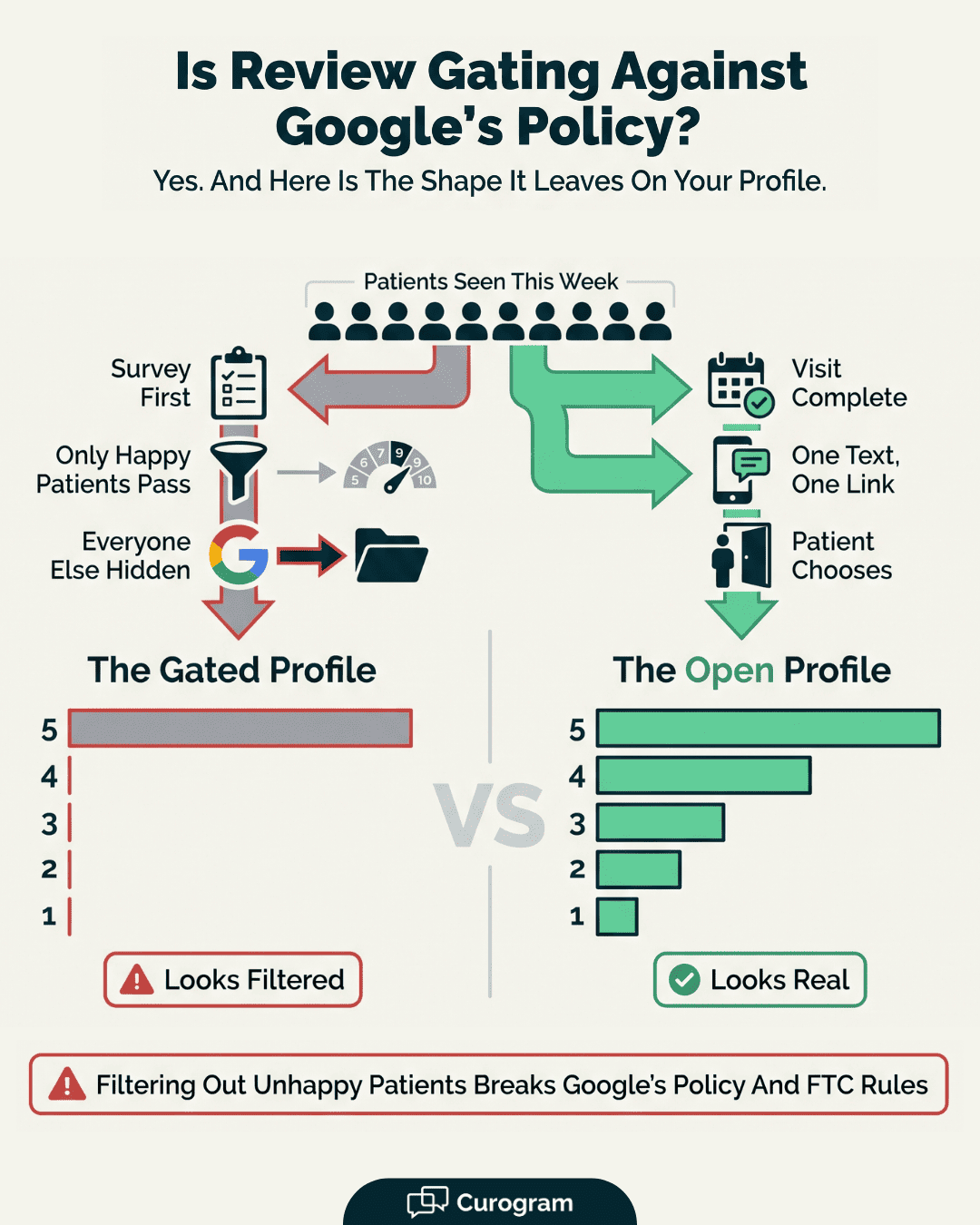
Most practices get this backwards. They build a survey, route the 9s and 10s to Google, and quietly send everyone else to a private form.
The result looks great on paper and terrible on a screen: a single flat spike at five stars, nothing beneath it, and a review count that never grows because two-thirds of patients got filtered out before they were ever asked.
Learning how to get patients to leave reviews is mostly about deleting steps, not adding them. The ask should fire when the visit closes, carry a one-tap link, and go to every patient without a score check standing in the way.
That last part is the one practices argue about, so it's worth stating plainly. Asking everyone produces more reviews, a rating distribution that reads as real, and negative reviews you can answer in public where the next prospective patient can see how you handle a problem. Screening produces fewer reviews and a pattern that draws scrutiny from Google.
The upside is not small. One practice in our own client data collected 1,064 new 5-star reviews in three months after moving to automated post-visit requests. Another climbed from a 1.67 rating with 101 reviews to a 5.0 with 479, without deleting a single thing.
Knowing how to get more patient reviews is now inseparable from knowing how to attract new patients. About 90% of new patient leads check a Google Business Profile before they ever open your website, based on our internal data.
Positive reviews build trust, lift your local search ranking, surface service problems you'd otherwise miss, and separate you from the practice two blocks over. Each of those feeds directly into how to attract new patients.
An empty review profile does real damage. A practice with four reviews, all from 2021, reads to a searcher as either closed or unbothered. Recency is a signal on its own.
A prospective patient trusts another patient's account more than your website copy. That's the whole mechanism. Firsthand experience, unpaid and unedited, carries weight your marketing never will.
Volume matters as much as sentiment. Thirty reviews averaging 5.0 stars looks thin. Four hundred reviews averaging 4.7 stars looks like a real practice that a lot of people have actually walked into.
Google treats review count, review recency, and review velocity as local ranking signals. A steady flow beats a one-time push every time.
| Signal | What Google Reads | Practice Takeaway |
|---|---|---|
| Volume | Total review count | Consistency beats a single campaign |
| Recency | Date of most recent review | A quiet quarter costs you position |
| Velocity | Rate of new reviews | Steady weekly flow outperforms bursts |
| Response | Owner replies | Replying to every review signals an active listing |
Working on how to get more patient reviews is local SEO work, whether or not you file it that way.
Reviews are the only feedback channel where patients tell you what they noticed without you asking a leading question. Three reviews in one month mentioning a 40-minute wait is an operations finding, not a reputation problem.
Read them for patterns. The complaints repeat.
Two practices, same insurance panel, same distance from the patient's house. One has 12 reviews and no replies. The other has 300 and answers every one.
The patient books the second one. Not because the care is better. Because it's the only one that looks staffed.
How to get patients to leave reviews hinges on three levers: ask at the right moment, remove every click between the patient and the review form, and make the request routine instead of a favor someone remembers to do.
Below are methods that hold up in a real clinic week.
The direct ask works best in the ninety seconds after a patient says something kind. Train checkout staff to hear that moment and respond to it.
Script it plainly:
"Glad we could help. If you have a minute, a review would help other people find us."
Then follow it with a text, because the verbal yes rarely survives the parking lot.
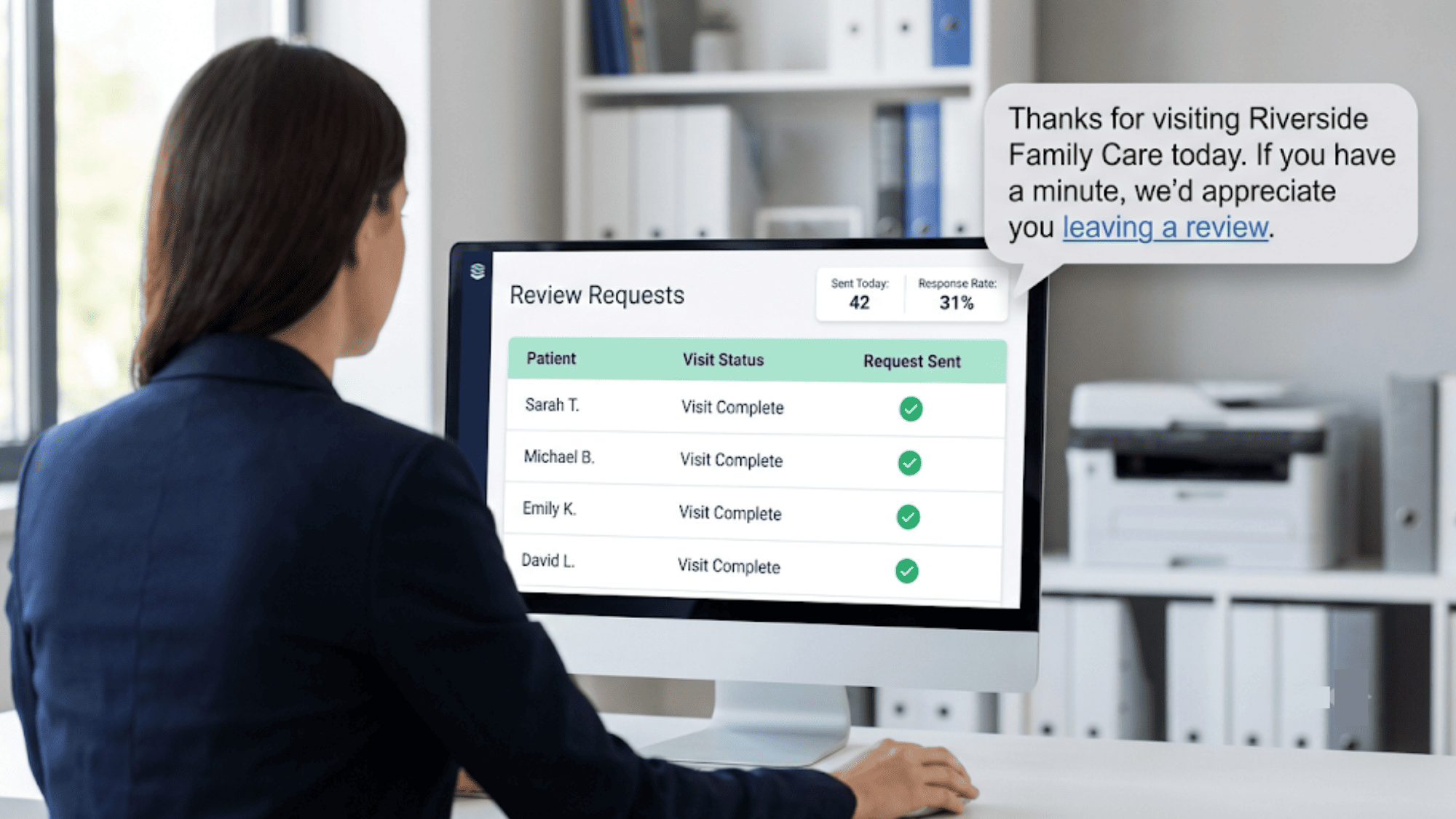
Automated follow-ups fire when the visit is marked complete in your EHR. No one has to remember. That's the entire advantage.
The message should carry:
That link distinction matters. A link to your Google Business Profile drops the patient on a page where they still have to find the review button. A direct review link opens the star selector.
Pro tip: Test your send delay. A message at checkout plus two hours often lands while the patient is still in the car. Twenty-four hours competes with everything else in their day.
Start with the patients your staff already know by name. The ones who bring coffee. The ones who've been coming for nine years.
This gets your first twenty reviews on the board fast, which matters because an empty profile is hard to build momentum on. It's a starting move, not a permanent strategy. Once you're live, ask everyone.
A compliment at the front desk is a review that hasn't been written yet. Close the gap while the patient is still standing there.
Two ways to close it:
Surveys are useful. What you do with the scores is where practices get into trouble.
The common setup routes 9s and 10s to Google and everyone else to a private form. That's review gating.
It violates Google's review policy and runs against FTC guidance on suppressing negative feedback, and it leaves a rating distribution that's a single flat spike at five stars, which is exactly the pattern that draws scrutiny.
Run the survey. Use it internally, for service recovery and staff coaching. Then send the review request to every completed visit, regardless of score.
Your website should carry a review link that's findable without scrolling. Most don't.
Put it in the footer, on the contact page, and on the after-visit page if you have one. A testimonials page helps too, with written patient permission on file for anything you quote.
Social requests convert at a low rate. They're still worth running because they cost nothing.
Keep the review link in your profile bio. Post an occasional plain request, no urgency, no theatrics. Never share a patient story without documented HIPAA-compliant consent, and never confirm in a comment that someone is a patient.
Portal messages reach patients who've already proven they'll log in. That's a self-selected engaged group.
The tradeoff: portal messages require a login, which is one more barrier than a text. Use the portal as a second touch, not the primary channel.
Physical prompts work because they hit while the patient is still in the building. Three that earn their space:
None of these will carry your program alone. They lift the response rate on the text you're already sending.
Count the taps. From the moment your message arrives to the moment the patient picks a star rating, the number should be one.
Test it yourself, on your own phone, at 7 PM. If you land on a page that asks you to search for the practice, or sign in, or scroll past directions and hours, the process is too long and your response rate will show it.
Staff ask for reviews more consistently when they know why it matters. Show them the number. Show them what happened to new patient volume when the rating moved.
Train the wording, not just the task. Role-play the awkward version: the patient who says no, the patient who says "I don't do that online stuff."
Staff incentives are fine. Patient incentives are not, and we'll cover why below.
You cannot collect reviews on a listing you don't control. Claim every profile, then keep them consistent.
| Field | Why It Matters |
|---|---|
| Name, address, phone | Mismatches across sites hurt local ranking |
| Hours | The most common reason for a call the profile could have answered |
| Services | Helps you appear in searches for what you actually do |
| Photos | Real interior photos outperform stock every time |
Google first. Then Healthgrades, Yelp, Facebook, WebMD.
Reply to every review inside 48 hours. Positive ones get a short, specific thank-you.
Negative ones need care. HIPAA prevents you from confirming the person was a patient or discussing any detail of their care, even to defend yourself.
A safe public reply looks like this:
"We take this seriously and would like to understand what happened. Please call our office manager at [number] so we can look into it directly."
That's it. Everything else moves offline.
A meaningful share of patients tap the link, land on the star selector, and then get interrupted. Nobody follows up on them because nobody knows it happened.
If your platform reports link clicks, that's a list. A single gentle reminder 48 hours later, sent only to non-completers, converts a portion of them.
Rules for the second touch:
Never re-ask someone who already left a review. It's the fastest way to look automated in a bad way.

Post-visit timing works for a one-off appointment. It works poorly for a patient in the middle of an eight-week course of treatment.
Ask when something finished. The cast came off. The series wrapped. The lab result came back clean.
That's the moment the patient has an outcome to describe, which produces a review with substance instead of "staff was nice." Specific reviews rank better and convert better, because a searcher reads them as real.
A recall campaign brings back patients who've drifted. Those patients also happen to be people with a completed history at your practice and no review.
Our internal data shows SMS recall reconverting at 35%, with 1,240 patients recovered. Once those visits close, they enter the same post-visit request flow as everyone else.
The sequence matters. Recall first, visit second, review request third. Asking a lapsed patient for a review before they've been back is asking someone to vouch for a memory.
Send the request under the name of the provider the patient actually saw. "Thanks for seeing Dr. Ramirez today" performs better than "Thanks for visiting our practice."
This also gives you provider-level review data, which is useful in two directions:
| What You See | What It Tells You |
|---|---|
| One provider generating most 5-stars | Their patient communication is worth modeling |
| One provider with thin volume | Their visits may not be closing in the EHR on time |
| A provider named repeatedly in complaints | An operations conversation, not a reputation one |
Patients search for individual doctors by name. A provider with reviews attached to their name shows up in those searches.
Tell patients at intake that you'll ask for feedback after the visit. One line on the welcome message or intake form.
It costs nothing and it changes the reception of the later text. The request stops reading as a marketing message and starts reading as the thing they were told would happen.
Practices using digital intake can put this line in the same form the patient is already filling out on their phone. No extra step for anyone.
Pull up your Google listing once a quarter and look at the star breakdown, not the average.
What you want to see is a staircase: a tall 5-star bar, a shorter 4, and small but real bars at 3, 2, and 1. That shape reads as a real practice with a lot of happy patients.
What you don't want is a single flat spike at five stars with nothing beneath it. That's the signature of a filtered request list, and it's what draws a closer look from both Google and any patient reading carefully.
If your distribution looks like a spike, somebody in your workflow is screening. Find it.
The single biggest lever on how to get patients to write reviews is the number of steps between the ask and the star rating. Cut it to one.
Every extra click is a place people leave.
Use the direct review URL, not the profile URL. Google generates a distinct link for every Business Profile that opens straight to the star selector.
The difference is bigger than it sounds. A profile link drops the patient on a page full of hours, directions, and photos, where they still have to find the review button and tap through to it. That's three or four decisions before they've written a word.
Pull the direct link once, save it somewhere your whole team can reach, and use the same one in every channel. This is the core of how to ask patients for Google reviews well.
QR codes convert when someone hands the card over and says something out loud. Left in a tray by the sign-out sheet, they're wallpaper.
Print them on checkout cards small enough to fit in a wallet. Put one on a waiting-room sign at seated eye level, not above the reception desk where nobody looks.
Two things to check before you print a run of anything. Scan the code yourself, from a phone that isn't yours, standing where the patient will actually stand. And point it at the direct review link, not your homepage.
Nearly every review gets written on a phone. Usually in a parking lot, a waiting room, or on a couch that evening, with the TV on.
Open your own review flow on your own phone at 7 PM and go through it. If any page requires pinching to zoom, or asks you to sign in, or loads slowly on a weak signal, you've lost people who genuinely intended to help you.
The patients you lose here are the ones who said yes at checkout. They meant it. The process just outlasted their patience.
How to ask patients for Google reviews comes down to link, timing, and reason. Send the direct link, send it same-day, and tell them plainly that it helps other patients find the practice.
Google is where the volume lives. About 90% of new patient leads check a Google Business Profile before they ever visit the practice website, based on our internal data. If you only have the bandwidth for one platform, this is the one.
Two things to get right:
You cannot convince a patient into a review. You can make it easy, ask at a decent moment, and mean it when you say their honest opinion is useful.
Where practices go wrong is in the framing. Anything that implies an expected star count, an obligation, or a consequence crosses from encouragement into pressure.
Keep the ask open. "We'd value your honest feedback" invites a real review. "We'd love a 5-star review" invites a compliance problem and a review that reads like it was requested.
The distinction shows up in the writing itself. Reviews written under a star expectation come out short, generic, and oddly uniform, because the patient understood the assignment.
Reviews written in response to an open ask mention the specific thing they noticed: the nurse who explained the lab work twice, the wait that ran long but got acknowledged.
Search engines and patients both read the specific ones as more credible. Ask for the truth and you get better copy than you would have scripted.
A bare link converts poorly because it reads as a chore someone assigned you. Give the request a purpose the patient can act on.
"It helps other patients find us" works. So does "It helps people know what to expect before their first visit." Both are true, and both point outward, toward the next person in the waiting room rather than toward your marketing goals.
What doesn't work is anything framed around the practice's needs. "Help us reach our review goal" tells the patient they're a metric. Most people will skip it, and the ones who do it will do it grudgingly.
A patient who ignores your text should face no follow-up beyond a single reminder, and no awkwardness at their next visit.
That means a few concrete things:
The right to say nothing is what makes the reviews you do get worth something.
Incentives are the fastest way to break a review program. Gift cards, raffle entries, discounts on a copay, a free follow-up visit — all of it violates Google's terms, draws FTC attention, and in healthcare can raise anti-kickback questions.
The reverse is worse. Anything that implies a consequence for not reviewing, or for reviewing poorly, is coercion in a clinical relationship where the patient has real dependency on your care.
Staff incentives are a separate matter and they're fine. Reward your team for asking every patient consistently. Never reward the patient for the answer they give.
The temptation to screen is strong. Resist it, and not only because gating breaks policy.
A profile with a handful of 4s, 3s, and even 1s reads as a real practice. Patients trust a 4.7 with 400 reviews over a flawless 5.0 with 30, because the flawless one looks curated and everyone knows it.
Negative reviews also give you something to respond to in public, which is the cheapest reputation work available. A calm, non-defensive reply under a one-star review is read by every prospective patient who scrolls that far. It tells them what happens if something goes wrong.
Reviews attract new patients three ways: trust before contact, position in local search, and a visible record that someone at the practice is paying attention.
Our own client data shows what volume does. One practice generated 1,064 new 5-star reviews in three months, with roughly 90% of submitted reviews landing at five stars, based on our internal data.
That number is worth breaking down, because it isn't a marketing figure. It's arithmetic:
| Layer | What It Means |
|---|---|
| 1,064 reviews in 90 days | Roughly 12 per business day |
| ~90% at 5 stars | Requests went to everyone, not a filtered list |
| 0 front desk minutes | Requests fire off visit-complete status in the EHR |
Reviews also travel. With written permission, a strong review becomes website copy, a social post, or a line in a new patient packet.
Most of the rules here exist because someone got sued or delisted. Worth knowing before you build the program.
Automation solves the failure mode that kills most review programs: the front desk means to ask, then three patients need rescheduling and the phone starts ringing.
A working setup does four things:
The result of removing the manual step shows up in the numbers. Practices running automated requests generate review volume that no front desk could match by hand, and they do it with no added staff minutes per visit.
Two results from our own client data:
Review volume at scale. One practice collected 1,064 new 5-star reviews in three months after switching to an automated post-visit request. Roughly 90% of submitted reviews came in at five stars, and the requests went to every completed visit, not a screened subset.
A profile rebuilt from the floor. Another practice started at a 1.67 rating with 101 reviews. Nothing was deleted. New reviews simply outnumbered the old ones until the visible average moved. It ended at 5.0 with 479 reviews, and inbound calls dropped 24%, because a complete, well-reviewed profile answers questions patients used to call in to ask.
The second case is the one worth studying. A bad rating isn't permanent. It's just outnumbered.
Most practices don't have a review problem. They have a memory problem.
The ask gets skipped because a patient at the window needs to reschedule, the phone is ringing, and someone has to find a chart. Nobody decided not to ask. The day just moved on.
The fix isn't more discipline at the front desk. It's removing the front desk from the equation entirely. The request fires when the visit closes, it carries a one-tap link, and it goes to every patient without a survey standing in front of it.
That last part is where practices talk themselves into trouble. Screening for the happy ones feels safe. It produces a rating distribution that looks exactly like what it is, and it costs you the negative reviews that make the positive ones believable.
Ask everyone. Reply to everyone, inside 48 hours, especially the one-stars. A calm reply under a bad review does more work than ten more 5-stars, because it's the only thing on the page that shows a prospective patient what happens when something goes wrong.
Learning how to get patients to leave reviews isn't a campaign you run for a quarter. It's a step at the end of a visit that you set up once and then stop thinking about.
Our own client data shows what that looks like at scale: 1,064 new 5-star reviews in three months, and a practice that climbed from 1.67 stars to 5.0 without deleting a thing.
Want to see it running in your own EHR? Schedule a demo and we'll walk through the post-visit request against your actual workflow.

1 min read
💡 Asking patients for reviews works best when the request is timed to a moment of real satisfaction, sent through a channel the patient already...

1 min read
💡 To generate Google reviews consistently, start by claiming and fully optimizing your Google Business Profile. Then ask customers at the right...

1 min read
💡 Getting patients to leave a review via SMS works because text messages get read. SMS open rates reach 98%, while email hovers near 20%. A...