
1 min read
How Physician Groups Replace Phone Calls With Texting
 Jo Galvez : 7/20/26, 8:00 AM
💡 Physician groups replace phone calls by moving scheduling, reminders, confirmations, intake, and billing follow-up onto secure two-way texting...

Atlas Medical Center was losing about one in seven booked visits. Their no-show rate sat at 14.20%. Three months after switching on automated text reminders, it fell to 4.91%.
Same providers, same patients, same schedule. The only thing that changed was how appointments got confirmed.
For a small practice, that gap is money. Every empty slot is a provider paid to wait and a patient who needed care but didn't arrive. Spread it across three or four providers and the yearly total gets uncomfortable fast.
So the fair question from any owner is simple: does patient texting reduce no-shows enough to cover its cost, and cut the call volume choking the front desk? This guide answers both with the actual math. We'll walk the no-show calculation for a three-provider clinic, then the phone-volume side, drawing on verified numbers from patient communication built for small practices rather than vendor promises.
The business case is smaller than owners expect. The ROI of HIPAA texting doesn't hinge on a huge behavior change. It hinges on a steady one: more confirmations, fewer forgotten visits, and fewer ‘are you still coming?’ calls.
Curogram clients run confirmation rates above 75% and see no-shows drop 53% below the industry average. Texting also complements your EMR instead of replacing it, so your charting and billing don't change.
We'll also be honest about what the ROI math leaves out, and why the number still lands in the black for most small clinics. By the end, you'll have a break-even you can defend to a partner or an accountant.
No-show ROI is one multiplication. Take what an empty slot costs you, multiply by how many you get, then apply the reduction rate. The first two inputs are yours. The reduction rate is the part we can back with client data.
You need three numbers, and you already own two of them. First, average visit value: what one completed visit is worth after your payer mix. Second, monthly no-shows: pull the count straight from your EMR's cancellation and no-show report. Third, the reduction rate texting delivers.
The first two live in your own system, so nobody has to guess. For the third, small clinics commonly see visit values between $120 and $200. We'll use $150 as an illustrative figure and let you swap in your real number. Industry no-show rates vary by specialty and region, which is why we lean on the MGMA no-show benchmarks as the outside reference point rather than a single blanket rate.
Most owners underestimate their no-show rate because they never pull it cleanly. The count lives in a status report, not the front dashboard. In eClinicalWorks, it sits under appointment status. In Tebra and athenahealth, it's a cancellation-and-no-show export. Pull the last 90 days, filter to the no-show status, and divide by total scheduled.
Do it per provider, not clinic-wide. A 6% clinic average often hides one provider at 11% whose panel skews toward same-day add-ons. That provider is where texting pays back first, so start the rollout there rather than everywhere at once.
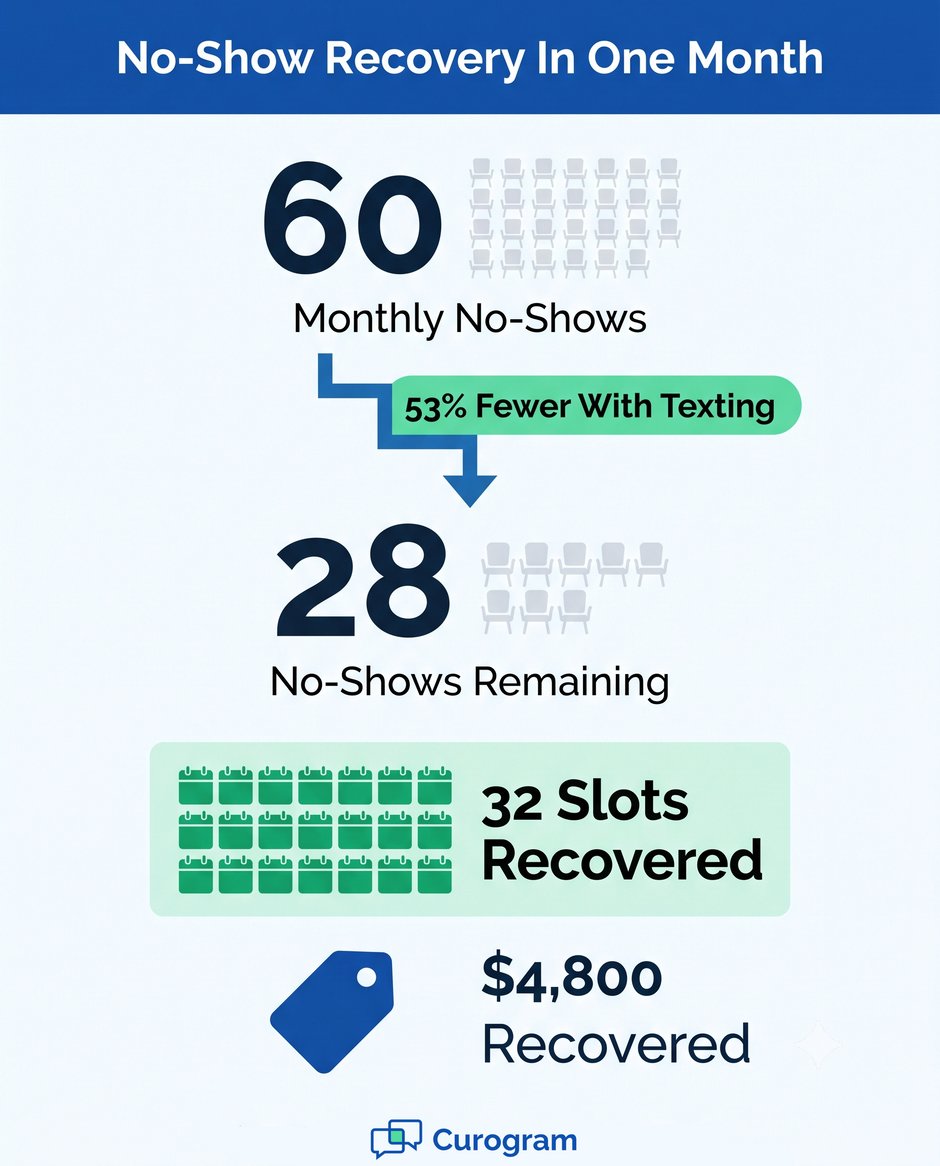
Say a three-provider clinic logs 60 no-shows in a normal month. That's illustrative, but close to what we see at that size. Apply the 53% reduction our clients average, and about 32 of those visits get kept instead of lost.
|
Before texting |
After texting |
|
|---|---|---|
|
Monthly no-shows |
60 |
28 |
|
Visits recovered |
0 |
32 |
|
Value at $150 each (illustrative) |
$0 |
$4,800 |
That's $4,800 back in a single month. Over a year, roughly $57,000 that used to walk out the door. Your real figure moves with visit value and payer mix, but the shape holds at any small practice.
The number that decides the purchase is small. If your platform runs a few hundred dollars a month, you cover it the moment texting prevents 2 to 3 no-shows. At $150 a visit, three saved slots is $450.
Most small clinics clear that in the first week, and everything after is margin. This is the patient texting no-show reduction data owners actually want for the case: not a projection, a floor. We map the price side of the equation in the guide to patient texting software pricing.
Reminders help. Confirmations help more, because a confirmed slot behaves differently on the day. When a patient taps to confirm, your front desk sees the real schedule and can backfill gaps early instead of discovering them at 9 a.m.
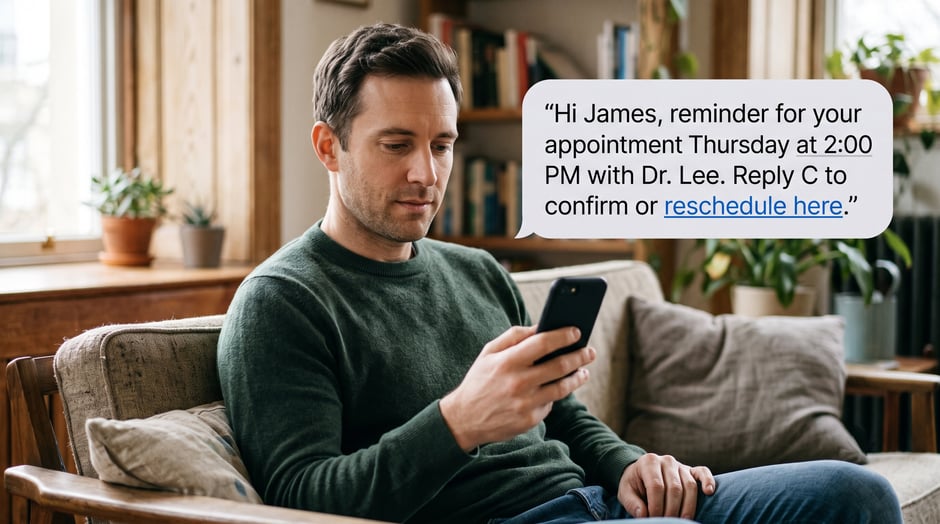
This is where the feature does the work. Automated Appointment Reminders and Confirmations send the reminder, read the reply, and update the appointment status without a staff call. Two-way texting lets a patient reschedule inside the thread instead of a voicemail tag.
A 53% drop isn't one big lever. It's a confirm-or-reschedule loop running quietly on every appointment on the book.
The review request never goes out because three patients need rescheduling and line two won't stop ringing. That's the phone tax. It's harder to see on a P&L than a no-show, and it still burns real hours every week.
Not every call disappears, but a predictable set does: confirmation callbacks, ‘what time is my appointment?’, reschedules that used to need a live person, and the reminder calls your staff placed by hand. Move those to text and you reduce phone volume in a medical office without dropping a single patient touchpoint.
The reason it works is reach. A 98% SMS open rate means the message lands, unlike the voicemail nobody checks. Patients answer a text on their own time, so the back-and-forth stops eating your staff's attention mid-task.
A one-way blast reminder does part of the job. Two-way texting closes the loop: the patient replies in the thread, a confirmation or reschedule resolves on the spot, and no callback gets queued. That reply loop turns a reminder from a courtesy note into a call your staff never has to place or field.
Put a number on it. Say confirmation-related calls run about 300 a month, at roughly 3 minutes each once you count hold time and notes. That's 900 minutes, or 15 hours. At a loaded front-desk cost near $22 an hour, the month looks like this.
|
Input (illustrative) |
Value |
|---|---|
|
Confirmation-related calls / month |
300 |
|
Minutes per call |
3 |
|
Staff hours absorbed |
15 |
|
Loaded staff cost / hour |
$22 |
|
Monthly staff cost recovered |
$330 |
That $330 sits on top of the no-show savings, not inside them. Two separate lines on the same platform bill. Run your own count for a month before you commit, since the number is easy to pull from the phone system and hard to argue with.
Smaller clinics see the same ratio at lower volume. A solo provider fielding 120 confirmation calls a month still reclaims about six hours. The dollar figure shrinks, but so does the platform cost, so the break-even ratio holds. Call-volume relief doesn't need a big practice to pay off.
Covina Arthritic Clinic went from 369 confirmations a month to more than 1,300, averaging over 1,100 confirmed appointments monthly. The point isn't only the confirmation count. It's that those 1,300 confirmations didn't arrive as 1,300 phone calls. The automated loop handled them, so the front desk never had to.
Fewer interruptions change what a shift can finish. The recall list gets worked. The review request goes out. New-patient paperwork gets chased before the visit, not during it.
Freed minutes don't show up as a check. They show up in everything that used to slip when the phone owned the day. Most clinics point that time at the recall list, which then feeds a different revenue line entirely.
Texting isn't triage. Clinical questions, symptom calls, and anything needing a nurse still route to a person, and they should. What texting clears is the logistics layer: confirmations, reminders, reschedules, forms, and directions.
Keeping those two lanes separate is the whole point. When routine confirmations stop interrupting the front desk, the clinical calls that do come through get answered faster. Track that win too: not just fewer calls, but shorter hold times on the calls that matter.

Vendor ROI claims usually stop at a bare number with no clinic attached. Here are two with names and figures you can check against your own reports.
Atlas ran high no-show rates that meant missed revenue and a schedule full of holes. Automated reminders and confirmations kept patients informed with timely notices, and the rate fell to 4.91% within three months.
No new providers, no schedule overhaul. Every booked patient got a reminder and a one-tap confirm. Replies updated the appointment status automatically, so staff saw the true day's schedule instead of a hopeful one.
The waitlist backfill mattered most. A cancellation confirmed at 8 a.m. became a filled slot by 10, instead of an empty room at 2 p.m.
A move from 14.20% to 4.91% is a 65% cut in that clinic's own rate, and it lands about three times better than the industry average. That's the patient texting no-show reduction data behind the headline 53% figure our client base averages. One clinic, one quarter, one visible line on the schedule.
Covina's confirmation process was manual and slow, built on staff placing follow-up calls one at a time. After automating it, monthly confirmations climbed from 369 to more than 1,300.
Before, a confirmation meant a person, a phone, and a callback. Reaching 369 in a month took real labor, and plenty of patients were never reached at all. The gap between booked and confirmed stayed wide.
Automating confirmations didn't cut a role. It moved the hours. Staff shifted from dialing to handling the exceptions that need a human: complex reschedules, new-patient questions, insurance snags. The routine yes-or-no confirm ran itself.
These aren't modeled projections. Both figures come from our internal case records, reported as the clinics measured them, and we cite only what we can verify. Atlas's 14.20% to 4.91% is a recorded before-and-after over three months.
Covina's jump from 369 to more than 1,300 confirmations is a monthly count, not an annualized estimate. When you build the internal case, you can attribute these directly and stand behind them in a partner meeting. Ask any vendor you compare against to show the same: named clinic, dated window, raw count.
Don't copy their rates; copy the method. Your baseline no-show rate is probably different from Atlas's 14.20%, so the size of your drop will differ too. The 53% reduction is a client-base average, not a guarantee for one clinic. Apply it as a planning midpoint.
Take your own baseline, model a cautious version at half that reduction, and check whether even the conservative case clears your platform cost. For most small clinics it does, which is why the ROI question usually answers itself before the pilot ends. Bring that one-page model to the demo and we'll pressure-test it with you.
Different specialties, same mechanic. Reminders plus two-way confirmations move a real, measurable line. Both clinics kept their existing EMR and their existing workflows underneath. Texting sat on top and complemented what they already ran, which is the whole point for a small practice that can't afford a rip-and-replace.
An honest business case names its costs. The no-show and phone math above is deliberately narrow, so here's what it doesn't count on either side of the ledger.
There's a start-up cost in time. Someone maps your EMR's appointment fields, builds the reminder and confirmation templates, and sets the opt-in language. For a small clinic that's usually a short configuration, not a project. It's front-loaded, though, and the first savings arrive before it's fully polished.
The mapping itself is concrete work, not a mystery. Someone matches your appointment types to reminder rules, so a physical and a telehealth follow-up don't get the same message. Reminder timing gets set, usually a first nudge a few days out and a confirmation the day before.
Test messages go to a couple of staff phones before any patient sees one. A morning of focused setup covers most small clinics.
Staff need a week or two with two-way texting. The first days bring questions: how to answer a patient thread, when to escalate to a call, how the status updates flow back. Patients adjust faster than teams expect once the messages start landing. Plan for a short ramp, not a cliff.
A normal rollout runs in four beats, not a best case. Week one is configuration: connect the EMR, map appointment types, set reminder timing. Week two builds the templates and opt-in language, sent to a small group first. Weeks three and four are the human part, where staff learn to read threads and decide when a text becomes a call.
By day 30, most clinics run confirmations on autopilot and handle only the exceptions by hand. The savings start in week two, before the team feels fully fluent.
Rollouts that stall usually fail in familiar ways. The most common is habit: staff keep dialing, so confirmations get double-handled. Another is tone, where templates read like a robot, and patients tune them out. The third is a thin opt-in list, because the ask got buried at signup.
The fixes are light. Put the texting queue on the same screen the front desk already watches, so it isn't a second place to check. Templates written in the clinic's own voice, first name included, get read. Collecting opt-in at check-in, not as a separate step, keeps the list full.
Skipping these is why a few clinics feel underwhelmed in month one. The tool isn't the problem; the setup was rushed.
The base case ignores real money on the other side. Automated post-visit surveys drove 1,064 new five-star reviews in three months for one multi-location practice. SMS recalls brought 1,240 lapsed patients back, at a 35% reconversion rate.
None of that is in the no-show or phone numbers, so the cost benefit of patient texting software runs conservative by design. If you want help weighing features against price, our guide to choosing a patient texting platform lays out the questions to ask.
Line the costs up against the floor. Break-even is 2 to 3 prevented no-shows a month. Setup and the adoption curve are one-time.
Compliance isn't a separate build either, since the platform carries SOC 2 Type II and HIPAA controls out of the box. Front-loaded effort against steady monthly return points one direction for most small clinics.
Owners tend to over-price this decision in their heads. They picture a big platform commitment against a vague promise. The real trade is narrower: a monthly cost against 2 to 3 prevented no-shows, with a halved call load and a stack of upside the base math never counted.
Atlas cut its no-show rate to 4.91%. Covina pushed confirmations past 1,300 a month. Both kept their EMR and added texting on top. That's the texting-software business case for a clinic in one line: small steady savings that clear the cost fast, then keep compounding.
The numbers here are ours to defend, but the inputs are yours. Bring your visit value and your no-show count, and we'll run the break-even on your actual schedule.
Book a demo, and we'll walk through your no-show rate, call volume, and break-even together, using figures from your EMR. No free-trial pitch, just the calculation for your clinic.
Frequently Asked Questions

1 min read
Jo Galvez : 7/20/26, 8:00 AM
💡 Physician groups replace phone calls by moving scheduling, reminders, confirmations, intake, and billing follow-up onto secure two-way texting...

1 min read
Jo Galvez : 7/21/26, 4:00 PM
💡 HIPAA-compliant texting for physician groups is secure, two-way patient messaging that meets HIPAA rules while syncing with your EHR. Curogram...

1 min read
.jpg?width=30&name=square-formal-photo%20(1).jpg) Mira Gwehn Revilla : 4/12/26, 1:00 PM
Mira Gwehn Revilla : 4/12/26, 1:00 PM
💡 A patient communication platform is a tool that helps medical practices manage all patient messages from one place. It handles two-way...