
1 min read
How to Generate Google Reviews for Your Business Success
💡 To generate Google reviews consistently, start by claiming and fully optimizing your Google Business Profile. Then ask customers at the right...
6 min read

Debond day is the best 20 minutes in orthodontics. The patient runs their tongue across the front teeth, grins at the mirror, and hugs somebody.
Then they walk out and write nothing. The parent who got a surprise balance last Tuesday writes 400 words that evening.
That gap is the whole problem. Happy patients say nothing, and unhappy ones arrive at your profile with a keyboard. Our position is that volume fixes this, and only a system produces volume. Ask every patient, every time, in the same words.
What changed since this page first ran is who sets the limits on that ask. The rules moved from Google to the Federal Trade Commission.
Most advice on this topic still cites a Google policy line that no longer exists. The binding rule is now federal.
The FTC rule on the use of consumer reviews and testimonials took effect on October 21, 2024. It applies to every business, dental and orthodontic practices included.
Google took a different path. Its Maps policy once told businesses not to selectively solicit positive reviews. That sentence is gone.
What replaced it is a fake engagement policy. Contributions have to reflect a real visit, and anything else gets removed.
|
The ask |
Allowed? |
|---|---|
|
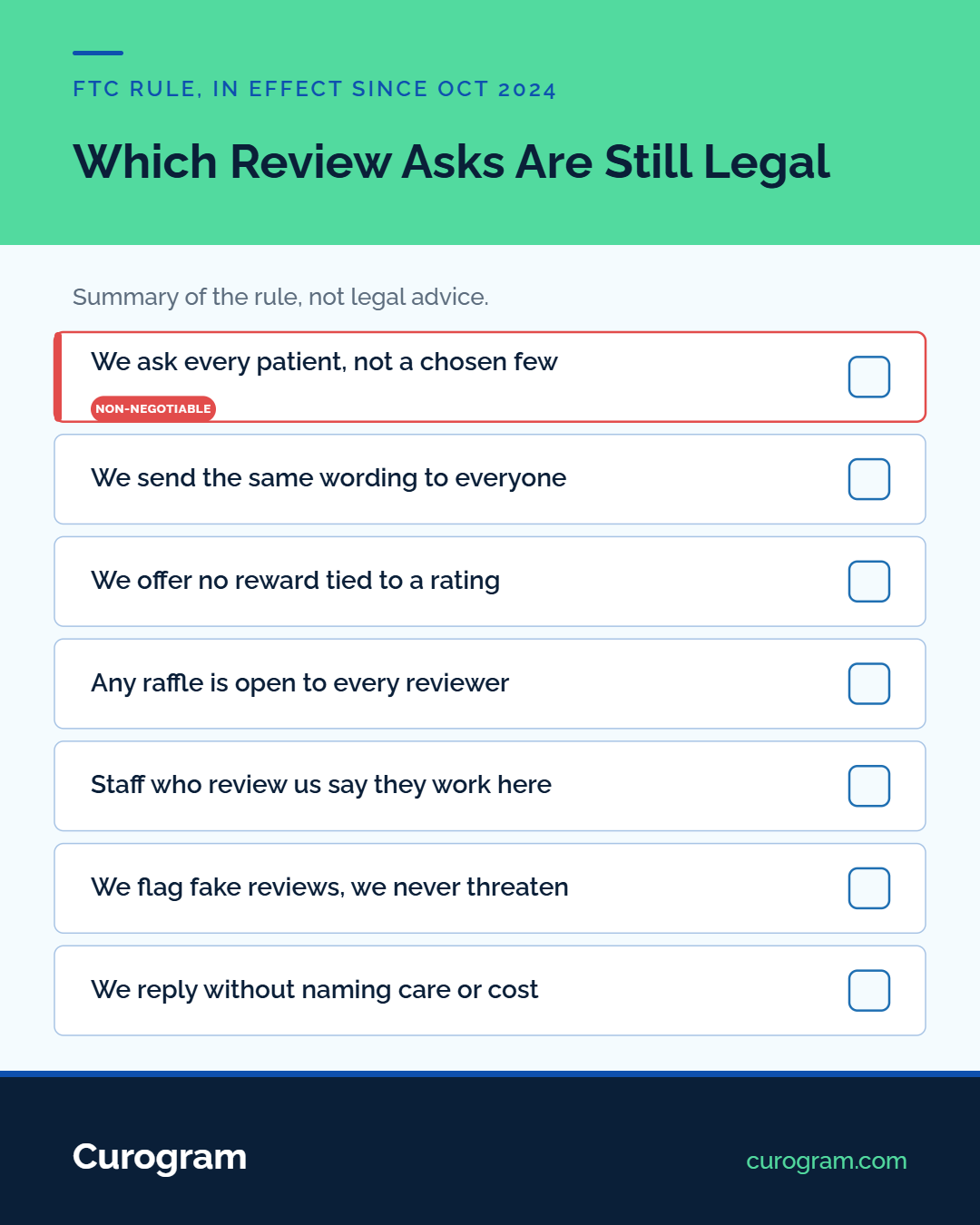
Text every patient after a completed visit |
Yes |
|
Offer a gift card for a 5 star review |
No. The incentive is tied to sentiment |
|
Offer a raffle entry for a review of any rating |
Yes, if the rating does not change the odds |
|
Let staff post reviews without saying they work there |
No. Insider reviews must be disclosed |
|
Threaten legal action to get a review pulled |
No. That is review suppression |
Penalties run to $53,088 per violation, set on January 17, 2025, and unchanged since. One bad contest can cover a lot of chairs.
BrightLocal surveyed 1,002 US adults and published the results on February 11, 2026. Online reviews get read by 97% of people choosing a local business. Recency carries more weight than most practices expect. 74% want to see a review from the last three months.
Push further and 32% want one from the last two weeks. A profile that went quiet in March reads as closed in October.
In that same survey, 31% said they will only use a business rated 4.5 stars or better. A year earlier it was 17%. Run the arithmetic on a thin profile. Five reviews at 5 stars and one at 1 star averages 4.33, which puts you under the cutoff.
Add 30 more honest reviews and the same angry parent moves the average by a rounding error. Volume is the only defense that works.
No message schedule rescues a practice people are annoyed with. Fix what shows up in the words first.
Open your profile and count what people actually name. Wait time, the billing conversation, and the front desk take most of the hits. Orthodontics has a specific one. A patient told to expect 18 months, who finished at 26 months, will say so in writing.
Set the estimate as a range at the consult, then restate it at every adjustment. The complaint usually tracks the surprise, not the delay.
Debond is the obvious peak. The patient is holding a mirror, and the parent is taking photos. Two more moments work almost as well: the day the bite finally closes, and the first clean retainer check. Each is a visible win.
Send the request within an hour of the visit. Wait until the weekend, and you are asking a person who has moved on.
A review has to land somewhere a parent will look. For orthodontics, that is one map listing per office.
Set the primary category to Orthodontist rather than Dentist. The two pull different searches, and the wrong one costs you the map pack. Fill in hours, insurance, parking, and if you treat adults. Add photos of the actual office, including the parking lot entrance.
Two offices sharing a Google Business Profile split their reviews and rank for neither. Each address needs its own listing and its own request flow.
Groups running reputation management in Office Ally track volume and rating by location and by provider. A dashboard surfaces the quiet office before a quarter goes by.
Staff is the reason the manual ask fails. They are also the reason a contest can land you in front of the FTC.
Monday the team remembers. By Thursday, there are three rescheduling calls stacked up and a parent at the window with a billing question.
The ask is the first thing dropped, because nothing breaks when it is skipped. Practices that automate review collection by text take the task off the counter entirely.
Reward the behavior your team controls. A contest on requests sent, or on visits closed out correctly, is clean. A contest on 5-star reviews received is not. It pays staff for a sentiment, which is the thing the FTC rule names.
If a team member does leave a review, the rule requires them to say they work there. An undisclosed insider review is a violation on its own.
Everything above sets up one workflow. Same ask, every patient, triggered by the chart rather than by memory.
Curogram Highlight: One Ask, Every Completed VisitCurogram's Reputation Management sends the review request by text once a visit is marked complete. No one has to remember, and the wording stays identical for every patient. The trigger comes from the chart. In CharmHealth, the status change to checked out fires the review request. No-shows and cancellations stay out of the send. Results break out by location and provider, so a group sees which office stopped asking. See how automated review requests are set up. Curogram is HIPAA compliant and SOC 2 Type II certified. |

Asking how a visit went, then calling the people who were unhappy, is good practice. Keep that survey separate from the public ask.
The line to hold is simple. Every patient gets the same review request, whatever they said on the survey. Routing only the pleased ones to Google is what regulators call gating. It also gives you a rating that tells you nothing true.
Replies are where dental practices get fined. The reviewer gave up their privacy, and you did not.
In March 2022 a North Carolina dental practice paid $50,000 to the HHS Office for Civil Rights. The owner answered a Google review with the patient's full name and treatment details.
A Texas dental practice settled for $10,000 in 2019 over Yelp replies. Those posts named a patient's last name, treatment plan, insurance, and cost. Neither practice set out to break HIPAA. Both were defending themselves in public, which is exactly how it happens.
Confirming someone is a patient is already a disclosure. So the reply cannot reference the visit, the treatment, or the balance.
Use one template. "We take this seriously and would like to understand what happened. Please call our office manager at 555-0147." Post it, then stop. Every follow-up reply is another chance to say something you cannot take back.
Reviews decide who calls you, and 31% of people now filter out anything under 4.5 stars. A thin profile cannot survive one bad week.
The fix is unglamorous. Ask every patient after every completed visit, in identical wording, triggered by the chart instead of the front desk.
Keep the incentives off sentiment, make staff disclose, and never put a patient detail in a reply. Those three lines keep you clear of the FTC rule and HIPAA both.
Do that for two quarters, and the arithmetic stops working against you. One angry parent becomes a rounding error instead of a rating.
See how automated review requests fire from a completed visit in your system. Book a Curogram demo.

1 min read
💡 To generate Google reviews consistently, start by claiming and fully optimizing your Google Business Profile. Then ask customers at the right...

1 min read
💡 Asking patients for reviews works best when the request is timed to a moment of real satisfaction, sent through a channel the patient already...

1 min read
💡 To get more patient reviews, send a same-day text with a direct review link after each visit is marked complete in your EHR. Three things...