
Is Texting HIPAA Compliant? Everything You Need to Know
Is texting HIPAA compliant? Uncover rules, privacy concerns, and tips for safe communication with patients while staying secure.
7 min read

A patient texts the front desk at 7:40 p.m.: "Did my A1C come back? Is it bad?" The office closed at five. A staff member who saw it on a personal phone wants to help, and starts to type the number back.
That reply would feel like good service. It would also put a lab result on a personal device, outside any system the practice controls.
Moments like that sit at the center of HIPAA-compliant patient engagement. Patients want quick answers by text, and practices want them to show up, follow plans, and come back. HIPAA allows all of it, as long as the tools and habits around it are built for PHI.
This guide covers why engagement matters to a practice and which outreach works. It also covers why texting is now the main channel, what HIPAA and texting laws require, and five habits that keep each message compliant.
Our view: most HIPAA risk in patient messaging starts when staff improvises on a personal device. Give them a secure tool and clear rules, and you can send more outreach without adding risk.
Engaged patients keep their visits, finish care plans, and come back for checkups. Each of those shows up on the schedule and in revenue.
A no-show leaves an empty slot that was staffed, roomed, and blocked for that patient. For chronic care, it can also mean a missed medication change or a lab that never gets drawn.
Reminders and two-way messages move that number. With automated reminders, Atlas Medical Center cut its no-show rate from 14.20% to 4.91% in three months. That comes from Curogram client data from clinical settings.
Patients who stay with one practice build a record the care team can act on. Their history, allergies, and trends sit in one chart, so each visit starts from what the team already knows.
Engagement keeps that thread intact. A recall text for an overdue colonoscopy or a flu shot reminder brings the patient back before a gap turns into a problem.
Patient engagement means getting patients involved in their own care. Day to day, it comes down to the messages you send and how easy it is for patients to reply.
Most patient engagement activities fall into a few groups:
Each one needs a channel the patient will see, and a way to answer that doesn't tie up the phone.
Recall and preventive outreach rarely target one patient at a time. A practice might need to reach every diabetic patient due for an A1C or every patient over 50 without a recent screening.
eClinicalWorks practices run population health campaigns by text to reach those groups. Our list of five ways eCW users engage patients with bulk messaging covers more uses. CureMD offices use mass patient messaging for closures and broadcasts when the whole schedule needs one notice.
Group messages carry their own HIPAA question. A closure notice holds no PHI, but a recall for "patients with diabetes" implies a diagnosis, so the wording has to stay general.
In its 2026 mobile fact sheet, the Pew Research Center found that 98% of U.S. adults own a cellphone and 91% own a smartphone. Almost any patient on your schedule can get a text.
Two-way texting lets a message wait until the patient is free, and the reply wait until staff are free. Neither side has to be on the phone at the same moment.
For the front desk, that turns a morning of voicemails into a list of replies to work through. For patients, it means confirming an appointment from a work break instead of calling during office hours.
Texting also works without a portal login. Patients who never set up a portal account still get the message.
HIPAA covers privacy. The Telephone Consumer Protection Act (TCPA) covers automated texts and calls, and its consent rules changed in 2025.
Since April 11, 2025, patients can opt out in any reasonable way, such as by replying "stop" or "cancel." Practices have 10 business days to honor it. They may send one text to confirm, within five minutes.
Health reminders, like visit and refill texts, usually don't need written consent first. A wider rule that would make one opt-out stop all texts from a sender was delayed to January 31, 2027.
HIPAA sets the rules for how practices use and share protected health information, or PHI. Patient texts often hold it, even when they look routine.
PHI is health information tied to a person. In patient messaging, that includes:
A text that says "Your cardiology follow-up is Tuesday" tells anyone who sees the phone something about the patient's health. That's why the channel matters.
HHS's Office for Civil Rights handles HIPAA fines. The amounts below were adjusted for inflation on January 28, 2026, and HHS kept them in place for the rest of 2026.
|
Tier |
What happened |
Per violation |
Yearly cap |
|---|---|---|---|
|
1 |
Didn't know and couldn't reasonably have known |
$145 to $73,011 |
$2,190,294 |
|
2 |
Reasonable cause, not willful neglect |
$1,461 to $73,011 |
$2,190,294 |
|
3 |
Willful neglect, fixed within 30 days |
$14,602 to $73,011 |
$2,190,294 |
|
4 |
Willful neglect, not fixed within 30 days |
$73,011 to $2,190,294 |
$2,190,294 |
Under a 2019 policy, HHS uses lower yearly caps for the first three tiers, starting at $36,505.50 for Tier 1. State attorneys general can also sue over the same breach.
Criminal cases go to the Department of Justice. Fines reach $250,000 and prison terms up to 10 years when PHI is misused for gain or harm.

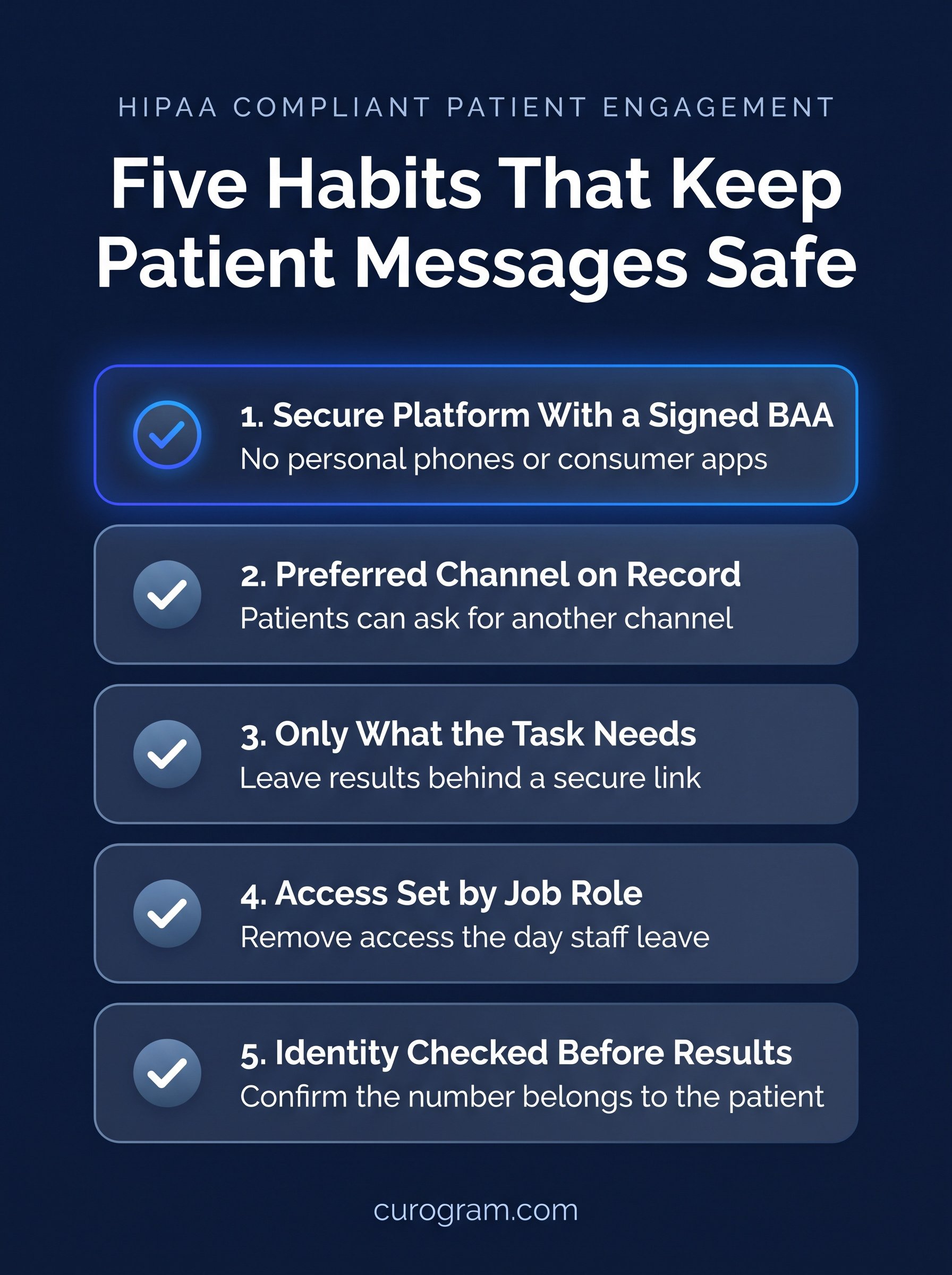
These five habits cover most of the risk in day-to-day patient messaging. Each one ties to a specific HIPAA rule.
Pick a platform built for PHI, and sign a business associate agreement (BAA) with the vendor before sending any patient data. HIPAA requires that agreement for any vendor that handles PHI for you.
Check for the Security Rule's technical safeguards: a separate login for each user, activity logs, and encrypted messages. Personal phones and consumer texting apps fail on all three.
HIPAA doesn't require written consent to text a patient about their own care. Patients do have the right to ask for a different channel, and practices must honor reasonable requests.
HHS says providers may warn patients about the risks of unencrypted messages and let them choose. Record each patient's preferred channel at check-in, along with any texting opt-outs required under the TCPA.
HIPAA's minimum necessary standard says to share only what a task needs. Talks between a provider and patient about care are exempt, but most front desk texts aren't care talks.
A reminder needs a date, time, and location. It doesn't need the reason for the visit. For results, send a notice with a secure link and keep the numbers inside the link.
The Security Rule says access should match each person's job. A scheduler needs the appointment list, while a billing clerk needs balances. Neither needs every lab result.
Set user roles in your messaging platform to match. When staff leave, remove their access the same day.
HIPAA asks practices to take reasonable steps to check identity before sharing PHI with someone they don't know. In messaging, that starts with the phone number on file.
Before sending results, confirm the number belongs to the patient. A spouse's phone or a shared family line can expose the message. Secure links that ask for a date of birth add a second check without a password.
Curogram Highlight: Group Texting From Your EMR ListsCurogram's Mass Text Messaging sends one message to anywhere from 100 to more than 10,000 patients, using lists pulled from your EMR. Practices target groups by appointment history or patient details. Patients who opted out of marketing are skipped, while closure and health alerts still go out. Replies land in one shared inbox, and delivery reports show which messages failed. Curogram works alongside your EHR, is HIPAA-compliant and SOC 2 Type II certified, and signs a BAA. Patients read messages in their phone's normal texting app, with no download. |
Patient engagement and HIPAA can work together when every message goes through a channel the practice controls.
Put four things in place. Use a texting tool with a signed BAA, and note each patient's preferred channel. Keep PHI behind a secure link, and set staff access by job.
Then check one thing this week. Ask your front desk if anyone has texted a patient from a personal phone this month. If so, give them a better way to do it.
Want to see secure group texting and two-way messages working with your EHR? Book a demo with Curogram and we'll walk through outreach that keeps PHI protected.

Is texting HIPAA compliant? Uncover rules, privacy concerns, and tips for safe communication with patients while staying secure.

Using mobile devices offers healthcare professionals advantages in patient engagement and providing quality care, but you must comply with HIPAA.

 Carylee Gali : 3/24/22, 7:00 AM
Strategies to get and keep new patients rely on the commitment of every medical practice and their desire to provide the best service to their...