
1 min read
The Hidden ROI of EMR Integration (FREE Checklist Included)
💡The hidden ROI of EMR integration is measured in time saved, staff relief, and patient loyalty. Beyond cutting costs, integration drives new...
6 min read

Most vendor checklists start with a feature list. The faster disqualifier is a document the vendor is already required to publish.
Watch a front desk on a Monday. Someone is retyping an insurance ID from a faxed referral into the EMR while two lines ring and a patient waits at the window. The practice bought a platform that promised integration. What it got reads the schedule and writes nothing back.
Our take: judge a platform by which objects it reads and writes in your EMR, and by what its contract and public documents say. The word "integration" on a pricing page proves nothing. This piece covers the risks, the features that matter, a checklist you can run in a demo, and a short self-assessment.
Interoperability between systems is common now. Data that staff actually use is rarer.
Federal health IT data for 2023 found 70% of hospitals could send, receive, find, and pull in outside records. Yet only 42% said their doctors often used that outside data.
The same split shows up in a 12-provider group. A reminder tool pulls tomorrow's schedule at midnight. A patient confirms by text at 9 a.m. Nobody wrote that confirmation back, so the front desk still calls everyone to check.
Ask what the word covers before you accept it. A nightly file drop, a one-way calendar feed, and a live API all get sold as integration. Only one of them knows a patient rescheduled at 4 p.m.
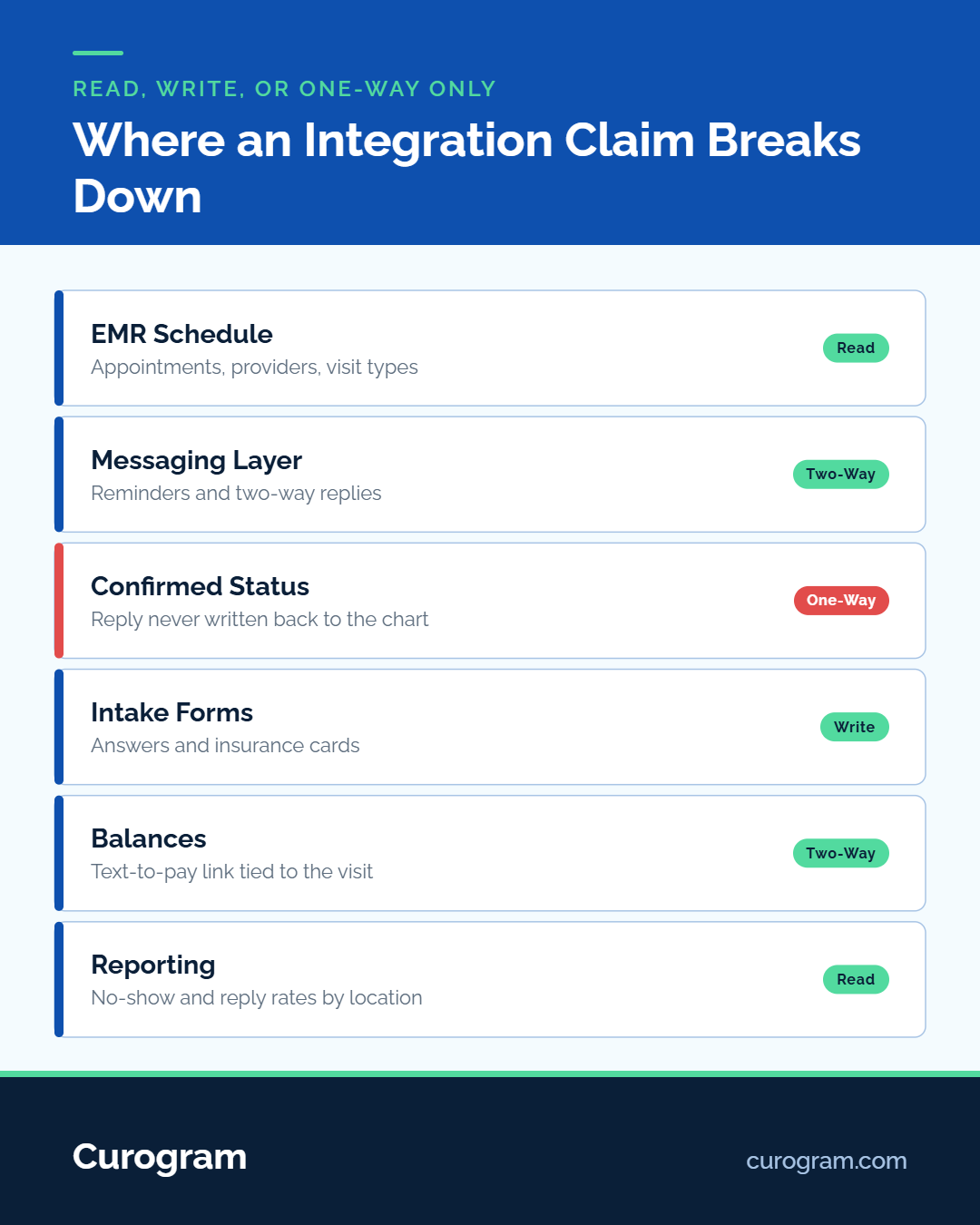
Features matter less than direction. For each kind of record, ask one thing: does the platform read it, write it, or both?
Appointments, patient details, forms, and payments each flow differently. A tool that reads the schedule but can't mark a visit confirmed leaves your day half-true. One that takes intake answers but can't push them into the chart just makes a second inbox to clear.
Ask for the list of supported EMR and practice management systems in writing, with your own EMR named and the direction marked for each object.
Reminders are the easy part. The harder test is a Tuesday when a provider calls out and 40 patients need to hear about it. A platform ready for that filters the day's list by provider or appointment type, then sends once. That's how Osmind EMR broadcast alerts work for behavioral health clinics.
Two more items belong on the same list: digital intake that lands in the chart, and text-to-pay tied to the visit.
Groups that add a site every year need location-specific templates, routing by role, and one report across clinics. Ask how a new location gets added, and whether that repeats the setup fee.
Adoption decides the rest. If the tool takes a day of training, the front desk falls back to the phone by week two. A screen that behaves like ordinary texting gets used.
Run this EMR system checklist during the demo, not after the contract. Each question has an answer a prepared vendor gives without checking.
|
Ask the vendor |
A passing answer sounds like |
|---|---|
|
Which records do you read, and which do you write back? |
Named one by one: appointments read and written, patient details read, forms written to the chart |
|
Is our EMR on your live list, or would we be first? |
A live client on our exact version, with a reference we can call |
|
What is billed once and what is billed per location? |
A written quote naming setup, per-interface, and per-site fees |
|
Will you sign a BAA before we send one patient message? |
Yes, at contract signing, with encryption and audit logs described |
|
Can we see no-show and response rates by site? |
A live report, filtered by location, shown in the demo |
|
Where are your API documents published? |
A public link, sent before the call |
That last question is the cheapest test you have. The federal API Condition of Certification makes certified health IT vendors post their API guides at a public link. No sales call, no NDA. Read them before the demo.
Written process counts too. Rules like the best practices for bulk SMS campaigns with athenahealth show how a vendor expects your team to run campaigns day to day. What the software can do is a separate question.
One deadline is worth tracking. CMS-0057-F gives affected payers until January 1, 2027 to run FHIR-based patient, provider, payer-to-payer, and prior authorization APIs. That will change how prior auth data reaches your staff.
✔️ Broad EMR interoperability without costly custom projects
✔️ Automated two-way reminders tied directly to schedules
✔️ Digital intake with direct EMR sync
✔️ HIPAA compliance with encryption, BAAs, and audit logs
✔️ Text-to-pay for faster co-pay and balance collections
✔️ Scalable support for multi-location organizations
✔️ User-friendly design that staff adopt quickly
✔️ Robust analytics dashboards to measure ROI
✔️ Proven client success with real outcomes

Five questions, answered honestly by the people doing the work. Ask the front desk, not the executive team.
Three or more yes answers means integration isn't a nice-to-have. Start with the workflow that touches the most staff hours, usually reminders or digital intake, and add the rest once one is running.
Curogram sits alongside the EMR you already run. The chart stays the system of record, and the texting layer works off its schedule.
Curogram Highlight: One Connection, Every Patient WorkflowCurogram's EMR Integration works with 70+ EMR and practice management systems, including eClinicalWorks, athenahealth, NextGen, DrChrono, Tebra, and Practice Fusion. Appointments import on their own, so nobody builds a message list by hand. From that one connection, two-way texting handles confirmations and questions in a single thread per patient. Secure forms collect intake before arrival, and text-to-pay sends a balance link tied to the visit. Practice analytics reports no-show and response rates by location. Results we can name, based on our internal data: Atlas Medical Center cut no-shows from 14.20% to 4.91% in three months. Covina Arthritic Clinic confirms more than 1,100 appointments a month. One multi-location group saw 35% of recalled patients book within a month, bringing back 1,240 patients. HIPAA compliance is built in, on a platform that is also SOC 2 Type II certified. |

The checklist above takes about 20 minutes in a demo, and it settles most of the decision. Direction of data flow, a named EMR on a live client list, a BAA, a report by location, and public API documents.
Pick one workflow and measure it for 90 days before adding a second. A platform that can't show you that number by location isn't integration-ready, whatever the pricing page says.
Book a Curogram demo and bring the six questions. We'll answer them on the call, with your EMR named.
.png)
1 min read
💡The hidden ROI of EMR integration is measured in time saved, staff relief, and patient loyalty. Beyond cutting costs, integration drives new...

1 min read
💡Healthcare compliance risks like unsecured communication, missing documentation, and EMR gaps cost clinics time, money, and patient trust. With...

1 min read
💡The cost of poor communication in healthcare rarely shows up as a line item. It shows up as missed visits, wasted staff hours, compliance risk,...