Welligent Telemedicine Integration for Behavioral Health Agencies
💡 The best Welligent telemedicine integration for behavioral health is Curogram. It lets agencies run 1-click, app-free video visits through secure...
12 min read
Mira Gwehn Revilla
:
March 24, 2026
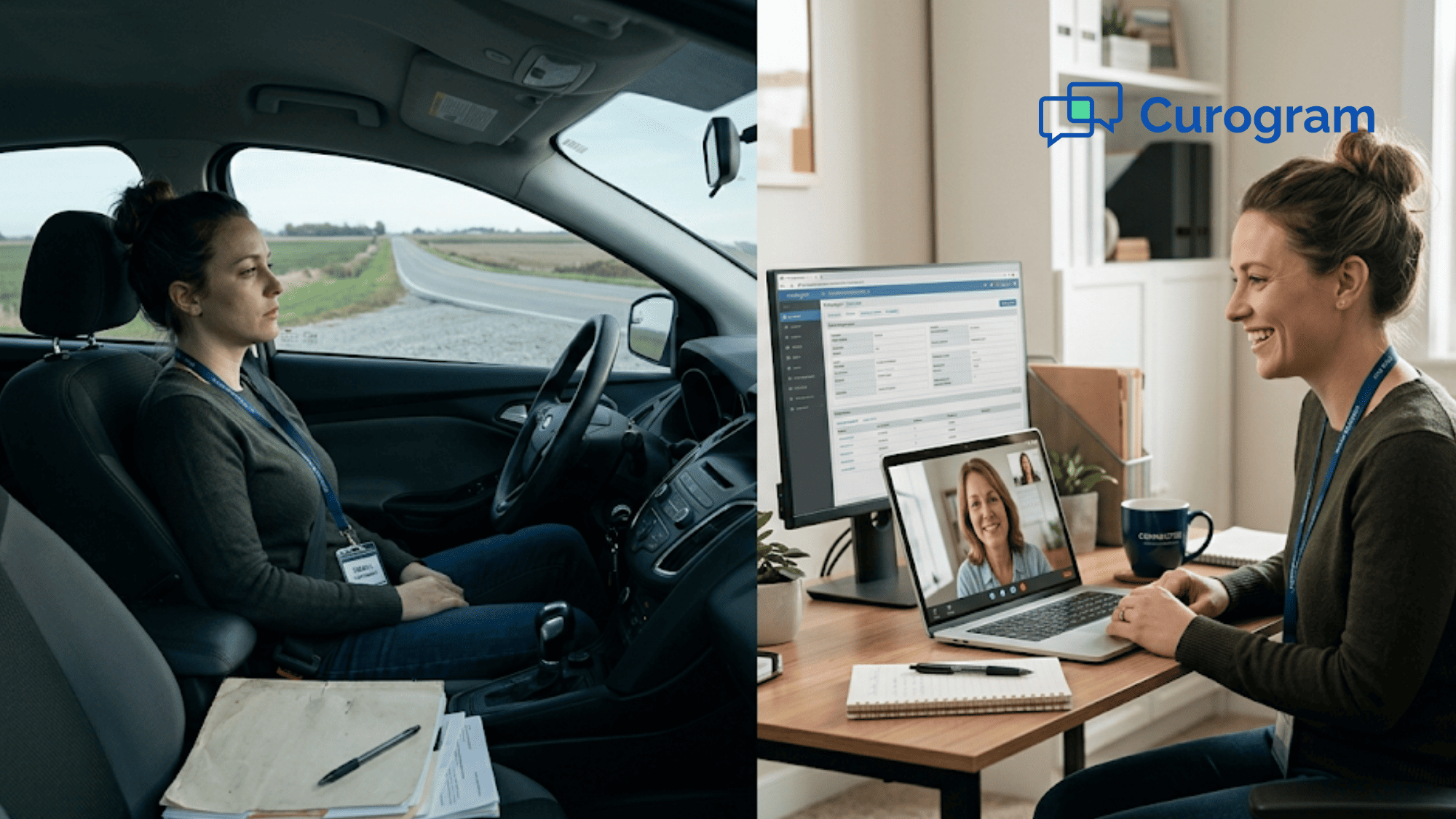
Picture this. Your case manager leaves the office at 8 a.m. She drives 90 minutes to a rural home. The visit lasts 15 minutes. Then she drives 90 minutes back.
That's three hours gone — for one brief check-in.
In human services, this scene plays out every single day. Case managers crisscross wide regions just to do short wellness checks. They spend more time behind the wheel than they do helping clients. And the clients on the waitlist? They keep waiting.
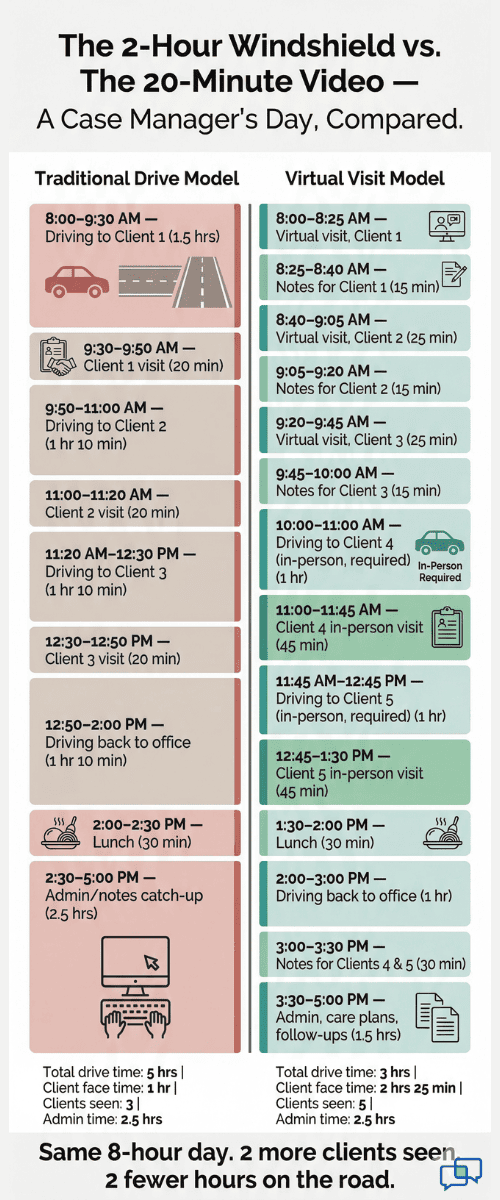
This is what we call "The 2-Hour Windshield" — the hidden drain on your agency's mission. It eats your budget. It burns out your best staff. And it caps how many people you can serve.
But here's the good news: not every visit needs a car trip.
When agencies use Welligent case manager capacity tools paired with telemedicine, they unlock hours of lost time each week. A routine follow-up or wellness check can happen over video in minutes. No apps to install. No portals to log into. Just a simple link sent by text.
Curogram makes this shift easy. Its 1-click video connects case managers with clients in the field right away. The session is secure, compliant, and logged — ready to sync back to Welligent.
The result? Your team does more with what they already have. No new hires. No budget battles. Just smarter use of the hours in a day.
In this article, we'll break down the real cost of travel, show you how virtual field visits work in human services, and walk through the math on how your agency can scale its impact without growing its payroll. Let's get into it.
Case managers in foster care, social work, and mental health serve large areas. Some cover entire counties. Others cross state lines. And many of these clients live in hard-to-reach spots — rural towns, remote homes, or spread-out urban zones.
The result? A huge chunk of the work week is spent driving.
It's not rare for a case manager to spend 10 to 15 hours per week in a car. That's up to two full work days lost to travel alone. Think about what that means in real terms.
|
Say, a case manager handles 25 active cases: Each case needs at least one check-in per month. If the average round-trip drive is 90 minutes, that's over 37 hours just on travel — almost an entire work week. Now add in the time for notes, calls, and follow-ups. There simply aren't enough hours. |
And this doesn't even count the visits that fall through. A client isn't home. A road is closed. Bad weather forces a delay. The whole trip is wasted, and the visit has to be set up again.
Travel time isn't free. Here's a basic look at what it costs an agency per case manager each year:
|
Expense |
Cost per Year |
|
Gas (12,000 miles at $0.67/mile) |
$8,040 |
|
Vehicle wear and tear |
$2,400 |
|
Lost output (10 hrs/week × 50 weeks × $25/hr) |
$12,500 |
|
Total per case manager |
$22,940 |
For an agency with 10 case managers, that's almost $230,000 per year poured into the road — not into client care.
And that figure doesn't include the soft costs. Missed visits mean gaps in care. Gaps in care lead to crises. Crises cost even more to manage.
Let's talk about the human side. Social work already has one of the highest turnover rates in any field. Based on data from the National Association of Social Workers, roughly 40% of social workers leave their jobs within the first two years.
Now add in long drives on top of heavy caseloads. You get staff who are tired, stressed, and falling behind on notes because they spent the day in traffic. Morale drops. Good people leave.
High travel loads also make it harder to reduce social worker travel time through simple fixes like better routing. The core issue isn't the route — it's the model. When every check-in requires a car, there's a hard ceiling on what one person can do.
Here's the part that hurts the most. When case managers are maxed out, agencies can't take new clients. The waitlist grows. People in crisis don't get help.
For non-profits funded by grants, this also puts future funding at risk. Grant makers want to see outcomes and reach. If your team can only serve 200 clients when the need is 300, that gap shows up in your reports.
The "windshield" isn't just a minor hassle. It's a direct threat to your agency's growth, staff health, and community impact. Every hour on the road is an hour not spent doing what matters — helping the people who need you.
So the question becomes: what if some of those drives didn't have to happen at all?

Not every client visit needs to happen face-to-face. This might feel like a bold claim in human services, where the work is deeply personal. But the truth is simple: many routine check-ins can happen over video just as well — and often better.
Think about the types of visits a case manager does in a given week. Some need to be in person, like home safety reviews or court-ordered checks. But many others don't.
Here are visits that work well on video:
A Welligent remote wellness check done by video still covers the same ground as an in-person one. The case manager can see the client, read body language, and note any changes. The only thing missing is the long drive.
Here's where many tools fail. Most video platforms ask clients to download an app, create an account, or log into a portal. For people in crisis, people with old phones, or people who aren't tech-savvy, tha's a wall — not a door.
Curogram solves this with a 1-click, app-free video link sent by text. The client taps the link. The session starts. That's it.
No app store. No username. No password. This is why it works so well for virtual field visits in human services, where clients often face barriers that most tech tools ignore.
Let's walk through a real use case.
Maria is a case manager at a mental health agency. She uses Welligent to manage her caseload. On Monday, she has five follow-ups to complete. Three are in a town 45 minutes away. The other two are across the county.
In the old model, Maria's entire day is spent driving. She completes three visits and pushes two to the next day. Her notes pile up. She's behind before the week even starts.
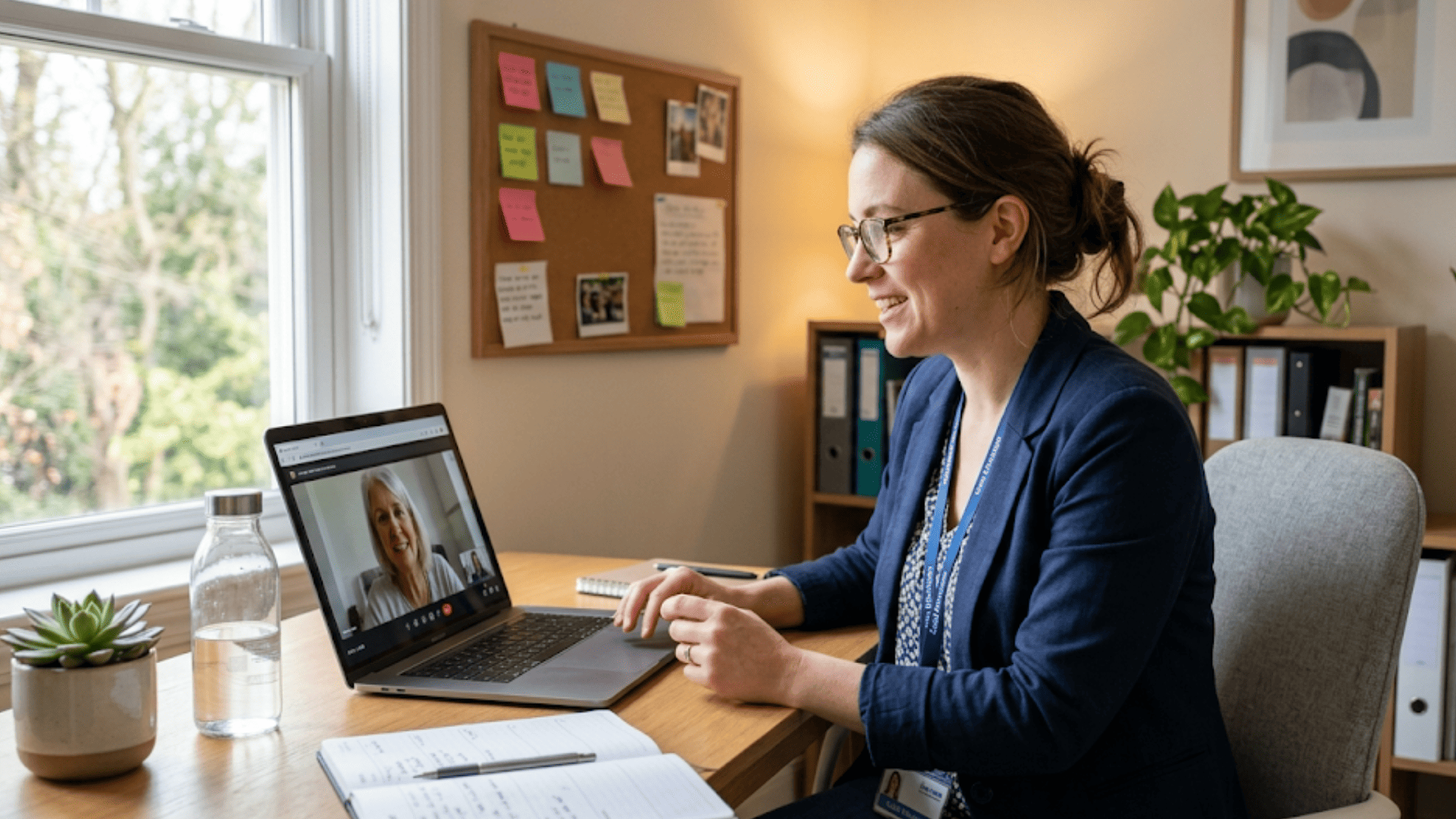
With Curogram, Maria texts a video link to each client on her list. Three of the five are routine follow-ups that work great over video. She finishes those by lunch. Now she has the rest of the day for the two visits that truly need to be in person.
That's the shift. The "2-hour windshield" task becomes a "20-minute video" success. The client is still seen. The care is still compliant. And Maria has time and energy to focus on the cases that need her most.
For agencies that serve clients in addiction services, 42 CFR Part 2 rules are critical. Sessions must be secure and private. Curogram meets these standards. Video sessions are encrypted, and all session data — including time, date, and who joined — can be logged and synced back to Welligent.
This means your efficient behavioral health interventions stay within the rules. You don't have to choose between speed and safety.
From the client's side, virtual visits often feel more natural. There's no stress about cleaning the house for a visitor. There's no awkward wait at the door. It's just a quick video call that fits into their day.
For clients who live far from the office or have limited transport, this access matters even more. They don't have to miss work or find a ride. They just pick up their phone.
The standard of care isn't about where the visit happens. It's about whether the visit happens at all. And when agencies remove the barriers, more clients get seen, more often.
Every agency director knows the tension. The need grows, but the budget stays the same. Hiring more staff would help, but there's no room in the grant for new salaries. So how do you serve more people without spending more money?
The answer is simple: you recover lost time.
Non-profits and human service agencies rarely have the budget to double their team — even when the demand doubles. Funding is tied to grants, state contracts, and Medicaid. These sources are fixed. They don't flex when the waitlist grows.
Hiring a new full-time case manager can cost $50,000 to $65,000 per year in salary alone. Add in benefits, training, and admin costs, and you're looking at $70,000 or more. For many small to mid-size agencies, that's simply not possible.
So the only real option is to get more output from the team you already have. Not by working them harder — but by cutting the waste that holds them back.
Let's break this down with real numbers.
Say your agency has 10 case managers. Each one spends an average of 10 hours per week driving to and from client visits. That's 100 hours of staff time spent on the road every week.
Now let's say you move just half of those visits to video using Curogram. Each case manager saves 5 hours per week. Across the team, that's 50 hours recovered.
Here's what that looks like over a full year:
|
Metric |
Value |
|
Case managers on staff |
10 |
|
Hours saved per person per week |
5 |
|
Total hours saved per week |
50 |
|
Total hours saved per year (50 weeks) |
2,500 |
|
Equivalent full-time employees gained |
1.2 FTEs |
That's the same as hiring a new full-time worker — for free. No new salary. No new desk. No new benefits package. Just better use of the time your team already has.
Those hours don't just sit idle. Here's where the real impact shows up.
Your team can take on more clients. If each virtual visit saves 90 minutes of drive time, a case manager can squeeze in two or three extra check-ins per week. Over a month, that's 8 to 12 more clients per person — and 80 to 120 more across a 10-person team.
Your team can do more frequent check-ins. Instead of seeing a client once a month, they can check in twice. More frequent contact means fewer crises, better outcomes, and stronger trust.
Your team has more time for notes and admin. One of the biggest pain points in case work is falling behind on records. When travel eats the day, notes get pushed to nights and weekends. With less driving, staff can stay on top of their work during normal hours.
The key to making this work is choosing tools that fit your clients — not the other way around. Many agencies have tried video platforms that flopped because clients couldn't figure them out. Or the tool needed strong Wi-Fi. Or it required a laptop.
This is where Curogram shines. To scale non-profit services with SMS and video, you need a tool that works on any phone, with no app or login required. Curogram sends a simple text link. The client taps it. The video call starts.
For clients in rural areas with spotty internet, Curogram's video works over basic cell data. As long as the client can stream a video on their phone, the session will run.
This removes the biggest barrier to virtual care: access. It doesn't matter if your client is tech-savvy or not. It doesn't matter if they have a new phone or an old one. The link just works.
Consider a foster care agency in central Texas that serves 15 counties. Their team of 12 case managers drives over 4,000 miles per month combined. Each worker juggles 30+ active cases.
By shifting routine check-ins to video, the agency could save each worker about 6 hours per week. That's 72 hours per week of recovered time across the team. Over a year, that's 3,600 hours — nearly two full-time positions.
With those hours, the agency could accept more referrals, do more frequent visits with high-risk youth, and reduce the backlog of court-ordered reviews. None of that requires new funding. It just requires a smarter model.

Here's another angle that matters for non-profits: proof of service.
Grants and state contracts often require detailed reports on how many clients were served, how often, and what happened in each session. If your staff are too busy driving to do visits, your numbers suffer. And when your numbers suffer, your next funding round is at risk.
Because Curogram logs session data — duration, time, and who joined — agencies have the proof they need for grant reports. That data can sync back to Welligent, so your records stay clean and audit-ready.
This is huge. It means your team not only does more — they can prove they did more. That's the kind of data that wins grants and keeps funders happy.
Scaling your mission doesn't require a bigger budget. It requires a better workflow. When you remove the travel bottleneck, your team's true capacity shows up.
Every hour saved on the road is an hour returned to the mission. And when you add those hours up across a full year, the math speaks for itself. More visits. More clients. More impact. Same payroll.
Keeping good case managers on staff is one of the hardest jobs an agency director faces. The work is heavy. The caseloads are high. And when you add hours of driving on top of all that, the burnout rate spikes fast.
Think about what a typical day looks like for a mobile case manager. She starts early, drives to three or four homes spread across a wide region, handles tough cases, and then comes back to the office to write up notes — often after hours. She does this five days a week.
Over time, the physical toll adds up. Fatigue, back pain, and stress from long drives aren't just minor issues. They lead to sick days, lower morale, and — worst of all — good people leaving the field.
When staff leave, the cost is steep. Training a new case manager takes months. During that gap, the rest of the team picks up the slack. The cycle of overwork gets worse.
When you reduce the need for daily driving, you give your team back something money can't buy: time and energy. A case manager who finishes three video check-ins by noon still has fuel in the tank for the in-person visits that truly need a face-to-face touch.
Less road time also means more time for notes during the work day. Staff don't have to choose between timely records and personal time. That alone is a major win for morale.
Here's an important point. If you hand your team a complex video tool that takes 10 clicks to set up a call, you've just added stress — not removed it.
Curogram is built to be simple. Case managers send a link via text. The call starts in one click. There's no training curve and no tech headaches. A team that feels supported by its tools, rather than weighed down by them, delivers better outcomes for the clients it serves.
How Curogram Helps Human Service Agencies Do More with Less
Curogram was built for real-world care settings — not just offices with fast Wi-Fi and front desks. That's what makes it a strong fit for agencies running Welligent.
Clients don't need to download anything. A text link opens a secure video call on any phone. This is critical for clients in rural areas, shelters, or unstable housing who may not have access to a computer.
For agencies that work with addiction or mental health services, privacy isn't optional. Curogram sessions are encrypted and meet 42 CFR Part 2 standards, giving both your team and your clients peace of mind.
Every video call logs the date, time, duration, and who joined. That data can sync back to Welligent, so your records stay up to date without double entry. This matters for audits, grant reports, and state compliance reviews.
Need to let 50 clients know that a group session changed time? Or that a team member is running late? Curogram's mass text feature handles that in seconds. You don't have to call each person one by one.
Based on our internal data, staff training on Curogram takes as little as 10 minutes. The interface feels like texting — because it is. Your team can start using it the same day.
For agencies juggling tight budgets, wide service areas, and high caseloads, Curogram isn't just a nice-to-have. It's the tool that turns wasted hours into real client contact.
When you pair it with Welligent, you get a system built for the way human services actually work — not how tech companies wish they worked.
The math is clear. When your case managers spend half their week in a car, your agency can't grow. The waitlist stacks up. Staff burn out. And the clients who need you most get seen the least.
But it doesn't have to be that way.
By moving routine visits to video, your team recovers hours every week. Those hours turn into more check-ins, more clients served, and better outcomes — all without adding headcount. One agency with 10 case managers can recover the same output as 1.2 full-time hires just by cutting drive time in half.
Curogram makes this shift simple. There's no app for clients to install. No complex training for staff. Just a text link, a 1-click video call, and a session log that syncs back to Welligent. It fits the way your team already works.
And it protects your people, too. Less driving means less burnout. Less burnout means better retention. Better retention means the clients in your care get the steady support they deserve.
The "2-Hour Windshield" doesn't have to define your agency's limits. You can serve more people, keep your best staff, and stretch your funding further — starting today.
Ready to see how much capacity your team can recover? Schedule a quick demo to see exactly how Curogram works with Welligent.
Curogram's video runs on basic cell data. As long as a client has enough signal to stream on their phone, they can join. No home Wi-Fi, app, or portal is needed.
Free tools aren't built for care settings. They often lack 42 CFR Part 2 compliance, don't log session data, and require app installs — all of which create problems for documentation, audits, and client access.
Based on our internal data, staff training takes as little as 10 minutes. The tool works like texting, so most teams are fully up and running within a day of setup.
💡 The best Welligent telemedicine integration for behavioral health is Curogram. It lets agencies run 1-click, app-free video visits through secure...
💡 Easy telemedicine for Azalea Health rural patients works through text-based video visits that require no app, no account, and no download. ...
💡 Rural clinic staff on Azalea Health can use text-based telemedicine to reduce no-shows and keep their schedules full. When a patient calls to...