
8 min read

The Manual Entry Tax | Staff Intake Automation

The Manual Entry Tax | Staff Intake Automation

💡 Veradigm EHR digital intake automation uses text-delivered forms to replace paper clipboards and eliminate 8–10 minutes of manual data entry per patient. Staff stop transcribing handwritten intake sheets into the system.          

FollowMyHealth only digitizes intake for enrolled portal users. The 60–80% of patients who never sign up still receive clipboards, creating a dual workflow that drains front desk hours every day.    

Curogram closes this gap by sending HIPAA-compliant intake forms through a text link to every patient.  

Forms flow directly into Veradigm through open API integration. No transcription, no scanning, no handwriting guesswork.


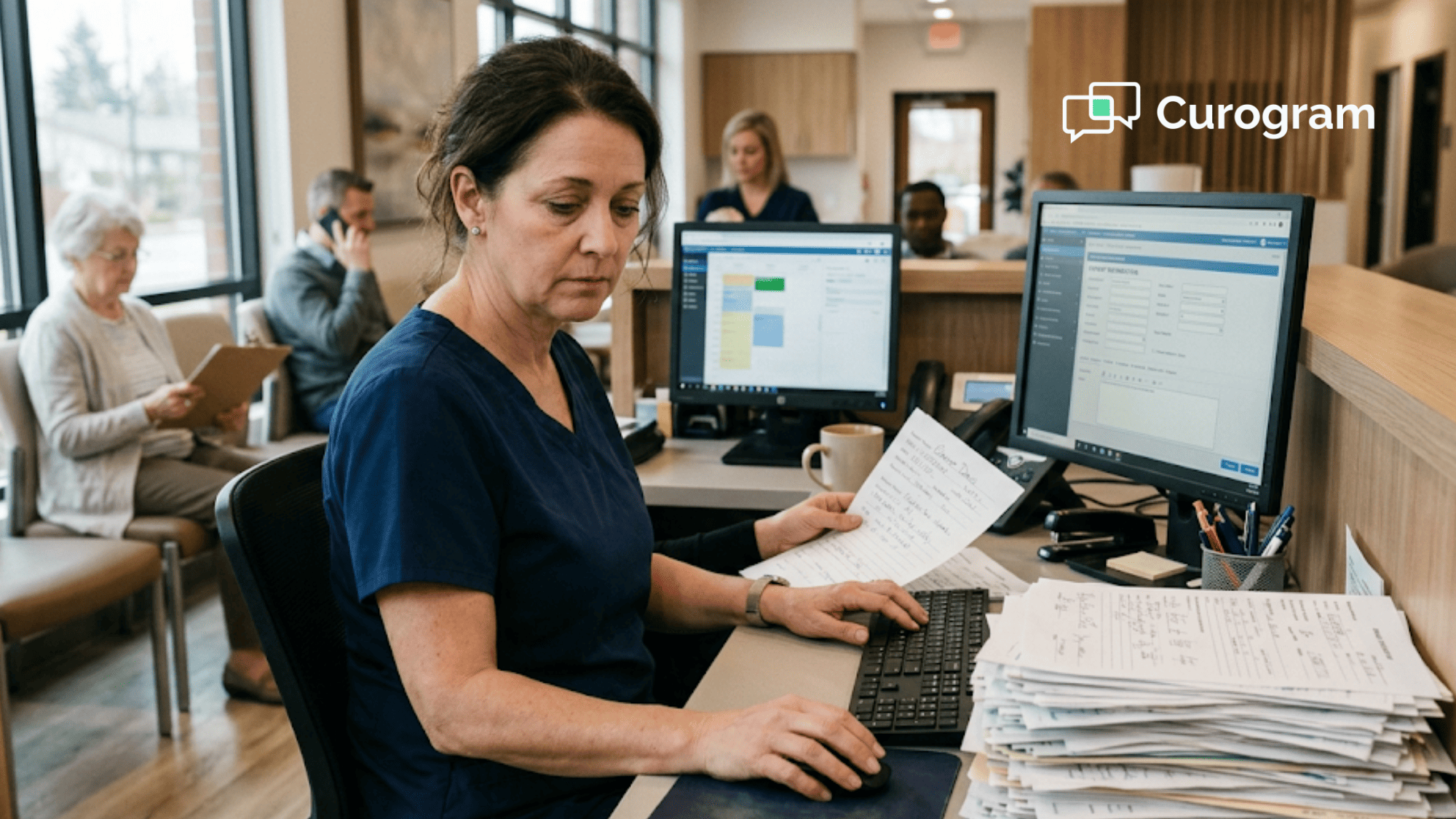
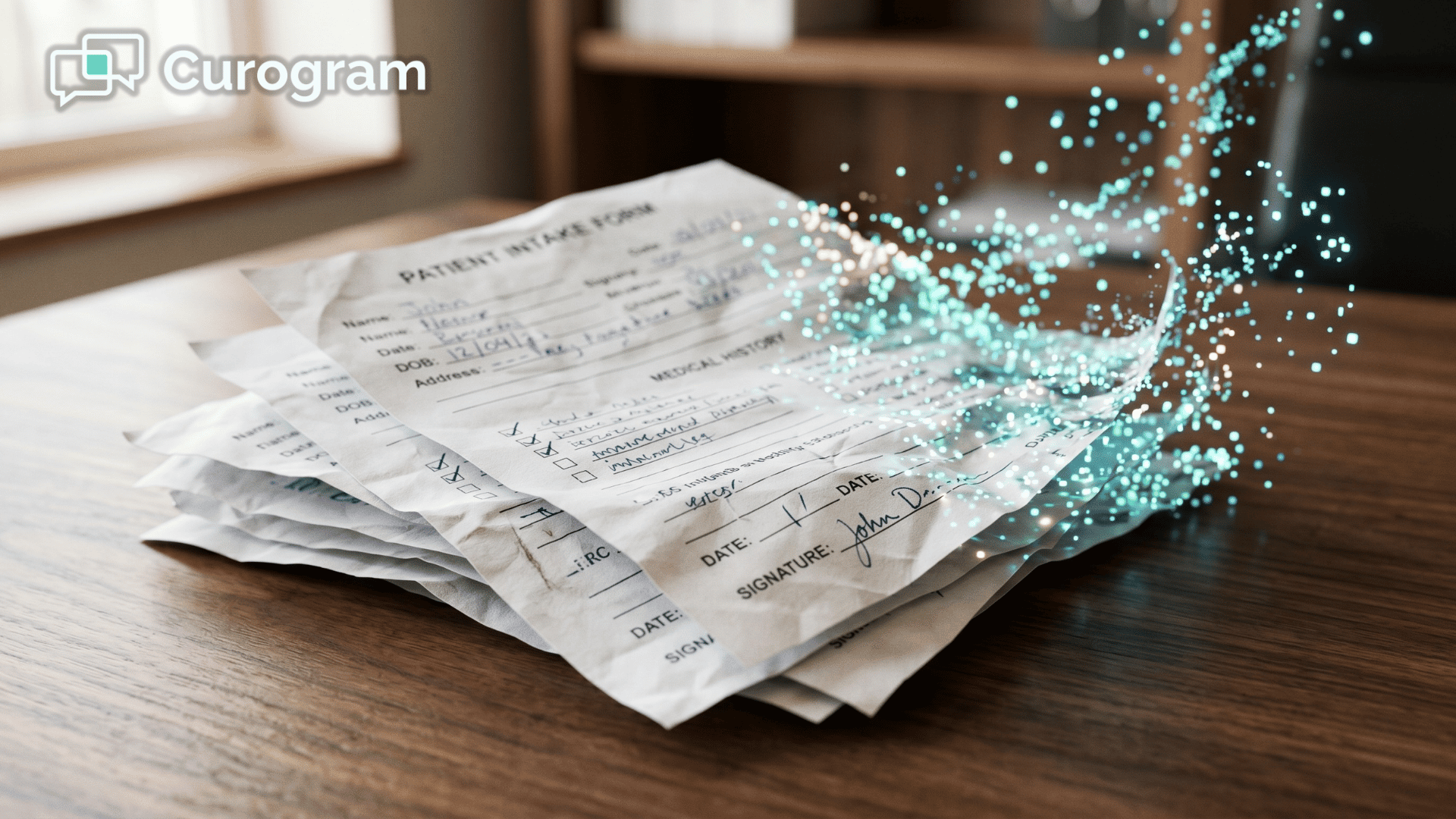
It is 9:17 AM on a Tuesday. Your front desk has already handed out six clipboards.

Three phones are ringing. A patient is asking about her referral.

Meanwhile, Janet is squinting at a handwritten medication list, trying to figure out if the scribble says Lisinopril or Losartan.

The difference matters. One wrong letter can trigger a safety alert, a denied claim, or a dangerous prescription.

This is the quiet tax every Veradigm practice pays. Clipboards, handwriting, and manual data entry eat hours of staff time before noon.

You already invested in Veradigm EHR. You rolled out FollowMyHealth. On paper, intake should be solved. In practice, only 20% to 40% of your patients ever enrolled in the portal.

The other 60% to 80% still walk in, sit down, and reach for a pen.

Here is the math that breaks your team.

A practice seeing 30 patients a day with 18 clipboard patients loses roughly 2.7 hours to transcription alone. That is 13 to 15 hours a week, per provider, spent copying handwriting into fields that already exist in the EHR.

It is not just slow. It is risky.

Handwritten intake is the single largest source of data errors your billing and clinical teams will ever see.

The good news is that Veradigm EHR digital intake automation fixes this without replacing FollowMyHealth, retraining your staff, or overhauling your workflow.

You just need a way to reach the patients the portal misses.

That way is text.

The Hidden Cost That's Draining Your Front Desk Every Day

The Math Behind a Typical 30-Patient Day

Most practice leaders underestimate how much time is lost to paper intake. It feels normal because it has always been this way. But when you put the numbers on paper, the picture changes quickly.

Let us walk through a typical 30-patient day in a Veradigm practice.

Intake Type Patients Minutes Per Patient Total Time
FollowMyHealth (digital) 12 0 (auto-populated) 0 minutes
Clipboard (paper) 18 9 minutes 162 minutes
Daily total 30 2.7 hours

That is almost three hours lost to one front desk seat, on one provider's schedule. Multiply that across a week and you are looking at 13.5 hours. Across a 3-location practice, that climbs past 40 staff hours weekly.

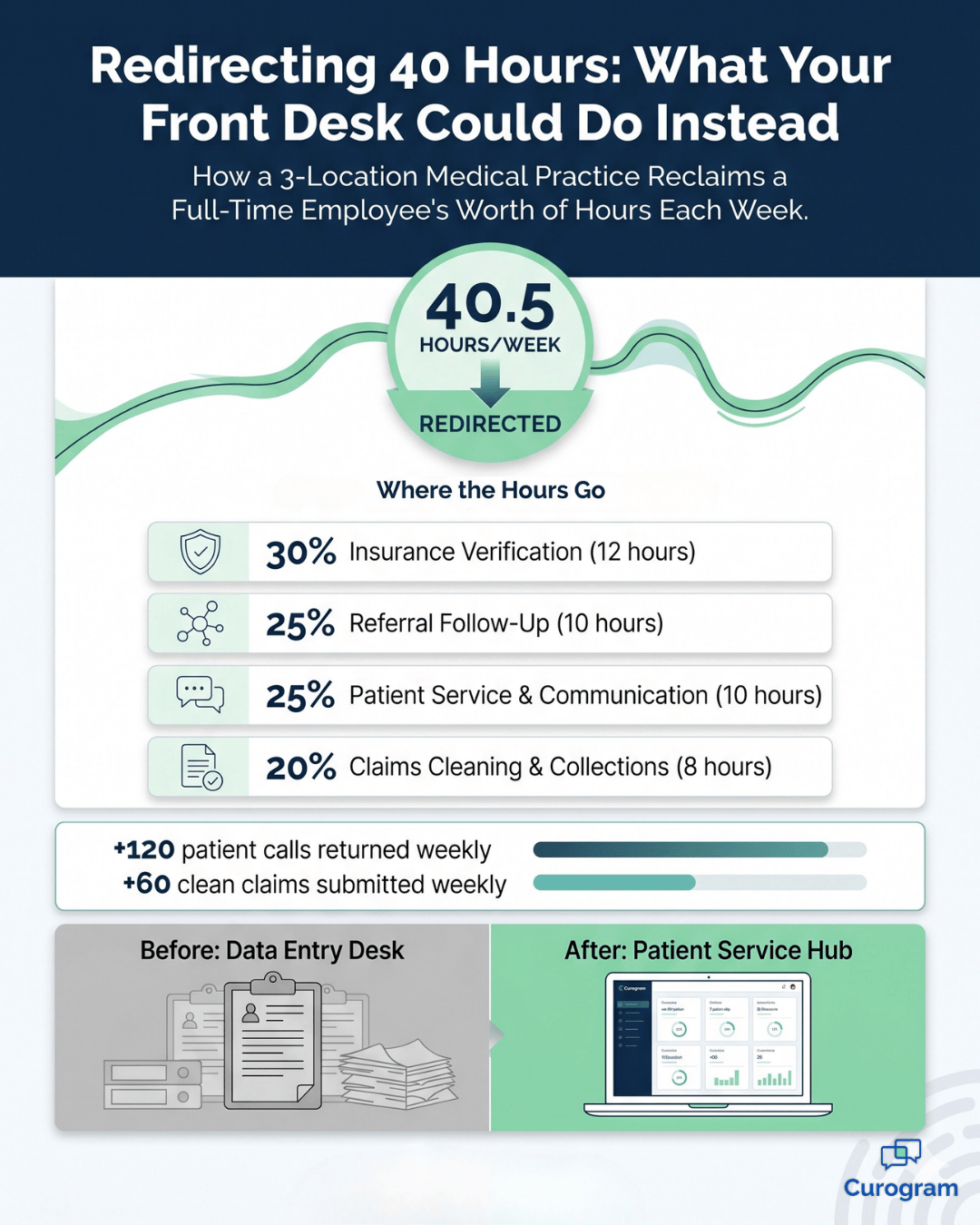
What does 40 hours really mean? It is the equivalent of one full-time employee whose entire job is copying handwritten forms into your EHR. That is a real salary line.

The Error Cascade No One Talks About

Manual data entry is not just slow. It is the single biggest source of transcription errors across your practice.

A sloppy "7" becomes a "1" in the insurance ID.

A rushed "10mg" looks like "100mg" on a pharmacy pre-check.

A missed allergy turns into a clinical safety event.

Each of those small errors travels.

Wrong insurance data causes claim denials and rework. Wrong medication data disrupts e-prescribing. Wrong allergy data creates real patient risk.

Studies on healthcare data entry estimate error rates of 4% to 15% in handwritten intake. Even at the low end, that means roughly 1 in every 25 clipboards carries a mistake someone will have to fix later.

The Dual-Workflow Burden

Here is the part that catches leaders off guard. Adopting FollowMyHealth did not eliminate paper — it simply built a parallel process next to it.

Your team now runs two intake systems at the same time.

One digital, for the portal users. One paper, for everyone else. That means double the training, double the troubleshooting, and double the quality checks, all to do a job that used to live in one workflow.

New hires learn both. Audits cover both. Nothing actually got simpler.

Why Your Patient Portal Isn't Solving the Problem

The Enrollment Ceiling

FollowMyHealth is a strong portal. It is not the villain here. But portals were never designed to reach every patient.

Enrollment is the bottleneck. Most patients never make it past step two of the setup process.

Here is where they drop off:

  • Download the app
  • Create an account
  • Verify their email
  • Remember a password
  • Log in the next time they actually need something

Every step is a place where a patient can quit. And most do.

Industry data consistently shows that 20% to 40% of patients actively use their healthcare portal. The rest ignore it, forget about it, or gave up during setup.

Think about this.

If 70% of your patients will not log into a portal, then 70% of your intake is still paper.

The digital front door is only open for the patients who already walked through it.

how medical practices redirect 40 staff hours weekly with digital patient intake

The Friction Patients Actually Feel

Patients do not wake up wanting to use a portal. They want to show up, see the provider, and leave.

A text message is different. It arrives on the one device they already use all day.

No app to download. No password to reset. Just a tap, a form, and done.

The average person checks their phone 96 times a day. Text messages have a 98% open rate within the first three minutes. Patient portals simply cannot compete with that level of access.

Where Veradigm's Open API Comes In

The good news for Veradigm customers is that the platform was built with open API integration in mind. That means third-party tools can plug into it cleanly without disrupting your existing setup.

This matters because you do not need to rip out FollowMyHealth to fix the intake gap. You just need to add a channel that reaches the patients the portal misses.

Text is that channel.

How Text-Delivered Intake Forms Actually Work

From Appointment Scheduled to Form Submitted

Here is where Veradigm EHR digital intake automation becomes practical.

Curogram integrates with Veradigm through its open API to identify every upcoming appointment.

Then it sends each patient a secure text link 48 hours before their visit.

The patient taps the link. No app. No login.

On their phone, they fill out mobile-optimized forms covering everything your EHR needs:

  • Demographics and contact info
  • Medical history and current medications (with autocomplete)
  • Allergies and surgical history
  • Insurance, captured with a quick photo of the front and back of the card
  • Consent signatures with a fingertip

Everything submits digitally. Staff see completed intake on their dashboard before the patient walks in. The transcription step disappears because there is nothing to transcribe.

17 Fewer clipboards per day, every day

That single remaining clipboard is usually a first-time patient without a smartphone, not a daily occurrence.

Patient completing a mobile-optimized medical intake form on a smartphone at home before appointment

The Pre-Visit Completion Dashboard

One of the most useful pieces for front desk staff is visibility.

The Curogram dashboard shows the status of every patient on tomorrow's schedule at a glance.

  • Green means the patient has completed intake.
  • Yellow means they started but did not finish.
  • Red means they have not opened the link.

At 4 PM today, your team already knows who will arrive ready and who needs a reminder text. That shift, from reactive to proactive, changes the entire morning rhythm.

Instead of processing clipboards as patients arrive, your scheduling coordinator simply manages exceptions.

The clipboard drawer becomes a backup, not a daily tool.

765 Minutes of data entry saved every week

That is nearly 13 hours a week, per location, no longer spent deciphering handwriting.

What Happens Inside Veradigm

Form responses flow directly into the Veradigm workflow through the open API connection. Staff see the completed data alongside the patient's existing record.

Kill the clipboard! Streamline intake and decrease wait times with Curogram's mobile-friendly online forms.  

No scanning. No manual entry. No guessing at handwriting.

The patient's own typed answers become the source of truth.

This is the piece FollowMyHealth cannot do for non-portal users. And it is exactly what most of your patients need.

What It Looks Like When the Clipboards Are Gone

A Thursday Morning That Actually Moves

Picture a Thursday morning. Thirty-six patients across two providers. The day should be chaos. Instead, it moves.

Twelve FollowMyHealth users submitted intake through the portal. The remaining 24 got Curogram text links two days earlier. Twenty completed their forms at home. Three finished in the waiting room on the same link.

One first-time patient without a smartphone used a clipboard.

Your staff did zero manual data entry for 35 of the 36 patients. The check-in desk processed everyone in about two minutes each, not fifteen.

The Numbers That Change

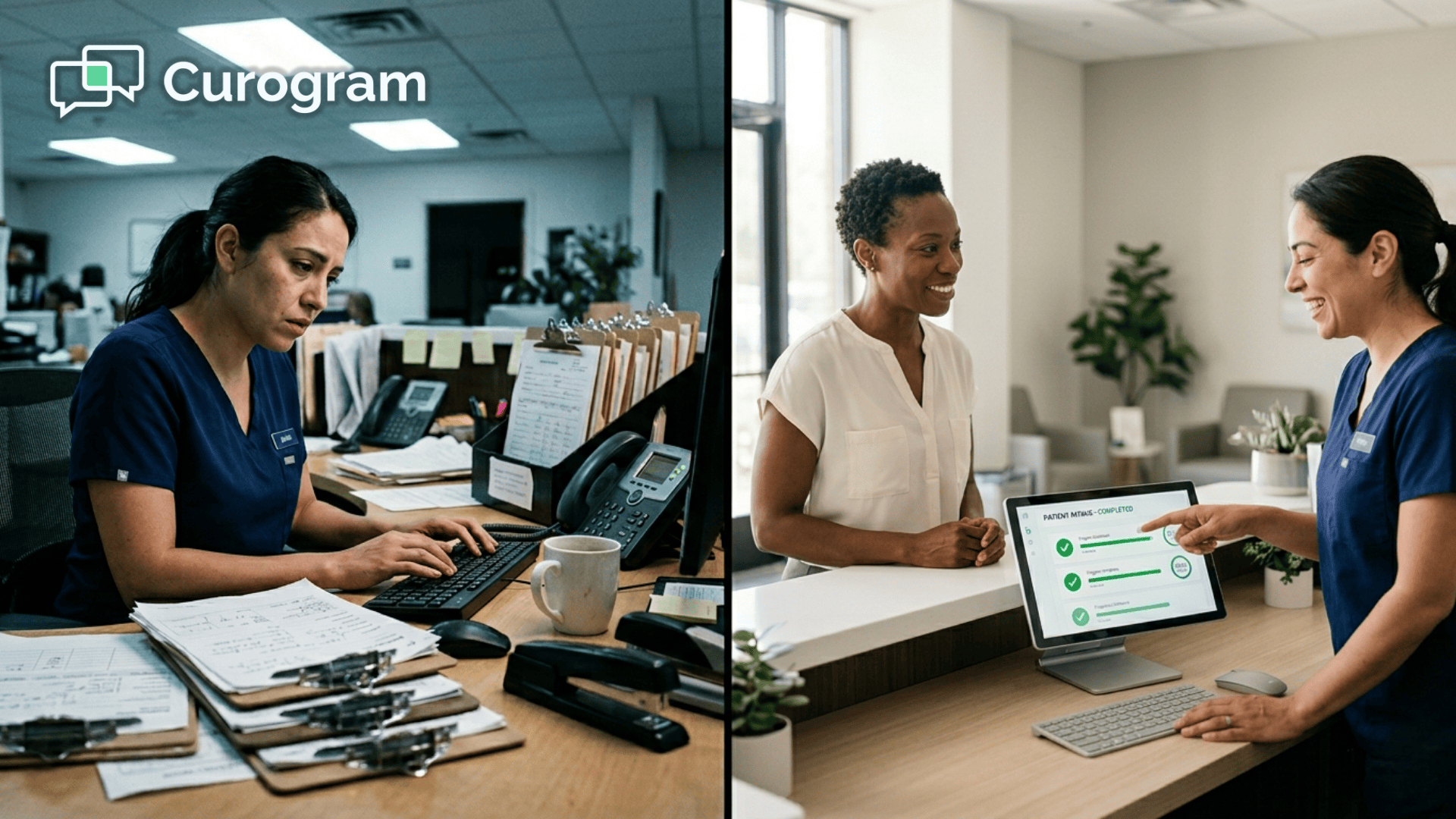
When you compare a clipboard-heavy day to a text-delivered intake day, the gap shows up in every part of the operation.

For your team, 38 hours a week is roughly the cost of a full-time employee. Not eliminated, redirected. That time now flows into insurance verification, referral follow-up, patient service, and schedule optimization.

The Shift From Transcription to Service

This is the part that most practices underestimate. Your staff did not go to school to retype handwriting. They went into healthcare to help patients.

When the clipboard pile disappears, so does the mental load. Check-in becomes a 2-minute verification instead of a 15-minute scramble. Morale improves because the work feels meaningful again.

12.75 Staff hours recovered weekly, per location

Providers notice too. Visits start on time with complete data. The first five minutes stop being re-ask sessions and start being actual care.

Your Front Desk Deserves Better Than a Clipboard

FollowMyHealth digitizes intake for patients who enrolled. That is a real win. But it only covers part of your schedule.

The rest of your patients are still handing you paper. And your staff is still paying the manual entry tax every single day.

Veradigm EHR digital intake automation through text-delivered forms closes that gap. Every patient gets the same clean, HIPAA-compliant intake experience, whether they use the portal or not.

Every form flows directly into Veradigm. Every minute your team spent transcribing goes back into patient-facing work.

Think about what that means for your practice. If your team recovers even 10 hours per week per location, that is roughly 520 hours per year. For a 3-location group, more than 1,500 hours annually, without adding a single headcount.

It means fewer claim denials tied to transcription mistakes. It means safer e-prescribing because medication lists come straight from the patient. It means faster check-ins, shorter wait times, and happier patients.

And it means your front desk staff stop being human scanners.

The right question is not whether your practice should automate paper intake. The question is how many more hours you are willing to lose before you do. Every week of waiting is another 15 to 40 staff hours your clipboard drawer quietly takes away.

You have the EHR. You have the portal. You just need the channel that reaches everyone else.

Ready to see what a clipboard-free Thursday looks like in your practice? Schedule a Demo with Curogram. Bring your average daily clipboard count and your current check-in time, and we will walk you through exactly how many staff hours you will recover in the first 30 days.


Frequently Asked Questions

Can we customize the intake forms for different specialties and visit types?

Yes. The form builder supports fully customizable templates by specialty, provider, and visit type. Cardiology patients can get pre-procedure risk assessments. Orthopedic patients receive surgical and imaging history forms. Pediatrics can pull in immunization records and developmental screenings. Forms are built once per specialty and auto-assigned based on appointment type, so your staff never has to pick the right template manually.

What about patients who don't have smartphones or can't complete digital forms?

The text link works on any phone with a web browser, including basic phones with internet capability and tablets. For the small group of patients who truly cannot use digital forms, clipboard intake is still available as a fallback. The dashboard tells your team in advance who needs paper, so you prepare only the clipboards you will actually use instead of printing forms for everyone.

Is patient data entered on the phone secure and HIPAA compliant?

Yes. Forms are transmitted over encrypted HTTPS connections and stored in HIPAA-compliant infrastructure with SOC 2 Type II certified controls. Patient data never travels through unencrypted channels. A Business Associate Agreement is executed with every practice. The security standard meets or exceeds what FollowMyHealth provides through its portal, just delivered through a much simpler channel.

How long does it take to roll out text-delivered intake across a practice?

Most practices are live within 2 to 4 weeks. The open API integration with Veradigm handles the technical setup, while your team focuses on reviewing form templates and training front desk staff. Staff training typically takes under 30 minutes because the dashboard is built to mirror the workflow your team already uses.

Will our patients actually fill out forms through a text link?

The data strongly suggests yes. Text messages see around a 98% open rate, and healthcare practices using text-delivered intake regularly report completion rates of 80% to 90% before the appointment. Patients are already on their phones. Removing the portal login step is the single biggest driver of completion.