


6 min read

Patient Recall in Valant Beyond Built-In Tools

Patient Recall in Valant Beyond Built-In Tools
💡 Patient recall in Valant beyond built-in tools means reaching lapsed patients through channels the portal cannot. Valant's portal works well for active patients who still log in. It does little for those who quietly stop coming back. That gap matters most in psychiatry, where one missed visit can mean a missed refill.

Curogram for Valant closes the gap with automated SMS recall. It syncs appointment history from Valant, then texts patients who have no upcoming visit. No portal login or app is needed. Staff see every reply in one dashboard and act fast.

Based on our internal data, recall texts brought 1,240 lapsed patients back at one multi-location practice. That is a 35% reconversion rate within a single month. For Valant practices, this turns silent attrition into recovered care and revenue.

A patient stops showing up. No call. No note. The chart just goes quiet.

In outpatient psychiatry, this happens more than most teams admit. Someone misses two visits and never reschedules. The portal shows no fresh activity. Slowly, that person slips out of care.

Many practices run on Valant for clinical records and scheduling. Valant tracks what happens inside the chart. It does not chase the patients who drift away. That is the gap Curogram for Valant was built to fill.

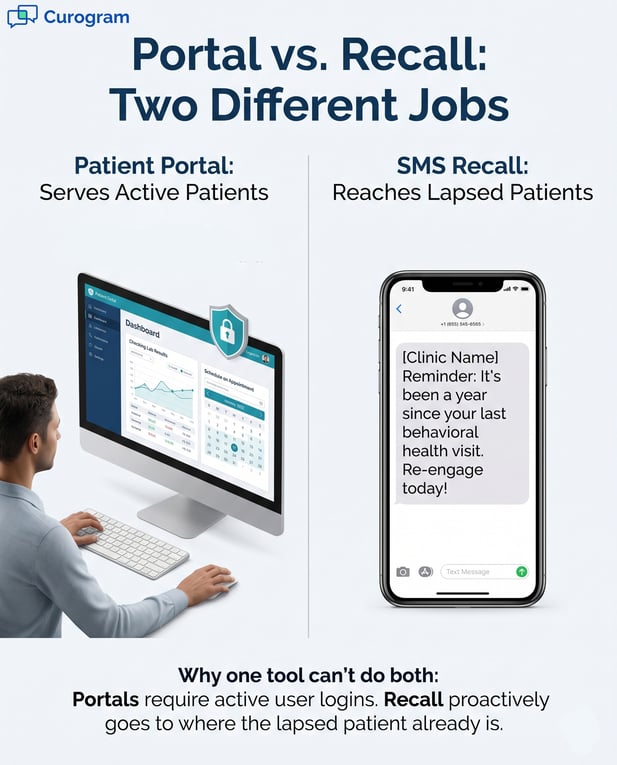
This is where patient recall in Valant beyond built-in tools comes in. The portal speaks to people who still log in. Recall speaks to people who have gone silent. Those are two very different jobs.

The stakes here are not only about money. A patient on a mood stabilizer who quits care can face real harm.

Withdrawal, relapse, and even crisis are all on the table. Bringing that person back is a safety net, not just a booking task.

There is a revenue side too. One provider can lose dozens of patients each year to silent drift. Every empty panel slot is care and income left on the floor. These small leaks add up fast, month after month, until they sting.

So the problem here is clear, but the fix does not have to be hard at all. You do not need to rip out Valant or retrain your whole team.

You simply need a reliable way to reach patients where they truly are, which is on their phones.

The rest of this guide shows exactly how that works. We will first look at why the portal alone falls short.

Then we will walk through how recall runs in practice. We will also cover why it matters so much for mental health care today, and where to start first.

The Invisible Attrition Problem In Outpatient Psychiatry

Attrition in psychiatry does not look like a loud complaint. It looks like silence. To fix a quiet problem, you first have to see it clearly.

Patients who simply stop coming

Primary care patients often call to cancel or move a visit. Psychiatric patients frequently do neither. They miss one appointment, then a second, and then they are gone. The portal stays still, and the chart goes dark.

One practice manager put it plainly. "We know we're losing patients who just go quiet."

The clinical version of that worry is sharper. A patient on an SSRI or mood stabilizer who stops care without oversight can face withdrawal and relapse.

Valant records the visits that do happen. It does not flag the visits that quietly stopped. It also will not reach out on its own to win those patients back. Someone, or something, has to notice the gap first.

What the silence costs

The math is easy to miss because each loss feels small. Picture a practice that loses five patients a week to silent drift. Over a year, that is 260 patients gone without a single word.

At about $200 per visit, and just one missed visit each, that is $52,000 from one provider's panel.

The loss is real, yet it never shows up as a single big event. It hides inside dozens of quiet gaps, which is exactly why it goes unfixed for so long.

That hidden cost is the real danger. You cannot plan around a leak you never measure. Once you can see it, you can finally act on it with intent.

Why Valant's Portal Is Not A Recall System

The portal is a good tool, but it was built for a different job. Knowing what it does well, and what it cannot do, makes the recall gap obvious.

The portal assumes engagement

Valant's portal serves patients who are already active. They log in, read messages, and reply to reminders.

The whole design rests on one quiet assumption, which is that the patient is still paying attention.

Recall flips that picture on its head. It targets people who have stopped logging in and stopped replying.

Sending a portal message to that person is much like sending nothing at all. The message may be perfect, but no one is there to read it.

Recall needs a different channel

A real recall system cannot wait for patients to come to it. It has to go to them, on a channel they still check every day. For most people, that channel is a simple text message.

Portal messaging and recall serve two different groups. One supports active patients inside your systems.

The other reaches lapsed patients who have drifted outside them. They need different tools because they solve very different problems.

This is the core idea behind reaching patients beyond the built-in portal. You meet people on the channel they truly use. That small shift changes who you can bring back. 

Infographic comparing patient portals vs SMS recall for healthcare marketing

How Curogram's Recall Works with Valant

Curogram does not replace Valant. It works alongside it, using Valant's own data to find and reach the patients who have slipped away.

Triggers pulled straight from Valant

Curogram syncs appointment history from Valant on an ongoing basis. It then watches for patients with no upcoming visit. You pick the window that fits your practice, such as 30, 60, or 90 days.

Once a patient crosses that line, they are queued for recall. No one has to build a list by hand. The system flags the right people the moment they go quiet.

Outreach that reaches patients directly

Recall messages go out by text, straight to the patient's phone. There is no portal login and no app to download. The message comes from your practice's own number, so it feels familiar and trusted.

Two-way texting, not a blast

A recall text is the start of a chat, not a one-way alert. When a patient replies to reschedule or ask a question, the message lands in the Curogram dashboard.

Your staff can read it and act on it right there. Even a "found another provider" reply gives you useful, honest data.

Segment by who needs care most

You can shape recall campaigns by provider, diagnosis, visit type, or time since the last visit. That control matters in mental health care.

You can run one campaign for medication management patients, who carry the highest urgency. You can run a calmer, separate one for therapy-only patients.

The payoff is concrete. Based on our internal data, one multi-location practice saw a 35% reconversion rate from recall texts.

In plain terms, 1,240 lapsed patients booked again from those messages alone. The added staff hours were close to zero, since the outreach ran on its own.

For a Valant psychiatry practice, that reconversion rate is more than a number. Each returning patient is someone who might have been lost to follow-up. The clinical upside and the revenue upside arrive together, hand in hand.


The Clinical Case For Automated Recall In Psychiatry

In psychiatry, recall is more than a revenue tool. It is part of safe, steady care. The clinical case and the business case point the same way.

Medication safety and continuity

Patients on psychiatric medication need steady oversight. When they stop care without warning, the risks are real. Withdrawal, symptom relapse, and crisis can all follow a sudden gap.

Automated recall acts as a quiet safety net. It catches people before a small gap becomes a serious one. A timely text can be the nudge that brings someone back. That is care, not just scheduling.

Better data, better outcomes

Tools like the PHQ-9 and GAD-7 only help if patients keep coming back. A lapsed patient leaves a blank space where their progress should be. You cannot track an outcome you never get to see.

Recall keeps that record going over time. For practices that value measurement-based care, this matters a great deal.

The clinical and money sides finally meet here. You recover patients and revenue in the very same step.

Think of recall as a record that keeps writing itself. Each return visit adds one more point to a patient's path.

Over months, that view shows whether a treatment is truly working. Without recall, the story stops mid-sentence, and so does your insight.

Close-up of a patient viewing an automated medical recall text message on their phone

Getting Started

Getting started is meant to be simple. You can begin with a small, focused group and grow from there with ease.

A simple way to begin

Curogram sets up your recall campaigns by group and urgency during a short rollout. Most practices are live within two to four weeks. There is no need to pause your other work to make it happen.

A smart first step is clear. Start with medication management patients who have been inactive for 60 days or more.

That group carries the highest urgency and the clearest return. You can expand to therapy patients once the flow feels natural.

From there, growth is gradual and low-risk. You add new groups as you build trust in the results.

Want to see recall working inside your own Valant practice? Book a quick demo with our team and we will walk you through it. You can also explore how Curogram supports behavioral health clinics. 


Frequently Asked Questions

How does Curogram know which patients to recall in Valant?

Curogram syncs your appointment history from Valant on an ongoing basis. It then spots patients with no upcoming visit. You set the window, such as 30, 60, or 90 days. Anyone past that line is queued for a recall text automatically.

Why is Valant's patient portal not enough for recall on its own?

The portal is built for active patients who still log in and reply. Recall targets people who have stopped doing both. A portal message to a silent patient often goes unread. You need a channel they still check, which is text.

How does SMS recall support patients on psychiatric medication?

A timely text can reach a patient before a small gap turns serious. Many people on these medications drift off without meaning to. The reminder nudges them back into care and oversight. That makes recall a safety net, not just a booking tool.

Why does recall matter more in psychiatry than in many other fields?

Psychiatric patients often stop coming without any call or notice. The clinical risk of a sudden gap can be high. Lost visits also hide your outcome data and your revenue. Recall closes all three gaps at the same time.

How long does it take to start recall with a Valant practice?

Most practices are live within two to four weeks. Curogram sets up your campaigns by group and urgency during that window. You do not need to pause your other work. A good first step is medication patients inactive for 60 days or more.