
 Aubreigh Lee Daculug

Curogram builds recall lists from Tebra visit history, such as overdue yearly visits, unrebooked cancellations, and patients from acquired practices who were never seen again.
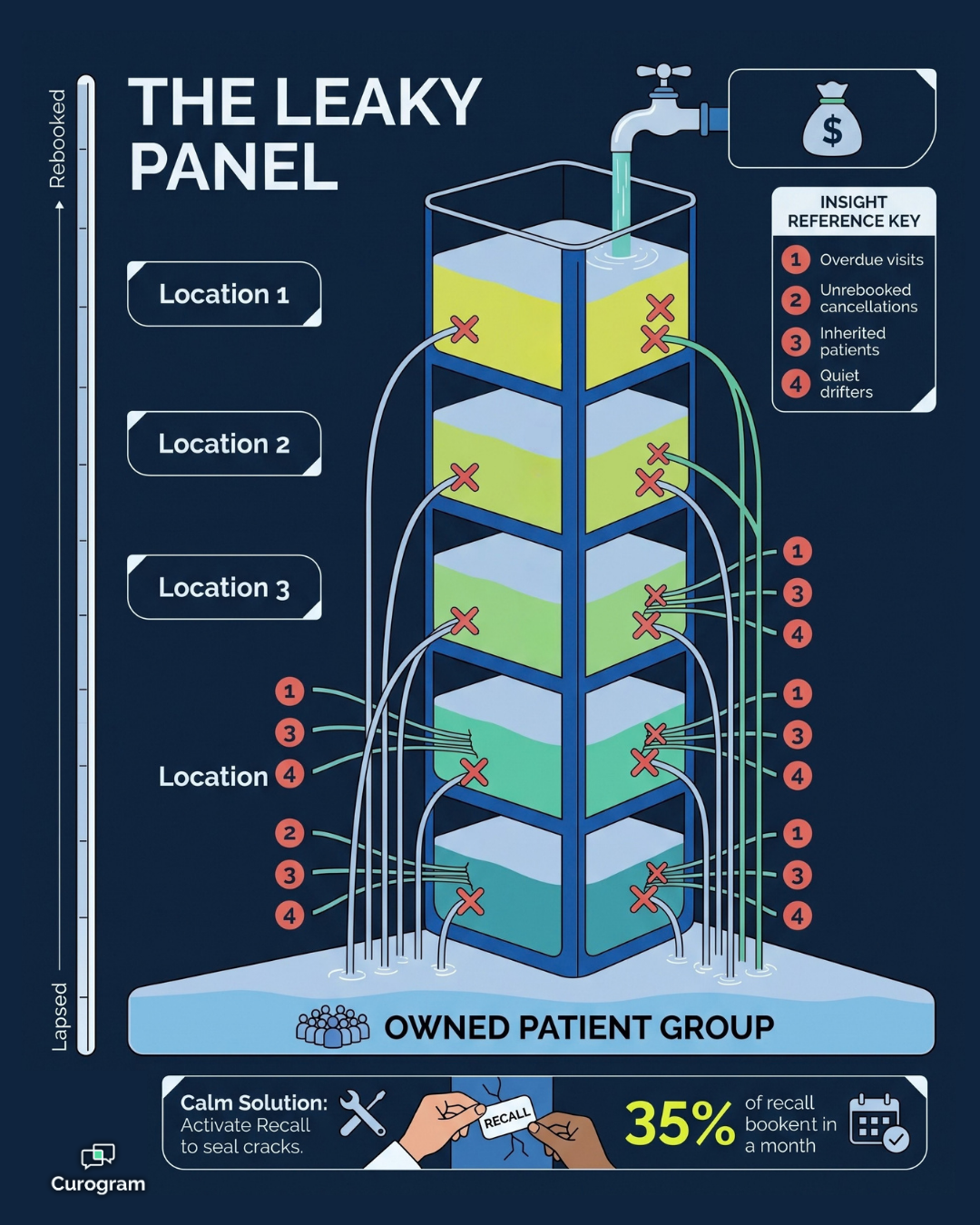
Each location sends warm texts from its own familiar number, and replies go straight to booking. It's how groups patch "The Leaky Panel."
The math favors recall. In one multi-location practice, 35% of patients who got a Curogram recall text booked a visit within a month.
Your group knows exactly what a new patient costs, because you track it channel by channel: paid search, local listings, social ads, and referrals. Every dollar has a line in the report.
Now try a different question. What does it cost to bring back a patient who already knows your practice?
Most groups can't answer, and the reason isn't difficult math. Reactivation has simply never operated as a real marketing channel, so it remains a someday project that nobody owns.
Meanwhile, the list of patients who drifted away keeps growing at every location. Some missed an annual visit, some canceled and never rebooked, and others moved their care to whichever office reached out first.
Then there are the panels you purchased. When your group acquired a practice, the price reflected its established patient base, including people who trusted that office for years. After the deal closed, most of them never heard a single word from the new owners.
That's the gap. You pay full price to attract strangers while patients who already chose you sit untouched in Tebra.
It's an easy problem to overlook. It's also an expensive one.
This article explains how patient recall campaigns for multi-location Tebra groups close that gap. You'll see where lapsed patients hide across your locations, why the usual fixes stall, and how an automated recall program operates day to day.
You'll also see the numbers, including verified results from a multi-location practice and example calculations for your own panel.
The goal isn't another one-time campaign. It's a permanent channel with a measurable conversion rate, reported alongside every paid channel your group already tracks.
For groups that have grown through acquisition, this matters even more. Inherited patients are part of what you paid for, and recall is how you finally collect on that investment.
Why Patients Quietly Slip Away From Every Location
Most growth reports answer one question:
How much did each new patient cost?
Very few ask the reverse, and cost per reactivation never appears because no one in the organization owns reactivation as a channel.
As a result, lapsed patients accumulate without a sound. No alarm goes off when someone skips an annual checkup, the schedule looks full enough, and the front desk stays busy with today's phone calls.
Consider a common situation. Your group closed on a new practice eight months ago, and of the patients who justified the purchase price, about a third have visited since. The rest have heard nothing from you, while your marketing team buys their neighbors at full acquisition cost.
This is "The Leaky Panel." Patients tend to slip out through the same few gaps:
- Overdue visits: Patients who were due for an annual or follow-up visit and never scheduled one.
- Unrebooked cancellations: Canceled appointments that nobody followed up on afterward.
- Inherited patients: People from acquired practices who haven't been seen since the sale.
- Quiet drifters: Patients who moved their care to whichever office contacted them first.
Across five locations, these segments can easily add up to thousands of patients. Even a modest return rate would outperform most paid channels on both volume and cost per appointment.
So why doesn't anyone solve this problem?
Some groups do try, usually when things slow down. A staff member works through a call list, one location mails postcards once a year, or someone exports a spreadsheet and sends a mass email.
In most groups, Tebra patient reactivation outreach happens in scattered bursts like these, if it happens at all.
Each effort fades because it depends on available staff time, and busy front desks rarely have any. Few organizations have ever run a lapsed patient win-back group-wide, with one consistent plan across every site.
The result is a group that keeps refilling the bucket instead of patching it. Acquisition spending climbs every year, while the back door stays open at every location.
How Curogram Turns Recall Into a Reliable Growth Channel
Curogram works as "The Panel Recovery Engine." It moves recall off the someday list and turns it into a steady channel with a conversion rate your leadership team can actually track.
The concept is simple. You identify the patients who should come back, reach them in a way that feels personal, and make booking easy, then repeat the process every month without anyone having to remember.
Segments Built From Real Visit History
Every campaign starts with a patient segment pulled from Tebra visit history. You can sort patients by visit type, by how much time has passed since their last appointment, and by where they came from.
That last category matters for growing groups. Acquired panel re-engagement gets its own segment, so patients from a practice you purchased receive a warm "welcome back" message instead of a generic blast.
Messages From a Number Patients Recognize
Texts go out from each location's familiar local number. To the patient, the message feels like their own office checking in, not a faceless call center.
Templates are shared and governed across the whole group, which keeps the tone clear and consistent. At the same time, each location still sounds like itself.
Pacing That Matches Front Desk Capacity
Recall automation text campaigns can be throttled to match each location's booking capacity. If a location can handle 40 new appointments a week, the campaign sends messages at a pace that fits that number.
This keeps replies arriving steadily instead of flooding the phones on a Monday morning.
A Direct Path From Reply to Appointment
When a patient replies, the conversation routes straight to scheduling. Once the visit is booked, that patient automatically enters your standard reminder sequence, which makes it far more likely they'll actually show up.
That handoff closes the loop, because a reactivated patient who misses the appointment isn't really a win.
Reporting That Proves the Results
Each location receives its own campaign report showing messages sent, replies received, and appointments booked. Group leaders can then compare the cost per appointment from recall against every paid channel.
For most groups, that comparison isn't even close. Recall wins, and now there's a report to prove it.
What Happens When Your Schedule Refills Itself
Here's the number that changes the conversation.
In one multi-location practice, 35% of existing patients who received a Curogram recall text scheduled an appointment within a month, and recall messages alone brought 1,240 patients back through the door.
That 35% is the reconversion rate recall delivered, and it's a level that paid ads rarely come near. A strong ad campaign measures success in single-digit click rates, while recall measures it in booked visits from people who already trust you.
In practice, this is a real shift in how your group thinks about growth. You move from buying strangers to recovering relationships, because the cheapest appointment you'll ever book is with a patient who already knows your name.
So what does that look like in dollars?
The table below uses example figures to show how reactivation vs acquisition cost can play out for a typical group, and you can swap in your own numbers to estimate your opportunity.
| Metric (example figures) | Value |
|---|---|
| Locations | 5 |
| Lapsed and inherited patients per location | 800 |
| Total recall audience | 4,000 |
| Booked visits at 35% reconversion | 1,400 |
| Example revenue per visit | $160 |
| First-round visit revenue | $224,000 |
| Cost to buy 1,400 new patients at an example $250 each | $350,000 |
This means your first recall round could bring in 1,400 visits you'd otherwise have to buy.
At the example rate, buying those patients through ads would cost $350,000 before a single visit took place.
Recall, by contrast, carries no per-patient ad cost. You're working with people already in your system, through a platform your group already runs.

And that's only the first round. Many of those returning patients will book follow-up visits, come back next year, and refer family members.
Over time, the schedule begins to refill from your own database, and inherited panels finally earn back their purchase price. Across Curogram's case studies, practices have seen a 10–20% revenue increase as recovered appointments fill open slots.
Five Steps to Launch Recall Across Every Location
Knowing the upside is one thing. Getting a recall program running across several locations is another, especially when each site has its own habits, staff, and schedule.
The good news is that the rollout doesn't need to be complicated.
Most groups can follow the same basic sequence:
- Start with your two strongest segments. Overdue annual visits and inherited patients usually respond best, so launch there before adding smaller groups like unrebooked cancellations.
- Agree on shared templates. Write one approved message per segment at the group level, then let each location add its own name and local number.
- Set pacing by location. Match each site's sending volume to its real booking capacity, so a smaller office isn't buried in replies while a larger one sits idle.
- Assign reply ownership. Decide who books recall replies at each location, and who can step in through the shared inbox when a site gets busy.
- Review results every month. Compare booked visits and cost per appointment by location, then move more volume toward the segments that convert best.
A pilot at one or two locations is a smart way to begin. It lets your team test the messaging, pacing, and booking workflow before you expand group-wide.
After the first month, you'll have real numbers instead of estimates. That's when recall stops being an experiment and becomes a channel your leadership team can plan around, right next to paid search and referrals.
Your Next Growth Channel Is Already on Your Book
Your highest-return marketing channel may not be an advertising platform. It may be the list of patients who already know your name.
Every location in your group holds people who stopped coming in. Some were due for care, some canceled and slipped away, and many arrived through acquisitions without ever hearing from you again.
None of them needs convincing that your practices exist. They simply need a reason to come back.
That's the core idea. Tebra holds your patient records and powers much of your growth engine, while Curogram gives patients their reasons to return, through warm texts from a local number they recognize and a fast path to booking.
The lapsed panel was never a weak asset; it just never had a system behind it. Patient recall campaigns for multi-location Tebra groups provide that system, with clear segments, steady sending, and results you can compare against every paid channel you run.
Here's a practical first step for this week.
Pull a count of patients with no visit in the last 18 months at each location, including everyone who joined through an acquisition.
That number is your recall audience, and you've already paid for it.
Then bring that number to us. Schedule a Demo with Curogram, and we'll size your reactivation opportunity using your own panel data. We'll model a 35% reconversion rate against what you currently spend to attract new patients, location by location.