
 Aubreigh Lee Daculug

For patients of an acquired practice, that silence feels even worse. Many assume the new owners simply don't want them.
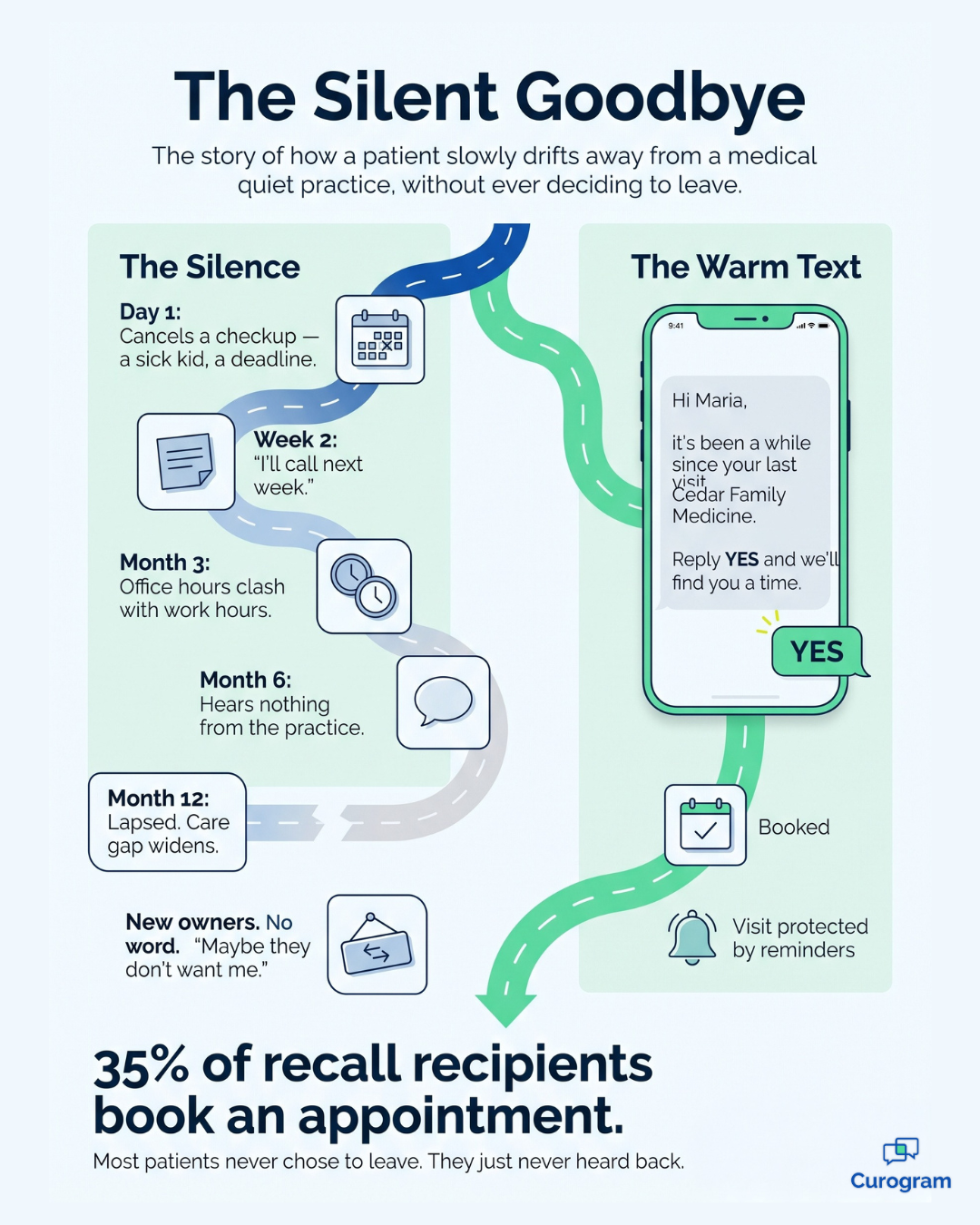
Curogram, "The Panel Recovery Engine," sends a warm, personal text from the location's own number, using Tebra visit history for context. Patients reply YES to rebook, with no portal and no hold queue. About 35% of recall recipients book an appointment.
Nobody formally breaks up with their doctor.
There's no angry phone call, no complaint form, and no farewell letter. Instead, a patient cancels an appointment, fully intends to reschedule, and then gets swept up in deadlines and school pickups. Weeks become months, and months eventually become a year.
That's how most patient attrition actually happens. It isn't a deliberate decision. It's a gradual drift.
All along, the patient keeps thinking, "I really should get back in." The thought surfaces during a commute or a lunch break, but your phone line is busy during business hours, and by evening the clinic is closed. So the intention fades once again.
Here's the uncomfortable part: your practice never reached out.
From the patient's perspective, that silence suggests you didn't notice they were gone.
Now add an acquisition to the picture. Your group purchases a well-loved community practice and migrates it onto Tebra. The longtime patients there felt loyal to the previous office, and they're waiting for someone to welcome them into the new organization.
Nobody does. Eventually, they conclude they weren't wanted, and they quietly find care elsewhere.
That's the real cost of silence. Care gaps widen, panels shrink, and the patients you invested in acquiring disappear for the same preventable reason as everyone else.
The solution is smaller than you might expect. Bringing lapsed Tebra patients back with text outreach works because the desire to return already exists. Most patients simply need a warm, personal invitation and an effortless way to say yes.
In this guide, you'll learn why patients drift away, what an effective win-back text feels like from their side, and how Curogram transforms a single reply into a scheduled visit.
You'll also discover why the first practice to say "we'd love to see you" usually wins the patient back.
How Patients Slip Away Without a Word
Most practices think of patient loss as a choice. Someone had a bad experience, found a cheaper option, or moved across town.
Those situations certainly happen. But in most cases, patients don't really leave at all. They simply stop showing up, and nobody on either side says a word.
Drift, Not Defection
The reality is surprisingly ordinary: patients forget to rebook. They cancel an annual physical because of a sick child or an important work deadline, and they genuinely plan to call back next week.
Unfortunately, next week keeps getting postponed until the appointment is completely forgotten.
After an acquisition, this drift speeds up. Patients who felt close to the old practice aren't sure who to call anymore, so they wait to be invited, and that waiting stretches into months.
The Workday Wall
Consider who your lapsed patients really are. Many are busy adults juggling jobs, kids, aging parents, and long commutes.
They think about booking a visit often, but your front desk is open during the same hours they're at work. Each time they mean to call, the timing is wrong, and every failed try makes the next one a little less likely.
Patients from an acquired practice face an additional layer of uncertainty.
Did my medical records transfer to the new system?
Is my regular doctor still practicing there?
Nobody has answered those questions, so the uncertainty quietly turns into hesitation.
When Silence Sends the Wrong Message
This is where the problem becomes expensive. To patients, silence never feels neutral; it feels like a message.
Your regular patients take it to mean the practice didn't notice they were gone. Your acquired patients take it to mean they weren't welcome. Neither conclusion is accurate, but both steadily push people toward another provider.
The Quiet Cost to Your Panel
While everyone stays silent, care gaps keep growing. A missed checkup becomes a missed screening, and a skipped follow-up can turn into a condition that's harder and more expensive to treat later.
Meanwhile, your patient numbers drop in two places at once. The panel your group built and the panel your group purchased both lose patients for the same preventable reason, and fortunately, it's a reason you can fix.
How Curogram Opens the Door Again
The solution isn't asking patients to try harder. It's making your practice the one that takes the first step, and making that step easy for everyone.
Curogram functions as "The Panel Recovery Engine." It positions your practice as the one that reaches out first, with a message that feels attentive, specific, and remarkably easy to answer.
What an Effective Recall Text Looks Like
Most practices plan recall from the chart. Very few plan it from the care gap outreach patient view, which looks at what the person on the other end actually reads, feels, and does next. That view is exactly where Curogram starts.
Here's an example of the kind of overdue checkup reminder text Curogram can send:
"Hi Maria, it's been a while since your last visit at Cedar Family Medicine. Dr. Patel's team would love to see you for your annual checkup. Reply YES and we'll find you a time."
The message is short, friendly, and personal. It names the clinic, the provider, and the reason for reaching out.
In just three sentences, the entire patient win-back message experience asks for a single word in return.
Why Personalization Matters
Curogram's Personalized Recall Texts automatically include the right details for each patient, so every message feels individual rather than mass-produced:
- Their location: The text arrives from the clinic's own familiar number, not a strange short code.
- Their provider: Patients see a name they already know and trust.
- Their overdue visit: The message names the exact visit they need, such as a physical or a follow-up.
- Their transition: For inherited panels, warm reintroduction templates explain the ownership change and invite patients back.
That last point matters more than most groups realize. Thoughtful new ownership welcome back outreach tells acquired patients three things at once: their records are safe, their care continues, and the new team truly wants them there.
From Reply to Booked Appointment
The context for each message comes straight from the patient's visit history in Tebra. When a patient responds, the reply flows right into booking, so nobody has to log in to a portal or wait on hold.
Rebooking by text reply takes only seconds. Once the appointment is confirmed, your reminder sequence takes over to protect it, which we cover in our guide to Centralized Reminder Governance.
This works for every kind of lapsed patient. The busy parent can reply on a lunch break, while the loyal patient from the acquired practice finally gets the invite they've been waiting for. For both, "reply YES" removes every step between meaning to return and actually returning.
To see how this fits into a bigger plan, read our pillar guide on Patient Recall Campaigns for Multi-Location Tebra Groups.
What Changes When You Reach Out
Here's the number that matters most: 35% of recall recipients book an appointment.
That result doesn't come from a hard sell. It shows that the wish to return was there all along, and those patients just needed an easy path and a sincere invite.
Visibility helps too. Curogram text messages achieve a 98% open rate, which means your invitation is far more likely to be read than an email sitting unopened in a crowded inbox.

What 35% Could Mean for a Multi-Location Group
The figures below are an illustrative example only. Swap in your own panel size and average visit value to see what it could mean for you.
| Example Scenario | Lapsed Patients | Booked at 35% | Est. Value (at $150/visit) |
|---|---|---|---|
| Single location | 400 | 140 | $21,000 |
| Five-location group | 2,000 | 700 | $105,000 |
| Five locations + one acquired practice | 2,600 | 910 | $136,500 |
In practice, this means a single recall campaign could return hundreds of patients to your schedule. Many of those appointments are overdue screenings and follow-ups that patients needed anyway.
For your team, that's revenue you've already earned the opportunity to capture. You don't need additional advertising or new patient acquisition, because you only need to invite back the patients you already have.
The Shift Patients Actually Feel
The most meaningful change won't appear on a spreadsheet. It shows up in how patients perceive your organization.
Before outreach, you were "the practice that went quiet." After one thoughtful message, you become "the practice that noticed," and that outreach repairs the relationship for both your longtime panel and your newly acquired one.
Patients finally get the care they kept putting off, and inherited patients feel welcomed instead of forgotten.
Best of all, those visits happen at your locations rather than at a competitor's office down the street.
Say "We'd Love to See You" Before the Silence Wins
Your lapsed patients are closer than they appear. Most of them are one thoughtful text away from becoming active patients again.
That includes the patients your group acquired. They didn't leave because they were dissatisfied; they left because nobody asked them to stay.
Here's a helpful way to think about it.
Tebra holds your memory of the patient, including their visits, history, and care plan, while Curogram serves as their reminder that you remember.
Those two roles work best together. Your records reveal who has drifted and what care they need, and Curogram transforms that information into a friendly message patients can answer in seconds.
Now think about the most loyal patients from the last practice your group acquired. Some saw the same physician for over a decade, and many brought their children and parents there too.
Has anyone from the new ownership ever personally invited them back?
If the answer is no, that isn't a failure; it's an opportunity. Those patients are still waiting to hear from you, although every month of silence makes their return less likely.
The same principle applies to the busy professionals on your established panel. They haven't forgotten about you, but they've run out of convenient chances to call. A single text gives them that chance on their own schedule.
You don't need an elaborate campaign or an expanded marketing budget to solve this. You need the right message, delivered from a number patients already trust, with a reply that converts directly into a scheduled appointment.
That's precisely what Curogram was designed to accomplish.
Ready to see it in action? Schedule a Demo and watch a recall campaign move from a patient segment to a booked appointment in about fifteen minutes. Then decide how many patients you'd like to welcome home.