
 Jo Galvez

A warm, specific message reads as attentive care rather than marketing: “Hi Marcus, it’s been about a year since your last physical at Midtown Medical. Reply YES and we’ll find you a time.”
Based on our internal client data, 35% of recipients book again. Curogram sends from the location’s own familiar number, draws context from DrChrono visit history, and lets the patient return with one reply.
No portal login, no hold queue, and no gap between deciding to come back and having an appointment.
Almost everyone still has a doctor. The 2024 National Health Interview Survey found that 90.3% of U.S. adults have a usual place for health care.
Most of them, 77.5%, named a doctor’s office or health center. The National Center for Health Statistics published those figures in April 2026.
Read that against your own lapsed panel. Those patients have not replaced you. They have a chart with your group, a provider they can name, and no appointment.
Attrition in a primary care or specialty group is mostly drift. A visit gets cancelled. Life fills the gap. The rebooking everyone assumed would happen never does. Patients forget to rebook the way anyone forgets an errand with no deadline on it.
Silence does the rest. A practice that never follows up reads as a practice that never noticed. Patients draw exactly that conclusion. Care gap outreach from the patient’s view lands differently. It is the first sign in a year that someone kept track.
We’ll take a position most vendors avoid. A recall text is a better patient experience than the silence it replaces.
Treating it as a marketing message is the mistake that makes it feel like one. Get the context right and it reads as your practice remembering one specific person.
Most Lapsed Patients Never Decided to Leave
Drift, Not Defection
Nobody sends a resignation letter to their doctor. A patient cancels in March, means to call back, and by June the intention has nothing to trigger it. No decision was ever made. That is why the return is far easier than it looks from inside the practice.
The youngest adults drift furthest. In that same survey, 83.7% of adults aged 18 to 34 had a usual place of care, against 97.5% of those 65 and over. Most lapsed panels concentrate in that gap.
The Knee That Keeps Aching
An ortho patient thinks “I should get that looked at again” every time the joint acts up. Then she remembers the phone call. Work hours. Hold queue. The thought passes.
Months later, a bookable ad from the ortho group across town wins, and it wins on convenience alone.
What Silence Signals
Patients read no contact as indifference. They assume a practice that never followed up did not notice they stopped coming. After a year, that assumption hardens into a fact. Reversing it takes one message that proves otherwise.
The Part That Is Not About Revenue
Care gaps widen out of sight. An overdue checkup reminder text often reaches someone whose condition a routine visit would have caught. Where nobody reaches out, that story ends worse and costs more. It usually ends in a system that holds none of her history.
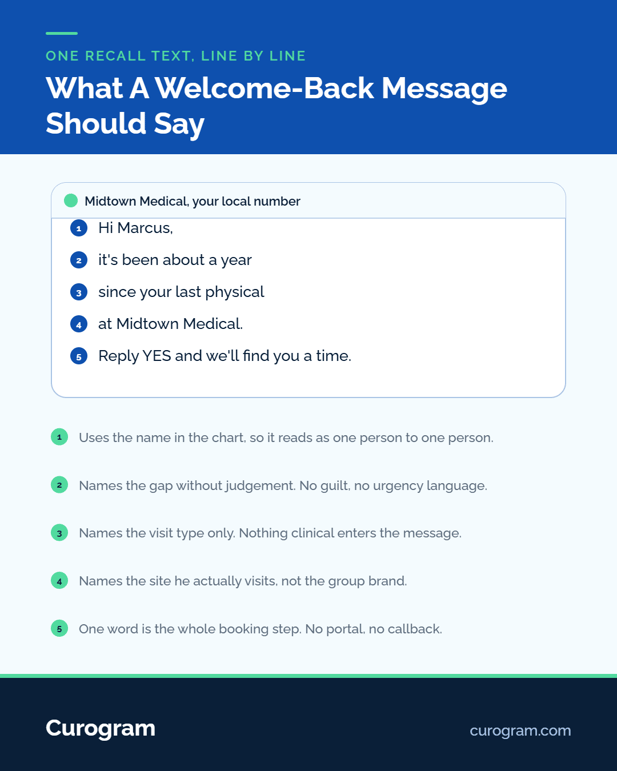
What a Welcome-Back Text Gets Right
It Names the Visit, Not the Condition
Good recall names the patient’s own context. The location, the provider, the visit type, roughly how long it has been. All of it comes from DrChrono visit history, so accuracy costs nobody any effort. Nothing clinical goes into the message. That keeps a text on a shared family phone safe to read.
Compare two openings. “We miss you at Midtown Medical” could have come from any business with a mailing list. “It’s been about a year since your last physical with Dr. Reyes at Midtown” could only have come from her practice.
It Comes From a Number She Recognizes
Messages sent from the site’s own local line, the one already in her contacts from three years of appointment reminders. Patient win-back message experience turns on that first half-second. An unknown area code asking about her health reads as a scam, whatever it says next.
Replying Is the Whole Booking Step
Rebooking by text reply removes every step between meaning to return and returning. She types one word from a bus stop at 7 pm. No portal login. No callback window. No waiting for the office to open.
Welcome-back outreach that ends in “call us during business hours” has rebuilt the obstacle it was written to remove.
Curogram Highlight: Personalized Recall Texts
Personalized Recall Texts are built from the patient’s own record. The message names her location, her provider, and the visit she is overdue for. A generic blast is the version patients resent, and the version that gets reported as spam.
Frequency stays deliberately low. A campaign contacts a lapsed patient on a set cadence. Anyone already in an open thread never gets a second campaign message on top of it.
Opting out takes one word, honored instantly and recorded for compliance. That does more work than it sounds like. A patient who knows one reply stops the messages reads the first one more kindly.

From One Reply to a Booked Visit
Every Reply Has a Destination
|
What she replies |
What happens next |
|---|---|
|
YES |
A scheduler offers two times at her usual location |
|
NOT YET |
The campaign pauses her for a set period |
|
I’VE MOVED |
She is marked inactive and receives no further outreach |
|
STOP |
Unsubscribed instantly, with the record kept for compliance |
Every branch produces cleaner panel data than silence did. Even the patient who has moved away is worth the message, because now you know.
The Visit She Kept Postponing
Across our client base, 35% of recall recipients book within a month. One multi-location practice saw 1,240 patients return from recall messages alone.
Patients had already decided they wanted those visits. The visits sat behind a phone call nobody had time to make in either direction.
Continuity as the Side Effect
She comes back to a provider who holds her whole history in DrChrono, instead of starting over somewhere with none of it.
The new appointment then enters the reminder sequence. The visit she finally booked becomes the visit she actually attends.
One practical note on reach. Lapsed patients hold your oldest phone numbers, so the first campaign will bounce more than a reminder send does. Every reply that says “wrong number” or “I’ve moved” cleans a record that silence would have left wrong indefinitely.
Conclusion: Say So Before They Forget You
Lapsed patients sit one warm text away from being current patients again. The message that brings them back is closer to a courtesy than a campaign. DrChrono holds your memory of the patient. Curogram is how she finds out you still have it.
Think of the last patient who disappeared from your panel. They almost certainly did not decide anything. Reach out.
Book a demo, and we’ll take a recall campaign from DrChrono segment to booked appointment in about fifteen minutes. We’ll use the message wording your team would actually send.
Frequently Asked Questions