
 Jo Galvez

Every location’s DrChrono data already segments that panel precisely: annual physicals overdue by month, ortho follow-ups that stopped when the pain eased, aesthetic maintenance cycles that quietly ended.
Curogram runs the campaign the data describes, sending warm win-back texts from each location’s own local number and routing replies straight to booking.
Based on our internal client data, 35% of recall recipients book an appointment within a month, and recovered visits drive a 10–20% revenue increase.
Capability was never the obstacle. Nothing in a group’s normal workflow owns the job of acting on that list, which is why the highest-return outreach available to the practice is the one campaign that never runs.
Every DrChrono group owns a growth channel it has never used. It sits in the practice management data, already segmented, and costs nothing to reach.
Count the patients across your locations with no visit in 18 months. In a five-site group that number usually runs into the thousands. Each has a chart. Each has a named provider, a last visit type, and a mobile number you already have permission to use.
The growth budget, meanwhile, goes to strangers.
MGMA Stat asked 269 practice leaders about revenue on 17 June 2025. Just over half, 56%, were up on the prior year. Another 30% were down, and lower patient volume was one of the named causes.
The groups that were growing named one lever first: more patient volume. Both halves of that poll point at the same audience. Neither half is usually talking about lapsed patients.
DrChrono patient reactivation outreach starts from a query the database can already answer. Time since last visit. Visit type, provider, service line, location.
Those five fields build lapsed patient win-back segments tight enough that an aesthetics recall never lands on a primary-care-only patient.
Our claim, stated plainly: recall is the highest-return outreach a growing group can run, and almost nobody runs it. Recording attrition and reversing it are separate jobs. DrChrono owns the first one.
The Table Nobody Queries
The Panel Is Already Segmented
DrChrono records attrition in detail you can query. Acting on that record is a different job. No front desk in a growing group has spare hours to work a list by hand.
|
Segment |
Typical lapse window |
What the message references |
|---|---|---|
|
Annual physical overdue |
14+ months since last visit |
Last physical date and usual provider |
|
Ortho follow-up dropped |
6–12 months, never discharged |
The joint and the reason for the last visit |
|
Aesthetic maintenance lapsed |
Past the treatment’s normal interval |
The treatment and its usual cadence |
|
Post-op check never booked |
30+ days after the procedure |
The procedure and the missing check |
Four segments, four different messages, one query each. Building them is an afternoon of work. Running them is what nobody owns.
Where the March Cancellation Ends Up
A patient cancels her annual in March and means to rebook. Nobody follows up. By November, something aches. She remembers nothing about your practice and searches for a doctor nearby.
She lands at a rival whose ads you were also bidding against. That new patient costs far more than a text would have.
Elective Cycles Do Not Restart Themselves
Aesthetic maintenance cycle recall matters more than the volume suggests. A broken cycle rarely restarts on its own. Nothing in the patient’s week prompts it, and nothing in the practice notices.
One missed interval usually becomes permanent. That patient’s value to the group ends on a date nobody wrote down.
The Compounding Part
Across five locations, the lapsed panel keeps growing. Attention stays on new-patient volume. So the list gets longer every month and goes unworked every month. A group that queries everything ends up running its best campaign never.
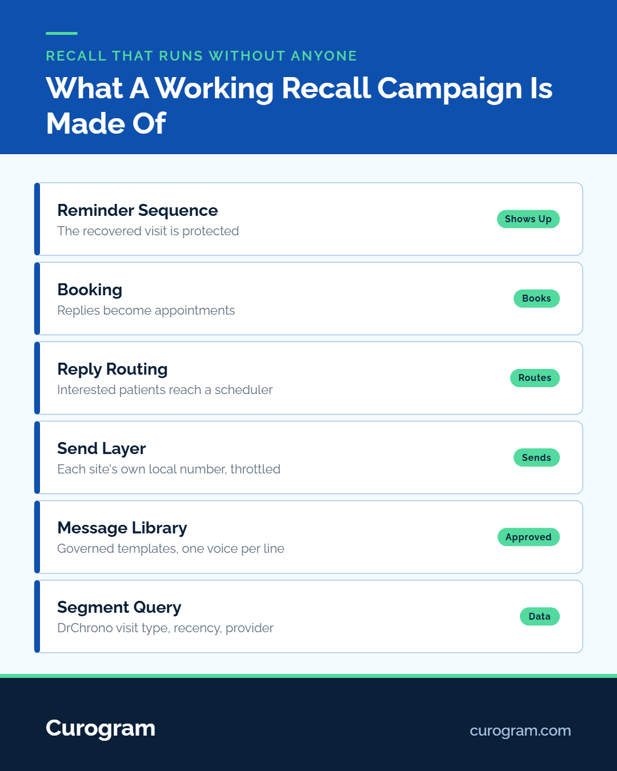
Turning the Query Into a Standing Campaign
Segments Built From Visit History
Curogram builds recall automation text campaigns straight from DrChrono visit data. Segments combine recency, visit type, provider, service line, and site. The list is tight before a single message goes out. Tight lists are what keep recall from reading as marketing.
A patient who gets a note about the physical she skipped hears her own practice paying attention. Exclusions matter as much as inclusions.
Anyone with a future appointment already booked, a recent cancellation on file, or an open thread in the inbox drops out of the segment before send.
One Voice Per Service Line
Primary care recalls annuals. Ortho recalls the follow-ups that lapsed when symptoms faded. Aesthetics recalls maintenance intervals.
Each line writes in its own voice, under one set of group templates. A five-site multi-specialty group avoids ending up with five tones and no rules.
Sending From the Number They Know
Messages go out under each site’s own local number, the one already saved in the patient’s phone. Annual physical rebooking outreach from a strange area code gets read as spam. A recall campaign gets one shot at that first impression.
Curogram Highlight: Patient Recalls
Patient Recalls turns a DrChrono segment into booked visits without adding a staff task. Segments pull from visit history.
Templates are set at group level and tuned per site. Sending is throttled, so replies arrive at a rate each site can actually book.
Two settings decide whether a campaign helps or hurts. Throttling matches send volume to open slots. That is the difference between a busy week and a schedule that buckles by Tuesday. Cadence rules stop a second recall from landing while the first thread is still open.
Recovered patients then flow into the reminder sequence. A visit won back in week one is still on the schedule in week three. Recall that books appointments the practice later loses to no-shows has moved the problem, not fixed it.

What a Refilled Schedule Looks Like
The Reconversion Number
Across our client base, 35% of patients who get an SMS recall book within a month. One multi-location practice saw 1,240 patients from recall messages alone. Ads do not reach reconversion rate recall figures like these. The audience already trusts the practice.
Sizing It Against Your Own Panel
Take the 18-month count for each site and apply the rate to it, not to a blended group total. Sites differ. A location that opened two years ago has a shallow lapsed panel. The flagship site, open a decade, has the deepest one. Start there.
Run one hygiene pass first. Lapsed panels carry the oldest contact data in the system, so expect a share of dead mobile numbers on the first send. Numbers collected at check-in over the past two years are reliable. Numbers last touched in 2019 are not.
Revenue That Was Already Yours
Recovered appointments drive a 10–20% revenue increase, per our internal data. The cost side is a text message. Continuity of care improves at the same time.
That matters for value-based contracts, and for the patients whose conditions went unseen while the schedule looked full.
Conclusion: Run the Query, Then the Campaign
Your lapsed panel is the largest, cheapest and most precisely documented growth audience the group has. DrChrono holds the data on who is overdue. Curogram gives those patients a reason to come back, in language that sounds like their practice rather than an advertiser.
Count the patients with no visit in 18 months across every location. That number is your recall audience, and it is already segmented by visit type and provider.
Book a demo and bring that count. We’ll size the opportunity from your own panel data and model 35% reconversion site by site. You’ll see what throttling looks like against your real booking capacity.
Frequently Asked Questions