5 min read
Patient Recall for athenahealth Networks | Curogram
Aubreigh Lee Daculug
:
September 17, 2026
Curogram adds the missing step. Each site texts its own lapsed patients from a familiar local number. Patients reply with one word. Staff then book them on the athenahealth schedule.
Curogram client data from clinical settings shows 35% of recall recipients booked a visit within a month. One practice saw 1,240 patients from recall texts alone.
Your quarterly care gap report is a work of art. It knows who skipped an annual visit. It knows who cancelled in March and never rebooked. It knows who is overdue for a lab draw or a follow-up.
Then the list goes out by letter and robocall. Almost nothing happens.
Next quarter, the report generates again. Most of the same names reappear.
That is the odd thing about patient recall campaigns for multi-location athenahealth networks. The hard part looks solved. Your reporting is precise, your segments are clean, and your population health team knows who is missing.
What breaks is the final step, where an actual patient schedules an appointment.
It sounds simple. It isn't.
A letter has to be opened, read, remembered, and acted on days later. A robocall has to be answered by someone who picks up unknown numbers. A portal message has to reach a patient who still remembers their password. Every one of those steps eliminates people.
So the network ends up measuring the wrong thing. Outreach attempted climbs. Appointments booked stays flat.
Meanwhile, you spend real money on ads to attract strangers. And thousands of people who already know your doctors, already have a chart, and already trust your staff sit unbooked on a report.
Reactivated patients are the cheapest appointments you will ever fill. They are also the ones most often abandoned.
Multiply that across ten or twenty locations and it stops looking like a rounding error. It looks like a growth strategy nobody is running.
This article examines why the distance between the report and the schedule stays open, what it costs across a network, and how conversational texting eliminates it. You will see the math, the workflow, and the documented results.
Your list is not the problem. Your list is the opportunity.
Why the Same Names Keep Showing Up Every Quarter
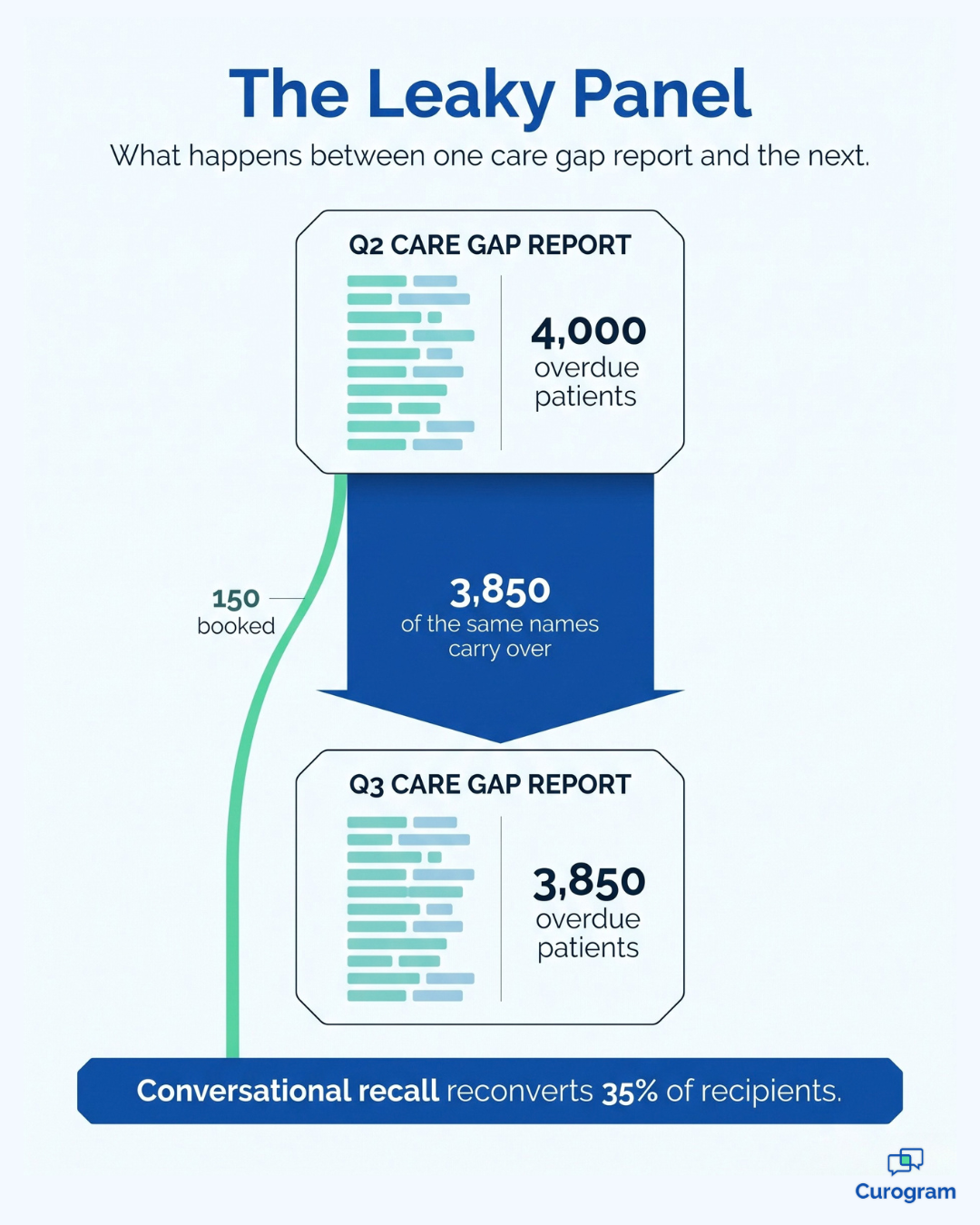
Most networks know this pattern well. The Q2 care gap report lists 4,000 overdue patients across a dozen sites. Letters go out. The Q3 report lists 3,850 of the same people.
Nobody performed badly. The data team delivered. The mail house delivered. The delivery channel simply does not convert.
That is the whole issue in one line. Your reporting is a precision instrument bolted to a blunt delivery method. Text messages, by contrast, get read. Curogram client data from clinical settings shows a 98% open rate on SMS.

What one quarter of missed reconversion costs
Here is a sample calculation for a mid-sized network. The figures are illustrative, not a study result.
| Recall method | Patients contacted | Reconversion rate | Visits booked | Value at $175 per visit |
|---|---|---|---|---|
| Letters and robocalls | 5,000 | 4% | 200 | $35,000 |
| Conversational text recall | 5,000 | 35% | 1,750 | $306,250 |
That difference is 1,550 visits in a single quarter. In practice, it works out to about $271,000 a quarter, or more than $1 million a year, from patients you already serve.
You also pay twice for each name you miss. An unconverted patient is an open quality gap and an empty slot at the same time. One hurts your measure scores. The other hurts your revenue.
This is why care gap closure conversion matters more than outreach volume. Mailing 5,000 letters looks like a lot of work. Booking 200 people is the actual result.
Left unaddressed, population health gradually becomes a reporting exercise. The reports get sharper every quarter. The schedule never moves.
The Missing Step Between Your Report and Your Schedule
Curogram sits between the list and the calendar. It does not replace athenaOne, and it does not try to. It adds the conversion layer your outreach has been missing.
Segments built from data you already produce
Recall lists are grouped by time since last visit, visit type, gap type, provider, and site.
So a mammography recall never reaches the wrong panel. Configuration is fast because the segments mirror the reporting you already generate.
Messages that sound like your front desk
Each location sends from its own familiar local number.
The tone is warm and plain:
"Hi Marcus, it's been about a year since your last visit. Reply YES and we'll find you a time."
One word is the whole ask. That is what makes athenahealth patient reactivation outreach feel like a nudge from a neighbor instead of a form letter from a system.
Replies that become appointments
A YES lands in your unified inbox or your central scheduling queue with full context attached. Staff book the visit on the athenahealth schedule, and the patient rolls into the normal reminder sequence so they show up.
Campaigns are throttled and staggered by site, so replies arrive at a pace your team can handle.
That is the difference between recall automation enterprise networks can govern centrally and a mass blast that floods the phones.
One report for revenue and quality
Results are reported by location and by gap category. Your dashboard shows reconversion rate quality measures next to booked visits, so gap closure and revenue recovery finally sit on the same page.
That single view is what turns scattered mailers into a real lapsed patient win-back network. Every site runs the same playbook, and you can see which ones need help.
When the Schedule Starts Refilling Itself
The change shows up first in the metric everyone quotes in meetings.
- 35% of recall recipients booked an appointment within a month, per Curogram client data from clinical settings
- 1,240 patients were seen from recall messages alone at one multi-location practice
- 10-20% revenue increase, with each recovered visit adding directly to the bottom line
Look at what those three numbers do together. The first proves people respond. The second proves it holds up at scale. The third turns it into money your finance team can plan around.
For your team, the shift is a change in language. The old report said outreach attempted. The new one says appointments booked.
That is what population health outreach that converts actually looks like day to day. Care gaps close because patients came in, not because a letter went out. Schedules refill from your own panel instead of your ad budget.
And the effect compounds. A reactivated patient does not just fill one slot. They come back for the annual, the follow-up, and the screening after that.
Start With the Patients Who Already Know You
Here is a quick exercise worth ten minutes of your week.
Pull last quarter's care gap list and this quarter's. Line them up and count the names that appear on both.
That overlap is your conversion gap, quantified in plain and uncomfortable numbers. Not a theory. A list of real people your network already identified, reached out to, and failed to bring back.
Now put a dollar figure on it. Multiply that overlap by 35%, then by your average visit value. That number is what a working recall program is worth to you this year.
Most networks are genuinely surprised by the magnitude of that overlap. Not because their data is inadequate, but because their data has been excellent for years while the delivery method quietly wasted it.
The fix is not more reporting. You already know who is overdue and why. What you need is a path back to care that takes a patient one reply to walk.
athenaOne handles your identification, your measures, and your reporting. Curogram handles the conversation that turns a name on a list into a booked visit. The two do different jobs, and they work better together than either does alone.
That is the whole idea behind the panel you already own. The cheapest appointment your network will ever fill belongs to someone who has already been there.
Ready to see what your own panel is holding? Book a Demo with Curogram and we will size your reactivation opportunity using your data, then model 35% reconversion against it. You will leave with a real number for your network, broken out by location and gap type.
Frequently Asked Questions
Yes. Recall texts to your own established patients follow standard healthcare rules. Curogram is HIPAA compliant. Consent and opt-out are handled for you, so no one on your team tracks them by hand.
They are built from visit history and gap data. You can sort by time since last visit, visit type, gap type, provider, and site. That precision is why a mammogram recall never reaches the wrong population.
No. Campaigns are throttled and staggered by location, so replies match what your team can book. Each reply lands in your inbox or scheduling queue with the chart details already attached.
Yes, with local personalization. Each site texts from its own number and names its own providers. Templates and rules stay central. You get one playbook and results reported site by site.
Fast. Most replies arrive in the first few days of a send. Curogram client data from clinical settings shows 35% of people booking within a month. One campaign gives you a clear read inside a quarter.