
 Aubreigh Lee Daculug

CharmHealth's Bulk SMS depends on its Text/Voice Notifications add-on, which costs $20 a month for 250 messages on the per-encounter plan, then $0.08 per message.
A single recall send to 10,000 patients adds about $780 in overages. We call that "The Capped Broadcast."
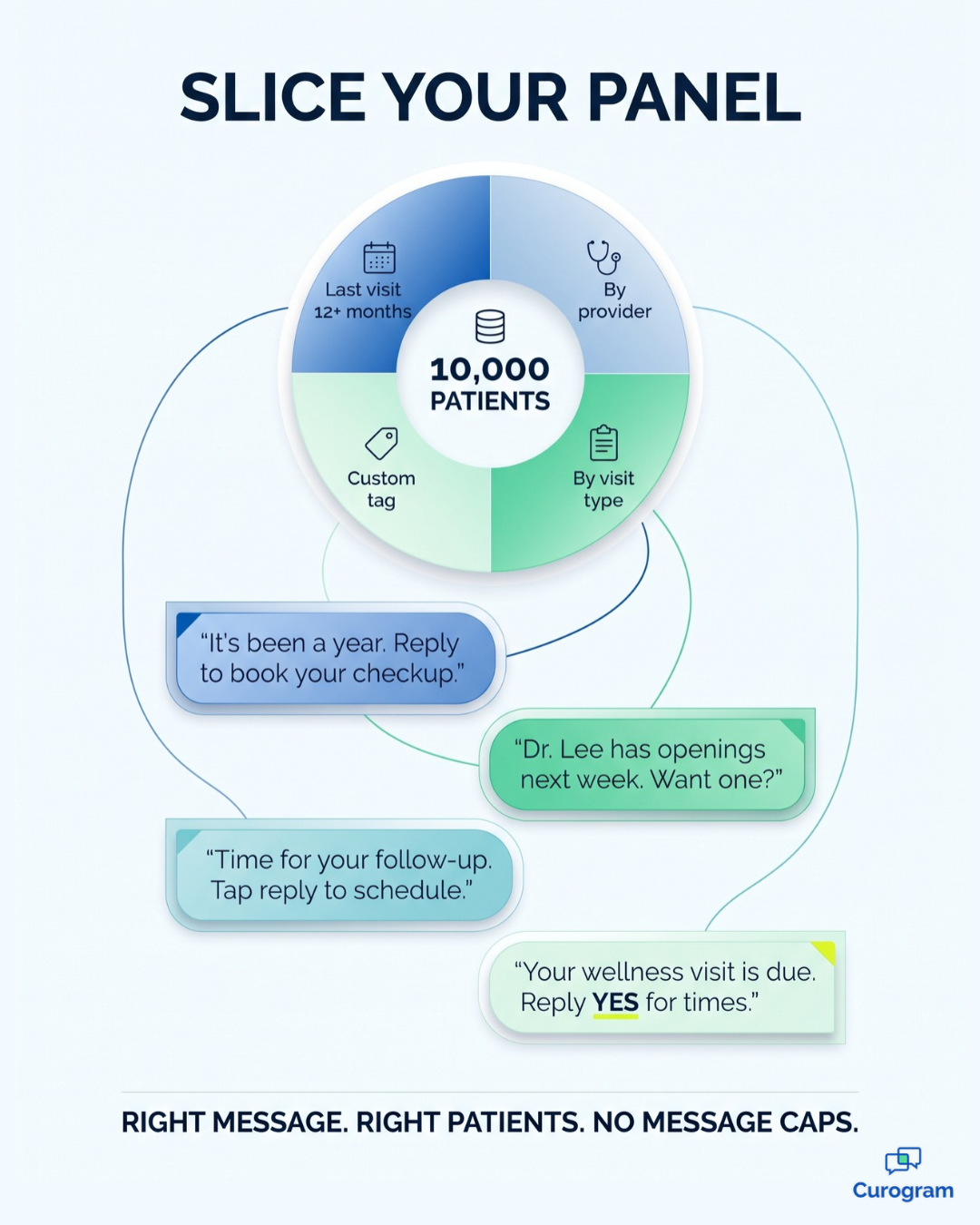
Curogram lets you segment patients by last visit, provider, or visit type and text them at any scale. In one multi-location practice, 35% of recalled patients scheduled an appointment within a month.
Every CharmHealth practice has a list it never sends. It lives in a saved report somewhere, and it grows a little longer every month.
It's the list of patients who haven't visited in a year or more. A few relocated, but most simply drifted away, the way busy people do when nobody reminds them that a follow-up appointment is overdue.
Those patients already know your name. Their charts, medical histories, and insurance details are sitting in your EHR right now. Reactivating them should be the easiest growth opportunity a practice has, since it costs far less than attracting a new patient and the open slots are already on your calendar.
So why does that list stay on the shelf?
For many CharmHealth offices, the answer is a meter. CharmHealth does include Bulk SMS, and it's a genuine feature.
However, it runs on a paid add-on with a monthly message allowance, and every text beyond that allowance carries an extra charge. When your database holds 10,000 patients, one recall send stops looking like outreach and starts looking like an invoice.
That's the problem this guide addresses. Patient recall texting for CharmHealth practices with large databases requires a tool designed for volume. Your team should be able to text the entire list, organize it into useful groups, and manage replies without counting messages first.
Mass texting for medical practices has changed considerably in recent years. A healthcare-focused platform can now operate alongside your EHR, keep every message HIPAA-compliant, and turn a dusty report into a dependable monthly routine.
In the sections below, you'll see exactly where the cost calculation breaks down and how Curogram works as a recall engine next to CharmHealth.
You'll also see what one practice achieved, plus a simple way to estimate the visits waiting in your own database.
Why Your Biggest Recall List Never Gets Sent
Let's give CharmHealth credit. It's an affordable cloud EHR, and its Bulk SMS feature is legitimate: authorized staff can select a facility or patient category, compose a message, and schedule delivery.
The complication is billing. Bulk SMS comes with the Text/Voice Notifications add-on, which costs $20 a month for 250 messages on the per-encounter plan and $0.08 for every message after that.
As a result, expenses increase alongside the one thing you actually want to increase, which is reach. A database of 10,000 patients, accumulated over years of dependable care, becomes too expensive to communicate with.
Here's how a recall campaign typically gets postponed in a busy office:
- The practice manager pulls the overdue list, which shows 10,000 patients who haven't been seen in 12 months or more.
- She drafts a friendly recall message and prepares a single delivery to the entire group.
- She calculates the cost. The first 250 texts are included, but the remaining 9,750 cost $0.08 each, which adds $780 on top of the $20 add-on fee. Any message longer than 160 characters bills as two, so a detailed message could nearly double that amount.
- She evaluates how patient replies will work. CharmHealth sends Bulk SMS from a shared number, so patients can't respond, and every "yes, please book me" becomes a phone call to the front desk.
- She postpones the list until "next quarter," and by then, the list is even longer.
Inaction carries its own price. Consider an illustrative example rather than an actual client result. If an average visit brings in $150 to $300, and 35% of 100 dormant patients would have rebooked, that's 35 visits, or $5,250 to $10,500 the practice never collects.
That loss is in addition to revenue lost through missed appointments. In a second illustrative example, 3 no-shows a day at $150 to $300 each adds up to $9,000 to $18,000 over 20 clinic days. Meanwhile, the practice continues paying for add-ons that were supposed to simplify outreach.
Now consider the owner behind those numbers.
She started on CharmHealth's free plan, upgraded to the encounter plan as the practice expanded, and now watches available appointments sit empty on this week's schedule.
Thousands of patients she already earned remain untouched in the database, because the tool that could fill those slots charges by the message.
Uncapped Outreach That Runs Beside CharmHealth
Curogram works as the recall engine for your practice. It's a mass messaging layer designed to reactivate patients at database scale. There are no per-message overages and no 250-message ceiling to plan around, so campaign size becomes a strategic decision instead of a budget negotiation.
For offices weighing a CharmHealth bulk SMS alternative, that change matters most.
Instead of asking,
"How many patients can we afford to text?" your team starts asking, "Who needs to hear from us this month?"
Segment First, Then Send to Thousands
Curogram's Mass Messaging lets you sort your patient list before you send anything. You can filter by last-visit date, appointment type, provider, or custom tags, and then choose the message that fits each group.
One setup can support several categories of outreach, including recalls, annual wellness campaigns, weather or holiday closure notices, and schedule changes. Each group gets a message written for it, not a generic blast. Replies flow into the same consolidated dashboard your staff already uses for two-way texting.
That's what uncapped patient recall messaging looks like day to day. It's also the base of any patient reactivation campaign healthcare teams can run every month without a budget meeting first.
How Curogram Connects to CharmHealth
It's worth being transparent about setup. CharmHealth's FHIR API is genuine, but access is carefully controlled. A developer must submit an access request, sign an API license agreement, and build inside a sandbox before the practice administrator authorizes the connection with a practice-specific API key.
Curogram's team handles that heavy lifting for you. Full integration typically takes 1 to 2 weeks, so it isn't a same-day switch. Once it's live, your CharmHealth patient database outreach runs from synced records instead of hand-built lists.
There's one more difference worth knowing.
CharmHealth's Two-Way Text add-on is an EHR-side tool, so staff manage replies from Messages > Text Messages > All.
Its secured messages also require patients to click a link, enter a one-time code that expires in two hours, and confirm their date of birth. Curogram texts arrive as ordinary messages that patients answer directly, without a portal or a code.

Built for Practices in Growth Mode
CharmHealth's pricing structure encourages growth. Many practices begin on the free plan and move to a paid plan as visit volume increases. Recall campaigns are one of the fastest ways to fill the schedule that justifies that upgrade.
Tone matters as well. For integrative medicine and behavioral health practices, a personally worded recall text feels like the practice checking in, not like an ad. That warmth is exactly what HIPAA compliant mass text messaging should sound like.
What Changes When Recalls Run Every Month
These results come from Curogram client data from clinical settings. In one multi-location practice, 35% of existing patients who received an SMS recall scheduled an appointment within a month, and 1,240 patients were seen from recall messages alone.
Why does texting work so well? Curogram SMS messages reach a 98% open rate, while portal invites often go unread. Phones are also close to universal, since Pew Research Center reports that 98% of U.S. adults own a cellphone and 91% own a smartphone.
The bigger shift is in habit. Recalls stop being a shelved list and become a standing campaign, a monthly task the front desk can finish in minutes.
Across case studies, Curogram customers report a 10% to 20% increase in revenue, and each recovered visit adds directly to the bottom line.
Here's what the "after" looks like when recalls run every month:
- The overdue-patient report gets shorter every month instead of longer.
- Open slots fill with patients whose charts already live in CharmHealth.
- A closure notice reaches the whole panel in one send.
- Nobody checks a message meter before pressing "send."
Recovered visits still need care after they're booked. Pair your recalls with automated appointment reminders so new bookings don't become no-shows, and treat every returning patient as a chance to strengthen your reputation management and Google reviews strategy.
For the hands-on steps, see our CharmHealth recall campaign workflow for staff and our guide to reactivating dormant CharmHealth patients with text recalls.
Your Database Is Ready. Is Your Recall Engine On?
CharmHealth runs your clinical operation well, managing your charts, schedule, and billing. Curogram handles a different responsibility. It reactivates your patient database with segmented, uncapped, HIPAA-compliant texting that turns dormant records into booked appointments.
Think about the partnership this way.
CharmHealth is built for your side of the work, while Curogram is built for the patient's side: one simple text that says, "It's been a year, so reply to book your follow-up." Patients answer the way they answer any other message, and your team sees every reply in one place.
The pairing also helps you escape The Add-On Trap. Instead of stacking one paid tool on top of another, you consolidate outreach into one platform with one bill. Your recall list stops being an expense you avoid and becomes a channel you actually use.
Try a quick exercise yourself. Count the patients in your CharmHealth database who haven't been seen in 12 months, multiply that number by 35%, and then multiply the result by your average visit value. That figure is an estimate, not a guarantee, but it shows how much revenue a 250-message cap may be keeping on the shelf.
Most practices are surprised by the answer. Even a modest panel can include hundreds of patients who would gladly return if someone simply asked. Those visits don't require new advertising, only a message that actually gets sent.
You don't need to rebuild your workflow to get there. Curogram's team manages the CharmHealth API setup, and your staff keeps working in the EHR they already know.
Ready to see it with your own numbers? Book your CharmHealth integration demo and bring your database size and average visit value. We'll map out your first recall campaign, identify the add-ons Curogram can replace, and review the net cost impact with you live.