


Consistent Reminders at Every Office Ally Location
Patients judge your whole group by one location’s reminder. Curogram makes every Office Ally site send the same clear, reply-able texts — 75%+...

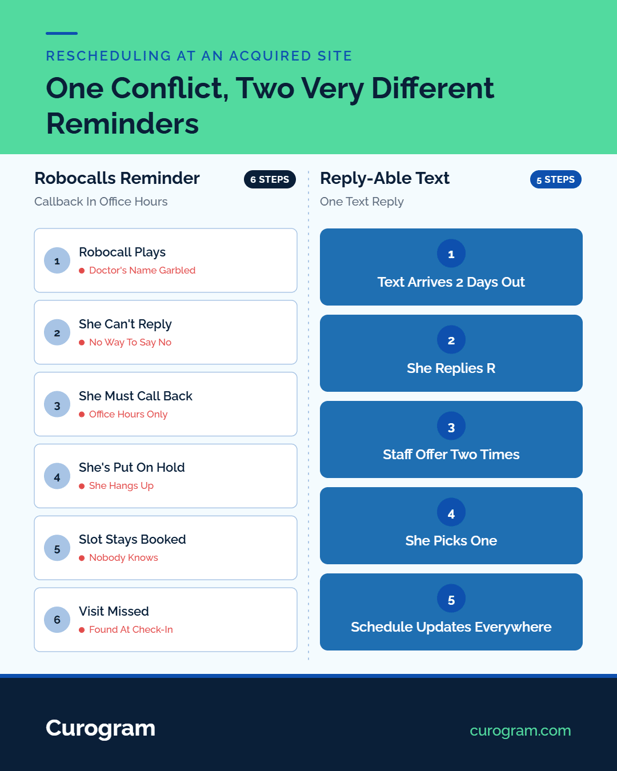
A patient has seen Dr. Chen at the Birch clinic for six years. Last spring, a larger group bought the practice. Her first reminder under the new owner was a robocall that got Dr. Chen's name wrong and gave her no way to answer.
She kept her appointment and started watching for the next sign that things had slipped.
For an acquired practice, the reminder is often the first change new ownership makes that patients can feel. Inside most growing groups, that change is left to chance. One site texts 48 hours out and takes replies. Another robocalls. A third sends nothing for one provider's patients.
From the patient's side, it looks like one group that runs differently depending on which door she walks through.
Every location should send the reminder your best location sends, with its own local name on it.
Each site's reminder is whatever growth and past owners left in its settings. For the patient, that turns every visit into a coin flip.
Illustrative example: a patient with visits at three locations of one group in the same month.
|
Location |
What She Got |
Could She Reply? |
|---|---|---|
|
Cedar |
Text 48 hours out, with her doctor and time |
Yes, confirm or reschedule |
|
Birch |
Robocall the morning of, doctor's name garbled |
No |
|
Newest site |
Nothing (new provider missing from reminder rules) |
No message to answer |
Most of the confusing reminders different locations send come from old settings nobody reviewed after a sale or a staff change. The damage shows up at the schedule.
A patient who can't make Thursday and gets a robocall has two options: call back during work hours or do nothing. Many do nothing. She meant to reschedule, but the message gave her no way to say so, and the slot sits empty.
Patients rate a group by its weakest site. The patient reminder experience multi-location group owners picture is usually their best clinic's, while patients remember the worst one.
Acquired-practice patients are the hardest graders. An acquired practice reminder change is often the first thing they notice after a sale, and a worse reminder confirms what they feared.

Curogram runs one reminder standard across the group through our Tebra integration. The standard covers quality and behavior. Each location's identity stays local.
At every site, the message reads the same way:
"Hi, this is Birch Family Care. You're booked with Dr. Chen on Tue, Oct 13 at 9:15 AM. Reply C to confirm or R to reschedule."
Cedar's version says Cedar. The timing, structure, and reply option don't change from site to site.
To reschedule by text reply, patient and staff trade a couple of messages. She types R. Staff see her visit details in the thread and offer two open times. She picks one, and the change syncs to the schedule.
She never waits on hold or logs into a portal. Our page on appointment reminder texts for Tebra users shows the confirm, cancel, and reschedule options.
Acquired sites keep their local number and name, so patients still recognize the sender. The first new thing they notice is a reminder they can answer.
That's the moment to show a patient what new ownership improved. In our experience, reminder reliability, patient trust, and show rates move together, and the upgrade costs the patient nothing.
Reply-to-Manage Reminders let patients confirm with one letter or rebook with a reply, at every location in the group, including the newest. Messages go out in the patient's preferred language.
Each reply reaches the schedule right away. If she replies to Birch and later calls the Cedar front desk, Cedar sees the same updated visit. Replies that need a person land in a shared inbox, so the right site picks them up.
Owners set the template and timing once. Sites fill in approved local details: provider names, directions, and sender name.
Based on our internal data, Curogram clients confirm more than 75% of appointments by text.
The goal is a patient who stops noticing which site she booked with. Every reminder arrives at the same points before the visit, reads the same way, and takes a reply.
This is brand consistency: patient messages that sound like one group while carrying each site's name. Patients start to think of it as how this group communicates.
The Birch patient from earlier now gets a text two days before her visit. It names Dr. Chen correctly, and she confirms with one letter.
For her, that's the first proof the sale changed something for the better. It shows up in the first reminder cycle after the switch.
Track confirmation rate per site for the first month. The sites that sent robocalls or nothing should climb the most.
Read the reply threads too. Patients asking to move a visit by text, where they used to no-show, is a sign the new standard is working.
For the operator's view of governance, see our guide to standardizing appointment reminders across Tebra locations. The shared inbox behind these replies is covered in our multi-location command center overview.
A group this careful about acquisition should be just as careful about arrival. Right now, most of that care stops at the booking.
Tebra fills the top of your funnel. Curogram works on the patient's commitment to show up at the bottom.
Compute one number this week: monthly no-shows, times visit value plus acquisition cost, times 12. Then decide whether the current setup gets another year.
Book a demo, and we'll work out your per-location leak from your own schedule data and model what recovery looks like.
Each location keeps its local number and name as the sender. Standardization applies to timing, wording structure, and the reply option, so patients still recognize their clinic while getting the same reliable message at every site.
She replies R to the reminder. Staff see the visit details in the thread, offer open times, and confirm her pick. The change syncs to the schedule, so she never has to call or log into a portal.
Preferences are set per patient, and calls and other channels remain available. Pew Research Center reports 98% of U.S. adults own a cellphone, so texting reaches most patients. Opt-outs are automatic and permanent.
After a sale, patients look for signs that care will slip. The reminder is often the first thing they experience from new ownership, so a worse one reads as a warning and a better one reads as proof.
Book a real test appointment at every location using a staff member's phone. Record the timing, wording, and whether you could reply. Differences between sites show exactly where the standard needs to apply first.
Patients judge your whole group by one location’s reminder. Curogram makes every Office Ally site send the same clear, reply-able texts — 75%+...

Patients judge your whole group by one location’s reminder. Curogram makes every DrChrono site send the same clear, reply-able texts — 75%+ confirmed.
No-show rates vary by location because reminder setups do. Curogram runs one proven 2-way sequence across every Office Ally site — 53% fewer no-shows.