7 min read

Population SMS Outreach for SmartCare EHR | CCBHC Scale

Population SMS Outreach for SmartCare EHR | CCBHC Scale
💡 SmartCare EHR population health SMS outreach CCBHC community mental health teams need runs on a texting layer beside the chart, not inside it. Curogram sends segmented mass texts alongside SmartCare EHR, so one message can reach 200 clients or 20,000.

This closes "The Outreach Gap." That is the space between what your mandate asks and what phone lines can do.

Flu clinics, Narcan distribution, seasonal depression screening, and closure alerts all go out the same day. One multi-location practice won back 1,240 patients from text recalls alone.

Your certification plan says you will reach out to the population you serve. Not react — reach out. That promise was written, reviewed, and approved by people who expected it to happen.

Now open your phone system and try to actually deliver it.

This is where the plan stops being a plan. SmartCare EHR knows exactly who your populations are, holding program enrollment, last-visit dates, site, and cohort. What it does not hold is any way to speak to all of them at once.

So the responsibility falls to people. Someone pulls a list, someone starts dialing, and forty calls happen before lunch while thousands of clients never hear a word.

Here is the uncomfortable part.

The clients who miss that call are almost always the clients your mandate was written for — lapsed, unstably housed, and long gone from the patient portal, if they ever logged in at all.

Meanwhile the obligations keep arriving.

A Narcan distribution event needs an audience by Thursday, a flu clinic needs sign-ups, and a site closure needs a same-day notice. A seasonal depression screening push has to land before the days get short.

Every one of those is a reach problem before it becomes a clinical problem.

Reach is exactly what a phone tree cannot give you. It sounds like a staffing issue. It isn't. You could double your front-desk headcount tomorrow and still fail to touch a 20,000-client panel in a single afternoon.

This guide walks through the real math of that gap, explains why the usual workarounds fail, and shows how CCBHC outreach campaigns actually get delivered at population scale.

You will see what a compliant broadcast looks like, how segments get built, and what happens when thousands of clients text back.

The plan is not the problem. The channel is.

When the Mandate Outgrows the Phone Line

Population health work assumes you can find people. CCBHC certification criteria, county contracts, and grant deliverables all take that for granted, describing outreach as a task rather than a technical problem.

SmartCare EHR does its job here, defining the population with real precision. The gap opens at the very next step, because defining a group and contacting a group are two different capabilities.

There is no native mass texting channel sitting behind those lists. So the plan meets the phone tree, and the phone tree wins. Most agencies discover this the first time they try two-way texting at scale.

Think about a Narcan supply alert that has to reach your substance use cohort today.

The supply arrives Tuesday and is gone by Friday.

One staff member starts working the list at 8 a.m., manages 40 calls before lunch, and the window closes with about 4% of the cohort reached.

Now run that same effort across a full panel.

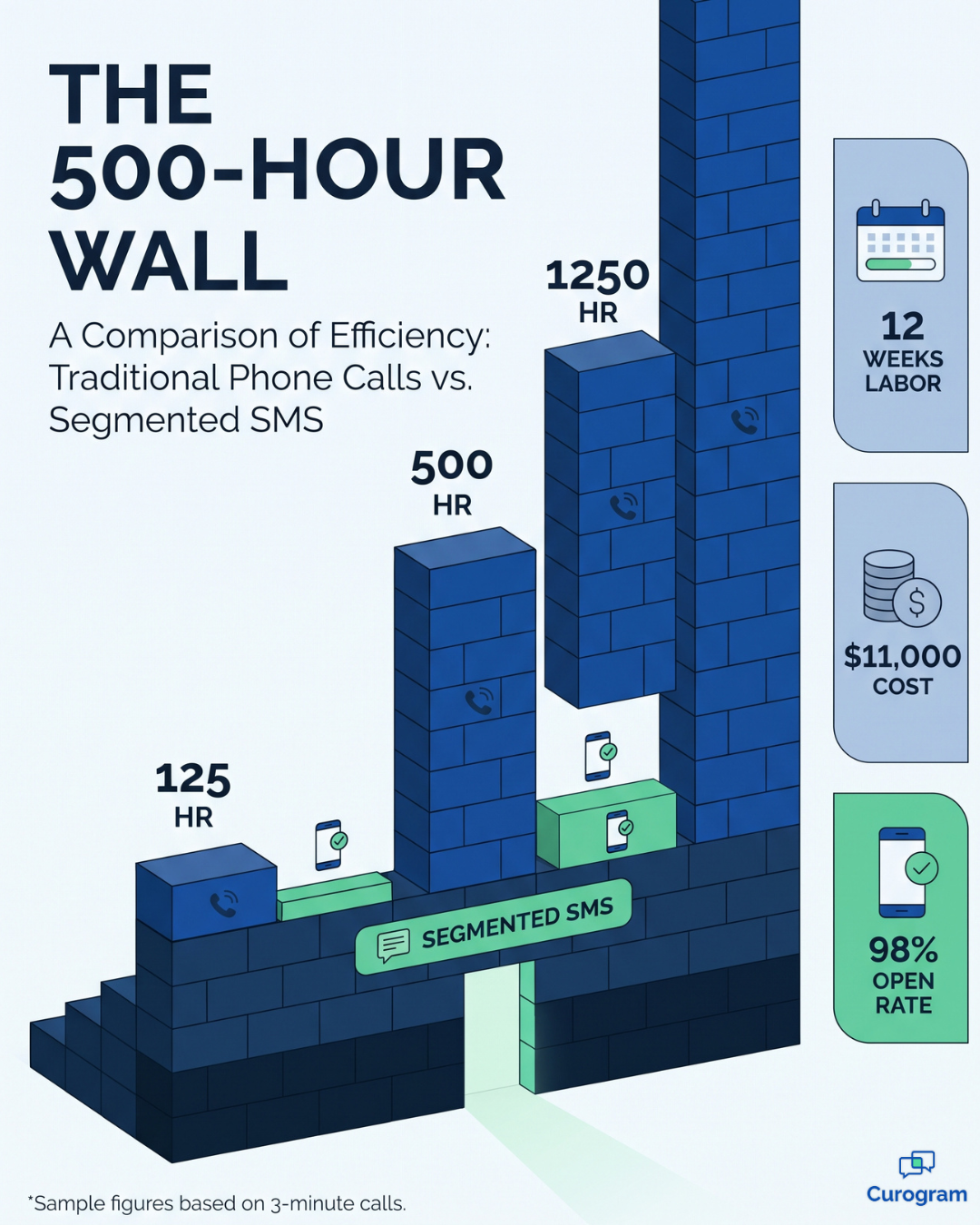
If your panel is Calls at 3 minutes each Staff-hours per campaign One full-time caller for
2,500 clients 7,500 minutes 125 hours About 3 weeks
10,000 clients 30,000 minutes 500 hours About 12 weeks
25,000 clients 75,000 minutes 1,250 hours About 31 weeks

These are sample figures, but the shape holds anywhere.

For a 10,000-client panel, one outreach push costs roughly 12 weeks of a single person's entire job. At a loaded rate of $22 an hour, that is about $11,000 in labor for one send.

This means the campaign usually never runs at all.

That is the true cost of the outreach gap. Not a failed campaign — an unattempted one. The mass text messaging behavioral health agency leaders keep asking for is not a convenience request. It is the only way the mandate becomes achievable.

And the people it fails are specific. The clients who miss outreach are the least likely to watch a portal inbox, the least likely to answer an unknown number, and the most likely to need the message.

Infographic comparing staff hours for phone outreach versus mass texting by client panel size

A Channel Built for the Whole Panel

Curogram runs as a texting layer beside your chart system, never as a replacement for it. Curogram integrates with EHR systems across the behavioral health landscape.

Sending, segments, and controls all live in Curogram, so your clinical record stays where it belongs.

That is the real shape of SmartCare EHR population health SMS outreach CCBHC community mental health programs can run. Segments in. Delivery report out.

Segments that mirror how you already work

A campaign is only as good as its list.

Segments can be built along the same lines your teams already use:

  • Program or service line
  • Site, region, or county
  • Last-visit windows, such as no contact in 90 days
  • Custom uploaded lists for grant cohorts or event invites

That gives you the segmented patient outreach SmartCare organizations already have the data to support. Whole panel when the message is universal. One precise cohort when it isn't.

Compliance that runs in the background

Consent tracking is not a spreadsheet chore here. The tool handles the opt-out management healthcare texting programs are required to keep, and it does that on every send, by itself.

Delivery reporting comes back with the campaign. You see what sent, what landed, and what failed. That is the proof your county contract or grant report will ask for later.

It all runs on a HIPAA-compliant, SOC 2 Type II platform, with a signed Business Associate Agreement in place.

Reach every patient in seconds. Use mass messaging for urgent closures, health alerts, or clinic news with a 98% open rate with Curogram.

Message copy that protects the client

For substance use programs, 42 CFR Part 2 raises the bar well past HIPAA. So message bodies stay logistics-only and cohort-blind by design.

The text never names a diagnosis, a treatment status, or a program that gives away why someone got it. Details live behind a secure link instead.

Write it so a stranger reading over a client's shoulder learns nothing. Date, time, place, secure link, reply keyword. Nothing else.

What Ships When the Channel Finally Exists

The change is not subtle. Outreach stops being a quarter-long project and becomes an afternoon.

Here is how a client recall SMS campaign moves from idea to delivery report:

  1. Build the segment — one program, no visit in 90 days.
  2. Draft a single logistics-only message with a booking link.
  3. Send to the full cohort at once.
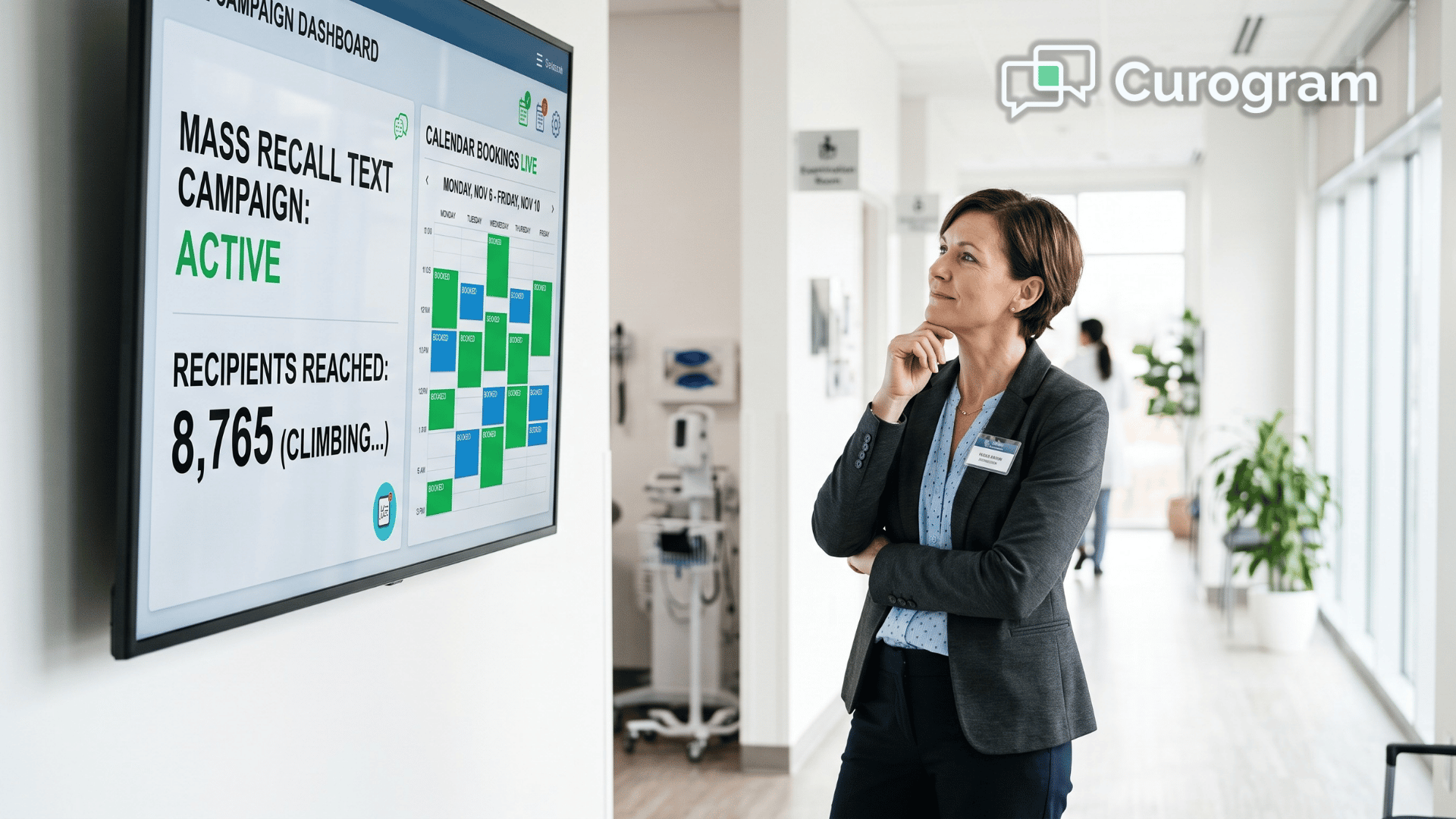
  4. Watch delivery data return in real time.
  5. Route replies into the program queues that own those clients.

Step five is where the volume lands. Thousands of outbound texts create hundreds of inbound conversations, and each one arrives as its own thread for the right team. Not one overwhelmed inbox.

Numbers from comparable clinical settings show the scale of that shift:

1,240 patients returned for care from SMS recalls alone, at a 35% appointment reconversion rate across a multi-location practice. Meanwhile 98% of text messages get opened, a rate portal notices never come close to.

So what does 1,240 recovered visits actually mean? Using an illustrative $120 average reimbursement, that is roughly $148,800 in care delivered that would otherwise have been missed.

For your team, it also means the mandate gets met with a report attached, not a story.

The same channel carries the rest of your calendar.

A county mental health mass notification about a sudden site closure goes out in minutes instead of voicemails.

A flu clinic push fills slots.

A screening reminder reaches everyone it was built for.

Clients who come back also tend to leave better public feedback, which is why many agencies pair outreach with automated review requests.

Compare all of that to 500 staff-hours. One campaign used to eat a season. Now it takes an afternoon and hands you a spreadsheet.

That is outreach that ships.

Which Campaigns Earn a Place on Your Calendar

Once sending becomes easy, a harder question arrives immediately:

Not "can we reach them," but "what deserves to reach them."

A channel that can text 20,000 people is only worth having if the messages are worth sending.

The short list most agencies keep

Five campaigns tend to survive the first year. Lapsed-client recalls run monthly against anyone with no visit in 90 days. Seasonal screening pushes go out twice a year to the full panel or a single age band.

Harm-reduction supply alerts fire the day supply lands, to one service line only.

The last two are simple logistics. Flu and wellness clinic invites go out by site ahead of each season, and closure notices reach only the affected location, same day. Each one has a clear trigger and a clear finish line, which is why they keep earning a slot.

What a year of that actually costs

Read that list as a workload, not a wish list. Five recurring campaigns at 500 staff-hours each would cost 2,500 hours a year by phone. That is more than a full-time job spent dialing.

By text, those same five become a handful of afternoons.

The recall campaign alone tends to justify the channel. Using the 35% rebook benchmark, a monthly push to a lapsed cohort of 800 clients could fill about 280 visits, month after month, with no outbound calls at all.

Why frequency becomes a compliance question

Behavioral health panels tolerate useful messages and punish noise. Most teams settle near one or two sends per client each month. Push harder and you gamble with the panel itself.

That is the real discipline here, because every opt-out is a client you can no longer contact, whatever the mandate happens to require next quarter.

Keep messages logistical, spaced, and clearly useful, and the channel stays healthy for the campaign that matters most.

Your Populations Are Already Defined. Now Reach Them.

Population health is a reach problem before it becomes a program problem. You can write the finest outreach plan in your state, and it will still sit in a binder if the only delivery method is a phone and a client list.

SmartCare EHR defines who your people are. Curogram is how you talk to all of them at once.

That split matters more than it sounds. Your chart system was built to hold clinical truth, and it does that well. It was never built to move 20,000 messages in an afternoon, track every opt-out, and produce a delivery report.

With a parallel texting layer in place, the work changes shape. A Narcan alert reaches its cohort the day supplies land, a lapsed-client push goes out Monday and fills Thursday's calendar, and a closure notice reaches every affected family before anyone drives to a locked door.

Staff get their afternoons back. Clients get the message. Auditors get evidence instead of a story.

The clients who were hardest to reach — the ones your mandate exists for — finally hear from you on the device they actually carry. That is the whole point. Not more outreach on paper, but outreach that lands.

The math is worth sitting with once more. Either 500 staff-hours per campaign, or a single afternoon. That gap separates a program you describe from a program you actually operate.

Ready to see it on your own panel structure?

Schedule a Demo and we will model a real campaign using your program segments, including cohort sizes, message copy, and the delivery report you would hand your county. 


Frequently Asked Questions

Is mass texting compliant for behavioral health populations?

Yes. Campaigns run on a HIPAA-compliant, SOC 2 Type II platform with consent tracking and automatic opt-out handling on every send. Message copy stays logistics-only, so it never names a diagnosis, a program, or a treatment status. Anything sensitive moves behind a secure link instead.

Can we target precisely, such as clients not seen in 90 days in one program?

Yes. Segments combine program, site, last-visit windows, and custom uploaded lists. The message reaches exactly the cohort a campaign intends, and no one else. You can send to a 200-person group or your full panel using the same tool.

What happens when thousands of clients reply?

Replies arrive as individual chats routed into your program queues. A recall campaign becomes hundreds of rebooked visits, handled by the teams that already own those clients. Nobody has to sort one shared inbox by hand.

Do we need an API connection to SmartCare EHR for this to work?

No. Curogram runs as a parallel texting layer, so campaigns can launch without waiting on an integration project. Segments are built to mirror your program structure, and sending stays inside Curogram. Your clinical documentation workflow does not change.

How fast can a first campaign go out?

Most teams build and send a first segment the same week they start. The heavy lift is deciding who to reach and what to say, not setting up software. Once the first campaign runs, later ones usually take an afternoon.