

9 min read

Precision Mass Texting for EHRYourWay Orgs | Curogram

Precision Mass Texting for EHRYourWay Orgs | Curogram
💡Mass texting for EHRYourWay multi-program behavioral health organizations means sending one SMS broadcast to a filtered cohort: a single program, one site, one clinician's caseload, or a custom list you build. EHRYourWay includes outreach tools that push notices to clients from inside the EHR. Curogram adds a dedicated SMS layer beside it, with segment-level filters and replies that route back as individual conversations.

When a Tuesday DBT group changes rooms, the text reaches that group's roster and nobody else on the schedule. Sends run in about ten seconds, opt-outs process automatically, and every send returns a delivery report you can hand to a supervisor.


A snow closure hits two of your six sites. The announcement goes out to the full client list, because that is the list the tool sends to. Twenty minutes later, the four sites that opened on schedule are answering calls from clients asking whether their group was cancelled. One send created the phone volume it was meant to prevent.

Multi-program behavioral health organizations need audience control at the segment level. One program, one site, one clinician's caseload, reached on the channel clients actually open, with nobody else copied in. Every announcement you send teaches clients whether your number is worth reading.

EHRYourWay handles the clinical side of this well, and its outreach tools can push a notice to clients without leaving the chart. For organization-wide news, that is often the right call.

Curogram runs beside it as a parallel SMS layer for sends where the audience has to be exact. It is the same layer behind two-way HIPAA texting alongside EHRYourWay, applied to a whole cohort at once.

Precision carries compliance weight in this field. For SUD, residential, and MAT programs under 42 CFR Part 2, a smaller audience means the message body has to say less.

A text to 40 people in one intensive outpatient program can read as pure logistics, with no program name and no clinical detail. Write that same text for 5,000 mixed recipients, and you either dilute it into nothing or include something you should not.

Dormant lists are the quieter cost. Based on our internal data, a multi-location practice that sent SMS recalls to overdue patients brought 1,240 of them back onto the schedule from those messages alone.

The Villain: The Blast-Everyone Problem

Coarse reach is not a software defect. It is what happens when the only available audience is everyone, and it costs more in behavioral health than almost anywhere else.

What EHRYourWay's Outreach Tools Cover

EHRYourWay is a well-built system with a real outreach module. Staff can send a notice to clients from inside the EHR, log it against the record, and move on. For organization-wide news, plenty of teams use nothing else, and they are right not to.

The gap opens when the audience gets smaller than the whole roster. Behavioral health organizations do not operate as one population. You are running residential, PHP, IOP, outpatient therapy, MAT, and maybe a school contract, across several addresses, with clinicians whose caseloads cross programs. An announcement that matters to 60 people in residential is noise to 900 outpatient clients.

Channel matters as much as targeting. A portal message waits for a login, and email lands in a folder nobody opens on a Sunday. Pew Research Center puts cellphone ownership among American adults at 98%, with 91% carrying a smartphone. Text is the one channel where a same-day notice behaves like one.

One Closure, Six Sites, Four Sets of Confused Calls

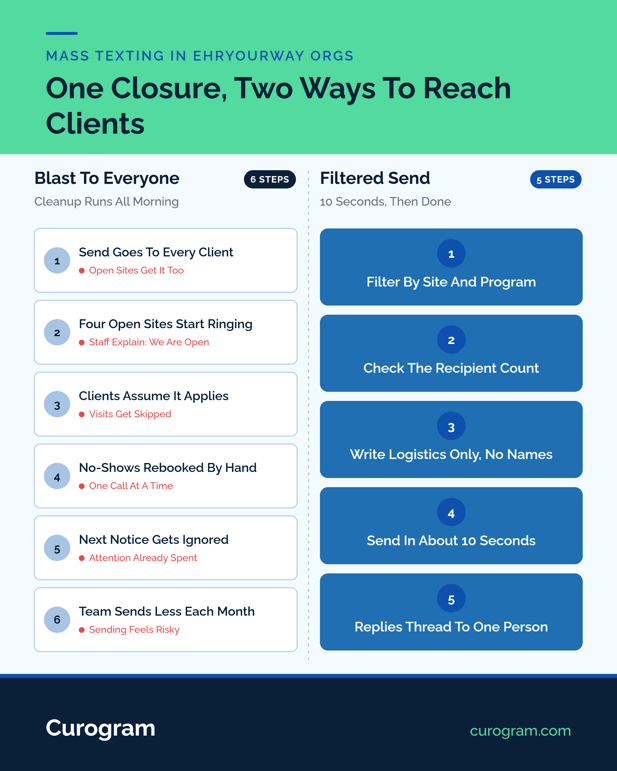
Go back to that snow closure. Two sites shut, four stay open, and the announcement itself is accurate and clearly written. It also reaches every client in the organization, so four front desks spend the morning explaining that they are open.

Those four desks now field three call types: clients asking whether their group is cancelled, clients who assume the closure applies to them and skip the visit, and clients who drive over to check.

The skipped visits are the expensive ones. Every empty clinical hour gets rebooked by hand, if it gets rebooked at all.

Weather is only the obvious version. A billing system change, a parking lot repaving, a holiday schedule, a clinician leaving.

Each is legitimate news for one slice of the population and static for the rest. Organizations respond by sending less, because sending has become a hassle with a cleanup cost attached.

Coarse Messaging Teaches Clients to Ignore You

Every irrelevant text costs a little attention. Send four in a row that do not apply to someone, and the fifth one, the one about their appointment tomorrow, gets swiped away with the rest.

That decay lands in the numbers you already watch. Confirmation rates slip. Opt-out requests climb. Staff starts hedging language so one message can cover six audiences, which produces the vague announcement nobody acts on.

Then the workarounds appear. Cohort-specific news falls back to phone trees, meaning a staff member, a printed list, and an afternoon.

Alumni lists sit untouched in a spreadsheet because nobody wants to text 3,000 former clients about something meant for the 200 who completed residential last year. Waitlist openings go to whoever the scheduler reaches first, which is rarely the person who has waited longest.

Narrow Audiences Are a Compliance Posture

Precision protects more than attention. For programs covered by 42 CFR Part 2, which takes in most SUD, residential, and MAT services, audience size shapes what the message can safely say.

A text going to one program's roster can carry logistics and nothing else: a time, a date, a room, a phone number. No program name, no diagnosis, no treatment detail, because everyone receiving it already knows the context. Stigma-safe wording comes free with a tight segment.

Write the same message for a mixed audience, and it has to explain itself. Explanation is where identifying detail creeps in, and a phone screen visible to a roommate or a parent is not a private place.

Curogram is HIPAA-compliant and SOC 2 Type II certified, which covers transport and storage. Choosing who receives the text is still a staff decision, made at the moment the segment gets built.

Infographic comparing mass blast vs filtered mass texting

The Guide: The Precision Broadcaster

Segment first, write second. That order is the whole difference between a broadcast tool and a megaphone, and it shapes how the feature is built.

What a Filtered Broadcast Is Built From

Segments come from four inputs: program, location, assigned clinician, and custom lists your team builds. Use one, or stack them: residential clients at the Fresno site, everyone on Dana's caseload, the 88 people who finished IOP in the past 18 months.

Filtered Broadcasts with Reply Routing is the feature name, and the recipient count is the safety catch. Staff pick the filters, see the count before anything sends, and confirm. A count of 14 means 14 phones. A count of 1,900 means somebody should look at the filters again.

Filtered SMS broadcasts in behavioral health settings live or die on that number. Most bad sends we hear about involved a well-written message attached to the wrong audience, caught after delivery rather than before it.

Where the Replies Go

Most broadcast tools treat replies as exhaust. A client texts back asking whether her group is cancelled too, and the answer disappears into a no-reply number or a queue nobody owns.

Replies to a Curogram broadcast arrive in the shared inbox as individual conversations, threaded to that client. The scheduler answers one person while the other 200 recipients see nothing. Staff assign, tag, and close those threads the same way they handle any inbound text.

Routing changes what a team is willing to send. Program-specific announcements in EHRYourWay organizations generate follow-up questions by design, and the follow-ups are where the schedule actually gets fixed. A broadcast that swallows replies costs you the rebooking, not just the conversation.

Opt-Outs, Delivery Reports, and the Audit Trail

One reply from a client processes the opt-out automatically. That client drops out of every future send with no staff member updating anything, which retires the do-not-text spreadsheet that always ran a week behind.

Each send returns a delivery report naming who received it, who did not, and which numbers failed. Failures are useful on their own.

A bounced number on a waitlist client tells you the record is stale before you are counting on that person to fill a Thursday slot.

For review, the report is the artifact. When a clinical supervisor asks what went to which clients on the day of the closure, the answer sits on file with a timestamp and a recipient list attached.

Four Sends That Only Work When the Audience Is Exact

Four send types account for most of the broadcast volume we see from multi-program organizations. Each one breaks as the audience widens.

Send

Audience

What the SMS body carries

Group room change

The 14 clients in Tuesday DBT

New room number, same start time, front desk number

Site closure

Two sites, all programs

Dates closed, reopening date, crisis line

Waitlist opening

Next 25 on the outpatient waitlist

Slot open this week, reply to claim it

Alumni check-in

Residential completers, past 24 months

Support group date, address, RSVP link


Waitlist notification texts work on a first-reply basis, so the list has to be capped and ordered before it goes out. Alumni outreach
texting for recovery programs carries the highest stigma risk and therefore the lightest wording.

Holiday closure client notification across multi-site organizations is the send most likely to go wide by accident, because the news feels universal even when the closure is not. Our program broadcasts for behavioral health teams guide walks through the wording for each.


The Success: The Ten-Second Announcement

The send itself is the least interesting part. What matters is what the count on screen lets staff do before they press it, and what comes back afterward.

A Same-Day Closure, Step by Step

Ice storm, two sites down, decision made at 6:40 in the morning by the operations director. A front desk lead runs this sequence, start to finish.

  • Open the broadcast composer and filter on location. Two sites selected, all programs included.
  • Read the recipient count: 312 clients. Compare it against what you expected those two sites to hold. A count that looks wrong is the last chance to catch a bad filter.
  • Write the body. Both locations closed today, reopening tomorrow morning at eight, crisis line number included. No program names, no clinical detail, nothing a bystander could read as a diagnosis.
  • Send. Delivery starts inside ten seconds and finishes while the lead is still on the phone with the clinical director.
  • Watch the shared inbox. Replies thread individually, so 30 questions get 30 answers without anyone reading someone else's.
  • Pull the delivery report before close. Four failed numbers, all flagged for record cleanup.

The other four sites hear nothing, which is the entire point of the exercise. Their morning stays a normal morning.

What the Recall Send Returned

Broadcasts earn their keep on good news too. Based on our internal data, a multi-location practice sent SMS recalls to patients who had not scheduled a follow-up inside the recommended window.

35% of those who received one booked an appointment within the month, and 1,240 patients were seen from the recall messages alone.

Translate that into program terms. Your equivalent list is IOP graduates who never started outpatient therapy, medication management clients three months past their last visit, and intakes who completed paperwork and then went quiet.

Those names are already in EHRYourWay. They are simply not reachable as a group from inside it.

The Same Engine, Running at Volume

Precision and scale are usually traded against each other, which is why the volume numbers matter. One multi-location practice using automated post-visit review requests on this engine collected 1,064 new five-star reviews in three months, with 90% of responding patients leaving five stars, according to our case study data.

Reminder sends show the same pattern on the schedule side. Atlas Medical Center cut no-shows from 14.20% to 4.91% across three months of automated confirmations.

If you want the review side of this, our patient reputation management coverage goes deeper on the survey timing.

The Phone Tree Comes Off the Wall

Targeted caseload messaging retires a specific piece of clinic furniture: the printed call list a staff member works down when a clinician calls out sick. One filter on assigned clinician, one message, and the caseload knows before the first appointment slot opens.

A caseload of 60 that used to take two staff members most of a morning takes one person about four minutes, most of it spent writing.

The behavior change we see after a few weeks is that teams start sending things they used to skip. A group has three open seats, so the waitlist hears about it that afternoon.

Alumni get an invitation to a Saturday meeting instead of a postcard nobody mailed. Dormant lists turn into assets somebody manages, mostly because using them stopped requiring an afternoon.

Woman in her living room holding a smartphone

Conclusion: Trade the Megaphone for a Scalpel

Reach in a multi-program organization is a targeting problem before it is a volume problem. The organizations that send the most useful messages are usually the ones sending the fewest total texts, because each send lands on a list that had a reason to receive it.

EHRYourWay already holds the structure that makes this work. Programs, sites, clinician assignments, and enrollment dates live in the chart, and that structure is what a segment is built from.

Curogram uses it to address the message, then handles the send, the replies, the opt-outs, and the delivery record on the channel clients read.

Start with the send that hurts most right now. For most teams, that is the closure notice, because the cleanup cost is visible the same morning.

Build that one segment, watch the recipient count come back at 312 instead of 3,000, and the rest of the use cases follow on their own.

See How Curogram Works Alongside Your EHRYourWay Platform. Book a demo and we will build a cohort broadcast on your live program structure, using your real sites and caseloads, so you can see the recipient count before you decide anything.


Frequently Asked Questions

How is this different from the mass notifications built into EHRYourWay?

EHRYourWay notifies from inside the EHR workflow. Curogram adds an SMS layer with tighter filters, program, location, clinician, or custom list, sends that run in about ten seconds, and replies that thread back as individual conversations.

How do we keep SUD program announcements consistent with 42 CFR Part 2?

Hold the audience to one program's roster, then write logistics only: time, date, room, and a phone number. No program name, no clinical detail. The narrow segment is what makes plain wording possible.

How are opt-outs and delivery tracked when a supervisor asks for an audit?

A single client reply processes the opt-out automatically, with no list maintenance. Every send returns a delivery report naming recipients, successes, and failures, so the closure record already exists when someone asks.

Why do alumni and waitlist lists respond better to filtered sends?

Both reward relevance. Alumni who finished one program inside a set window recognize a message written for them, and waitlist texts capped to the next 25 people keep first-reply claiming fair and workable.

How quickly can staff build and send a cohort broadcast during a closure?

Filter selection takes seconds, and the recipient count appears before sending, which is the check that prevents wide misfires. Writing the body takes longer than the send, which runs about ten seconds.