8 min read
SmartCare EHR Reminders | 2-Way BH No-Show Reduction
Mira Gwehn Revilla
:
August 28, 2026
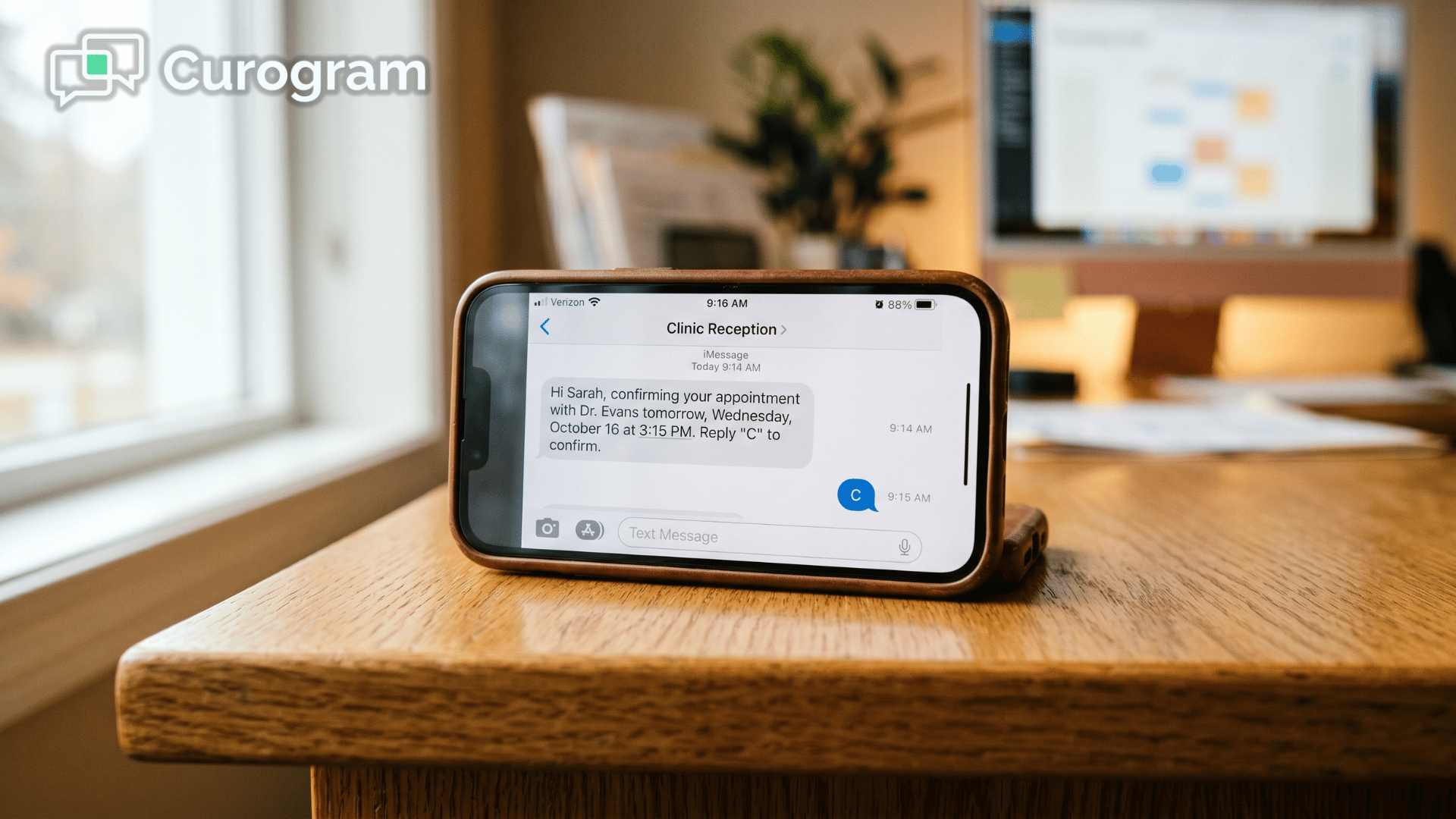
- Reminders go out 48 hours, 24 hours, and 2 hours before the session, by text, to the number already on file.
- Replies sort into confirm, cancel, and reschedule, so an 8 p.m. cancellation opens a slot staff can refill by 9 a.m.
- Silence gets flagged, so the morning call list is 6 clients who never answered instead of all 40.
- Message bodies carry time, location code, and reply options only, which is how they stay safe under 42 CFR Part 2.
- Atlas Medical Center cut no-shows from 14.20% to 4.91% in three months, based on our internal data.
Most behavioral health clinics already send reminders. The text goes out the night before from a number that accepts nothing back, and the attendance number holds steady. Sending more of them won't close the gap.
A client reads the 8 p.m. reminder, types "cant make it, no ride tomorrow," and hits send. That message lands nowhere.
Nobody at the clinic sees it, so the slot stays blocked and the clinician sits with an open hour. In the report, that client is a no-show for the one appointment they tried to handle responsibly.
Whether a reply gets processed is what moves the number. Confirmations, cancellations, and reschedules are data the front desk can act on the same night they arrive.
Behavioral health carries the worst attendance figures in outpatient care. A study of 400 patients at a regional mental health clinic in northern Israel, published in European Psychiatry, found a 39.6% non-show rate for first appointments.
Its authors put missed visits in mental health at roughly twice the rate of other specialties. A 2025 quality improvement project at a Michigan federally qualified health center recorded a 27% behavioral health no-show rate before intervention, and cited literature where rates pass 50%.
Curogram clients run 53% below the industry average for no-shows across specialties. Atlas Medical Center went from 14.20% to 4.91% in three months, based on our internal data.
Curogram connects with EHR systems used across behavioral health. The case figures here come from analogous clinical settings, and we flag that each time one appears. What transfers is the workflow below.
The Black Hole
SmartCare EHR by Streamline Healthcare keeps the appointment record clean. Staff see the day, the program, the clinician, and the authorization. Clients see almost none of it without a portal login.
Portal adoption is where community mental health breaks from primary care. A client with serious mental illness, a shared phone, and no fixed address is not resetting a password to check a Thursday session time. Text is the channel that reaches them.
So clinics bolt on a reminder tool that sends. It fires the night before, it looks fine in the audit log, and it has no return path. What a practice ends up with is a broadcast, and broadcasts don't tell you who is coming.
A Reply That Lands Nowhere
Watch what happens to "can't make it." Your client answers the do-not-reply number. That carrier accepts the message and drops it, or it queues in a vendor inbox nobody on staff has ever opened.
Three things follow. Nothing told the schedule otherwise, so the slot stays held. Your clinician keeps the hour open and fills it with charting. Then the client gets coded as a no-show and, in many programs, gets a letter about attendance policy.
The Waitlist Nobody Gets to Call
Almost every CMHC keeps a waitlist. Ask a scheduler how often they actually fill a cancelled slot from it and the answer is usually "when we find out early enough."
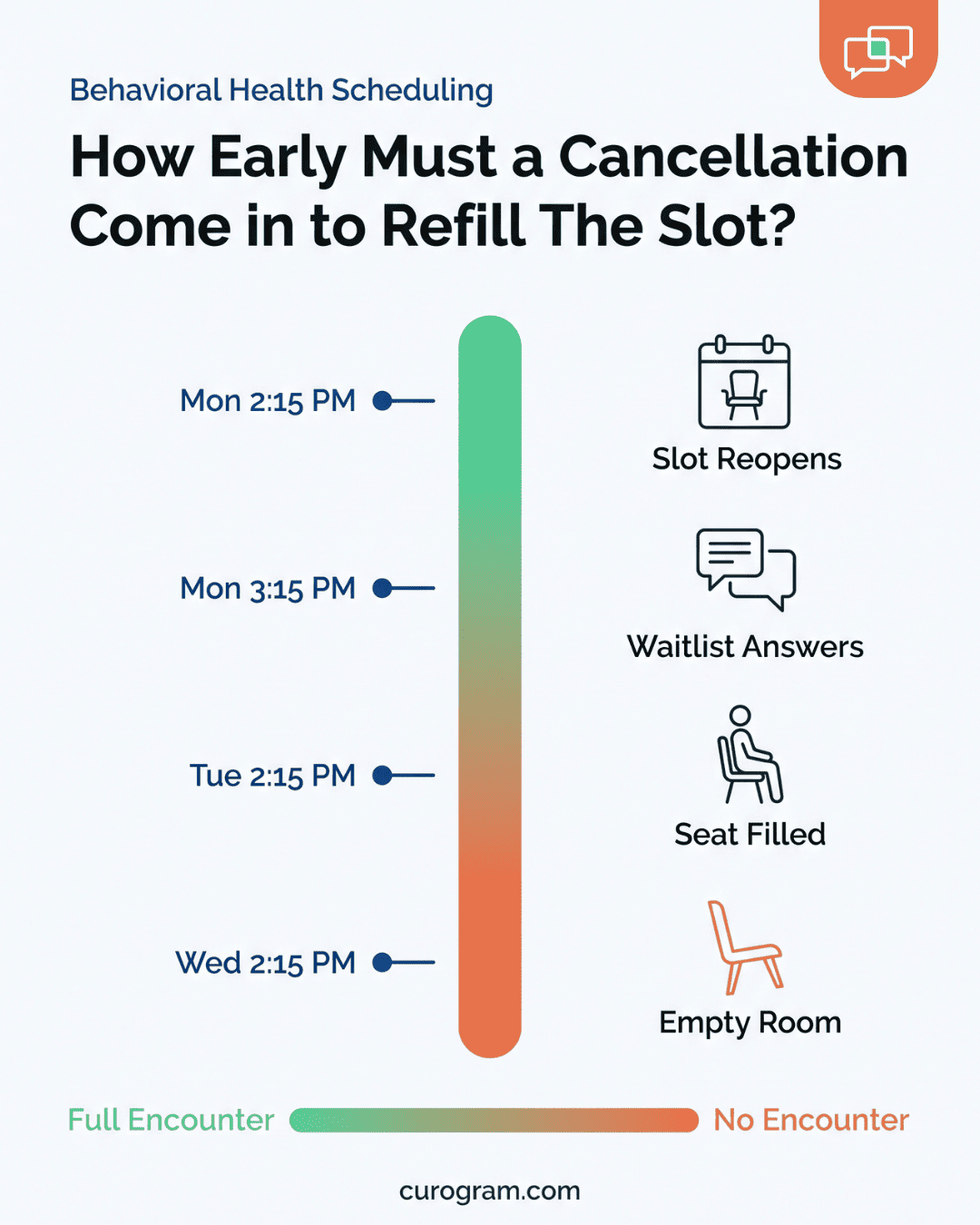
Early enough has a real number attached. A slot vacated 40 hours out is refillable, because a waitlisted client can arrange a ride and a day off. A slot vacated at 1:50 p.m. for a 2:15 p.m. session is gone. Same cancellation, different lead time, opposite outcome.
One-way reminders push every cancellation into that second bucket. Clients who tried to tell you on Monday get discovered on Wednesday, when the clinician walks out to an empty waiting room. The waitlist stays a spreadsheet nobody opens.
What a Blocked Slot Costs
Behavioral health no-show rates at CCBHC and CMHC sites run high enough that the arithmetic gets ugly fast. The table below is illustrative example math, built from stated assumptions rather than a client account.
|
Assumption |
Figure |
|
Scheduled outpatient visits per month |
900 |
|
No-show rate |
28% |
|
Missed visits per month |
252 |
|
Average Medicaid outpatient rate (illustrative) |
$100 |
|
Monthly revenue not billed |
$25,200 |
|
Annual |
$302,400 |
Missed Sessions are a Clinical Event
For a client on medication-assisted treatment, a skipped check-in can mean a gap in a buprenorphine prescription.
For someone discharged from an inpatient psychiatric stay, a 7-day follow-up visit is the one NCQA tracks in its HEDIS Follow-Up After Hospitalization for Mental Illness measure.
Substance use treatment appointment adherence sits close to relapse risk. Drop out of an IOP schedule for a week and the group has moved on, which makes coming back harder than staying.
Scheduling teams tend to call missed visits a productivity problem. Quality officers see the same event as a clinical one. Both are looking at a reminder nobody could answer.

The Attendance Engine
Building SmartCare EHR appointment reminders for no-show reduction in behavioral health starts with one design decision. Every send has to accept an answer, and every answer has to reach a person or a queue.
Three Touches, Each with One Job
A single night-before text asks the client to solve a transportation problem in 14 hours. Spread the sequence across three sends and each one does different work.
Your 48-hour message is for planning. It gives enough runway to arrange a ride, swap a shift, or move the session while the week still has open slots. Most cancellations that are useful to a clinic arrive at this stage.
At 24 hours, the message is a commitment check. Confirmations cluster here, and so do reschedule requests from clients whose week just changed.
That 2-hour text is logistics. Room, entrance, parking, what to bring. It catches the client who confirmed on Monday and forgot by Wednesday afternoon.
2-way SMS reminders in community mental health work best when each send has one job and one reply option. Write them in plain words. A client should be able to read one on a cracked phone screen.
Reminder Reply Processing is the Working Part
Reminder reply processing is what separates a broadcast from a system. Software reads the inbound message, sorts it, and routes it.
|
Client replies |
What the platform does |
What staff see |
|
"C" or "yes" |
Marks confirmed |
Green on the day sheet |
|
"cancel" or "cant make it" |
Flags the slot as open |
Cancellation queue, timestamped |
|
"can we move it" |
Opens a staff thread |
Assigned to a scheduler |
|
Anything unclear |
Routes to a human |
Unread inbox, no auto-reply loop |
|
Nothing at all |
Flags as unconfirmed |
Call list for the morning |
Silence Gets a Column of its Own
An unanswered reminder is information. Out of 40 Wednesday appointments, 30 confirm and 4 cancel by Tuesday afternoon, which leaves 6 nobody has heard from.
Those 6 are the morning call list. Staff spend 20 minutes on clients who actually need a human, and the other 34 calls never get made. Automated appointment confirmation alongside SmartCare shrinks outreach to the cases that earn it.
Undeliverable messages surface the same way. A disconnected number shows up as a hard failure on the day it fails, not as a mystery no-show two weeks later. Number changes are common in this population, and catching one takes a scheduler about five seconds.
SmartCare Stays the Source of Truth
None of this replaces the EHR. SmartCare keeps the schedule, program enrollment, and the billing record. Curogram operates as the communication layer beside it, so confirmations and cancellations reach the people who update that schedule.
Engagement data exports as its own record: confirmation rate, cancellation lead time, reply rate by program. Quality officers pull it for CCBHC reporting without asking IT to build anything first.
Cadence Tuned to the Program
One cadence across every caseload is why reminder fatigue sets in. MAT clients on daily or near-daily contact need short logistics texts, not a full three-touch sequence for every dose visit. IOP clients on a fixed Monday, Wednesday, Friday block need the 48-hour send once a week, not nine times.
Court-mandated clients need the plainest wording of all. A missed session there can carry a legal consequence, and someone else may read the message.
The Answered Reminder: Numbers Leadership Can Report
Take a 2:15 p.m. IOP session on a Wednesday at a mid-size CMHC. This is how one slot behaves once replies are processed.
-
Monday, 2:15 p.m. A 48-hour reminder goes out to 40 clients scheduled for Wednesday.
-
Monday, 2:41 p.m. One client answers "cant come wed, work put me on 2nd shift." Software flags the cancellation and drops that client into a reschedule thread.
-
Monday, 3:10 p.m. A scheduler offers Thursday 4:00 p.m. in the same thread. Client takes it. Wednesday's slot is now 42 hours away and open.
-
Monday, 3:15 p.m. That open slot goes to the waitlist. Three clients get a text offering it, and the first to reply takes it.
-
Tuesday, 2:15 p.m. A 24-hour reminder goes out. 30 confirmations land within four hours. 4 more cancellations arrive, all with enough lead time to refill.
-
Wednesday, 7:30 a.m. An unconfirmed list holds 6 names. Front desk calls those 6, reaches 4, and moves 1 to Friday.
-
Wednesday, 12:15 p.m. A 2-hour text goes out with the entrance and room number.
The refilled slot is the part that pays. A cancellation caught 42 hours early becomes a billable encounter for someone on the waitlist. Caught at 2:14 p.m., that same cancellation is an empty room and a paid clinician hour.
Nothing in that sequence required a new staff role. What changed is that Monday's reply reached a person while the week could still absorb it.
Curogram Highlight: 2-Way Confirmation Processing
2-Way Confirmation Processing reads what clients send back and acts on it. Every reminder goes out from a number clients can answer. Every answer gets sorted the moment it arrives.
Confirmations mark the day sheet. A cancellation opens the slot and records when the clinic learned about it. That timestamp decides whether the hour can be refilled. Reschedule requests open a staff thread instead of dead-ending in an auto-reply.
Free text that fits no category routes to a person. So "im in the hospital" reaches your care team, not a keyword filter.
Unanswered reminders get their own list. Staff call the handful nobody has heard from, and the rest of the day sheet takes care of itself. Bad numbers surface the day they fail, which turns a repeat no-show into a five-second contact update.
All of it runs beside SmartCare. The EHR keeps the schedule and the billing record. Confirmation, cancellation, and reply data export as a separate file for CCBHC and SAMHSA reporting.
Message bodies stay logistics-only by default: time, location code, and reply options, with anything clinical behind a secure link. That default keeps reminders workable under 42 CFR Part 2. It protects clients in court-mandated treatment too.
Curogram operates under a business associate agreement and is HIPAA-compliant.
Conclusion: Turn Reminders into Engagement
A reminder tells a client when to show up. A reply tells you whether they will, and your schedule can only act on the second one.
SmartCare already knows the appointment. What it lacks is a channel where a client types "no ride" at 9 p.m. and a scheduler sees it before the slot goes cold. That channel is the difference between a 28% no-show rate and one you can defend in a board meeting.
Run your own math before you talk to anyone. Take monthly scheduled visits, multiply by your current no-show rate, then multiply by your average encounter rate.
Cut the no-show rate in half and look at the gap. For a CMHC at 900 visits and 28%, that recovery is roughly $12,600 a month in encounters you already staffed.
Curogram clients hold no-show rates 53% below the industry average and confirmation rates above 75%, based on our internal data. Atlas Medical Center got there in three months.
Schedule a demo and watch a cancellation surface, a waitlist text go out, and the slot refill in real time. Bring your own no-show rate and we'll do the arithmetic with you.
Frequently Asked Questions
Unrecognized text routes to a staff inbox instead of triggering an auto-reply. A message like "im in the hospital" or "my ride fell through" reaches a scheduler who can act on it. Keyword-only systems discard those, which is how a client who did communicate still ends up coded as a no-show.
A cancellation 40 hours out is refillable, because a waitlisted client can arrange transportation and time off. The same cancellation at 1:50 p.m. for a 2:15 p.m. session is an empty room. Tracking the timestamp on every inbound reply tells you what share of your lost hours were actually recoverable.
Confirmation rate, response rate, and cancellation lead time export as their own record, separate from the EHR schedule. Quality officers can show reach and engagement by program with timestamps behind each figure. That holds up in a state audit better than a log entry saying staff attempted outreach.
A MAT client with near-daily contact who gets a full three-touch sequence for every visit receives dozens of texts a week and stops reading them. IOP clients on a fixed Monday, Wednesday, Friday block need one 48-hour send weekly. Matching cadence to visit frequency keeps reply rates from collapsing.
Include time, location code, and reply options only. Leave out the program name, diagnosis, dose, and clinician role, since any of those reveals treatment on a lock screen a family member can see. Anything clinical belongs behind a secure link that requires the client to authenticate first.