9 min read
Automated Text Reminders for InSync EHR | Cut No-Shows
Mira Gwehn Revilla
:
September 18, 2026
- Reminders send on a cadence you set, such as 72 hours, 24 hours, and 2 hours before the visit
- A client replies YES to confirm, or texts back to cancel or move the appointment
- Cancellations reach the front desk in real time, early enough to refill the slot
- More than 75% of appointments get confirmed across our client base, based on our internal data
- Message text can confirm a visit without naming the program or type of care, which matters for 42 CFR Part 2 clients
A reminder posted to a patient portal only works if someone logs in to read it. Federal survey data from 2024 put frequent portal use at 34% of U.S. adults.
A study of safety-net practices found 47% of patients had never opened a portal at all. Behavioral health no-shows live in that gap, and they cost more there than almost anywhere else in outpatient care.
InSync by Qualifacts handles therapy and behavioral health scheduling capably. Its client portal posts appointment updates behind a login, and TechRadar's review lists the lack of any smartphone app among the platform's drawbacks.
Missed visits in this field are not occasional. A 2026 systematic review of outpatient mental health clinics pooled nonattendance at 34% for first appointments and 42% for second ones.
SUD programs run higher. SAMHSA's Strengthening Treatment Access and Retention work began with 67 treatment organizations averaging a 37.4% no-show rate.
Curogram adds the piece InSync leaves to the portal. Texts go out on schedule, and clients answer with one reply.
Confirmations, cancellations, and reschedule requests reach your front desk while there is still time to act on them. Across our client base, more than 75% of appointments get confirmed, based on our internal data.
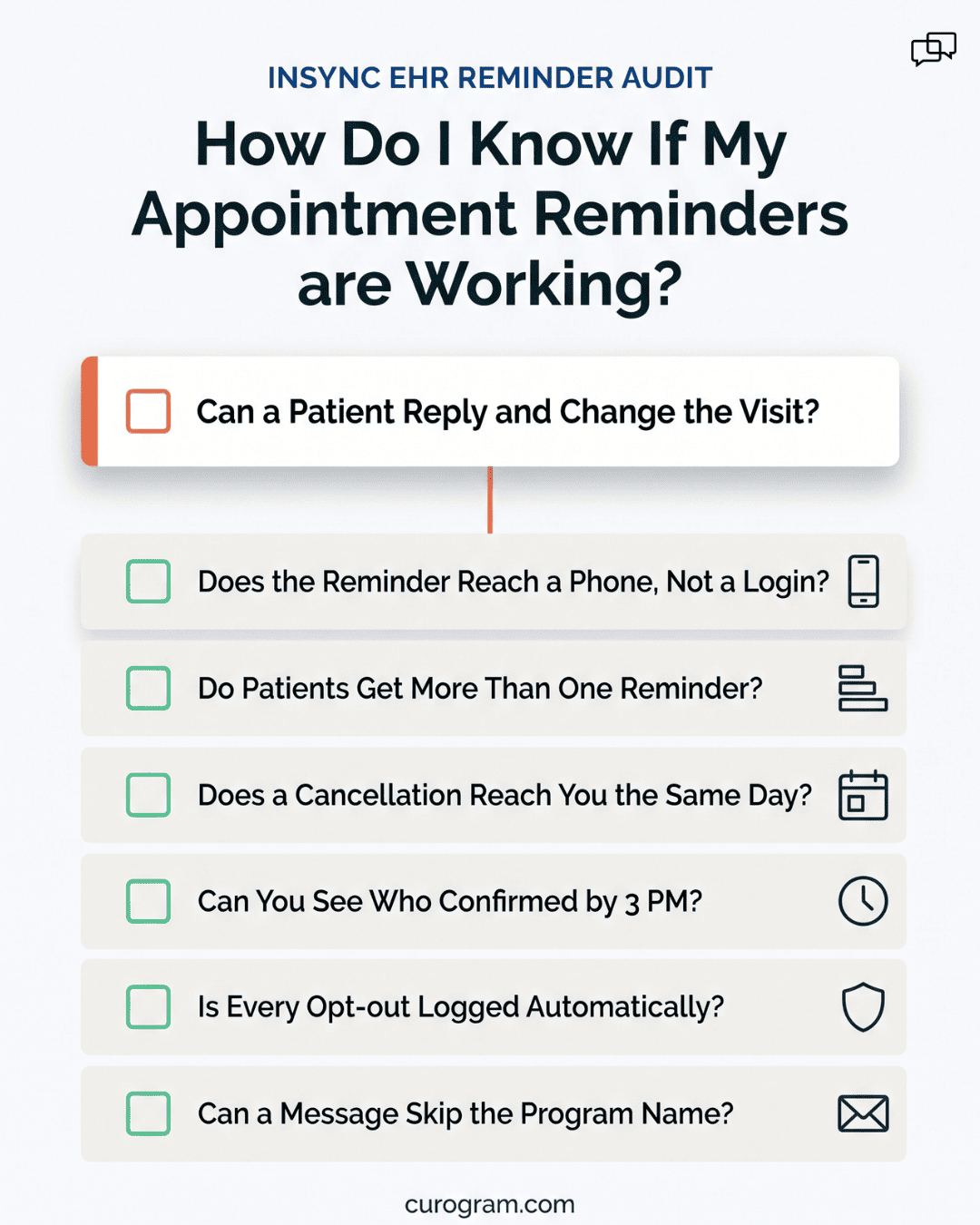
That reply changes what 3 PM looks like at your front desk. Nobody works a call-down list to find out who plans to show up. Your team reads a schedule that already answered, and the slots that opened up have a full day left to get filled.
The Silent Schedule: When a Reminder Posts and Nobody Reads It
InSync earns its spot in behavioral health and rehab therapy. Therapy notes, treatment plans, medication management, group session blocks, MAT visits, PT and OT calendars: the build handles all of it. Qualifacts supports thousands of behavioral health organizations across its platforms.
Qualifacts markets reminders too. Its client portal page promises automated appointment reminders and notifications. InSync sells appointment reminders as a purchasable add-on, listed next to lab interfacing, OCR card scanners, and e-faxing.
Delivery is where the chain breaks. Those reminders live in a browser-based portal that asks for a password first. TechRadar's review praises the portal itself and lists the absence of any smartphone app as a drawback.
InSync Portal Scheduling Notification Limitations in Plain Terms
Three limits show up on a real schedule.
A reminder in a portal waits for the patient to come get it. There is no reply path that writes back to your schedule, so a client who needs Thursday moved still has to call during business hours. And portal accounts are thinnest exactly where missed visits cluster.
Federal data supports that last point. ONC's 2024 review of substance use and mental health treatment facilities found that among facilities running an EHR alone, 44% use it to let patients view records online. Among those mixing EHR and paper, 33% do.
The Step by Step of a Dead Appointment
Front desk books a Thursday 10 AM intake. InSync posts the confirmation to the portal. The client, six weeks into recovery, has changed phone numbers twice this month and never finished setting up a portal password.
Thursday at 10:12, the chair is empty. Somebody calls. It goes to a number that belongs to a stranger now.
Three things are already spent by then. A counselor prepped for a session that will not happen. An hour of licensed clinical time sits blocked and unbillable. And the client who went quiet gets read as treatment resistance instead of someone who never got the message.
What Therapy Schedules Lose
Rehab therapy runs on frequency. A plan of care that calls for 2 or 3 visits a week only works if those visits happen, and every skipped session pushes the discharge date further out.
Six missed visits a day at $150 each, across 22 working days, is $19,800 a month. Those are illustrative figures. Swap in your own rate and your own daily miss count.
Dropout is the cost that never shows up on a report. Patients who stretch an 8-week plan across 14 weeks often stop coming before discharge goals are met.
Authorization periods expire, the referring physician stops sending patients, and the chart closes with a functional score that never improved.
The 4 O'Clock Call-Down
Ask any office manager what happens at 4 PM. She opens tomorrow's list and starts dialing while today's phones are still ringing. Twenty calls in, most have gone to voicemail, and the two that connect produce cancellations she now has no time to backfill.
Clinical leaders feel a different version of it. A director reviewing attendance cannot separate a client who is disengaging from a client whose reminder never arrived. That distinction changes the intervention, and the portal does not record it.
Over in PT, the owner watches the same 3 PM Thursday slot go empty for a third week. The patient never canceled, and nobody found out in time to fill it.
The Confirmed Book: Reminders That Answer Back
Automated text appointment reminders for InSync EHR practices run off the schedule you already keep. Curogram sits beside InSync as the messaging layer.
Your schedule stays in InSync. Curogram reads it, texts every scheduled patient on the number they already use, and routes whatever comes back to your front desk.
Cadence is yours to set. Most behavioral health practices run three touches: 72 hours out for planning, 24 hours out for commitment, and 2 hours out for the people who need a nudge that morning.
Replies are the part a portal can't do. Answering "YES to confirm" takes a client about 10 seconds and no password.
A cancellation typed at 9 PM shows up on your board that night, not at 10 AM the next day. Reschedule requests open a thread your staff can answer the next morning.
InSync EHR Appointment Reminder Integration: The Honest Pathway
InSync EHR appointment reminder integration is real and documented, and it isn't a two-click install.
Qualifacts publishes InSync FHIR APIs built to FHIR R4.0.1 and US Core 6.1.0, with support for SMART App Launch 2.0.0 and bulk data access. That's better documentation than most behavioral health EHRs offer.
Access has gates. Developers register for the sandbox first, submit a Qualifacts FHIR API Developer Registration form, and work through the InSync FHIR API coordinator. Production access is limited to Qualifacts customers who have licensed the InSync FHIR API.
BAAs get signed with Qualifacts and with your practice. Our team carries that coordination, so your clinical workflow stays where it is.
Expect a few weeks of paperwork rather than an afternoon. Nobody at your front desk learns a second scheduling system, and no one stops booking in InSync.
SMS Appointment Confirmations for Behavioral Health Practices
Confidentiality rules shape the wording, not the channel. SMS appointment confirmations for behavioral health practices can carry a date, a time, and a provider's first name without naming the program, the diagnosis, or the type of care.
For a client whose family doesn't know about treatment, that wording decides whether the message gets a reply or a delete.
42 CFR Part 2 programs came under new alignment requirements with enforcement starting February 16, 2026. Message templates and consent records carry more weight now than they did two years ago. Curogram tracks consent and opt-outs automatically, with a timestamp on each one.
Compare that to a call log with a staff note reading "left message."

Automated Reminders for Therapy Visit Schedules
Rehab therapy breaks manual confirmation faster than any other setting. A caseload of 60 patients at 2 visits a week means 120 appointments to confirm, every week, with no end date. Nobody staffs that by phone.
Automated reminders for therapy visit schedules handle the volume because the cadence repeats without anyone touching it. A patient on a 10-week plan gets the same 24-hour text before visit 3 and before visit 19.
Rescheduling gets cheap, too. A patient who has to move Tuesday texts back Monday night, which gives your front desk a full day to fill the hour instead of writing it off. Frequency holds, the plan of care stays on its original timeline, and the authorization does not run out mid-course.
Where Qualifacts iQ Stops and Curogram Starts
Qualifacts launched iQ Agent for Scheduling in January 2026. It's an agentic AI tool for schedulers, built inside the EHR, driven by chat-based prompts. Qualifacts' own product page lists the scheduling agent as available for Credible customers.
Read the design and the split is clear. iQ speeds up the staff side of booking: fewer clicks, less manual coordination, faster fills. Whether the patient confirms sits outside its scope, and that's the half your no-show rate is made of.
Curogram covers that half. It also travels. A practice that migrates from InSync to Credible or CareLogic keeps the same reminder workflow, the same templates, and the same message history.
The 3 PM Certainty: What Confirmed Appointments Do to a Schedule
Pull the numbers before you change anything. InSync reporting can break no-shows out by provider, appointment type, and day of week, and that split usually tells you more than the practice-wide average does.
Look for three patterns. Intakes almost always miss more than established visits. Monday and Friday tend to run worse than midweek.
And one or two providers usually carry a rate well above the rest, often because of panel mix rather than anything they are doing.
Write the baseline down with a date on it. Sixty days after reminders go live, the same report is your before-and-after, and you will want the original in writing when someone asks whether the change paid for itself.
The Numbers to Expect
|
Metric |
Result |
|
Atlas Medical Center no-show rate |
14.20% down to 4.91% in three months |
|
Covina Arthritic Clinic confirmations |
More than 1,100 per month |
|
Curogram client confirmation rate |
Above 75% |
|
Curogram client no-show rate vs. industry |
53% lower |
Atlas got there in a single quarter. Covina's figure is the one to sit with: 1,100 confirmations a month works out to roughly 50 phone calls a day that nobody has to make.
Two things drive those results, and neither is complicated. Patients answer texts. Staff act on answers while there is still runway.
What the Reminder Layer Actually Does
Automated SMS Reminders with 2-Way Confirmation is the feature doing the work here. It reads your InSync schedule, sends texts on the cadence you set, and processes what patients send back without anyone opening a queue.
Cadence is configurable by appointment type. A 90-minute intake can get 72-hour, 24-hour, and 2-hour touches. A standing 30-minute med check might need one text at 24 hours. Group sessions go out to the whole roster at once.
Reply handling is where staff hours come back:
- YES marks the appointment confirmed and updates the front desk view
- A cancellation frees the slot right away and flags it for backfill
- A reschedule request opens a two-way thread staff can answer in the same window
- STOP records an opt-out with a timestamp, which is the record you want if TCPA ever comes up
Wording is template-controlled, so a Part 2 program can send "Your appointment is Thursday at 3:00 PM with Dana" and leave everything else out. Templates are set once, per appointment type, and they apply to every visit after that.
Nothing here replaces InSync. Your schedule, notes, treatment plans, and billing stay exactly where they are. Curogram reads the appointment, sends the message, and hands back the answer.
Practices running it confirm more than 75% of appointments, based on our internal data. Covina Arthritic Clinic confirms more than 1,100 a month this way.
Conclusion: Put Tomorrow's Schedule in Writing
InSync runs the schedule. Curogram confirms it. Those are two different jobs, and only one of them depends on a patient remembering a password.
Practices that make the change stop guessing at 3 PM. Confirmations land before the afternoon ends, cancellations arrive with a day of runway, and the front desk gets its phone time back.
We would argue the bigger win is clinical. A client who goes quiet after three texts is telling you something real. That is a signal your team can act on, rather than a mystery you discover at 10:12 on Thursday morning.
Run your own math first. Pull last quarter's no-show rate out of InSync by provider and appointment type, multiply the missed visits by your average session rate, and look at the monthly total. Most owners are surprised by the number.
Request a demo and bring that report. We will set your reminder cadence against your real schedule and your real visit volume, then show you what the confirmed version of the same week looks like.
Frequently Asked Questions
Both can run. InSync keeps posting appointment updates to the portal for clients who use it. Curogram texts the same appointment details to every scheduled patient, whether or not they have a portal login. Replies come back to your front desk queue, so a confirmation or cancellation lands in one place instead of two.
Delivery and reading are different things. Federal survey data from 2024 shows only 34% of adults log into a portal six or more times a year, and clients in early recovery or crisis are less likely than average to keep a password handy. A reminder nobody opens has the same effect on Thursday as no reminder at all.
The reply lands in your queue the moment it is sent, with a timestamp. Curogram logs the cancellation and flags the slot for backfill. Message templates confirm the date, time, and provider first name without naming the program or the type of care, so the thread stays as confidential as the file behind it.
Plan in weeks. The pathway runs through Qualifacts' documented FHIR R4 APIs, which means developer registration, sandbox access, an API coordinator review, and BAAs with both Qualifacts and your practice. Our team handles that coordination. Your schedulers keep booking in InSync the entire time, with no change to their workflow.
Fewer touches per visit, applied consistently. A 24-hour text before every appointment usually carries an established patient on a plan of care, with a 72-hour touch added for the first two visits and after any gap in attendance. Three reminders for every visit on a 30-visit plan wears the patient down.