8 min read

Two-Way Text Confirmations | InSync Therapy Patients

Two-Way Text Confirmations | InSync Therapy Patients
💡 Two-way text appointment confirmations for InSync therapy patients let people confirm, cancel, or reschedule by text with one reply. No portal login is needed. Curogram reads each answer in real time and works alongside InSync EHR by Qualifacts.
  • A PT patient on a 3x-a-week plan gets a text the day before and replies YES from a lunch break.
  • A counseling client gets a text 72 hours out and again at 24 hours. It shows a time, never a program.
  • A reply of "can't make it" starts a reschedule, so staff can offer the slot to someone else.
  • Covina Arthritic Clinic confirms more than 1,100 appointments a month this way, based on our internal data.
  • Curogram clients average a confirmation rate above 75%.
Each confirmed reply is a visit that stays on the calendar. For therapy patients, that keeps a plan of care close to its original end date.

A 24-visit plan of care at three visits a week takes 8 weeks. If the patient averages two visits a week instead, that same plan takes 12. Nobody on your team chose to add a month to that knee rehab. The extra weeks came from visits no one confirmed.

Most of those misses begin with a message the patient never saw. InSync by Qualifacts gives patients a portal for appointment requests, forms, and payments. It works well for people who log in. Plenty of therapy patients never do.

Our position is plain. The reminder that protects a plan of care is one the patient can answer from the phone already in their hand.

Two-way text appointment confirmations for InSync therapy patients work that way. A text arrives. The patient taps YES, or replies to cancel or move the visit, and your front desk sees the answer right away.

That matters most for the people your program serves. A parent fitting PT around school pickup won't open a browser, dig up a password, and check whether Thursday moved.

A client in early recovery may not manage a login at all. For her, one missed week can break the weekly rhythm her treatment depends on.

So this is written from the patient's side of the phone. It's for practice owners and therapy program leads who argue for the patient experience in staff meetings. You've likely seen the pattern already.

There's an open slot at 10:15 and a patient who "didn't know." Then the plan of care slides another week to the right.

The Silent Schedule (As Your Patients Experience It)

InSync's patient portal earns its place. Patients can request visits, fill out forms before they arrive, and pay a balance. For a motivated patient with a laptop and a saved password, it covers a lot.

Trouble starts when the portal is the only place Qualifacts InSync therapy scheduling updates show up. A schedule change posts. The system may send a notice that "you have a new message." To see what changed, the patient has to open a browser, sign in, and click through.

For someone with three PT visits this week, that's homework. It comes on top of the home exercise program, the drive, and a job that doesn't pause for rehab. An unread notice looks exactly like no notice. From the patient's side, the schedule went silent.

That's the weak point in the therapy patient reminder experience when the portal is the only channel. A 30-second check becomes a five-step chore: open a browser, find the site, reset a password, sign in, and click the message.

A PT Patient's Week When Thursday Moves

Walk through one ordinary week. It shows how a single change turns into lost progress.

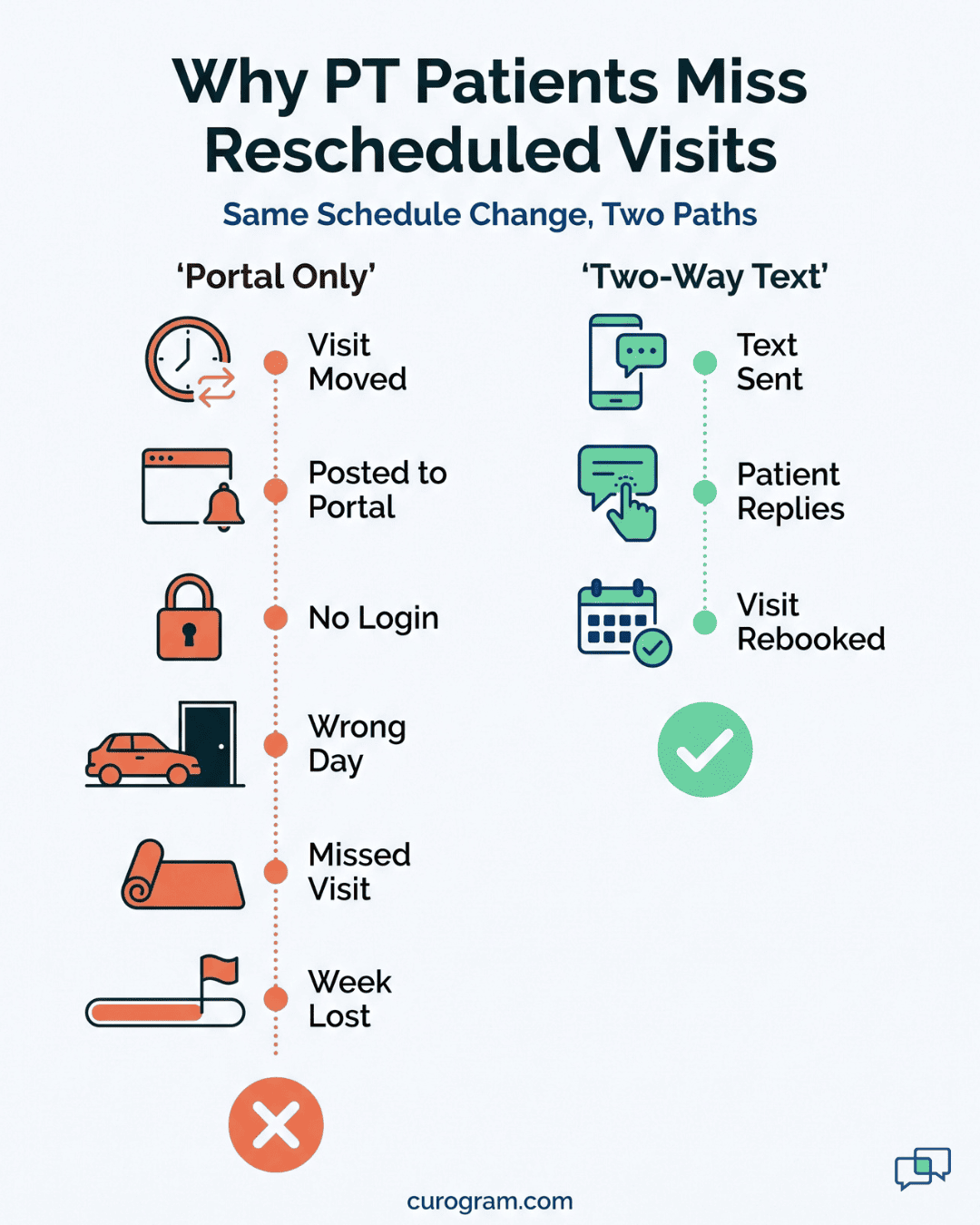
  1. The therapist's schedule shifts, so Tuesday's PT session moves to Thursday.
  2. The change is posted to the portal, and a generic notice goes out.
  3. The patient doesn't log in. Nothing on her phone says "Thursday."
  4. She either drives in Tuesday to find her slot gone, or skips Thursday because she thinks her visit already passed.
  5. Her home exercise program loses its anchor. She's not sure what to do next without the in-person check.
  6. The missed visit gets booked "when we can," often a week out.

Step 4 is where your front desk feels it. Someone has to explain the mix-up at the counter while two patients wait to check in. That talk is awkward for everyone, and the visit still has to be rebooked.

How One Missed Session Stretches the Whole Plan

A knee or shoulder plan of care is built on frequency. Two or three sessions a week keep range of motion moving and give the therapist a chance to progress the exercises. When the week drops to one visit, progress slows and the end date moves out.

Week 8 of the plan becomes week 11. A few more gaps and it lands near 14. Motivation fades as the finish line keeps moving.

And the insurance clock keeps running. Many plans come with a set number of visits approved inside a date window. Each lost week eats into that window.

Your staff then spends hours on work no one planned for. That means calls to reschedule, notes to explain the gap, and sometimes a new authorization request.

The Behavioral Health Version Carries Higher Stakes

In a counseling or SUD program, the cost of one missed visit is steeper. Take a client managing severe anxiety who misses a weekly session she didn't know had moved. Next week feels harder to face. A one-week gap can stretch to three before anyone reaches her.

Weekly sessions build on each other. A coping skill practiced in week 4 gets reviewed in week 5. Miss week 5, and that review may not happen until week 7.

Those no-shows usually trace back to access. When engagement sits behind a login, the patients who struggle most with logins are the ones who fall out. Some are dealing with symptoms that make any extra task feel huge. Others share a phone, or don't have reliable internet at home.

Infographic showing how PT appointment confirmation texts let patients reply and rebook instead of missing a visit

A Reminder That Answers Back

A two-way reminder from Curogram shows up as a normal text from your practice. It works on any phone that can get SMS, including a basic prepaid model. There's no app to download and no password to reset.

A therapy reminder might read:

"Hi Dana, this is Valley Rehab. You have PT on Thursday, 4:00 PM. Reply YES to confirm, or reply to cancel or reschedule."

That one message does three jobs. It tells the patient the right day. It asks for an answer. And it gives her a way out that doesn't involve calling during business hours and waiting on hold.

When she replies YES, Curogram marks the visit confirmed right away. Your front desk doesn't have to call her. If she replies "can't do Thursday," the thread moves to rescheduling while the conversation is still open on her screen.

Timing That Matches How Often Patients Come In

Visit frequency should drive the reminder schedule. A patient in weekly therapy needs more lead time. A patient coming three times a week needs a lighter touch, or the texts start to feel like noise.

Visit type

Typical frequency

Reminder timing

Psychotherapy or counseling

Weekly

72 hours and 24 hours before

PT, OT, or speech

2 to 3 times a week

Day before each visit

Post-op PT check-in

Every 2 to 4 weeks

72 hours and 24 hours before


For recurring visit reminders for physical therapy, the day-before rhythm fits best. The patient hears about each visit once, close enough to plan around it.

PT appointment confirmation texts on that schedule also give your team a same-day read on who's coming tomorrow.

Run the count to see why. A 3x-a-week patient on the 72-and-24-hour pattern would get 6 texts a week, and some would land on visit days.

The day-before pattern sends 3. Patients who get too many texts start to tune them out, or reply STOP, and then you've lost the channel for the whole plan.

The Plan of Care That Finishes On Schedule

Based on our internal data, confirmations at scale look like this:

  • Covina Arthritic Clinic confirms more than 1,100 appointments per month. Before Curogram, staff handled confirmations with manual follow-ups.
  • Across current clients, the average confirmation rate is above 75%.
  • Curogram clients see no-show rates 53% lower than the industry average.
  • Atlas Medical Center cut its no-show rate from 14.20% to 4.91% in three months.

For patients, the shift is timing. They stop finding out about schedule changes after the fact. They answer them in the moment, from a lunch break or a school pickup line.

A Worked Example: One Knee Rehab Plan, Two Ways

To see how missed therapy visits and treatment plan length connect, run one plan both ways. The figures below are illustrative, not client data.

The setup: a post-op knee patient has a 24-visit plan of care at three visits a week. The goal is 8 weeks.

Step 1. Portal-only reminders. Some weeks she makes all three visits. Other weeks, a moved slot or a forgotten time costs her one or two. Over the plan, she averages 1.7 visits a week.

Step 2. Two-way text confirmations. She still hits conflicts. But when she replies "can't make it," staff rebooks her the same week. Her average rises to 2.8 visits a week.

Step 3. Do the math. Divide 24 visits by the weekly average.

Illustrative plan

Portal-only

Two-way text

Visits in plan

24

24

Visits kept per week

1.7

2.8

Weeks to finish

About 14

About 9

Visits used by day 60

About 14

About 24


Step 4. Check the authorization. Say the payer approved 24 visits within 60 days. At 1.7 visits a week, she's used about 14 by day 60. That leaves 10 visits that need a new request, and a gap in care while it's reviewed.

At 2.8 visits a week, she finishes inside the window, around week 9. Your billing team files nothing extra, and her therapist signs the discharge note on time.


Curogram Highlight: 2-Way Text Confirmation

2-Way Text Confirmation is the Curogram feature behind every example in this article. It sends reminders by text, reads each reply, and updates the visit status in real time. Your staff doesn't dial through a list each afternoon.

Covina Arthritic Clinic started where many therapy practices are now. Confirming appointments was slow, hands-on work, with staff doing manual follow-ups.

Curogram automated the reminders and read replies as they came in. Based on our internal data, the clinic now confirms more than 1,100 appointments a month.

For an InSync practice, the feature does four jobs:

  • Sends reminders on a schedule you set by visit type, such as 72 and 24 hours for weekly counseling, or the day before for 3x-a-week PT.
  • Marks a visit confirmed the moment a patient replies YES.
  • Routes "can't make it" replies to your team so the visit gets rebooked instead of lost.
  • Logs consent and opt-outs on every message, with discreet wording for behavioral health clients.

Setup is on us. We handle the connection through InSync's FHIR R4 API, including sandbox testing and the approval steps Qualifacts requires. Your team keeps working in InSync the way it does today.

Reminders run 100% automated. Your front desk gets its time back for replies that need a person, like a patient asking whether to bring her knee brace.

Conclusion: Make Showing Up the Easy Option

Patients miss therapy visits for ordinary reasons. The schedule changed, the notice sat in a portal, and nobody asked them to confirm. A two-way text puts the question in front of them and takes ten seconds to answer.

InSync holds your treatment plans and your clinical record. Curogram handles the patient's reply. You need both to turn a plan of care on paper into a plan of care completed.

Try one exercise this week. Pull last month's plans of care that ran long or were never finished. For each one, find the first missed visit. Then ask how many of those misses started with a schedule change the patient never confirmed.

Bring that count to your demo, along with the extra weeks each of those plans ran.

Request a demo to see the patient side from start to finish. You'll watch a reminder arrive and a one-tap YES confirm the visit.


Frequently Asked Questions

How do text confirmations protect privacy for behavioral health and SUD clients?

Curogram is HIPAA-compliant, and reminders are written to confirm a time and place only. They don't name a diagnosis, a program, or the type of service, so a glance at a lock screen reveals nothing. That wording fits the privacy expectations of 42 CFR Part 2. Consent and opt-out are tracked on every message, and a client who replies STOP won't get further texts.

What happens when a patient replies that they can't make it?

The reply lands in Curogram right away, and your staff sees it in the same thread. They can offer open times, the patient picks one, and staff books it in InSync. The original slot opens for someone on the waitlist. A would-be no-show becomes a rebooked visit and a refilled opening, often in one short exchange.

Why don't patients need an app or a portal account to confirm?

Confirmations arrive as standard SMS, so they work on any phone that can text, including prepaid and basic models. There's no download, login, or password. Patients who like the InSync portal can keep using it for forms and payments. The text reaches the many patients who never log in, and opting out takes one reply.

How do missed therapy visits change the length of a treatment plan?

Plans of care are built on visit frequency. In an illustrative 24-visit knee plan at three visits a week, the goal is 8 weeks. If missed visits drop the average to 1.7 a week, the plan runs about 14 weeks. It can also outlast the authorization window, which means a new request and a pause in care.

How does Curogram connect to InSync EHR by Qualifacts?

Curogram connects through InSync's documented FHIR R4 API. Qualifacts requires developer registration, sandbox testing, and a production request to its FHIR API coordinator, with agency approval for provider-facing apps. Curogram's team handles those steps with your practice. InSync stays your system of record, and Curogram adds the two-way texting layer patients see.