10 min read

CureMD Appointment Reminders With Two-Way Text Confirmation Built In

CureMD Appointment Reminders With Two-Way Text Confirmation Built In
💡 CureMD appointment reminders with two-way text confirmation turn a one-way message into a reply your schedule can trust. CureMD sends the reminder, but a sent reminder is not a confirmed visit.
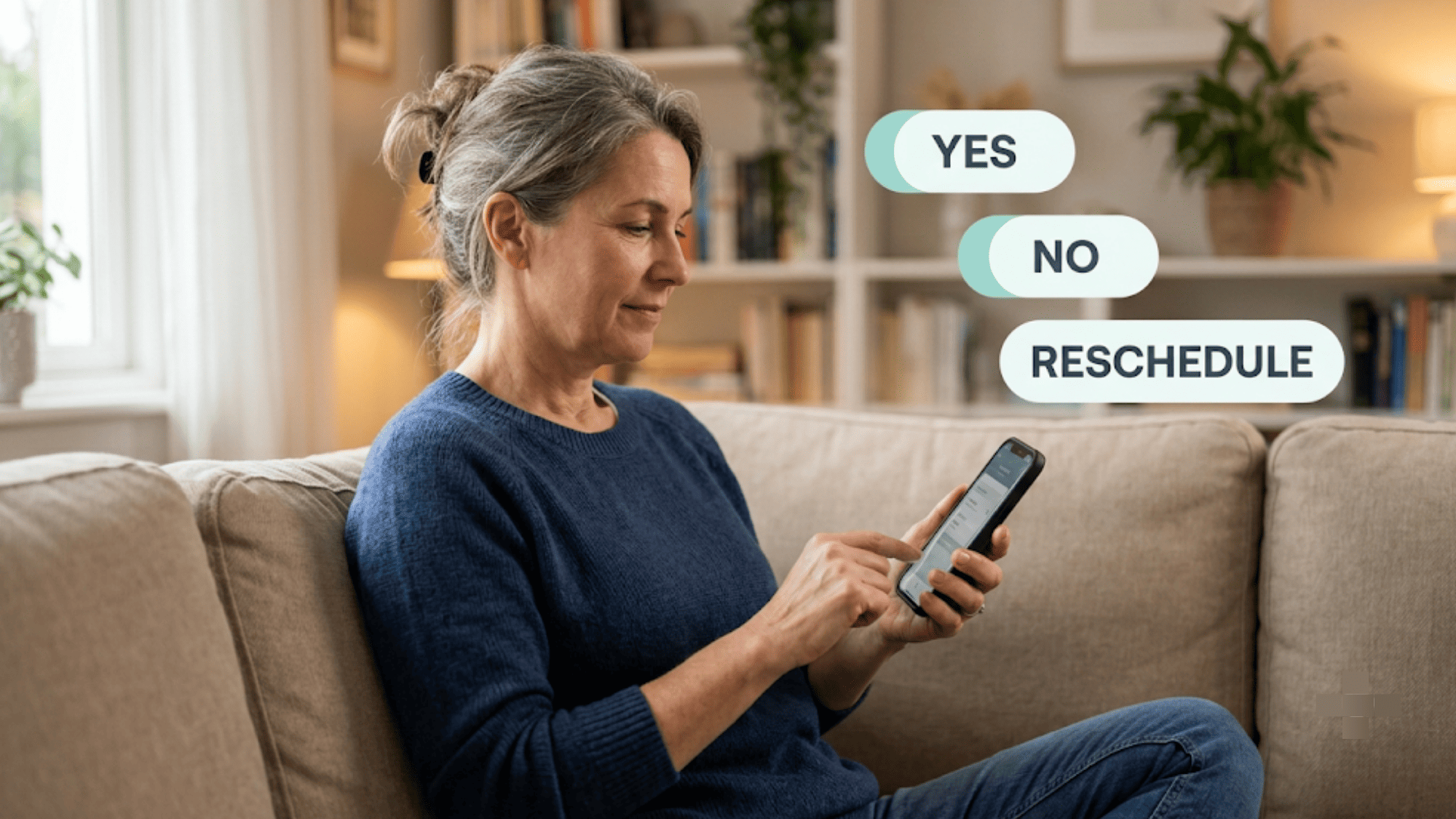
  • Patients text YES, NO, or RESCHEDULE, with no portal login needed.
  • Appointment status updates on its own, so staff skip the confirmation calls.
  • Curogram runs alongside CureMD; you keep CureMD for scheduling.
  • Two-way replies fit primary care, pediatrics, and specialty clinics.
  • You get a clear view of who is coming and who is not.
Comparable practices cut no-shows from 14.20% to 4.91% in 90 days, based on our internal data. Curogram clients hold no-show rates about 53% below the industry average.

A reminder that goes out is not the same as a patient who shows up. CureMD sends your appointment reminders on time, every time. Yet your front desk still cannot say who plans to come. That gap between "sent" and "confirmed" is where schedules break down.

Here is the hard part. A one-way text tells the patient about the visit. It does not tell you anything back. So staff still pick up the phone to confirm each day.

The schedule stays a guess until the morning of clinic. For primary care, pediatrics, and busy specialty clinics, that guess is costly. An open chair means lost time and lost revenue. Same-day cancellations show up too late to fill.

CureMD appointment reminders with two-way text confirmation fix this from both sides. CureMD keeps doing what it does well. Curogram adds a reply channel on top of it. Patients simply text YES, NO, or RESCHEDULE, and the status updates on its own.

No portal login. No app to download. No staff calls to chase a simple answer. Each reminder now returns a clear result you can act on.

This shift matters most where one slot is worth a lot. Think rheumatology, regenerative medicine, or a full pediatric panel. A single recovered visit can outweigh a whole day of small wins. That is real money back on the books.

The payoff is measurable, based on our internal data. Comparable practices cut no-shows from 14.20% to 4.91% in three months. Curogram clients also hold no-show rates about 53% below the industry average.

This guide shows you how to close that loop for good. You will see how two-way replies work in your clinic day to day. You will learn why they help your staff, and what results your team can expect over the first months.

The Villain: The Confirmation Gap

CureMD does its job well. It sends reminders on schedule, without fail. But sending is where the story stops. The system tells the patient about the visit, yet the patient never has to answer back.

That one-way street creates a blind spot. You know a reminder went out. You do not know if it worked. There is no clear signal that says, "Yes, I will be there." This is the heart of the confirmation gap.

To close the confirmation loop on CureMD, you need a reply, not just a send. Right now, that reply comes the slow way. Staff dial through a list, leave voicemails, and wait for callbacks. It eats hours that should go to patients in the building.

The Daily Strain on Your Front Desk

Take a Monday panel of 40 visits. Your team may need to call 20 or more people just to confirm. Many calls go to voicemail. Some numbers are wrong.

A few patients answer, then change their minds later anyway. Each call runs two to three minutes with no reply. Do that 20 times and you have burned an hour before lunch. That hour could have gone to greeting patients or fixing a billing error.

By the time clinic starts, the schedule is still a guess. You find out about a gap when the room sits empty. That is far too late to offer the slot to someone else. The wasted time never comes back.

Why the Gap Costs Real Money

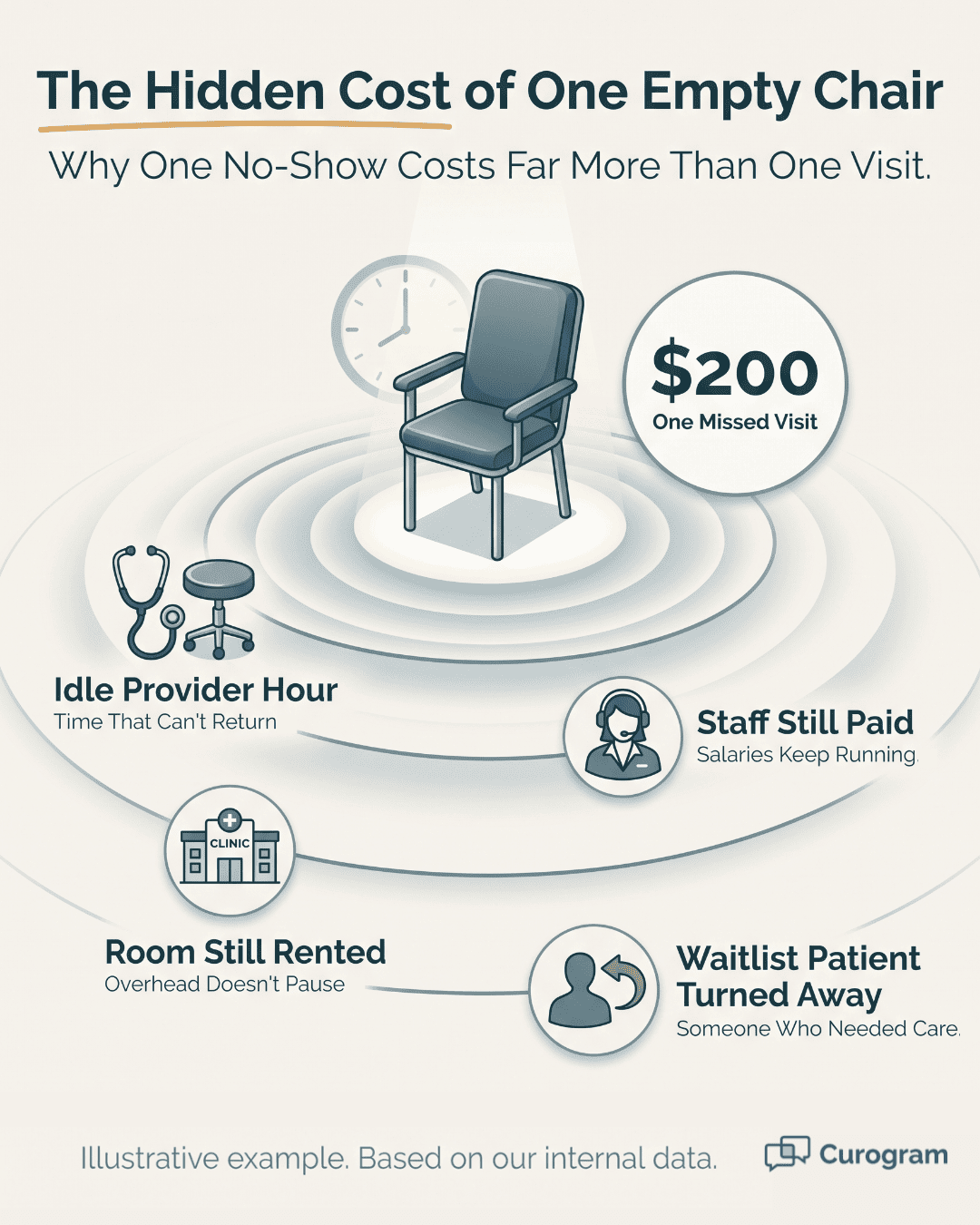
An empty chair is not a neutral event. It is paid staff, paid rent, and an open provider hour with no income. Industry estimates put no-show rates anywhere from 10% to 50%, based on the specialty and patient mix.

Here is a simple, illustrative example. Say a visit is worth about $200 to the practice. Say the clinic loses two visits a day to no-shows. Over a year, that adds up to roughly $100,000 in lost revenue. The exact figure will vary, but the shape of the problem is clear.

There is a hidden cost too. Every unconfirmed slot could have gone to a patient on your waitlist. So you lose the visit, and you lose the fill. Two patients miss out from one silent reminder.

The Gap Grows Silently

The worst part is how quiet the gap stays. No alarm goes off when a reminder gets no reply. The day just arrives, and the chairs sit empty. Small losses pile up week after week until the pattern feels normal. It should not feel normal.

The Gap Hits High-Value Clinics Hardest

Not every open slot costs the same. A missed primary care visit stings. A missed specialty visit can hurt far more.

Think about rheumatology, regenerative medicine, or infusion care. These visits often carry higher value and longer prep time. When one of these patients slips through the confirmation gap, the loss is much larger. You also lose the chance to treat someone who needs care.

The Result: A Schedule you Cannot Trust

The deepest cost is not any single dollar. It is the loss of trust in your own calendar. Your team stops planning around the schedule because it keeps lying to them.

They brace for empty rooms they could not predict. They scramble to fill last-minute holes. They carry stress that has nothing to do with care. CureMD no-show reduction through text reminders starts by naming this gap. You cannot fix what you cannot see, and the gap is the thing to see first.

Infographic showing the hidden cost of one no-show

The Guide: The Confirmation Engine

The fix is not a new scheduling system. You do not need to replace CureMD. You need to add one missing piece: a reply. Curogram acts as the confirmation engine that turns each reminder into a two-way exchange.

Here is the core idea. A patient gets a text about their visit. They tap out a short answer. That answer flows back and updates the appointment on its own. The loop closes without a single staff call.

How the Reply Flow Works

Curogram sends the reminder as a simple text. The patient reads it on any phone, smart or basic. They reply with YES, NO, or RESCHEDULE in plain words. No app, no login, no password to reset.

If they text YES, the visit is confirmed and marked. If they text NO, the slot opens up early enough to fill. If they text RESCHEDULE, staff step in to find a new time. Each path gives you a clear next step.

You can see the CureMD YES, NO, RESCHEDULE text flow at a glance below:

Patient replies

System does

You do

YES

Marks the visit confirmed

Nothing; the slot is safe

NO

Opens the slot early

Fill it from your waitlist

RESCHEDULE

Flags for follow-up

Offer a new time by text


These two-way smart reminders work with CureMD, not against it. CureMD stays your source of truth for scheduling. Curogram sits on top as the communication layer. Think of it as adding a voice to a system that could only speak.

A Layer, Not a Rip-and-Replace

Many teams fear that new tools mean new headaches. They picture data migrations and long training weeks. That is not the case here.

Curogram runs alongside CureMD as a light add-on. Your staff keep the workflows they know. The reminder cadence and the reply handling live in Curogram. The schedule of record still lives in CureMD.

This matters for busy front-desk teams. They do not want to learn a whole new platform. They want the phone to stop ringing with confirmation calls. A layer approach gives them relief without a hard reset.

One Channel, Less Phone Noise

Fewer confirmation calls change the whole front-desk mood. The phone rings less, so staff breathe more. They can greet walk-ins and answer real questions. The reply data also builds a record of who tends to confirm. Over time, you learn which patients need an extra nudge and which do not.

People ignore voicemails. They dodge unknown calls. But most people read a text within minutes. That simple truth is why two-way texting works so well.

A reply takes three seconds and one thumb. There is no hold music and no phone tree. Patients feel informed, not chased. The tone stays friendly, so it never reads as nagging.

Why the Fit is Strong for Specialty Care

For rheumatology, regenerative medicine, and other high-value clinics, one recovered slot means real revenue. These practices cannot afford silent no-shows. A closed loop protects both the schedule and the bottom line.

The patient side matters just as much. A quick, kind reminder makes people feel cared for. They sense that the practice is organized and on top of things. That trust brings them back for the next visit, too. To reduce no-shows for CureMD primary care and specialty teams alike, the reply is the engine that drives it all.

The Success: The Closed Loop

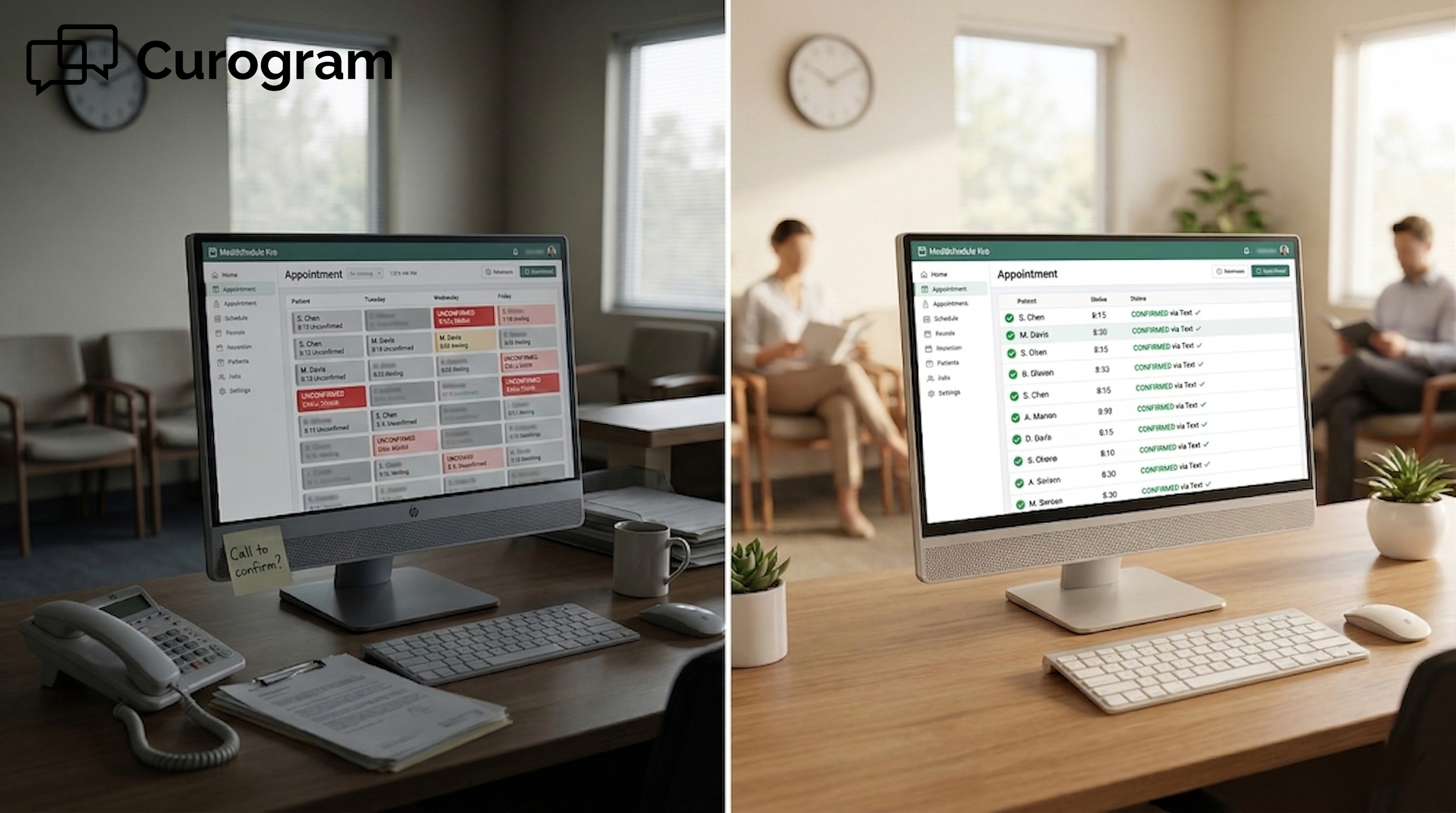
When the loop closes, everything changes. Reminders stop being a shot in the dark. Every message comes back with a status you can act on. The schedule finally tells the truth.

Let us look at what a closed loop delivers. We will walk through the numbers, the daily shift, and the revenue you win back. All practice figures below come from our internal data.

The Metric: Fewer Empty Chairs

Start with the headline result. Atlas Medical Center cut its no-show rate from 14.20% to 4.91% in three months. That is a drop of about 65% in one quarter.

Put simply, the practice went from missing roughly one in seven visits to about one in twenty. Those recovered slots are patients seen and revenue kept. The change came from closing the loop, not from working harder.

Across the client base, the pattern holds. Curogram clients average a confirmation rate above 75%. They also run no-show rates about 53% below the industry average. A strong CureMD reminder confirmation rate is the engine behind both figures.

Here is a quick view of the shift for a sample 40-visit day:

Measure

Before closed loop

After closed loop

No-show rate

About 14%

Under 5%

Missed visits per day

About 6

About 2

Confirmed before clinic

Unknown

More than 75%

Staff confirmation calls

20 or more

Handful of exceptions


The point is not the exact row. The point is the direction. You move from guessing to knowing.

The Shift: From One-Way to Closed Loop

A one-way reminder ends the moment it is sent. A closed-loop reminder keeps going until you get an answer. That single change reshapes the whole day.

Now each reminder returns a clear result. YES means the slot is safe. NO means you can fill the gap early. RESCHEDULE means staff find a better time before the day arrives.

Your morning huddle looks different, too. Instead of a list of maybes, you see a list of confirmed visits. You can spot the open slots while there is still time to act. You call your waitlist, not your no-shows.

This is what people mean by a schedule you can forecast. You plan staffing to match real demand. You prep rooms for visits that will truly happen. The stress of surprise gaps fades away.

The Outcome: Revenue You Win Back

Fewer empty chairs means more collected revenue. Practices see a 10% to 20% rise in revenue, based on our internal data. Recovered slots turn into completed visits. Each recovered appointment feeds straight into profit.

Let us make that concrete with an illustrative example. Say a clinic runs 40 visits a day at about $200 each. A drop from six no-shows to two saves four visits daily. That is roughly $800 a day, or well over $150,000 across a working year.

The exact math depends on your visit value and volume. But the logic is hard to argue with. Every reply that says YES protects income you would have lost. Every early NO gives you a chance to rebook.

What the First 90 Days Can Look Like

You do not have to wait a year to see change. Most practices notice a shift within weeks. Reply rates climb as patients learn the format.

In month one, confirmations start flowing back. In month two, staff make far fewer calls. By month three, the no-show rate often drops sharply, much like the Atlas result above. The loop pays for itself fast.


Patient on a home sofa tapping a phone reply with floating YES, NO, and RESCHEDULE bubbles above it

How Two-Way Smart Reminders Close the Confirmation Loop

The engine behind all of this is Two-Way Smart Reminders. It is the feature that turns a plain alert into a real conversation. And it does the work without adding steps for your staff.

Here is what it does in plain terms. Curogram sends a scheduled text before each visit. The patient replies with a simple word. That reply updates the appointment status on its own.

No one on your team retypes the answer. There is no double entry and no separate log to keep. A YES marks the visit confirmed. A NO opens the slot so you can fill it in time. A RESCHEDULE flags the patient for a quick staff follow-up.

The feature is built for real patients on real phones. It needs no app and no portal login. It works on any phone that can send a text. That low bar is why reply rates stay high and steady.

It also stays fully HIPAA-minded. Reminders use safeguards like a signed BAA, encryption, and access controls. Patients confirm without exposing private details in the message. Security and ease live side by side.

Best of all, it runs alongside CureMD. You keep your scheduling exactly as it is today. Curogram simply adds the reply layer on top. The two systems play their own roles and stay in sync.

You can turn it on without a heavy setup. Most teams are sending two-way reminders within days, not weeks. The loop starts closing right away.

The payoff shows up fast. Staff stop chasing confirmations by phone. The schedule reflects who is truly coming. And you win back slots that used to vanish without warning.

Conclusion: Close the Gap Between Sent and Confirmed

The lesson is simple. CureMD sends the reminder. Curogram gets the confirmation. Together they turn a one-way alert into a loop you can trust.

That difference is bigger than it sounds. A sent reminder only tells the patient about the visit. A confirmed reply tells you the truth about your day. One is a hope; the other is a fact.

Think of it this way. CureMD is built for your schedule. Curogram is built for their reply. The reply is the piece that makes the schedule real and reliable.

The results back this up, based on our internal data. Comparable practices cut no-shows from 14.20% to 4.91% in three months. Curogram clients hold no-show rates about 53% below the industry average. They also confirm more than 75% of visits before clinic starts.

Those numbers are not magic. They come from one change: closing the loop. When every reminder returns a status, the guessing stops. Your team plans around facts, not fears.

The gains reach every corner of the practice. The front desk makes fewer calls. Providers see fuller panels. And recovered slots turn into revenue you would have lost. The whole clinic feels the relief.

It works for primary care, pediatrics, and high-value specialty clinics alike. Anywhere a missed visit hurts, a closed loop helps. The higher the stakes, the bigger the payoff.

Book your demo today and get two-way smart reminders running alongside CureMD within days, not weeks. Start closing the confirmation gap before your next busy morning.


Frequently Asked Questions

How does a two-way text reminder actually confirm a visit without any staff work?

Curogram sends a reminder text, and the patient replies YES, NO, or RESCHEDULE. That reply updates the appointment status on its own. Staff only step in for reschedules, so no one retypes a thing.

Why do text confirmations lift the confirmation rate more than reminder calls do?

Most people read a text within minutes but skip voicemails and unknown calls. A reply takes one thumb and three seconds. That low effort is why more patients respond, which pushes your confirmation rate higher.

How is this different from the reminders CureMD already sends on its own?

CureMD sends one-way alerts that tell the patient about the visit. Curogram makes them two-way. You learn the outcome, confirmed or not, instead of only knowing that a reminder left the system.

Why does closing the loop matter more for specialty clinics like rheumatology?

High-value visits carry more revenue and longer prep time. One silent no-show costs far more than a routine slot. A closed loop protects that income and opens gaps early enough to fill from your waitlist.

How quickly can a practice expect to see fewer no-shows after starting?

Most teams notice a shift within weeks as reply rates climb. Confirmations rise in month one, calls drop in month two, and no-show rates often fall sharply by month three.


Confirm a Dolphin Orthodontic Appointment With One Text Reply

Confirm a Dolphin Orthodontic Appointment With One Text Reply

💡 Parents can confirm a Dolphin orthodontic appointment with one text reply through Curogram. No link. No app. No menu. Reply "yes," "yep,"...

Read More
Smarter OncoEMR Patient Appointment Reminder Text Confirmation Tools

Smarter OncoEMR Patient Appointment Reminder Text Confirmation Tools

💡 OncoEMR patient appointment reminder text confirmation oncology treatment lets cancer patients reply to chemo reminders by text. No portal login...

Read More
Office Ally Appointment Reminders | Smart Text Confirmation

Office Ally Appointment Reminders | Smart Text Confirmation

💡 Office Ally appointment reminders through Reminder Mate help practices send automated texts, calls, and emails in 16 languages. But sending a...

Read More