
.jpg?width=30&height=30&name=square-formal-photo%20(1).jpg) Mira Gwehn Revilla
Mira Gwehn Revilla
Simple Telehealth for Proven EHR | Curogram
 Jo Galvez : Jun 19, 2026, 12:00:00 PM
Launch HIPAA-compliant video sessions from an SMS link alongside Proven EHR. No app downloads, no logins, just one tap to connect.
.png?width=2000&height=1125&name=Behavioral%20Health%20Telehealth%20for%20SmartCare%20EHR%20No%20App%2c%20No%20Download-featured2%20(1).png)
A client sits in a parked car outside a pharmacy. Their phone holds a link to a video session. But the link wants them to download Zoom first. They tap it, land in the app store, and freeze.
This moment plays out every day in behavioral health. The session is ready. The provider is waiting. Yet the client still cannot get in.
Many practices run telehealth through outside tools. SmartCare EHR often routes video visits through Zoom, GoToWebinar, or Microsoft Teams. Each one asks for a download, an account, and a login.
That setup works fine in a quiet office. It works far less well for a client in crisis or on a weak signal. A few extra taps can end a visit before it starts.
The result is a no-app telehealth client experience that these clients rarely get. Instead, they face a maze. And the people most likely to get lost are the ones who need care the most.
This article looks at telehealth from the client's side of the screen. We compare how it feels to join through Zoom or Teams versus a simple text link. The focus is the SmartCare EHR behavioral health telehealth client experience — no download, no app.
We will name the friction first. Then we will show a clearer path. Curogram works alongside SmartCare EHR, not against it. Your clinical record stays put. Only the way clients connect changes.
By the end, you will see why one tap beats seven. And you will see why that gap matters most in behavioral health, where access and trust are everything.
SmartCare EHR does a lot well. It holds clinical notes, treatment plans, and billing in one place. For staff who chart all day, that backbone matters.
But SmartCare does not run video visits on its own. It hands them off to outside tools. Most often that means Zoom, GoToWebinar, or Microsoft Teams.
Each tool brings its own rules. Each one asks the client to download, sign up, and log in. We call this pattern the Third-Party Maze.
Walk through one visit from the client's side:
Now add real life. The client may be in a car, a shelter, or a break room. Their phone may be old. Their data plan may be thin. Each step is a new place to get stuck.
This is the Zoom barrier behavioral health clients hit most often. The tool was built for staff meetings, not for someone in distress. What feels easy to a clinician can feel like a wall to a client.

Staff spend the first ten minutes acting as tech support. Slots sit empty when clients cannot connect. A missed visit means lost revenue and lost momentum.
Based on our internal data, simpler appointment tools push confirmation rates above 75%. The reverse holds too. Every added step chips that number down.
For care itself, the stakes climb higher. A missed session can break a treatment streak. It can stall a medication review or a required check-in. For staff, the daily troubleshooting feeds burnout.
Consider who sits behind these failed connections. A client with serious mental illness may not have the focus for seven steps. A person with a substance use disorder may quit after one error message.
A client in court-mandated treatment risks real consequences for a no-show. Someone facing housing instability may lose signal mid-download. None of them failed. The maze did.
That is the heart of the problem. The clinical care is strong. The access path is broken. And in behavioral health, a broken path can mean no care at all.
Curogram takes a different path. It acts as the Access Simplifier. It replaces third-party telehealth steps with one tap from a text.
Here is how it feels for the client. A text arrives. They tap the link. The video opens right in their browser. No app store. No account. No portal. They are in the visit in seconds.
This is what a text-based telehealth launch looks like in practice. The whole flow lives in one message thread. Nothing new to install. Nothing new to learn.
The branded feature behind this is Curogram Telemedicine. It is HIPAA-compliant, browser-based video built for one-tap entry. Clients join from the same text channel they already use for reminders and questions.
A quick side-by-side shows the gap clearly:
|
Step |
Zoom or Teams |
Curogram Telemedicine |
|
Get the link |
Text or email |
Text |
|
Open the session |
App store first |
Browser opens at once |
|
Account needed |
Yes |
No |
|
App download |
Yes |
No |
|
Taps to join |
About 7 |
1 |
|
Time to connect |
Several minutes |
Under 10 seconds |
Now the key point on fit. Curogram does not replace SmartCare EHR. The two work side by side. Clinical notes, plans, and billing stay in SmartCare. Client contact and video flow through Curogram.
That split keeps your record clean. Your staff still chart where they always have. Clients just get a smoother door into the visit. This is what SmartCare EHR behavioral health telehealth accessibility should feel like.
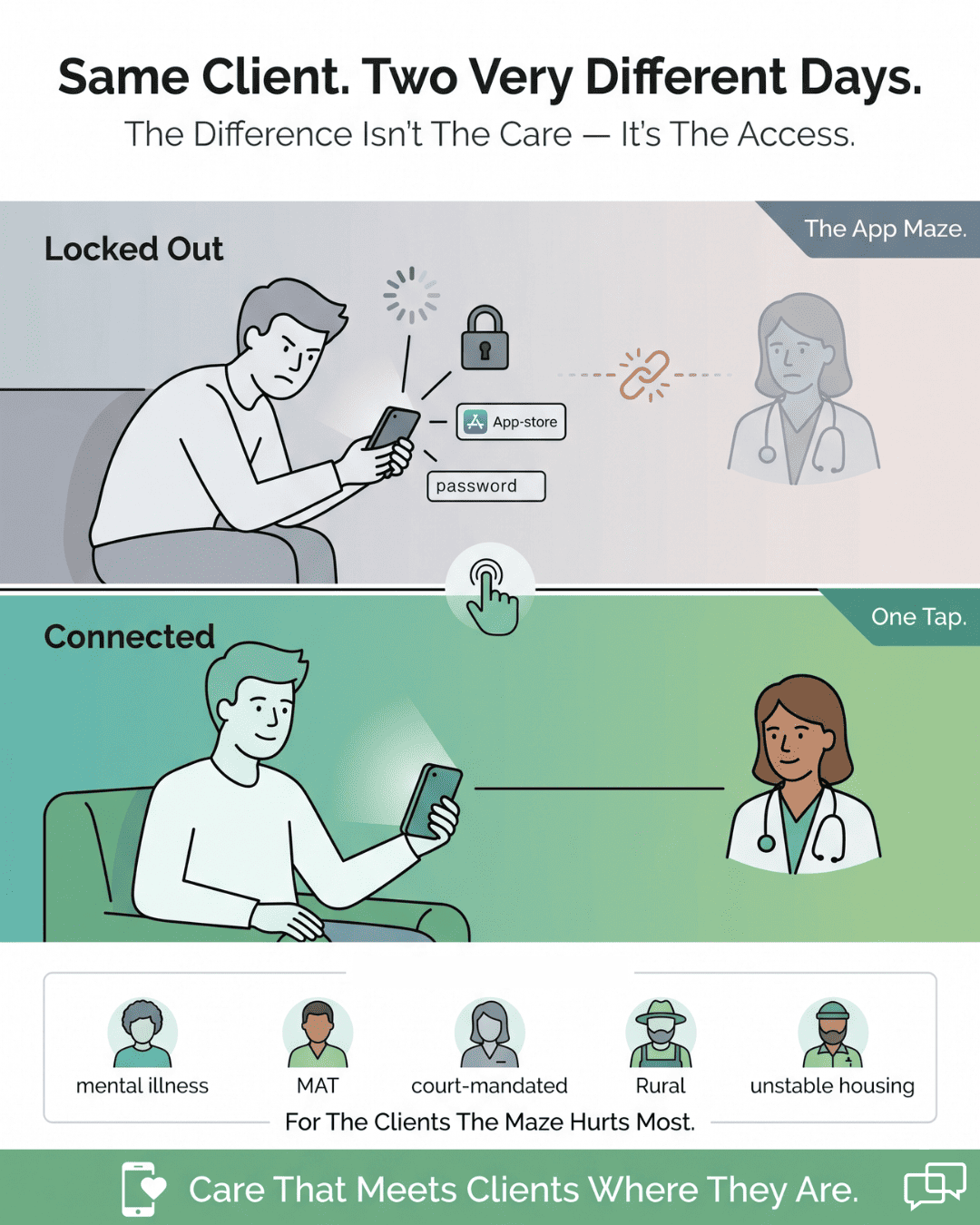
Think about who you serve. Clients with serious mental illness. Clients with substance use disorders. CCBHCs and court-mandated programs. Many face stress, stigma, or unstable housing.
For these clients, every extra step is a chance to drop out. One tap removes that risk. The visit starts before doubt can creep in.
Some worry that text-launched care feels less personal. The opposite is true. When the tech fades, the human part stands out. The client is not fighting an app. They are simply face to face with their provider.
That is the goal of a no-app telehealth client experience. Not a colder visit, but a warmer one. The screen stops being a hurdle. It becomes a window.
So the Access Simplifier does one simple thing well. It clears the path. The clinical work stays strong in SmartCare. The connection just gets easier, faster, and kinder for the people who need it.
The real win shows up at the moment of connection. A client who failed to join Zoom last month taps a text this month — and they are in. No app. No reset. No stress.
That shift changes everything downstream. When clients connect with ease, they show up more often. When they show up, care moves forward. Access is not a side issue. It is the start of every good outcome.
Based on our internal data, Curogram practices run no-show rates 53% below the industry average. That figure is a Curogram-wide benchmark, not a single clinic's result. Still, the pattern is clear. Lower friction means fewer empty slots.
One clinic shows the scale of the gap. Atlas Medical Center cut its no-show rate from 14.20% to 4.91% in just three months. Simple, reliable reminders and easy access drove that drop. The same logic applies to video visits.
A session only helps if the client can reach it. One-tap entry turns a fragile link into a dependable doorway.
Now look at the harder moments behavioral health teams know well.
Crisis days - A client in distress has little patience for downloads. A text link meets them where they are. They tap once and reach their provider fast.
Transport and weather gaps - A bus that never comes can end an in-person visit. So can a snowstorm. With a text-launched session, the client stays home and still connects.
MAT and SUD check-ins - Clients in medication-assisted treatment often need frequent, brief video visits. Missing one can stall their plan. One-tap access keeps these check-ins steady, even on a rough week.
Rural access - Some clients live hours from the nearest clinic. Travel alone can cost a full day. A browser-based visit removes that trip entirely. Care reaches them where they are.
These are not edge cases. They are the daily reality of behavioral health. Telehealth can widen access for clients with serious mental illness and substance use disorders, especially in rural and under-resourced areas. The catch is that access only counts if clients can actually connect.
That is the quiet power of the Access Simplifier. It does not just add a feature. It removes the moment where care usually breaks.
Think back to the client in the parked car. With Curogram, that scene ends differently. The text arrives. They tap. The session opens. Their provider's face fills the screen. No app store. No password. No panic.
The technology steps back. The care steps forward. That is what success looks like when the barrier finally falls.
Why One Tap Changes the Whole Visit for Behavioral Health Clients
One tap sounds small. For behavioral health clients, it is not. It can be the difference between a kept session and a missed one.
Here is why. Every extra step in a join flow is a chance to drop out. A download. A password. A blank screen. Any one of them can stop a client who is already stressed.
Curogram closes those gaps. The client taps the text link, and the video opens in the browser. There is nothing to install and nothing to recall. The path from message to session is one motion.
This matters most for the clients you worry about. Someone in crisis. Someone in MAT. Someone with limited focus or a shaky connection. For them, simple access is not a luxury. It is the bridge to care.
And the channel stays familiar. Clients already get reminders and replies by text. Now they join their visit there too. One thread holds the whole relationship.
The visit also stays private. Curogram's video is HIPAA-compliant, with encrypted audio and video. For substance use care, it supports 42 CFR Part 2 rules. Easy access never trades away safety.
Best of all, none of this disrupts your record. SmartCare EHR still holds the clinical work. Curogram simply carries the client to the session. The two work as one, each doing what it does best.
SmartCare EHR gives your practice a strong clinical core. It holds your notes, plans, and billing in one trusted place. That backbone is not going anywhere.
But your clinical record was never meant to be your client's front door. That is where Curogram fits. It extends SmartCare's reach all the way to the client's phone.
The split is simple. SmartCare EHR is built for your clinical data. Curogram is built for your clients' access. Together, they make a practice that is both clinically sound and easy to reach.
The payoff lands at the moment of connection. No app store. No login. No portal. Just a text, a tap, and a live visit in the browser.
That ease matters most for behavioral health. Your clients face stress, distance, and unstable days. One-tap access meets them through all of it. To see the full setup, explore our pillar guide on launching frictionless video visits without apps, portals, or third-party logins.
The same text channel carries more than video. Pair it with appointment reminders so clients never miss a session. Add two-way texting for quick coordination before and after the visit.
Your clients should not have to download Zoom to see their therapist. With Curogram, they never will.
Discover how Curogram works alongside SmartCare EHR without touching your clinical record. Schedule a walkthrough with our team this week.
 Jo Galvez : Jun 19, 2026, 12:00:00 PM
Launch HIPAA-compliant video sessions from an SMS link alongside Proven EHR. No app downloads, no logins, just one tap to connect.

.jpg?width=30&name=square-formal-photo%20(1).jpg) Mira Gwehn Revilla : Jun 22, 2026, 1:00:00 PM
Mira Gwehn Revilla : Jun 22, 2026, 1:00:00 PM
Learn the SmartCare EHR telehealth setup behind a simple video workflow, so your behavioral health clients can join a secure visit with one quick tap.
 Mira Gwehn Revilla : Jun 23, 2026, 3:00:01 PM
Offer SmartCare EHR telehealth without an app download, so your behavioral health clients can join a secure video visit with one quick tap on a text...