

ROI of HIPAA-Compliant Text-to-Pay for Medstreaming Centers
💡 Text-to-pay systems help Medstreaming imaging centers improve cash flow by speeding up collections and reducing A/R days. Secure SMS payment...
6 min read
Jo Galvez
:
February 11, 2026
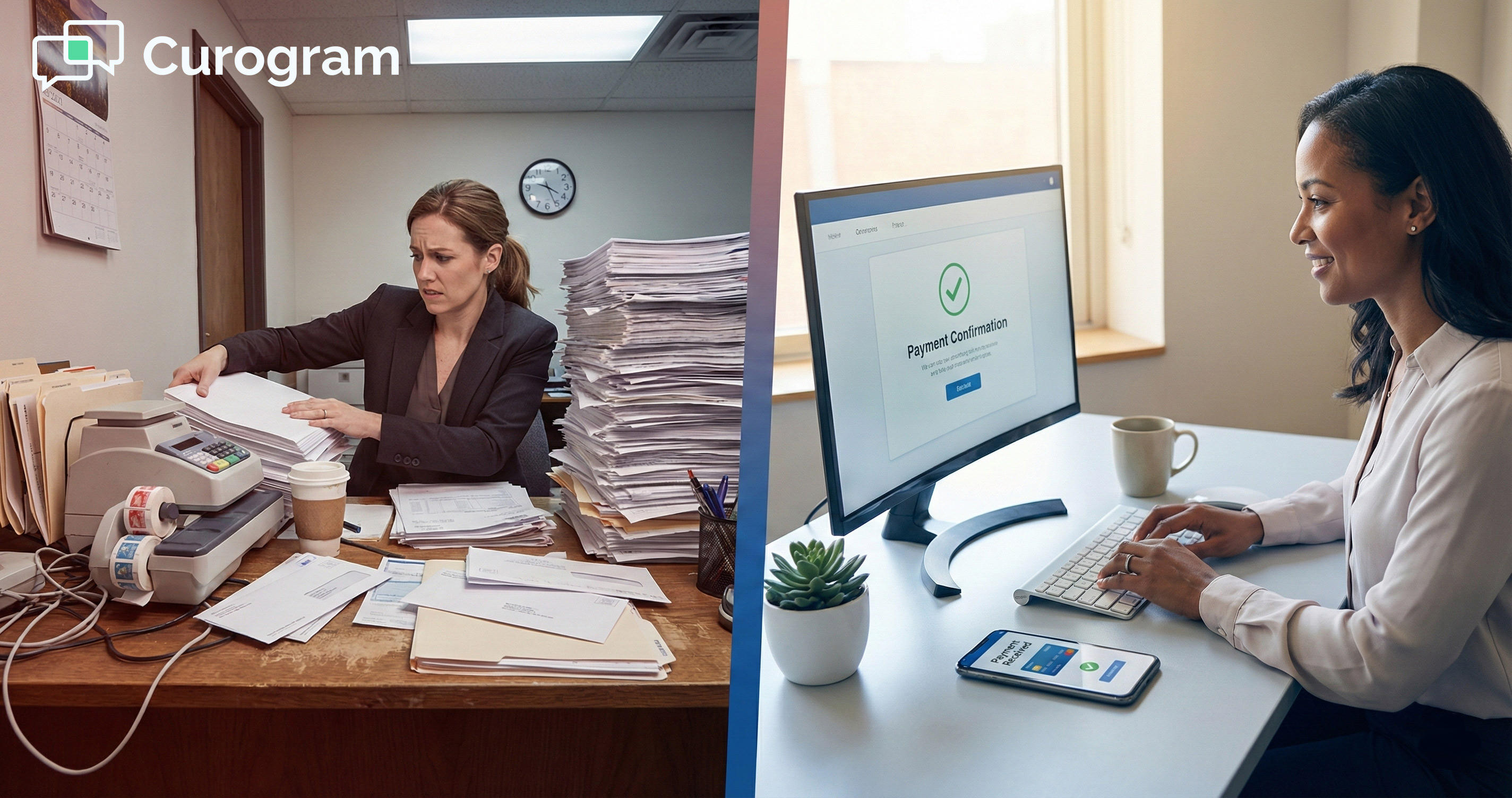
Your front desk team prints the statements. They fold them, stuff them into envelopes, and run them through the postage meter.
A week later, half of those envelopes sit unopened on kitchen counters or buried in junk mail piles. So your team does it all over again.
This is the reality of paper billing in most medical practices that use Prime Clinical. It feels like a normal part of operations because it has always been done this way. But normal does not mean affordable.
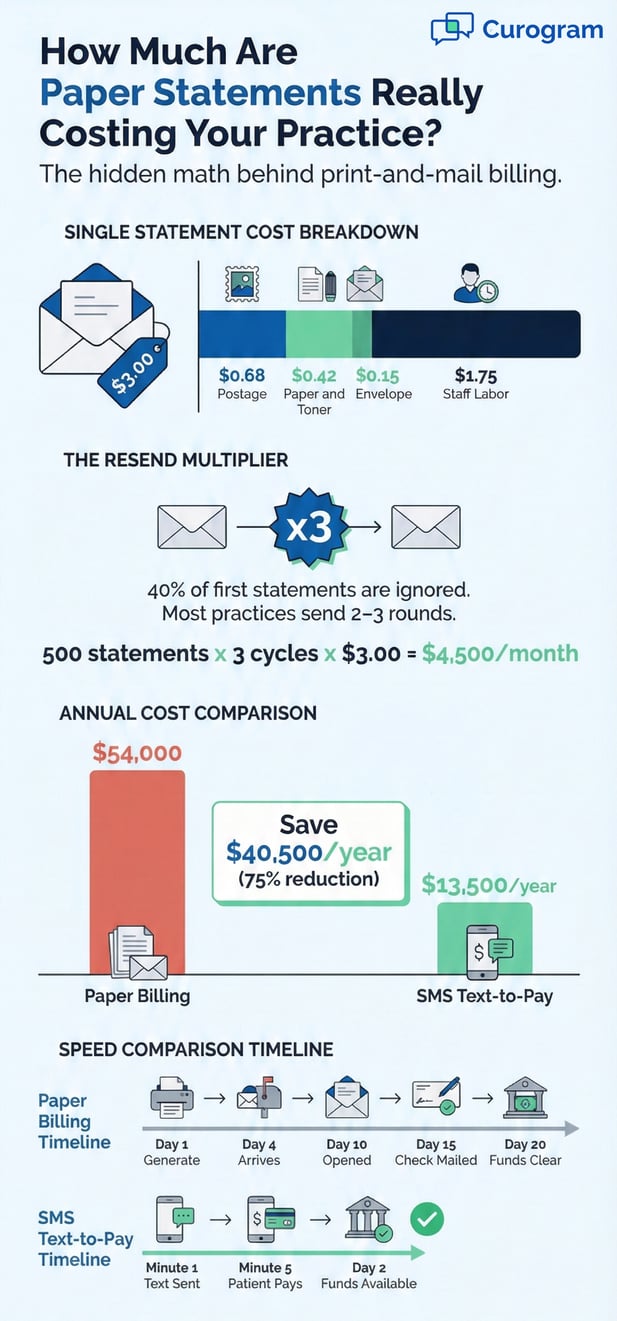
The true cost of generating, printing, and mailing a single patient statement is around $3.00. That covers postage, paper, toner, envelopes, and the staff labor behind every step.
For a practice sending 500 statements a month, that expense alone hits $1,500. Factor in the resend cycles that come when patients ignore the first notice, and that number can triple.
Most office managers never see this total because the costs are spread across different budget lines. Postage sits in one column. Office supplies sit in another.
Staff hours never get tracked against the billing task at all. When you pull everything together, the annual price tag can climb past $50,000 for work that a text message could handle in seconds.
If you want to reduce patient statement costs in your Prime Clinical practice, the answer is not a better envelope or a cheaper stamp. It is removing paper from the equation entirely.
Text-to-pay links let your office send a secure payment request straight to a patient's phone, where it gets opened, read, and paid the same day.
This article breaks down exactly where your billing dollars go, how much time paper wastes compared to SMS, and how Curogram's batch sending feature turns an all-day task into a one-click action. The numbers might surprise you.
Most office managers accept paper billing costs as a normal part of running a medical practice. But when you break the numbers down, the waste becomes hard to ignore.
Understanding the real cost of patient collections starts with looking at every dollar that goes into a single statement.
Every envelope that leaves your office carries a stamp that costs at least $0.68. Add in the price of paper stock, toner, and envelopes, and the materials alone eat into your bottom line.
These are line items that show up on expense reports, yet many practices never tie them back to the billing process.
Soft Costs
The hidden expense is staff time. Someone on your team has to pull the aging report from Prime Clinical, print each statement, fold it, stuff it into an envelope, and apply postage. That labor could be spent on tasks that actually grow the practice.
When you measure Prime Clinical billing efficiency in terms of hours lost, the paper workflow is one of the biggest drains on your front desk team.
The Resend Factor
Here is where the math gets painful. Industry data shows that roughly 40% of first statements are ignored. That means your office sends a second round, and sometimes a third, to the same patients. Each cycle repeats the full $3.00 expense.
Run the simple calculation for a mid-size practice: 500 statements multiplied by 3 billing cycles multiplied by $3.00 each. That adds up to $4,500 every single month going out the door.
Over a year, that is $54,000 spent on paper that often ends up in the recycling bin. Practices looking to eliminate paper statements in a medical practice should start by tallying this number for their own office.

Getting a bill out the door is only half the battle. The other half is getting paid, and that is where paper really falls behind. Mail moves on its own schedule, and patients open envelopes on theirs.
The gap between sending a statement and receiving payment can stretch into weeks, which quietly drains your practice's cash flow. Understanding how that delay affects your bottom line is the first step toward fixing it.
The cost of paper goes beyond stamps and toner. There is also the delay. In billing, time directly affects your accounts receivable aging report. Every extra day a balance sits unpaid is a day your practice operates without that cash.
With paper billing, a statement is generated on Day 1. It arrives in the patient’s mailbox around Day 4. Maybe the patient opens it by Day 10.
If they mail a check, it goes out by Day 15, and the funds finally clear around Day 20. That is nearly three weeks from bill to payment.
SMS billing flips that timeline. The bill is generated on Day 1, and a text with a secure payment link reaches the patient within the same minute. Many patients tap, pay, and finish within five minutes. Funds are available by the next business day.
This is the clearest example of text-to-pay ROI that a practice owner can see without running a complex financial model.
The Prime Clinical Impact
When balances move from the 60-plus day column to current, your aging report looks dramatically healthier. A clean aging report makes it easier to forecast revenue, plan staffing, and reinvest in the practice.
By choosing to accelerate the revenue cycle in Prime Clinical, offices see results almost immediately once they switch to digital billing. The shift from weeks to minutes is the kind of change that shows up on the very first month’s financial summary.
Switching to digital billing only works if the process is actually faster than what you are doing now. Sending individual texts to hundreds of patients would not save anyone time.
The real value comes from a system that connects directly to your practice management software and handles the heavy lifting for you. You can automate balance notifications alongside appointment reminders.
That is exactly what batch sending is designed to do, and it changes the entire billing workflow from a daily chore into a quick, simple task.
The Workflow
One of the biggest myths about digital billing is that it means texting patients one at a time. That would be just as slow as stuffing envelopes. The real power is in batch sending, which lets your team handle hundreds of statements in a single action.
The Tech
Curogram connects with Prime Clinical and pulls balance data directly from your system. Your staff exports a balance report, and the platform reads it automatically. There is no double data entry and no switching between screens.
This level of integration is what drives true Prime Clinical billing efficiency for busy offices that handle a high volume of patient accounts.
From there, your team can filter the list to find all patients with a balance above a set amount, such as $10 or $25. One click on the batch send button fires out secure text-to-pay links to every patient on that list. The billing day becomes the billing minute.
Five hundred secure payment links go out instantly. Patients receive a simple text with a link that opens a mobile-friendly payment page. No app downloads, no portal logins, no confusion.
This process does more than eliminate paper statements for your medical practice. It also cuts the cost of patient collections because fewer follow-up calls and resend cycles are needed.

Paper billing is a habit left over from a time before smartphones existed. It is expensive, slow, and frustrating for both your staff and your patients.
Switching to text-to-pay through Curogram lets your Prime Clinical practice cut statement costs by up to 75%, collect payments days faster, and free your front desk from hours of manual work each week. The text-to-pay ROI speaks for itself when you stack the numbers side by side.
Stop paying the post office to slow down your cash flow.
Audit your billing costs. Calculate Your Savings and see how Curogram Text-to-Pay pays for itself in postage savings alone.
Curogram pulls balance data directly from your Prime Clinical system, so there is no manual data entry. Your staff selects the patients with outstanding balances and sends a batch of secure payment links via text. Patients tap the link, land on a mobile-friendly payment page, and pay in minutes. Funds typically clear by the next business day.
The sticker price of a stamp is only part of the story. Each statement also carries the cost of paper, toner, envelopes, and the staff time needed to print, fold, stuff, and mail it.
When 40% of first statements go ignored, your office repeats that entire process two or three more times. Those resend cycles can push the true cost of patient collections past $50,000 a year.
Most practices notice a drop in printing and postage expenses within the first billing cycle. Because text-to-pay links reach patients instantly, payments come in faster and your accounts receivable aging report improves right away.
Staff hours previously spent on manual mailing are freed up almost immediately. Many offices report a measurable return on investment within 30 days.
Every day a patient balance sits unpaid is a day your practice operates without that revenue. Paper statements can stretch the payment timeline to 20 days or more, which pushes balances into older aging buckets.
Older balances are harder to collect and more expensive to chase. SMS billing compresses that timeline from weeks down to minutes, keeping cash flow steady and predictable.
Batch sending delivers hundreds of payment links at once, so every patient with a balance gets notified on the same day. Text messages have a much higher open rate than paper mail, which means fewer patients miss the bill in the first place.
Built-in tracking lets your staff see who has paid and who has not without making a single phone call. This cuts the cost of patient collections by reducing the repeat work that drives up billing expenses.
💡 Text-to-pay systems help Medstreaming imaging centers improve cash flow by speeding up collections and reducing A/R days. Secure SMS payment...
💡 Text-to-pay technology is changing how behavioral health practices handle billing. For organizations using InSync EMR, adding this payment method...
💡 Text-to-pay integration gives radiology networks a faster way to collect patient balances. When you improve cash flow via Ramsoft text-to-pay...