Text-to-Pay in Veradigm with Curogram
💡 Text-to-pay in Veradigm helps imaging centers collect payments faster and reduce admin work. This mobile payment method sends secure links...
9 min read
Jo Galvez
:
February 12, 2026
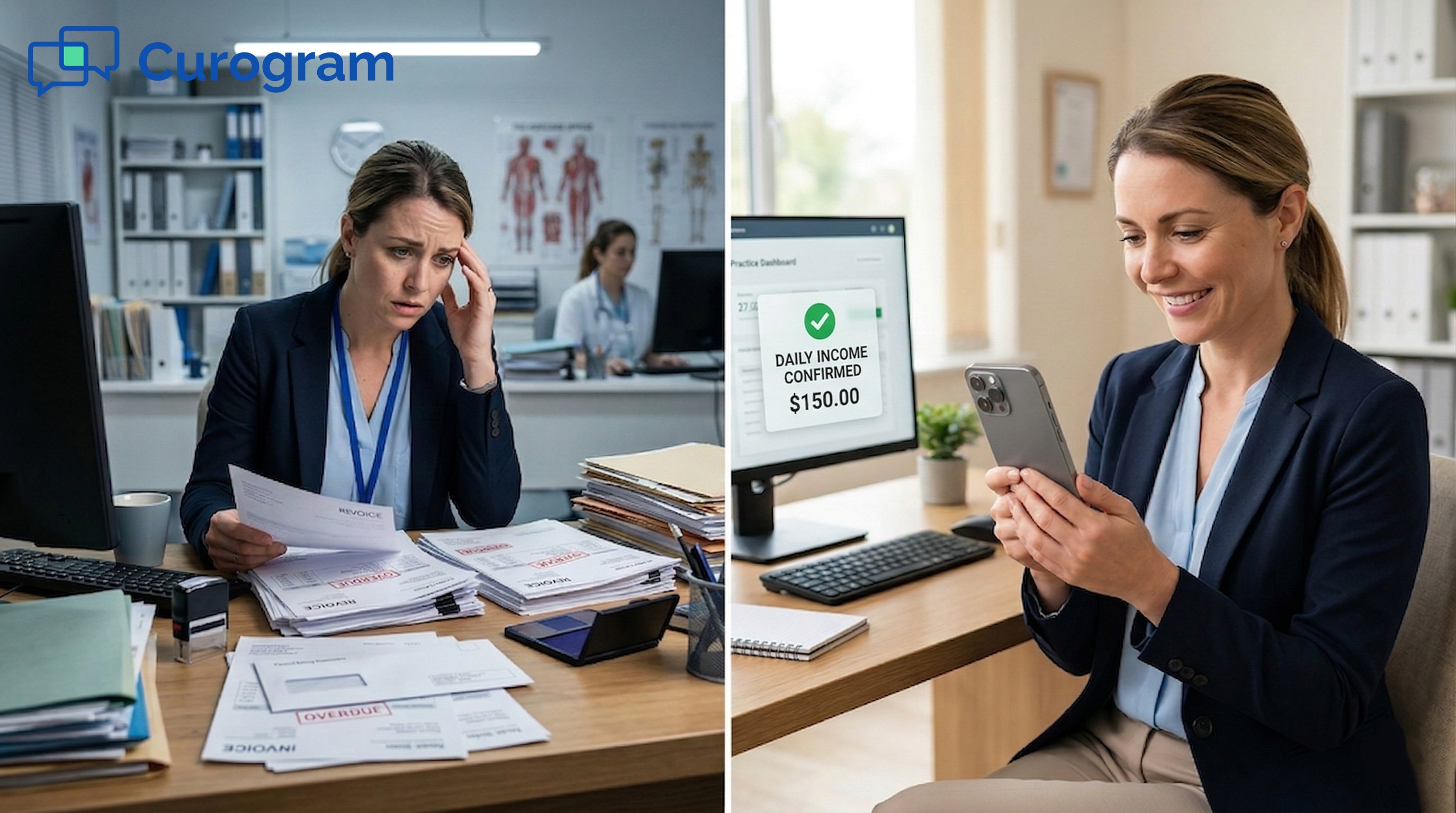
A patient walks up to your front desk. They dig through their bag for a wallet. The card reader jams. A line forms.
When the patient finally says, "Just bill me," your team knows that a $25 copay may never come back.
This scene plays out in clinics every single day. It drains time, patience, and cash. Staff spend hours each week on small-dollar chases that cost more to bill than they are worth. The front desk becomes a toll booth instead of a welcome center.
There is a better way. When you collect patient copays upfront in Prime Clinical, you remove the friction before it starts. Curogram makes this possible by sending a text-to-pay link straight to the patient's phone a full day before the visit.
The patient pays from their couch. When they arrive, your staff simply says, "Thanks, we're all set."
No card swipe. No receipt printer. No awkward ask. This is the zero-touch check-in, and it is changing how modern practices handle money at the door.
In this article, we will walk through why the old way of collecting at the front desk bleeds revenue. Then we will show you how moving payment upstream with Curogram and Prime Clinical stops the leak.
You will also learn how features like card on file create an experience patients actually enjoy. If your practice wants to reduce bad debt and save time at every visit, keep reading.
The front desk is the first place a patient meets your practice. It should feel calm and welcoming. But for many clinics, it has turned into a slow-moving payment counter. That friction costs your team time and your practice real money.
Think about what happens when a patient arrives. Staff greet them, pull up their chart, and then ask for a copay. This is where the trouble starts.
The patient opens a purse or digs through pockets. They hand over a card. The reader takes its time, or worse, it fails.
Staff try again. The patient behind them shifts on their feet. One slow payment can hold up your lobby for five minutes or more.
Multiply that by 20 or 30 patients a day. Your front desk team is now stuck playing cashier instead of doing the work that keeps the clinic running. Phone calls go to voicemail. Intake forms pile up. The ripple effect is real.
Then there is the patient who shows up without a way to pay. They ask to be billed later. Your staff, not wanting a scene, agrees.
That $25 copay just entered a black hole. Each time this happens, your practice absorbs the loss quietly.
It sounds small. But stack these losses across a week, a month, a year. The total is anything but small.
The Leakage
When a patient leaves without paying, the clock starts ticking against you. The odds of collecting that balance drop fast.
It costs about $3.00 to print, stuff, and mail a single statement. For a $25 copay, that is already 12% of the balance gone before the patient even opens the envelope. If the first statement does not work, you send another. And another.
The chance of collecting may drop by about 20% every week that passes after the visit. By week four, nearly half the balance is at risk. The return on effort shrinks to almost nothing.
It is easy to brush off a $25 or $30 balance. But when hundreds of patients owe these small amounts, the total climbs fast. Many practices carry tens of thousands of dollars in aging small-balance debt that they will never see.
This is the real trap of "bill me later." It is not one lost copay. It is a pattern that quietly chips away at your bottom line every single month.
The Bad Debt
Small balances under $50 make up a huge share of write-offs in medical practices. These amounts are too small to justify the cost of continued billing, but too many to ignore.
When the cost to collect is higher than the balance itself, most offices just write it off. They mark it as a loss and move on. Over time, this habit creates a growing pile of revenue that your practice earned but never received.
To reduce bad debt in your medical practice, you need to stop the leak at the source. That means collecting before the visit, not after.
Staff who spend their days calling patients about unpaid balances burn out quickly. It is not the work they signed up for. When your team is stuck chasing money, they have less energy for patient care and daily tasks that keep the office healthy.
The bill-me-later trap hurts more than your bank account. It wears down your people.

The fix is not to chase harder. It is to collect bills sooner. When you move the payment step to before the visit, you avoid the front desk mess entirely. Curogram makes this shift simple for practices that run on Prime Clinical.
Hotels figured this out a long time ago. They take your card before they hand you the room key. No one thinks twice about it. Medical practices should follow the same logic.
When a patient agrees to an appointment, they expect to pay a copay. There is no surprise involved.
Asking them to pay ahead of time simply moves the step to a more convenient moment. Most patients prefer it because it means less waiting when they arrive.
The hotel model works because it sets clear terms early. Patients know what they owe. They handle it on their own time. And when they walk through your door, there is nothing left to settle.
Patients already pay for food, rides, and shopping from their phones. A copay should be no different. By offering pre-visit payment links, your practice meets patients where they already are.
This is not about being pushy. It is about being modern.
The Workflow
Here is how the process works when Curogram is paired with Prime Clinical.
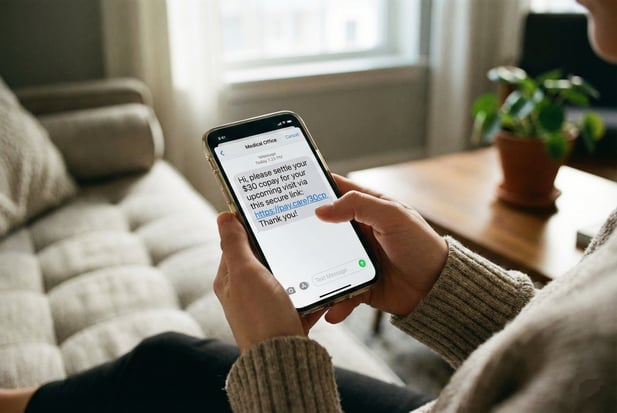
About 24 hours before the visit, Curogram sends a text alongside the appointment reminder. The message is simple and clear: "Hi [Name], your copay for tomorrow is $30. Click here to pay now and skip the line."
These automated copay reminders do the work so your staff does not have to.
The timing matters. A day before the visit, the appointment is still fresh in the patient's mind. They are far more likely to act than if you reach out a week early.
The patient taps the link, enters their card info, and pays in under a minute. They can do it from their couch, their car, or their lunch break. No call. No login. No portal password to remember.
When they arrive at your office the next day, the front desk checks them in with a smile. That is the contactless check-in experience that Prime Clinical practices are building with Curogram.
Once the patient pays, the magic happens behind the scenes. Curogram logs the payment directly into the Prime Clinical system.
The receipt is sent to the patient by email. There is no need to print anything at the front desk. This saves supplies, cuts clutter, and keeps the workflow digital from start to finish.
For practices that want to go fully paperless, pairing copay collection with digital intake forms creates a seamless pre-visit process. Patients fill out their forms and pay their copay in the same text thread.
Because the payment syncs with Prime Clinical Intellect, your billing team sees the status in real time. There is no need to reconcile at the end of the day. Every copay is tracked, time-stamped, and tied to the right patient and visit.
This level of Prime Clinical point-of-service collections keeps your books clean and your team focused on care, not cash.
Collecting the copay before the visit is a huge win. But what happens after the insurance company processes the claim? What about the balance that shows up weeks later? This is where card on file takes things to the next level.
The Tech Behind Card on File
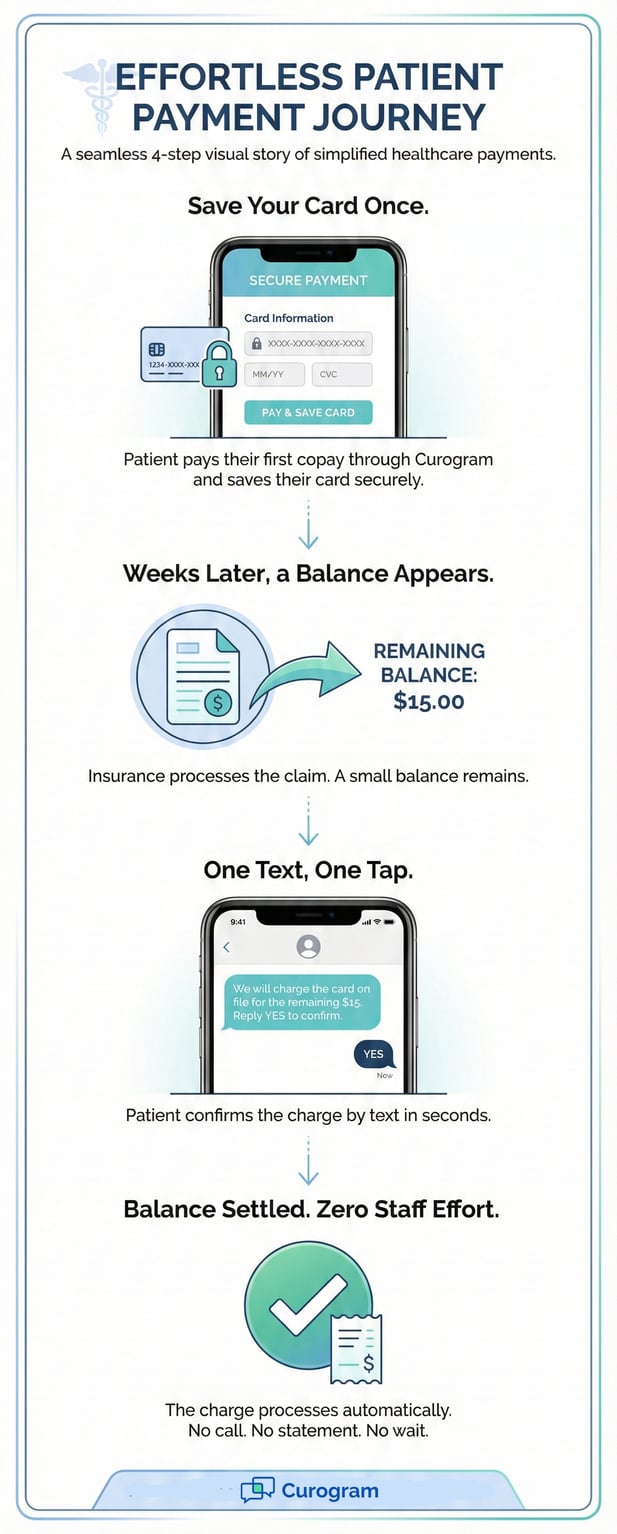
When a patient pays through Curogram for the first time, the system gives them the option to save their card. This is not about storing raw card numbers on a local server. The process is fully secure and built for healthcare.
Curogram uses a PCI-compliant payment gateway to tokenize the card. That means the actual card number is replaced with a random string of characters. Even if someone gained access to your system, they would not be able to use the token to make a purchase.
This method is the same one used by major retailers and online platforms. It is the gold standard for secure card storage. Patients can feel safe knowing their data is handled with the same care they expect from any trusted brand.
The patient only needs to enter their card details once. From that point forward, every future copay or balance can be handled through a simple text. No repeated data entry. No asking for the same card at every visit.
This one small step at the start saves both the patient and the practice a huge amount of time over the life of the relationship.
Copays are just the beginning. The real power of card on file shows up after the insurance claim is processed.
Let's say a patient paid a $30 copay before the visit. After the claim goes through, the insurance company says the patient actually owes $45 because of their deductible. That leaves a $15 balance.
Without a card on file, your team would have to call or send a statement. With the card on file, Curogram sends a simple text: "We will charge the card on file for the remaining $15. Reply YES to confirm."
The patient replies, the charge goes through, and the balance is closed. No call. No mail. No wait.
When balances are settled within days instead of weeks or months, your cash flow stays healthy. You spend less on statements and follow-up calls.
Your accounts receivable stays lean. And your billing staff can focus on the claims that truly need attention.
This is how practices reduce bad debt at the medical practice level. Not by chasing harder, but by making payment so easy that patients handle it in seconds.
Patients today expect speed and ease. They order food with one tap. They pay for rides without pulling out their wallet. Healthcare should feel the same way.
When your practice stores a card on file and uses text-based payments, you create a checkout flow that feels like online shopping. It is smooth, fast, and familiar. Patients do not need to learn a new portal or remember a password.
This kind of experience builds loyalty. Patients who find it easy to pay are more likely to stay with your practice. They are also less likely to leave a negative review over a billing headache.
Every charge is sent by text with a clear breakdown. The patient always knows what they owe and why. They approve the charge before it goes through. There are no surprise bills and no hidden fees.
This level of openness is what patients want. It shows that your practice respects their time and their money.
When you pair this with the contactless check-in that Prime Clinical and Curogram deliver, you create a front-to-back experience that feels right.
Card on file is not just a payment tool. It is a trust builder that turns a one-time patient into a long-term one.

The best time to collect is when the patient is most engaged. That moment is right before care is delivered, not weeks after.
When a patient books a visit, they expect to pay. They know a copay is part of the deal. By sending a text-to-pay link 24 hours ahead, you meet that expectation at the right moment. The patient takes care of it on their own time. No friction. No follow-up.
This approach flips the old model on its head. Instead of acting like a bank that extends credit for $25, your practice collects what is owed when it is owed. You stop giving interest-free loans to patients who simply forgot their wallets.
Curogram makes this shift easy for every practice running Prime Clinical. The pre-visit payment links go out with the reminders. The payments sync into the system.
The card stays on file for any future balance. Every step is handled by text, which means no extra work for your front desk.
The numbers speak for themselves. Practices that collect patient copays upfront in Prime Clinical see fewer write-offs, faster revenue cycles, and more time for staff to focus on patient care. Check-in times drop. Patient satisfaction rises. Bad debt shrinks.
Your front desk should be a welcome center, not a toll booth.
Modernize your front desk. Watch the Workflow to see how Curogram automates copay collections for Prime Clinical users.
Curogram sends a text message to the patient about 24 hours before the visit. The text includes a secure payment link along with the copay amount.
The patient taps the link, enters their card info, and pays in under a minute. The payment is logged into Prime Clinical right away.
Collecting before the visit removes the front desk bottleneck and speeds up check-in. It also cuts the risk of patients leaving without paying.
Data shows that the chance of collecting drops by about 20% each week after the visit. Pre-visit collection keeps your revenue secure from the start.
When a patient pays through Curogram, they can choose to save their card securely using a PCI-compliant gateway. The card number is replaced with a token, so it is never stored in raw form.
For future visits or post-visit balances, the practice sends a text asking the patient to confirm the charge. The patient replies YES, and the balance is settled.
Small balances under $50 are often too costly to chase through mail or phone. When you collect before the visit, those balances never enter your aging report.
This removes the cycle of sending statements that cost more than the amount owed. Over time, it leads to far fewer write-offs.
Patients like it because it saves time and removes hassle at the front desk. They pay from their phone before they arrive, so there is no digging for cards or waiting in line.
It feels like the same fast, easy payment they use for shopping and food delivery. This modern approach builds trust and improves the overall visit.
💡 Text-to-pay in Veradigm helps imaging centers collect payments faster and reduce admin work. This mobile payment method sends secure links...
💡 Patient payments for Osmind can be faster and simpler with secure text-to-pay tools. Curogram lets mental health clinics send one-click payment...
💡 Clinics using Osmind EMR can boost their Osmind EMR ROI for patient payments by switching from paper billing to secure SMS payment links....