
Eliminating the Scanner Bottleneck in Prime Clinical
💡 Practices that want to eliminate scanning medical records in Prime Clinical can do so by switching to digital intake forms. Curogram replaces...

9 min read
Jo Galvez
:
February 9, 2026
A single wrong digit can cost your practice weeks of lost revenue. It sounds extreme, but it happens every day in medical offices that still rely on paper forms and manual data entry.
When a front desk team member misreads a "7" as a "1" on a patient's insurance card, that claim gets rejected before anyone even notices the mistake.
This is the reality for practices that use Prime Clinical Intellect as their EMR. The system is built for precision. It expects clean, exact data in every field, from member IDs to dates of birth.
But when humans retype that data from handwritten forms, errors slip in. Those errors travel downstream into billing, and that is where the real damage begins.
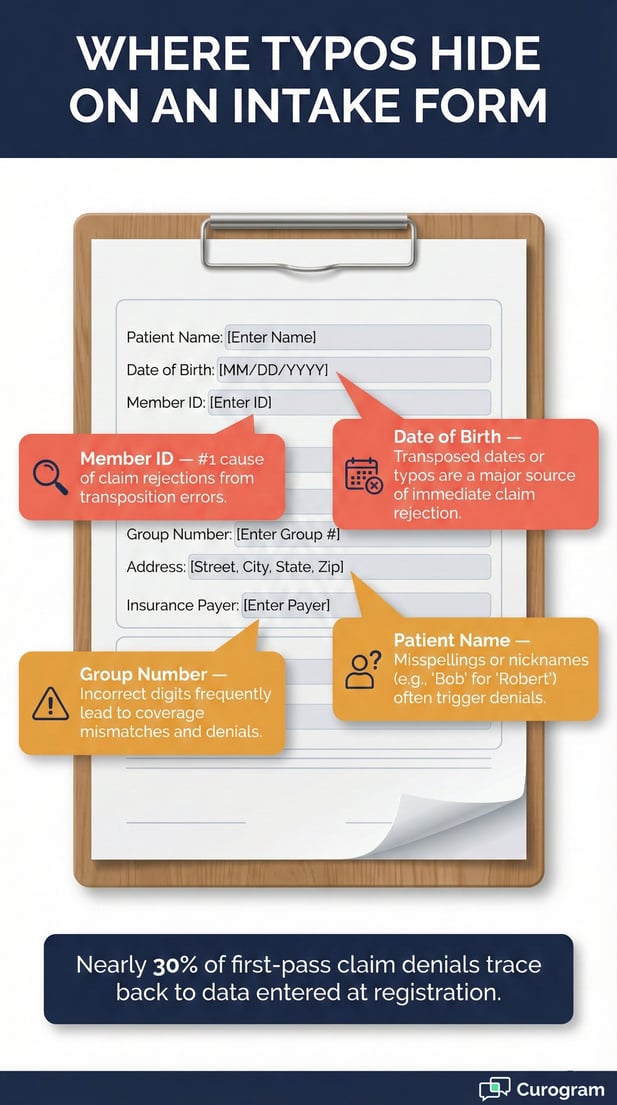
Claim denials due to typos are one of the most common and preventable problems in medical billing. Studies show that roughly 30% of initial claim denials stem from bad data entered at the front desk. Each denied claim triggers a costly rework loop that eats into staff time, delays payment, and frustrates everyone involved.
The good news is that you can reduce data entry errors in Prime Clinical Intellect without adding more staff or slowing down your workflow. The fix is simple: eliminate manual transcription from medical records and let patients enter their own information through digital forms.
When patient-typed data maps straight into your EMR, you remove the human error that causes most denials.
In this article, we will walk through the true cost of dirty data, show you how to shift the data entry burden to the patient, and explain how automated insurance capture works inside your Prime Clinical setup.
By the end, you will have a clear path to cleaner claims, faster payment, and a billing team that spends less time chasing preventable mistakes.
Every claim starts with data. If that data is wrong, the claim fails. It does not matter how skilled your billing team is or how well you code your procedures.
A single typo at the front desk can undo all of that work in an instant. For practices running Prime Clinical, this problem hits hard because the system depends on exact field values to process claims.
You have heard the saying: garbage in, garbage out. In medical billing, that phrase is not just a cliche. It is a daily reality. When bad data enters the system at intake, it poisons everything that follows.
Why Prime Clinical Demands Precision
Prime Clinical is a precise database. Every field connects to a downstream process. When a staff member enters a Member ID, that number must match the payer's records exactly.
A date of birth must be correct to the day. Even the patient's name has to match what the insurance company has on file.
The system does not guess. It does not auto-correct. If the data does not match, the claim is dead on arrival. This is not a flaw in the software.
It is how payer systems work. They verify data against their own records, and any mismatch triggers a denial.
Where Errors Start
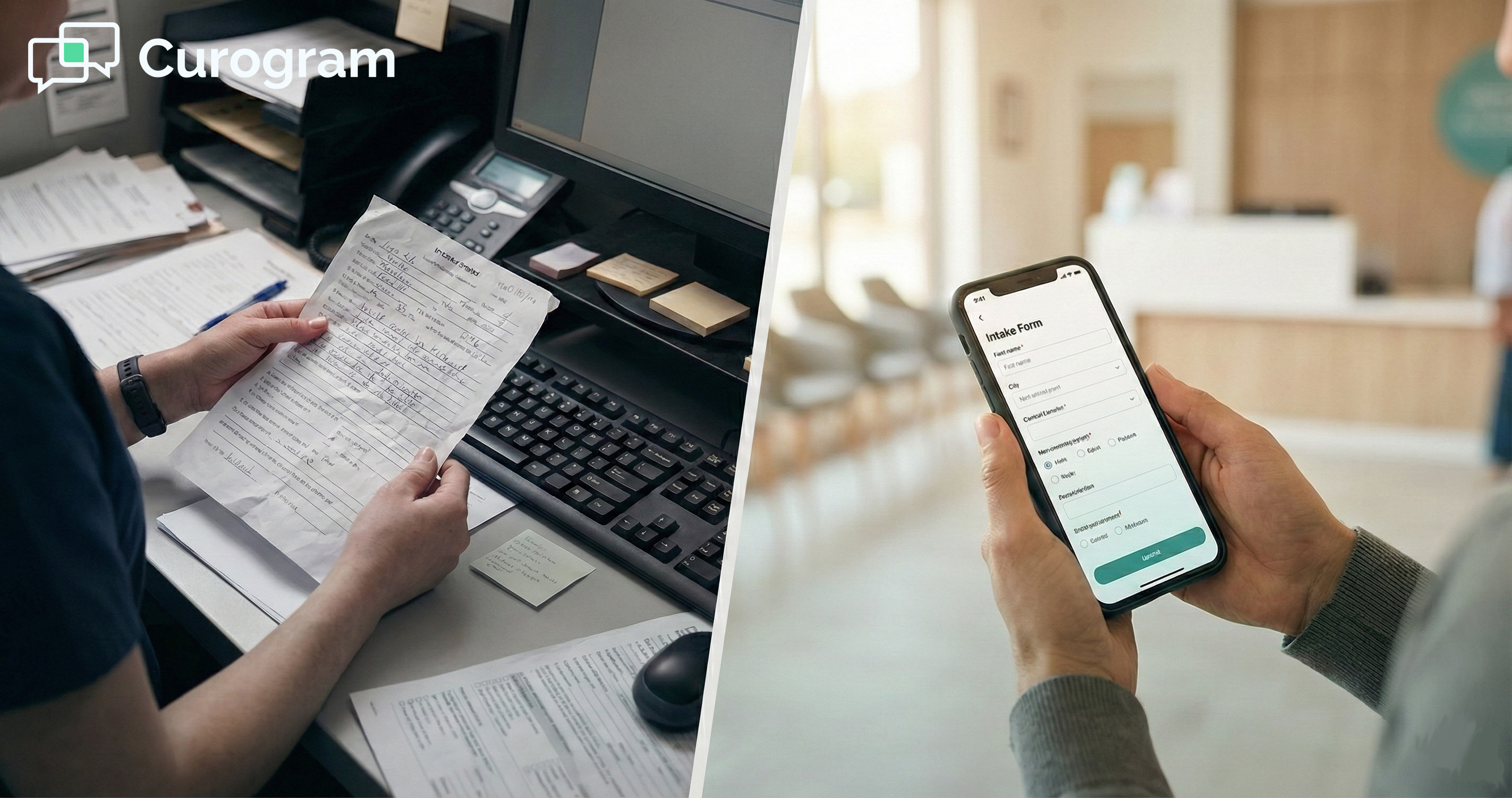
Most errors begin with paper. A patient fills out a form by hand. Their "7" looks like a "1." Their last name is hard to read. A staff member does their best to decode the writing and types it into the system. That single moment of guessing is where Prime Clinical EMR data integrity breaks down.
It is not that the staff are careless. They are rushed, handling dozens of patients a day. When you rely on humans to eliminate manual transcription from medical records by retyping every detail, mistakes are built into the process.
The Rework Loop
A denied claim does not just disappear. It kicks off a chain of tasks that drains time and money from your team. Here is what that cycle looks like in practice.
When a claim is denied for a data error, the work does not end. It multiplies. First, a billing team member has to research the denial to find what went wrong. This alone takes an average of 20 minutes per claim.
Then the front desk has to call the patient. They need the correct ID number, the right spelling, or the accurate date of birth. The patient may not answer. They may need to dig out their insurance card again. Days pass before the fix comes through.
Once the data is corrected, the claim gets resubmitted. But now it is weeks behind where it should be.
The practice has already spent staff time, phone time, and billing hours on a claim that should have gone through the first time.
Multiply that by dozens or hundreds of claims per month, and you start to see the true cost. This rework loop runs in the background of every practice that still relies on manual intake.
The Financial Impact
The dollar cost of dirty data is staggering when you add it all up. Most practices never calculate this number, which is exactly why the problem persists.
Industry data shows that reworking a denied claim costs between $25 and $118 per claim. That range depends on the complexity of the error and how many staff members get involved in fixing it. For a practice that processes hundreds of claims each week, this adds up fast.
A high-volume practice could lose tens of thousands of dollars each year to claim denials due to typos alone. That money does not show up as a line item on a budget. It hides in staff overtime, delayed deposits, and write-offs that no one tracks.
Beyond the dollar amount, there is a morale cost. Billing staff who spend their days fixing the same kinds of errors get frustrated. Front desk teams feel blamed for mistakes that are really a process problem, not a people problem.
The truth is that dirty data is a system failure, not a staff failure. When you fix the process, you fix the outcome.

The most effective way to reduce data entry errors in Prime Clinical Intellect is to change who does the typing. Instead of asking your staff to decode handwriting and retype details, you let the patient enter their own data. They know their name, their address, and their insurance ID better than anyone.
Rethinking who types the data is a small change with a huge payoff. It removes the riskiest step in the whole intake chain.
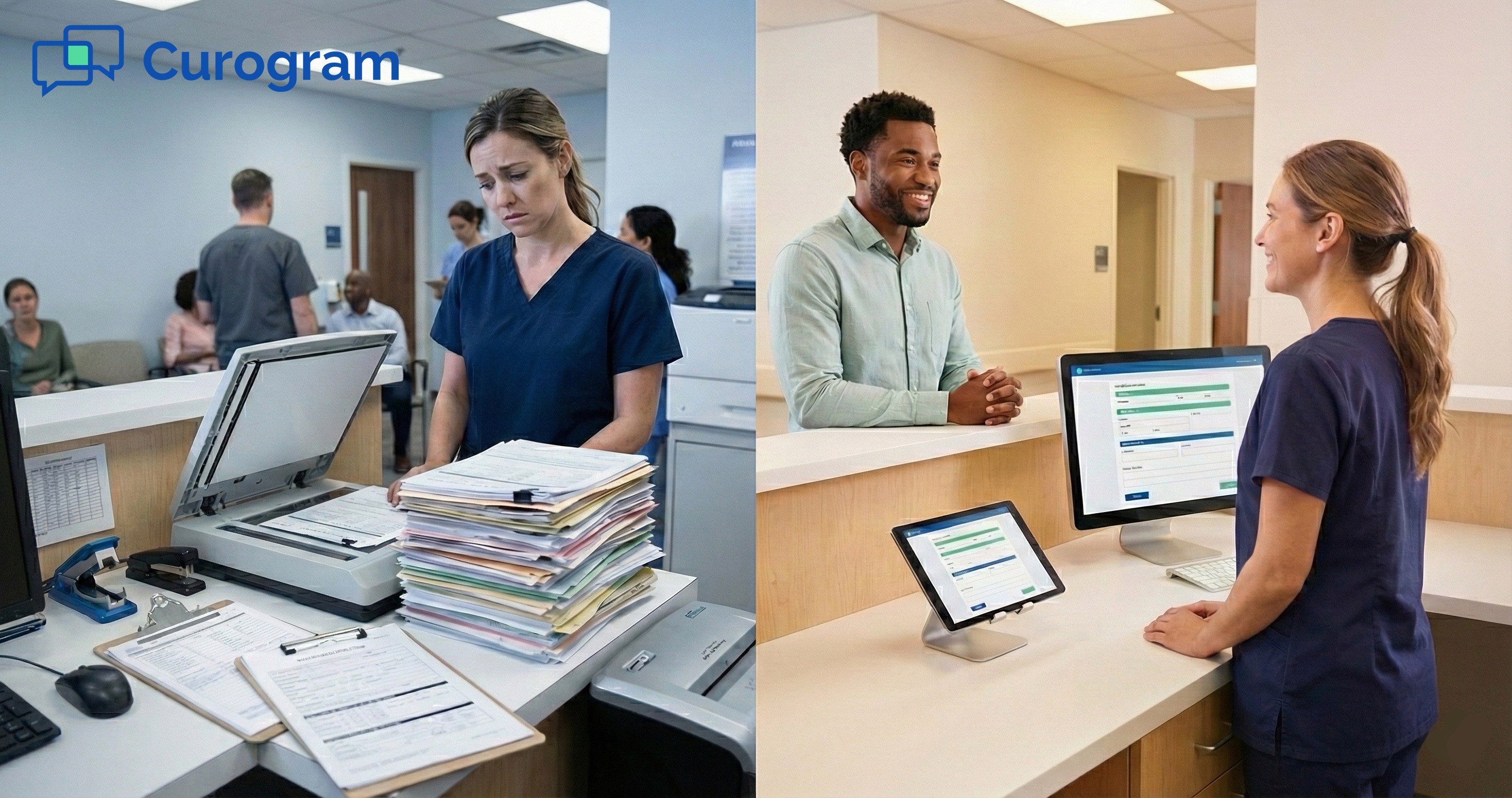
In a traditional workflow, your front desk staff are data entry clerks. They take a paper form, squint at the handwriting, and type everything into Prime Clinical. Each keystroke is a chance for error. Each error is a potential denied claim.
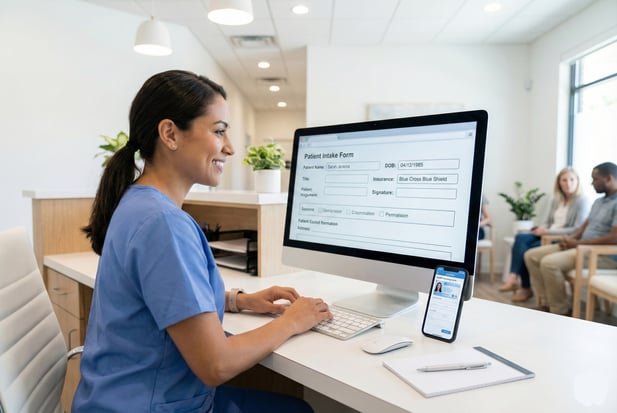
With digital intake, you flip that model. The patient types their own details on their phone before they even walk through the door. Your staff member then reviews the data on screen and clicks to approve. The human role changes from typist to validator.
Patients type their own information every day. They fill out online orders, bank forms, and app sign-ups. They know how to spell their name. They know their date of birth. Asking them to type it once on a form is not a burden. It is the most natural thing in the world.
This simple shift removes the biggest source of error in the whole process. No more misread handwriting. No more guessing at numbers. The data the patient types is the data the system receives.
Technology makes this shift possible. When the right tools connect the patient's phone to your EMR, data moves without any human retyping in between.
When a patient fills out a Curogram form on their phone, something important happens behind the scenes. The exact data string they type is what lands in Prime Clinical. There is no middle step. No one retypes it. No one copies it from a screen to a form.
This is what we call the digital handshake. The patient's device talks to the EMR, and the data transfers without any human touch. This is how you protect clean intake data in Prime Clinical from start to finish.
Curogram's forms are built to map each field to its matching field in Prime Clinical. The patient's first name goes into the first name field. The Member ID goes into the Member ID field. There is no room for mix-ups or misplaced data.
This direct mapping is the backbone of the whole approach. It ensures that what the patient types is exactly what the chart receives. That precision is what leads to clean claims and fewer denials.
Even with digital intake, you still want a human check before data hits the chart. The difference is that your staff are reviewing, not retyping.
Your staff still play a key role. Before the data syncs to the chart, a team member reviews it on screen. They check for obvious issues, like a blank field or an ID that looks too short. Then they click to approve and sync the data.
This step keeps a human in the loop without relying on that human to do the heavy lifting. The patient did the data entry. The staff member just confirms it looks right.
This workflow cuts error rates in a big way. When you compare typed-by-patient data to retyped-by-staff data, the difference is clear. Staff no longer carry the weight of manual input for every single patient.
The front desk team can focus on patient care, check-in flow, and scheduling instead of squinting at messy handwriting. That is a better use of their time and a better experience for everyone.
Insurance details are the most error-prone data in any intake workflow. Member IDs are long strings of numbers and letters that are easy to mistype.
Group numbers, plan codes, and payer names all have to match the payer's records exactly. This section covers how automated insurance capture takes the risk out of this step.
The Workflow: Snap, Attach, Verify
The old way of handling insurance cards involved photocopies, squinting, and manual typing. The new way takes seconds and removes every retyping step.
During the mobile intake process, the patient gets a prompt to take a photo of their insurance card. They snap a picture of the front and back using their phone's camera. That image uploads as part of the form and attaches to the patient's record in Prime Clinical.
There is no need to photocopy the card at the desk. No need to hand it to a staff member who then types the numbers into the system. The image itself becomes the source of truth.
When the form syncs, the insurance card image shows up in the patient's chart. Staff can pull it up and compare it against the data the patient entered. If the Member ID on the card matches the Member ID in the field, they approve it.
This visual check is fast and reliable. It takes seconds instead of the minutes it would take to type the data from scratch. And because the image is stored in the chart, anyone on the team can refer back to it at any time.
The Prime Clinical Benefit
Having the card image inside the chart changes how your team handles insurance data. It turns a slow, error-prone task into a quick visual check.
With the card image right in the chart, your billing team can verify insurance details before the claim ever goes out. They do not have to call the patient. They do not have to hunt for a photocopy. The data is right there, attached to the record.
This means fewer surprises at claim time. If something looks off, your team catches it before it becomes a denial. That proactive check is the difference between a clean claim and a rework cycle.
The biggest win here is the removal of transposition errors. When no one retypes the insurance ID, no one can swap two digits by accident. The patient typed the number. The image confirms it. The field holds it. End of story.
This alone can cut a large chunk of claim denials due to typos in your practice. For offices that process a high volume of claims, the time and money saved adds up quickly.

Fixing your intake process is not just a front desk project. It is a billing project. Every piece of data that enters Prime Clinical cleanly is one less problem for your billing team to chase down later.
Clean data at the start means clean claims at the end. That simple idea drives every change we have covered in this article.
When patients type their own data and that data maps straight into your EMR, you cut out the step where most errors happen. No more decoding handwriting. No more retyping. Just clean data flowing into clean claims.
This is how modern practices protect their revenue cycle. They do not ask staff to work harder. They built a process that makes errors nearly impossible.
Every dollar you spend reworking a denied claim is a dollar you should not have had to spend. Every hour a billing team member spends on the phone correcting a typo is an hour they could have spent on higher-value work.
Digital intake through Curogram gives you a way to stop that cycle. It is not about saving paper. It is about saving the claim.
Secure your data integrity. Schedule a Demo to see how Curogram eliminates transcription errors for Prime Clinical users.
Digital intake lets patients type their own details on their phone. That data maps straight into Prime Clinical fields without any retyping. This removes the manual step where most keystroke errors happen. The result is cleaner records and fewer denied claims.
Each denied claim triggers a rework loop that involves billing research, patient callbacks, and claim resubmission. Industry data puts the cost of reworking one denied claim between $25 and $118. For high-volume practices, those costs add up to tens of thousands per year.
During mobile intake, the patient snaps a photo of their insurance card. That image attaches directly to their record in Prime Clinical. Staff can then verify the data on screen without retyping any numbers, which removes transposition errors on Member IDs and group codes.
Patients know their own information best. When they type it directly into a digital form, there is no handwriting to misread and no manual transcription needed. Staff review and approve the data rather than retyping it, which keeps the records accurate from the start.
Paper forms create a chain of error. The patient writes by hand, staff decode the writing, and then retype it into the system. Each step adds risk. Digital forms skip the middle steps and send the patient's typed data straight to the EMR, which keeps the data clean.
💡 Practices that want to eliminate scanning medical records in Prime Clinical can do so by switching to digital intake forms. Curogram replaces...
💡 Digital intake workflow, along with Veradigm solutions, helps imaging centers eliminate delays and errors from paper-based processes. Patients...
💡 Digital intake in Exa reduces errors, shortens waits, and prepares patients before visits. Online also allow staff to focus on patient care...