7 min read
Google Reviews for Ketamine Clinics | Building Patient Trust
Aubreigh Lee Daculug
:
June 5, 2026
Curogram, working alongside Osmind, texts every patient after a visit and guides happy ones to leave a Google review.
One practice earned 1,064 new 5-star reviews in 3 months, with 90% of surveyed patients leaving 5 stars.
More reviews build stronger trust signals, lift your local ranking, and fill more consultation slots — with no ad spend.
A patient with treatment-resistant depression has spent three weeks working up the courage. They've read the studies. They've watched the testimonials. Today, they finally type four words into their phone: "ketamine clinic near me."
Two clinics show up. Yours has 14 reviews. The one across town has 240.
They never call you. Not because your care is worse. Because your proof is thinner.
This is the quiet problem inside interventional psychiatry. Your treatments work. Your outcome scores prove it. But the patient deciding where to book can't see any of that.
They can only see your Google reviews — and for novel treatments that still carry stigma, a short list of reviews simply isn't enough to ease their fear.
Here's the answer most practices miss: Google reviews for ketamine clinics building patient trust in Osmind practices solve the single biggest barrier to growth — the gap between "I'm interested in ketamine therapy" and "I'm ready to book here."
For someone weighing ketamine infusions, TMS, or Spravato, your review profile is the main trust signal. It decides whether curiosity turns into a consultation.
A handful of reviews leaves them guessing. Hundreds of authentic, recent reviews tell them other people like them felt safe, were treated well, and got better. Same treatment, very different outcome for your practice.
That's where Curogram comes in. Working alongside your Osmind workflow, it automatically asks every satisfied patient for a review by text — no app, no portal, no extra work for your staff. One practice using this approach generated 1,064 new 5-star reviews in just 3 months.
Review volume isn't vanity. For interventional psychiatry, it's the trust signal that fills your chairs.
The Hidden Gap Between Your Results and Your Reputation
Osmind powers excellent clinical work. Your protocols are sound. Your TMS patients improve. Your data shows it.
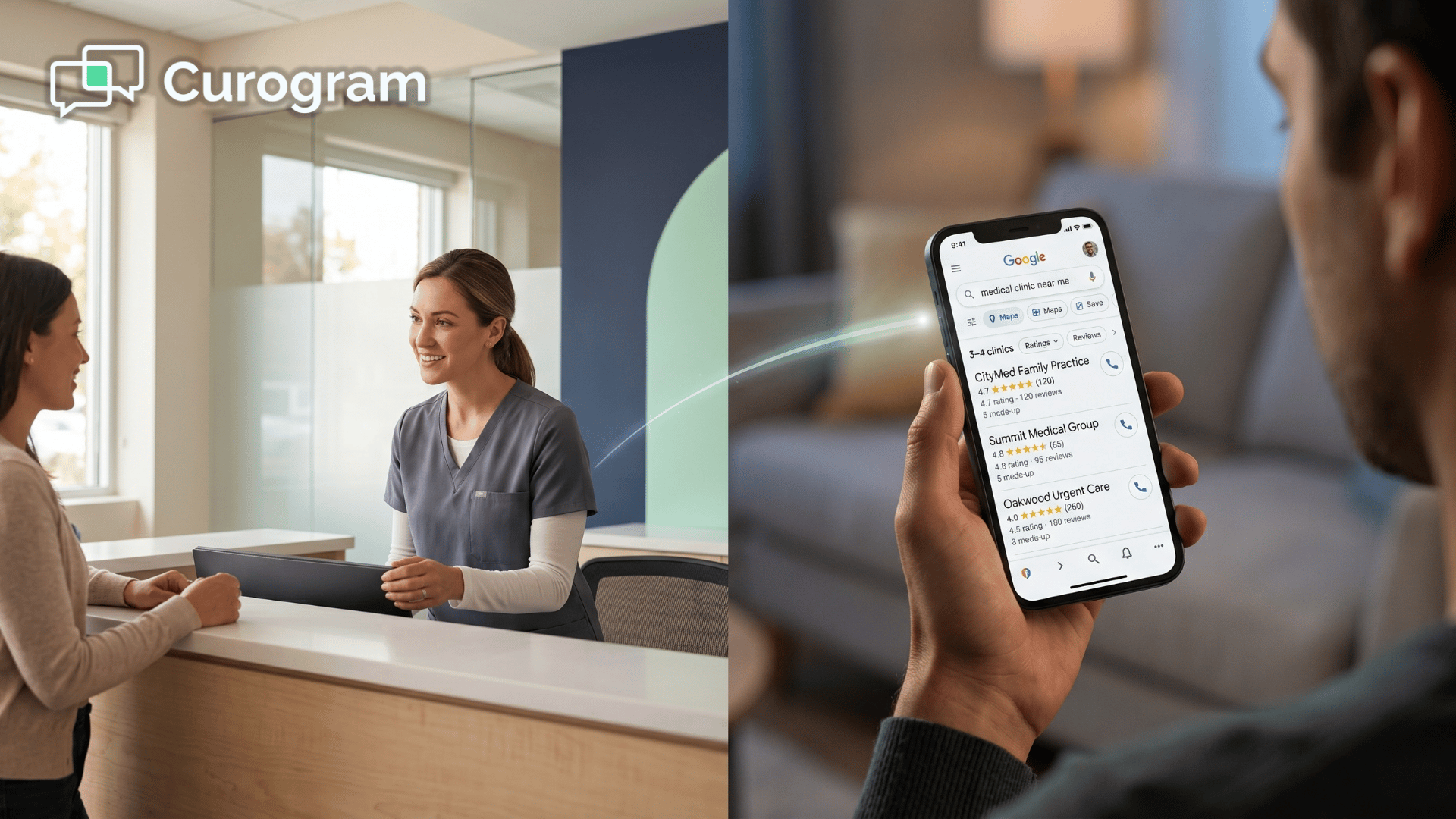
But your prospective patients can't see your Osmind dashboard. They see your Google Business Profile. And when your profile shows 15 reviews next to a competitor's 200-plus, all that clinical excellence becomes invisible to the one person who matters most — the patient choosing where to book.
The decision happens before they ever reach your website
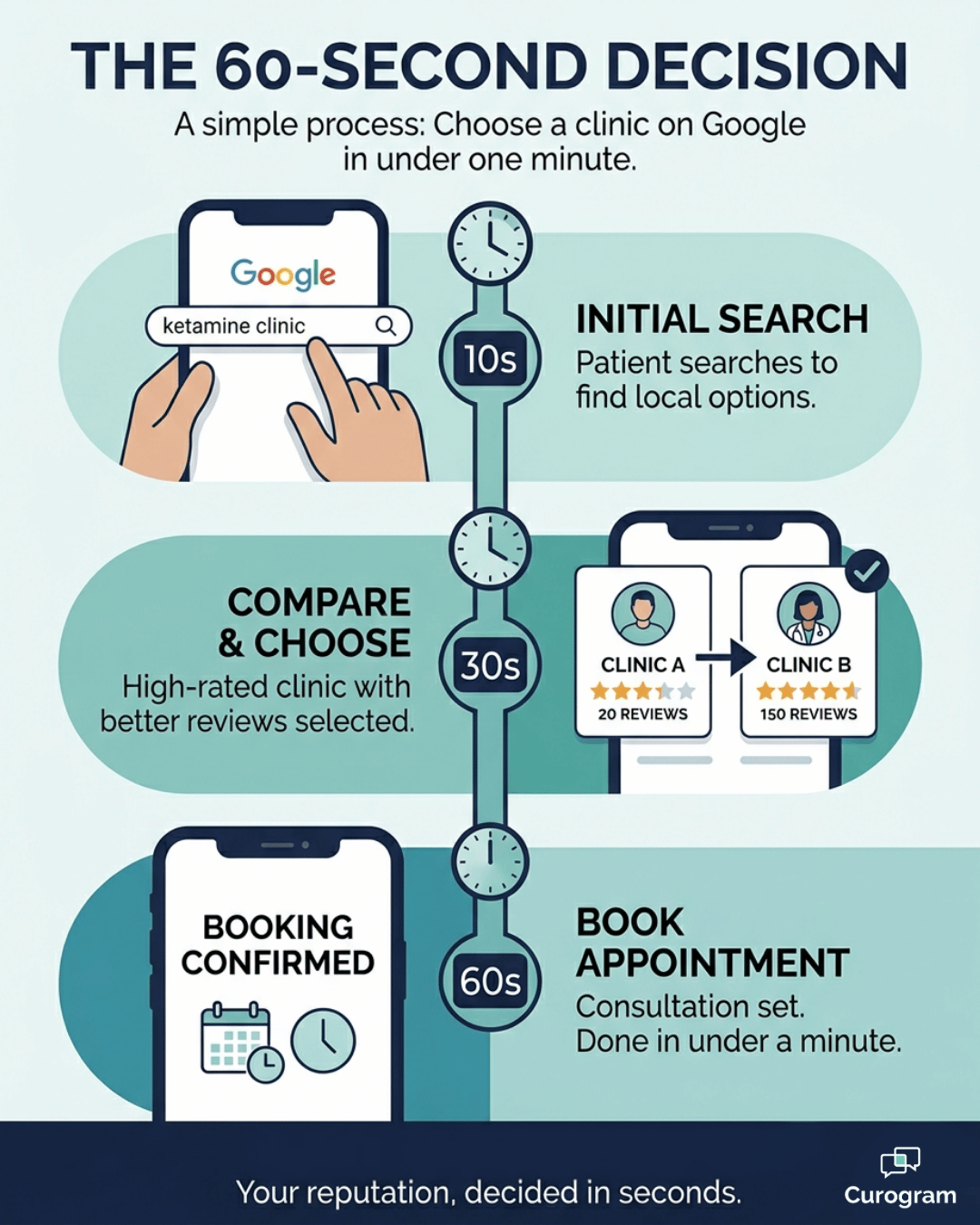
Most of that decision plays out on a single search results page, in under a minute. Here's a simple example to make it concrete.
| What happens | The number |
|---|---|
| People searching "ketamine clinic near me" in your area each month | 200 |
| Share who check your Google Business Profile before your site (90%) | 180 |
| Your reviews vs. the clinic across town | 14 vs. 240 |
So 180 people form an opinion of you based mostly on review count and rating — and most of them never click through. This means your busiest "salesperson" is a profile you're barely tending.
Novel treatments raise the bar even higher
For interventional psychiatry, the stakes climb. These patients are already fighting internal resistance to try something new, so they need overwhelming proof that people like them had a good experience.
A sparse profile can't give them that.
Your online reputation around ketamine treatment is exactly where that trust is won or lost. For TMS clinics especially, review volume creates the trust signals that turn a quiet search into a booked appointment.
~993 |
| Where one multi-location practice started — a review count that quietly blended into the background of local search. |
The hard part? Your best stories already exist.
They live in grateful text messages, in your outcome scores, in private notes. They just don't live where new patients are looking — and that gap between your real reputation and your public one is costing you patients every single day.

Turning Quiet Satisfaction Into Public Proof
You don't have a satisfaction problem. You have a visibility problem. The trust between you and your patients is already there — it's just not on Google yet. Curogram closes that gap by turning every completed appointment into a chance to capture the trust that already exists.
How the review request actually works
The flow is built to be effortless for the patient and invisible to your staff:
- After a visit, the patient gets a short, friendly text survey.
- Patients who report a positive experience get a one-tap link to your Google Business Profile.
- Patients who report a problem get a private feedback channel, so you can make it right.
That last point matters. The system surveys everyone equally and routes feedback fairly — it never hides unhappy voices. That's the difference between authentic reputation building and the kind of review gating Google punishes.
90% |
| Of surveyed patients left a 5-star rating when the request reached them at the right moment — proof that asking well produces quality, not just quantity. |
Why text beats every other channel
Because there's no app to download and no portal to log into. The patient taps once while the good feeling is still fresh. Simplicity is the whole reason reviews actually get left.
It all flows alongside your Osmind appointment workflow, too.
As patients finish their ketamine sessions, TMS visits, or Spravato administrations, the follow-up happens on its own. Your front desk doesn't lift a finger.

Built for the way hesitant patients think
This fit is especially strong for your field. Social proof for novel psychiatric treatments matters more, not less.
A first-time infusion patient wants reviews that answer real questions:
What did it feel like? Was the staff kind? Did it help?
In interventional psychiatry, patient reviews do quiet but powerful work in overcoming stigma. When your profile holds hundreds of stories like that, you're not just a search result — you're the validated choice.
(For the bigger picture, see our pillar guide, "Automated Google Reviews for Osmind Practices," and "Automating Review Collection Without Adding Staff Workload.")
What Changes When Your Reviews Speak First
Numbers tell the story best. One multi-location practice put Curogram's automated surveys to work and watched its reputation transform — adding 1,064 new 5-star reviews in just 3 months.
That growth lifted the practice from roughly 993 reviews to 8,159 total.
It didn't just add a few reviews; it went from a forgettable profile to one that dominates local search — and 9 out of every 10 new reviews were the best rating possible. In practice, this flips your entire growth model, moving you from "hoping patients remember" to owning the most powerful acquisition tool you have.
Your Google Business Profile becomes a real new patient acquisition engine that runs alongside Osmind, 24 hours a day, with no ad budget behind it.
How fast it shows up
Google's local algorithm weighs three things when it ranks you:
- Review velocity — how many new reviews arrive over time.
- Total volume — how many reviews you have overall.
- Recency — how fresh your most recent reviews are.
Most practices see ranking improvements within 4 to 6 weeks of steady review generation. The conversion lift, though, starts on day one — because a searcher comparing you to a thin competitor sees the difference immediately.
For your team, the payoff is simple. A patient Googles "ketamine therapy near me" and finds you with 300-plus reviews and a 4.9 rating.
They read about depression lifting and anxiety easing. They don't even consider the clinic with 18 reviews. They just call.
Let Your Patients Build the Trust That Fills Your Chairs
Here's the truth about interventional psychiatry: your hardest work happens before the patient ever walks in. They have to push past fear, stigma, and weeks of doubt just to consider treatment.
By the time they search for you, they're looking for one thing — a reason to feel safe.
Your clinical results already give them that reason. The problem is those results live where no new patient can see them: your Osmind dashboard, your PHQ-9 scores, your private notes.
Think of it this way. Osmind is your clinical proof. Curogram is your public proof. One shows that your treatment works. The other shows it to the people deciding whether to trust you.
When your Google Business Profile holds hundreds of recent, authentic reviews, the choice gets easier for every hesitant searcher. They read stories from patients who felt their depression lift and their PTSD loosen its grip. They stop comparing. They call. No phone tag, no convincing — just a patient who already decided you're the right choice.
And the best part? You don't buy that trust with ad spend. You earn it from patients you've already helped, and Curogram simply makes their voices visible, automatically, after every visit. It's the lowest-effort marketing you'll ever run.
Your treatment results have already earned a strong reputation. The only question is whether the patients searching for you can actually see it.
So stop letting your best outcomes stay hidden. Let the people you've helped do the talking, build the review profile your care deserves, and turn quiet success into social proof that fills your schedule.
Schedule a Demo to see how practices like yours build 200-plus review profiles within months — and turn hesitant searchers into booked consultations without spending a dollar on ads.
Frequently Asked Questions
The message is fully customizable, and it arrives after the patient has left your office — not during the raw, post-treatment window. Most practices word it as a genuine check-in, like "How are you feeling after your visit today?" rather than a hard review ask. It reads as care, not marketing. Patients who had a good experience respond because they feel truly asked, and they want to share it.
No. Google's policy targets fake reviews, paid or incentivized reviews, and review gating — quietly soliciting only happy patients while burying unhappy ones. Curogram surveys every patient the same way. Dissatisfied patients get a private feedback channel instead of being silenced. The reviews are real, voluntary, and from actual patients, which is exactly the activity Google rewards with higher local ranking.
Google's local algorithm weighs review velocity, total volume, and recency, so most practices see ranking gains within 4 to 6 weeks of consistent activity. The conversion impact is faster than that. From day one, any patient comparing your profile to a competitor's sees more reviews and fresher ones. The practice that grew from roughly 993 to 8,159 reviews saw new patient inquiries climb within the first month.
Yes. The review request itself contains no protected health information — it's a simple post-visit check-in, not a clinical message. Curogram is built as a HIPAA-compliant platform, and the patient chooses what to write in their own public review. Your job is only to invite the feedback; what they share, and how much, stays entirely in their hands.
The opposite. Unhappy patients are routed to a private feedback channel that comes straight to your team, not to Google. This gives you a chance to make things right before frustration ever turns into a public 1-star review. In practice, it works two ways at once: your profile fills with genuine 5-star stories, and you catch service issues early instead of reading about them online.