

8 min read
From Appointment to 5-Star Reviews | Oracle Health & Curogram
Aubreigh Lee Daculug
:
May 2, 2026
Google's algorithm rewards practices with more reviews, higher ratings, and recent activity.
Health systems with 1,000+ recent reviews and 4.8+ stars rank above competitors with fewer, older reviews. Top-ranked practices get 3–5x more clicks than those listed below them.
That ranking gap directly affects new patient leads. Automated review generation across all locations is now the fastest way to grow search visibility and boost monthly appointments without spending more on ads.
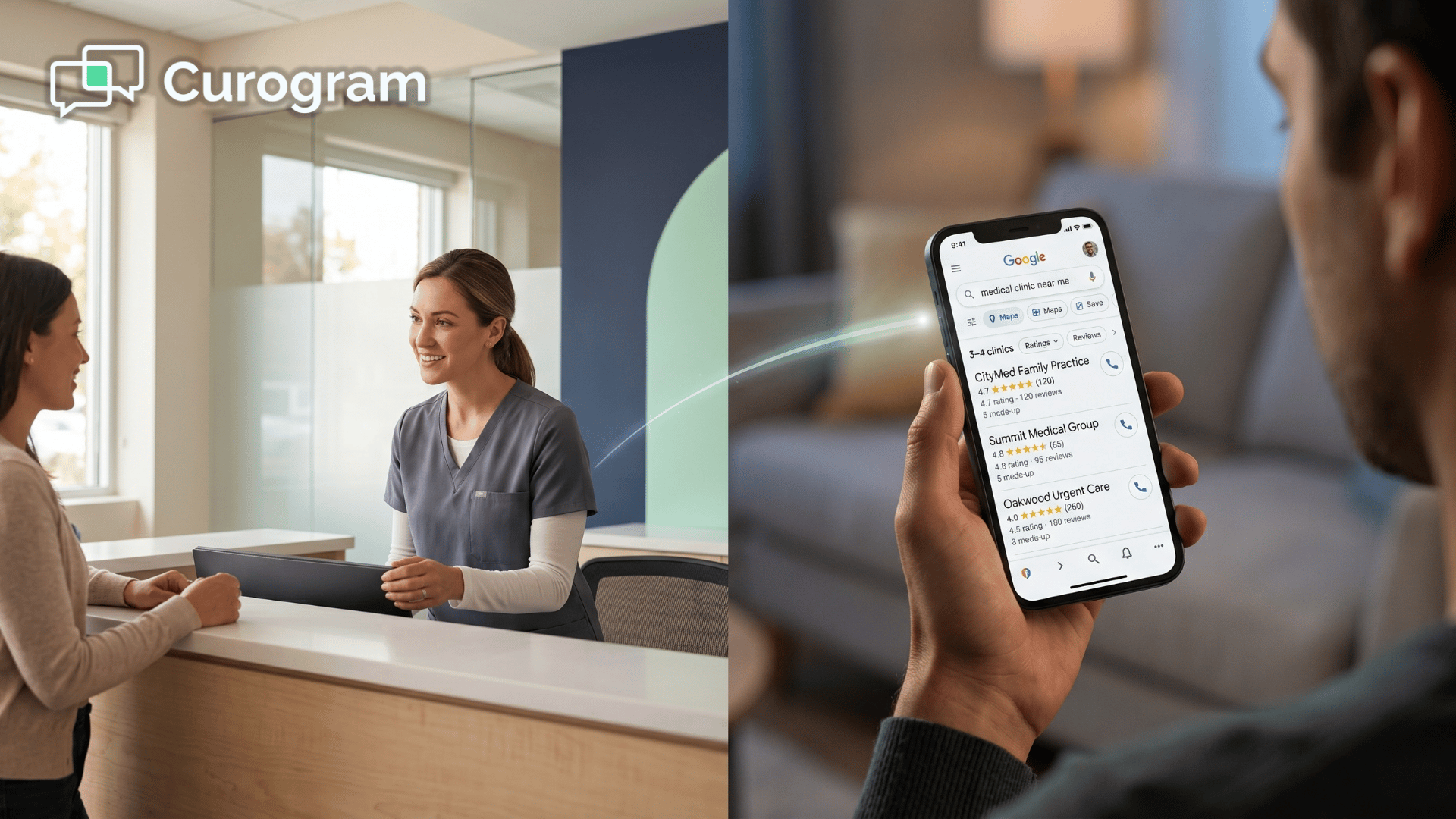
Picture a patient with a sore knee, sitting on the couch at 9 p.m.
They open Google and type "orthopedic clinic near me." Three clinics show up at the top. They tap the first one.
That tap just decided who gets a new patient. Not the clinic with the best surgeons. Not the one with the cleanest waiting room. The one Google chose to display first.
This is how most new patient journeys begin today. Around 90% of healthcare consumers start their search on Google. Yet many practices still treat their Google Business Profile like an afterthought, something the marketing team updates once a year.
Meanwhile, competitors are pulling ahead. They have more reviews. Higher ratings. Newer feedback. And every month, Google nudges them a little higher in the local rankings.
It sounds simple. It isn't.
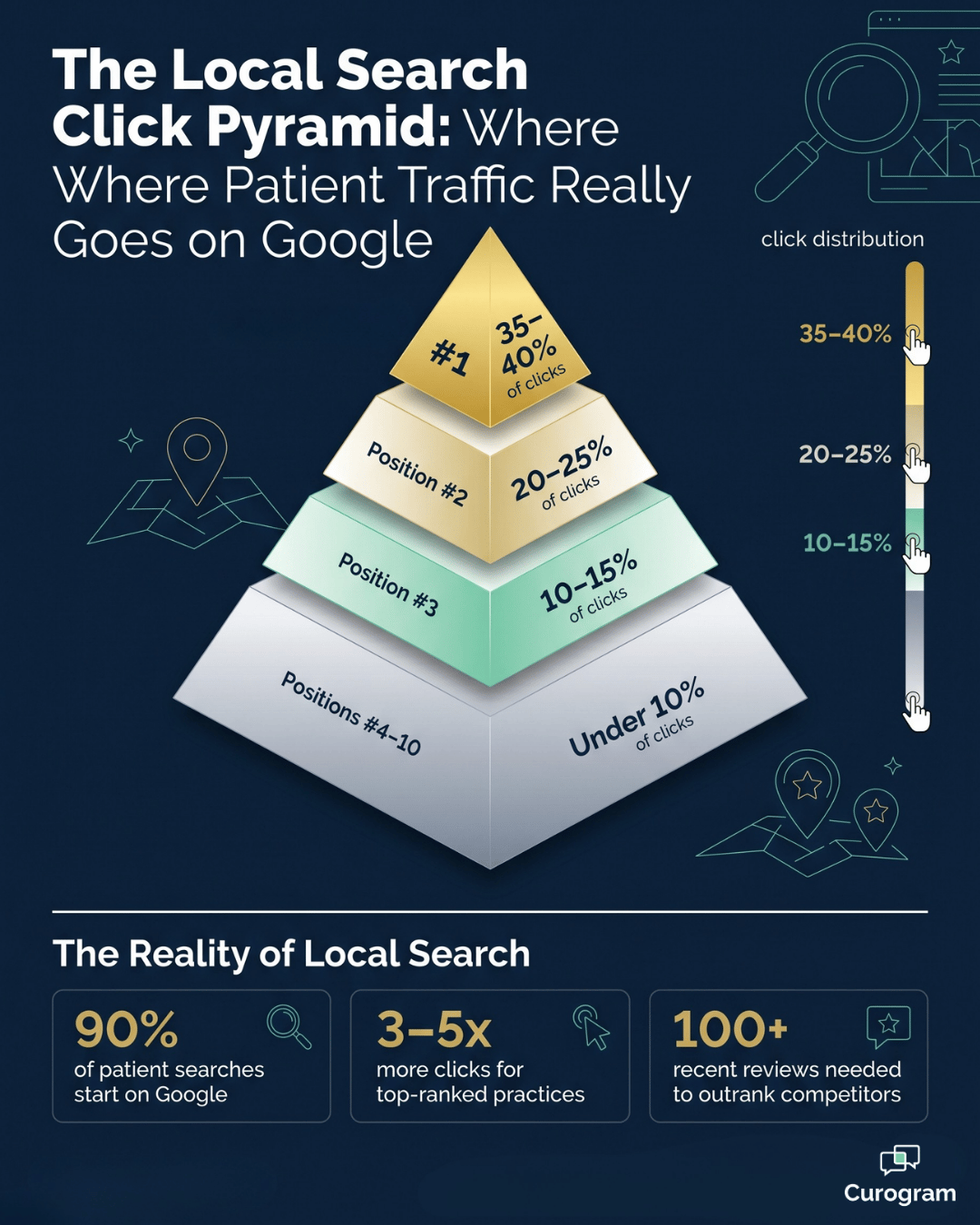
Behind every "near me" search is an algorithm weighing review volume, star rating, recency, and patient engagement. Practices that win this game capture 35–40% of clicks for top searches. Practices that lose it become invisible, even if they offer better care.
For multi-location health systems, this problem multiplies. If you run 50 locations and each one only gets 10 reviews a month, you're producing volume on paper but losing every individual local search.
That's how you end up with strong clinical quality and stagnant new patient lead numbers at the same time.
The good news: this is a solvable problem. Once you understand how Google ranks healthcare profiles and how new patient leads actually flow from search to scheduled appointment, you can build a system that compounds visibility every month.
That's exactly what this article will walk you through.
How Google Decides Which Health Systems Patients See First
Google's local search isn't random. It follows rules. And once you understand those rules, you can stop guessing why a competitor outranks you.
Why Your Google Business Profile Beats Your Website Every Time
When someone types "cardiology near me" or "urgent care in Tampa," Google ranks results using three big factors:
- Relevance — Does your business match what the patient searched for?
- Distance — How close is your location to the patient?
- Prominence — How well-known and trusted is your practice online?
Relevance and distance are mostly fixed. You can't move your clinic. But prominence is where reviews come in, and that's the factor you can actually grow. Google looks at how many reviews you have, your star rating, how recent the reviews are, and how often patients click through your profile.
Health systems with 100+ recent reviews and a 4.7+ rating consistently outrank those with thin profiles.
Here's the part most marketing teams miss. The top three results capture the majority of clicks in any local search.
35–40% |
| Of all local search clicks go to the #1 ranked practice. That single position captures more traffic than positions 4 through 10 combined. |
If you're sitting at position #4, you're sharing scraps with six other practices. For a multi-location health system, this gap repeats at every single location.
A 100-location system with weak profiles loses to a competitor with strong ones in 100 separate local battles.
Why Recent Reviews Matter More Than Old Ones
Volume helps. But recency might matter more.
A practice with 10,000 reviews from five years ago can lose to a practice with 2,000 reviews collected this year. Google reads recent reviews as a signal that your business is alive, active, and engaged with patients. Old reviews fade in importance.
This creates a compounding effect. A clinic generating 100 new reviews a month gets a small ranking lift in month one.
By month six, they have 600 fresh reviews and a noticeable ranking advantage. By month twelve, they have 1,200+ recent reviews and a moat their competitors can't easily cross.
20–25% |
| Click share for the #2 position in local search. Drop to position #3 and that share falls to just 10–15%, showing how steep the ranking penalty really is. |
For multi-location systems, the math gets harder. A 50-location practice generating 50 system-wide reviews a month sounds productive. But spread across 50 locations, that's only one review per location per month. Not enough to move the needle anywhere.
Real ranking gains require systematic review collection at every single location, every single month.
How Star Ratings Shape Patient Decisions
Patients judge fast. Star ratings are often the first thing they notice, and the difference between 4.8 and 3.8 stars is huge.
Studies show patients are about 40% more likely to click on a 4.8-star profile over a 3.8-star one, even when clinical quality is identical. A single star can cost you a third of your potential new patient traffic. That's a brutal penalty for inconsistent reviews.
Maintaining a high rating means making sure your happiest patients actually leave reviews.
If you only collect feedback when people are angry, your average rating slides. Smart reputation systems guide 5-star respondents straight to Google, while routing lower ratings internally so your team can fix the issue privately.
For multi-location practices, ratings need to stay consistent across every site.
Patients searching nearby see all your locations at once. If 80% of locations have 4.7+ ratings and 20% are stuck at 3.8, the inconsistency damages your whole brand.

How Better Search Visibility Turns Into Real Appointments
Higher ranking is great. But ranking alone doesn't pay the bills. What matters is what happens after a patient clicks.
From Click to Scheduled Visit
Once a patient taps your Google Business Profile, they land on either your location page or an appointment booking interface. This is where most practices leak revenue.
Here's a clean example.
Two practices each get 1,000 Google profile clicks a month.
Practice A has online patient scheduling that takes 90 seconds. Practice B requires a phone call during business hours.
130 Patients |
| The monthly difference between these two practices. Practice A converts 20% of clicks into booked appointments (200 patients). Practice B converts only 7% (70 patients). Same visibility. Wildly different outcomes. |
Over a year, that friction costs Practice B around 1,560 new patients. Same Google ranking. Same marketing spend. Just a clunkier booking flow.
For multi-location systems, location-specific booking is critical. If a patient clicks on your Tampa clinic and then gets sent to a generic system-wide page, they have to start over. Many won't.
Common friction points that quietly drain your conversion rate include:
- Phone-only booking with limited business hours
- Required account creation before scheduling
- Generic system-wide pages instead of location-specific ones
- Confirmation that arrives hours later instead of instantly
Each one shaves a few percentage points off your conversion rate. Stack them together and you've turned a Google ranking win into a mediocre patient acquisition channel.
What New Patient Leads Are Actually Worth
Let's translate visibility into dollars.
New patient appointments typically range from $150 to $400 for an initial visit, depending on specialty. Use $200 as a middle estimate.
If you book 200 new patients a month from Google search at $200 each, that's $40,000 a month, or $480,000 a year, just from organic search.
And that's only the first visit.
Patients who return for follow-ups, refer family members, or use other services often have a lifetime value of $800–$1,500.
$1M–$3.6M |
| The three-year incremental new patient revenue health systems can generate by improving Google reputation. That's 30–50% more new patient leads from organic search, with no extra ad spend. |
For a 100-location system, this can mean 150–250 extra new patient appointments every month, or $30,000 to $100,000 in monthly incremental revenue.
Your Google Business Profile isn't a marketing vanity metric. It's a revenue channel.

Why Market Position Compounds Over Time
In most healthcare markets, the top 3–5 ranked providers capture 60–70% of all new patient leads. That's not a small advantage. It's a near-monopoly on patient discovery.
If you're starting with 100 reviews and a competitor has 5,000, you can't catch up overnight. But generating reviews 10x faster, say 100 a month versus their 10, closes the gap meaningfully over 12–24 months.
Quality matters as much as quantity. A practice with 2,000 4.8-star reviews ranks higher than one with 3,000 4.2-star reviews. Volume without quality just amplifies bad signals.
The leader's advantage compounds. More clicks bring more new patients. More new patients leave more reviews. Those reviews push ranking higher, which brings more clicks. The gap widens every month.
This is why starting now matters more than starting big.
How Curogram Helps You Win the Google Game
Most practices know they need more reviews. The problem is doing it consistently across every location, every week, without burning out front-desk staff. That's where automation changes everything.
What the Platform Actually Does
Curogram's automated post-appointment surveys run quietly in the background. After every visit, patients receive a short text asking about their experience.
The system then sorts responses based on how the patient rates their visit:
- 5-star responses are guided directly to your Google Business Profile to leave a review
- Lower ratings are routed to your team privately, so you can fix the issue before it becomes a public 1-star
This smart routing protects your average rating while still giving you honest internal feedback you can act on. Unhappy patients get heard. Happy patients get directed where they help your visibility most.
1,064 Reviews in 3 Months A real Curogram client, a multi-location practice struggling with reputation management, generated 1,064 new 5-star reviews in just 90 days.
About 90% of responding patients left a 5-star rating.
Why It Doesn't Disrupt Your Front Desk
Because Curogram integrates with any EMR, your front-desk team doesn't change their workflow at all. The review system pulls from your existing appointment data, sends the messages, and tracks results in one dashboard.
No double data entry. No new login for your staff to memorize.
This is how you stop competing for scraps and start dominating local search.
See What Systematic Review Growth Could Do for Your Practice
Every month you wait, a competitor adds reviews you'll have to outpace later. The math is simple. The longer you delay, the more expensive the catch-up becomes.
Most practices already have the patient volume needed to generate hundreds of reviews a month.
What they lack is a system that turns every appointment into a review opportunity automatically, without adding work for the front desk. That's the gap Curogram closes.
In a 30-minute demo, you'll see exactly how the platform works inside your existing EMR. We'll walk you through automated post-appointment surveys, the smart routing that sends 5-star responses to Google and concerns to your team, and the dashboard that tracks review growth across every location.
You'll also see how Curogram's other tools, like 2-way texting, automated reminders, electronic forms, and text-to-pay, fit into the same patient communication flow.
For multi-location systems, we'll model what 1,000+ monthly reviews could mean for your search visibility, your new patient lead volume, and your bottom line.
For single-location practices, we'll show you how to dominate your local market within 12 months.
You'll also have the option to request a competitive Google benchmark. This compares your current review count, rating, and estimated search visibility against your top competitors in your service area.
It's a clear, data-backed way to build the internal business case for reputation management investment.
Schedule a demo today and see how Curogram can turn your Google Business Profile into your most reliable new patient acquisition channel. The practices winning local search a year from now are starting today.
Frequently Asked Questions
Yes, and the impact is bigger than most leaders expect. About 90% of healthcare consumers check online reviews before choosing a provider. Strong ratings build trust before a patient ever calls.
Reviews reflect both clinical care and the administrative experience around it. A clinic with great doctors but a confusing billing process might end up with a 4.2-star average, with comments praising the providers and complaining about checkout.
You'll usually see early movement within 30–60 days of consistent review generation. A practice that goes from 50 reviews to 150 reviews in two months will start ranking higher in local search as Google factors in the new velocity.
No, asking is allowed. Google's policies actually encourage businesses to request reviews from real customers. What's not allowed is incentivizing reviews (offering discounts or gifts in exchange) or filtering out unhappy patients before they can post.
Negative reviews are part of running any healthcare practice. The goal isn't zero negative reviews. It's catching unhappy patients before they post and keeping your overall rating high enough that one bad review doesn't define your profile.