1 min read
Confirm Your NextGen Appointment | One Text, Five Seconds
💡 When a NextGen patient receives an appointment reminder, confirming it usually means calling the office or logging into the patient portal. Both...

7 min read
Aubreigh Lee Daculug
:
August 20, 2026
A reminder went out at 4 p.m. yesterday. Eleven patients read it. Not one of them could answer it.
That is the quiet failure at the center of most reminder programs. The message arrives, the patient sees it, and the system has no way to hear back.
So the reminder only does half a job. It tells the patient about the visit. It tells your clinic nothing about whether they plan to come.
Your front desk still walks into Wednesday morning blind. Nobody knows which of tomorrow's 90 appointments are real and which are already gone.
The schedule looks full right up until 9:15, when three rooms sit empty and three patients who wanted those slots are still waiting on a callback.
Then the calling starts. Your team works the list, leaves voicemails, and marks a few maybes.
It is an expensive way to learn something a patient would have told you in four seconds by text. Most of them are holding the phone when the voicemail lands. They simply have no way to reply to it.
Here is what makes this frustrating for practices on Oracle Health, formerly Cerner. The record system is not the problem. It schedules well, it notifies patients, and it tracks everything cleanly.
The missing piece is smaller and more specific than most vendors admit. It is the reply path, and the staffed follow-through behind it at the ambulatory clinic level.
This guide covers that gap in detail. We will look honestly at what Oracle Health already sends, why a notification is not a confirmation, how a two-way sequence actually runs from first message to refilled slot, and what the numbers look like once patients can answer.
One reply. One schedule action. No callback required, and no room sitting empty at 9:15 because nobody replied.
Start with what Oracle Health already does, because it is more than some vendors let on.
Oracle Health Patient Administration sends a notification to the patient's preferred contact method when an appointment is scheduled, cancelled, or rescheduled. The Oracle Health Patient Portal lets patients confirm and check in for upcoming visits on their own.
Those are real capabilities and they work.
The catch is where the confirmation lives. It happens inside the portal, behind a login, on the patient's initiative. Nationally, only about 34% of people use a portal six or more times a year, so most of your schedule never opens the door.
Now look at the message itself. A notification travels one direction. The patient reads it in the car, thinks "I need to move that," and has nowhere to put the thought.
That thought becomes a phone call to your clinic, or it becomes nothing. When it becomes nothing, you have a no-show that announced itself a day early and nobody was listening.
The scale of that gap is worth doing in numbers. MGMA data puts the median no-show rate for medical practices in the 5% to 7% range, with single-specialty groups near 6.81% in 2023.
Here is what 7% costs at different clinic sizes, using a $150 average visit and 250 clinic days.
| Clinic size | Visits per day | Missed visits per day | Annual revenue lost |
|---|---|---|---|
| 3 providers | 60 | About 4 | About $158,000 |
| 6 providers | 120 | About 8 | About $315,000 |
| 10 providers | 200 | 14 | About $525,000 |
This means a six-provider ambulatory clinic loses roughly $315,000 a year while sitting at an industry-normal no-show rate. Normal is not the same as acceptable.
And that figure counts only the empty room. It leaves out the staff hours spent dialing, the patients who wanted an earlier slot, and the goodwill lost when someone waits three weeks for an opening that quietly went unused.

Appointment reminder texts for Oracle Health Cerner ambulatory practices follow a simple loop. Message out, reply in, schedule updated.
Here is what each stage looks like in practice.
One reminder the day before is a coin flip. A sequence gives patients more than one moment to respond.
A typical setup sends a first message about a week out, a second two days before, and a final one the morning of the visit.
Each message includes the provider, the location, and any prep instructions the visit requires. Timing, count, and wording are all configurable by appointment type.
The reply codes stay deliberately short, because short is what gets used.
Anything a patient types beyond those letters lands in the shared staff inbox as a normal conversation. Nobody gets a dead-end auto-reply telling them to call the office. That inbox workflow is covered in the front desk texting guide.
This is where the money is. A cancellation caught at 6 p.m. the night before is a slot you can still sell.
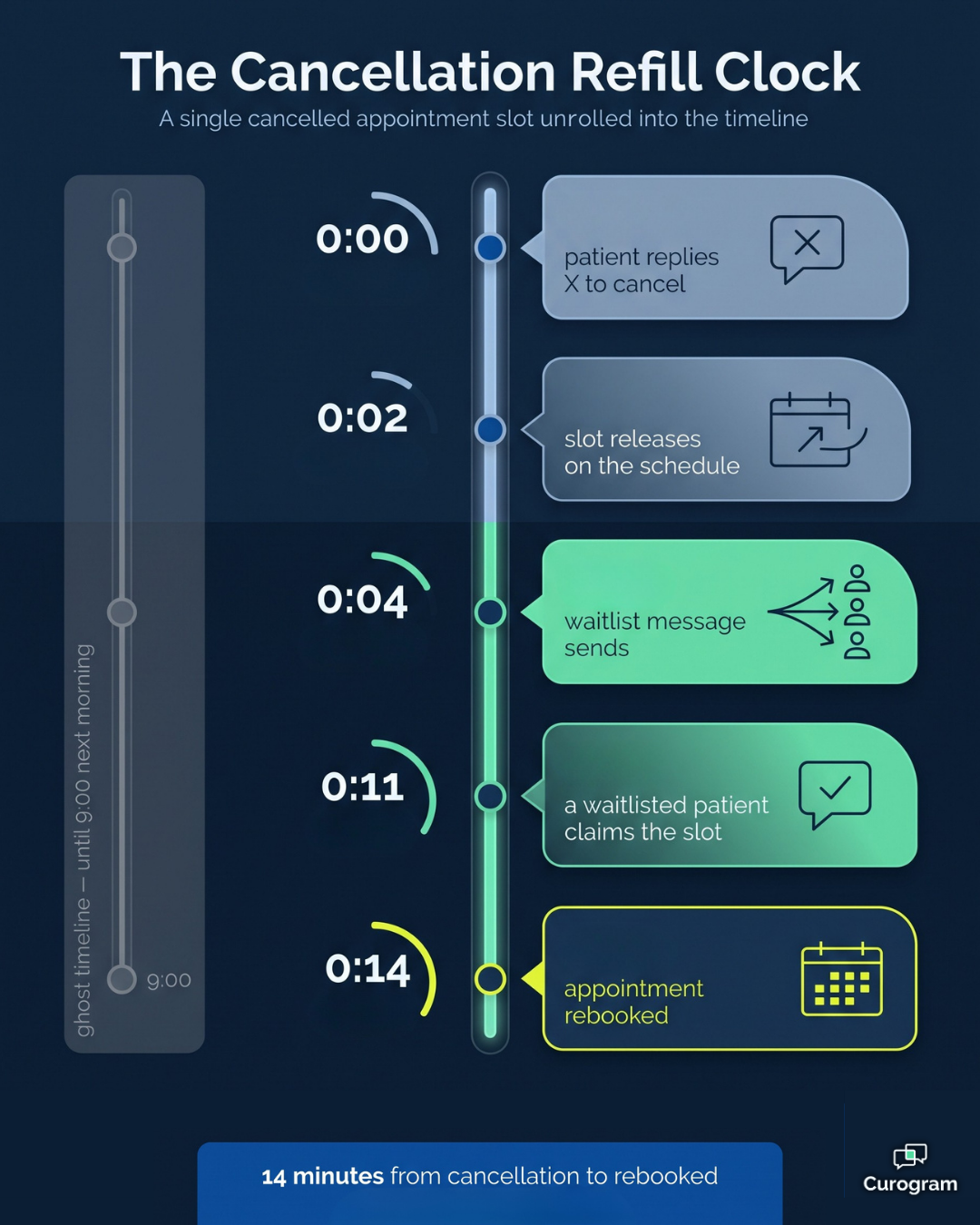
When a patient sends X, the opening surfaces immediately instead of appearing as an empty room the next morning. Your team texts the waitlist for that provider and visit type, and the first patient to reply takes the slot.
What used to be a $150 write-off becomes a booked visit and a shorter wait for somebody else.
Every reply is recorded, which turns reminders into a reporting asset. Confirmation rates can be viewed and exported by provider, location, and appointment type.
That lets a practice manager see which clinic runs at 82% confirmed and which sits at 61%, then dig into why.
Curogram's appointment data syncs directly from Oracle Health, with confirmations and cancellations reflected back in the EHR, so the numbers match the schedule your staff is actually working.
For a closer look at how this compares with other texting vendors, see the Curogram and Emitrr comparison.
The shift is easy to state. Reminders stop being announcements and start producing answers.
Atlas Medical Center cut no-show rates from 14.20% to 4.91% in three months using automated reminders with confirmations. That is roughly two-thirds of their missed visits recovered in a single quarter.
Across Curogram clients, no-show rates run 53% below the industry average, and more than 75% of appointment confirmations are handled without a staff member touching them.
Apply that second number to a six-provider clinic confirming 600 appointments a week, and about 450 of those confirmations complete themselves.
Covina Arthritic Clinic went from 369 confirmed appointments a month to more than 1,300. That was not a new marketing push. It was the same patient population, finally given a way to reply.
Waitlist refills are the part practices tend to underestimate. A cancellation that arrives the night before is a slot you can still fill, while the same cancellation discovered at 9 a.m. is just an empty room.
Recover two of those a week at $150 a visit and that is $15,600 a year from cancellations you were already receiving, just too late to use.
For your team, the practical change shows up before the numbers do. The morning call list shrinks. Tomorrow's schedule is knowable today. Staff spend their first hour on patients in the building rather than on voicemails nobody returns.
There is a moment in a Curogram demo that lands better than any statistic.
A patient texts X to cancel a Thursday afternoon slot. The opening surfaces, a waitlist message goes out, and a different patient claims it. The room never goes empty. The whole loop takes minutes and no one picks up a phone.
That is the difference between a reminder and a confirmation, shown rather than argued. Every practice has seen the other version of that Thursday, where the room stays empty and nobody finds out until the patient fails to arrive.
For ambulatory practices on Oracle Health, the case is straightforward. Your EHR handles the record and the notification. A two-way layer handles the reply and the follow-through, and the two work together rather than competing.
None of this asks for an enterprise build change. Appointment data syncs from the system you already run. Your staff work in a browser tab that looks like a messaging app, and most teams are comfortable with it inside a single shift.
The economics take care of the rest. A clinic sitting at an industry-normal no-show rate is writing off six figures a year in empty rooms. Cutting that rate by even half changes what the practice can invest in, from staffing to hours to how quickly a new patient gets seen.
If you want to size that number for your own clinic first, Curogram's no-show ROI calculator will get you close in a few minutes. The broader picture of texting alongside your record system is covered in our guide to two-way patient texting for Oracle Health practices.
Then schedule a demo and we will run your own reminder sequence live, cancellation and refill included. Bring the schedule you are worried about.
They are, when the platform is built for it. Appointment reminders can carry protected health information, including the patient's name and visit details, so they fall under HIPAA. That requires a signed business associate agreement, encryption in transit and at rest, role-based staff access, and a full audit trail. Curogram holds SOC 2 certification alongside HIPAA compliance. Consumer messaging apps and personal phones do not meet that standard.
It does not have to, but it needs coordinating. If your health system already sends notifications from Oracle Health, the goal is one clear message per patient rather than two competing ones. In practice, most clinics either turn off the native reminder for the appointment types Curogram covers, or split them by visit type. Bring your Oracle contact and your Curogram implementation lead into the same conversation during setup. Confirm the dedupe approach for your specific build before go-live.
Yes. Confirmation activity can be viewed and exported by provider, location, and appointment type. Most practice managers use it two ways. First, to spot which providers or sites are lagging on confirmations. Second, to test whether a change in reminder timing or wording actually moved the number.
The message routes to your shared staff inbox as a normal conversation. Someone on the front desk picks it up, answers, and handles the schedule change. Patients are not forced into rigid keywords or told to call the office. The codes speed up the common cases; the inbox catches everything else.
Yes, and they can opt out at any time. Consent is captured and recorded, and opt-out requests are honored automatically. Most practices collect consent during registration or with the first message in the sequence. Keeping that record clean is part of what a compliance reviewer will check, which is why it is logged rather than tracked by hand.
1 min read
💡 When a NextGen patient receives an appointment reminder, confirming it usually means calling the office or logging into the patient portal. Both...
1 min read
💡 The Osmind infusion suite scheduling automated SMS confirmation workflow is solved by Curogram. Osmind manages clinical bookings, while Curogram...
1 min read
💡 Cloud 9 orthodontic appointment reminders powered by Curogram's Confirmation Loop Engine send automated text reminders that patients and parents...